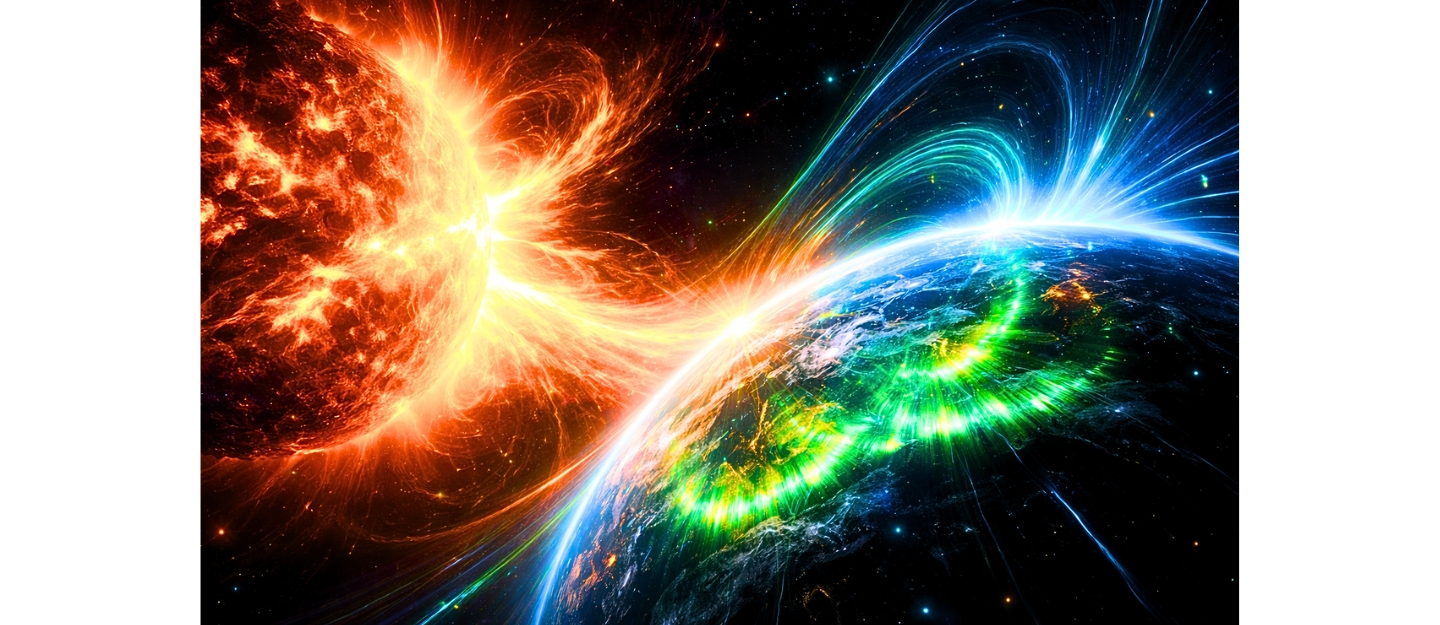
A G4 geomagnetic storm represents a severe level of space weather activity that directly affects Earth’s magnetic environment. Because intense solar activity drives these storms, they originate from powerful solar eruptions that eject vast clouds of charged particles toward Earth.
When those particles collide with the magnetosphere, they inject large amounts of energy into near-Earth space. Consequently, a G4 storm produces widespread and noticeable effects across technology, radio propagation, and atmospheric behavior.
Solar Origins of a G4 Storm
A G4 geomagnetic storm begins with a strong solar flare or a fastME that erupts from the Sun’s surface. As the Sun releases plasma and magnetic fields into space, that material travels outward at extremely high speeds.
When Earth lies in the path of this eruption, the solar wind compresses and distorts the magnetosphere. Therefore, the stronger and faster the solar event, the more intense the resulting geomagnetic storm becomes once it reaches Earth.
Interaction With Earth’s Magnetosphere
Earth’s magnetosphere normally shields the planet from charged solar particles. However, during a G4 storm, the incoming energy overwhelms this protective bubble. As a result, magnetic field lines stretch, reconnect, and inject energy into the ionosphere and upper atmosphere.
Additionally, these rapid changes disturb electric currents that flow naturally around the planet. Consequently, the entire near-Earth electromagnetic environment becomes unstable for hours or even days.
Effects on the Ionosphere
The ionosphere plays a critical role in radio communication by reflecting and refracting radio waves back toward Earth. During a G4 geomagnetic storm, intense ionization disrupts the normal layered structure of this region. Therefore, radio signals that usually reflect cleanly may scatter, absorb, or fail entirely.
Moreover, uneven ionization creates rapidly changing conditions that make propagation unpredictable. As a result, operators experience sudden signal loss, distortion, or extreme fading.
What a Radio Whiteout Is
A radio whiteout occurs when intense ionization causes the ionosphere to absorb radio energy instead of reflecting it. Because the D-layer becomes highly energized during strong geomagnetic activity, it effectively acts like a sponge for radio signals.
Consequently, entire frequency ranges can go silent, even when stations transmit strong signals. This condition does not involve visual brightness but instead refers to the sudden disappearance of usable radio propagation.
How a G4 Storm Causes a Whiteout
During a G4 storm, energetic particles flood the upper atmosphere and dramatically increase ionization density. Therefore, the lower ionospheric layers absorb high-frequency and sometimes very high-frequency signals before they can refract. Additionally, the rapid fluctuation of magnetic fields introduces noise and phase distortion.
As a result, radio operators experience what feels like a total blackout across large portions of the spectrum, even though transmitters and receivers still function normally.
Impact on HF, VHF, and Satellite Signals
High-frequency radio suffers the most during a G4 storm because it relies heavily on ionospheric reflection. Consequently, long-distance HF communication can vanish entirely for extended periods. Meanwhile, VHF and UHF signals may experience enhanced noise, sporadic propagation, or sudden signal drops.
Additionally, satellite communications and GPS accuracy degrade because signal paths pass through disturbed ionospheric regions. Therefore, navigation errors and data loss become more likely during severe geomagnetic events.
Electrical and Ground-Based Effects
Beyond radio propagation, a G4 geomagnetic storm induces electrical currents in long conductors on Earth’s surface. Because rapid magnetic fluctuations generate geomagnetically induced currents, power grids and pipelines can experience abnormal loads.
Consequently, transformers may overheat, protective systems may trip, and voltage instability can occur. Although modern infrastructure includes mitigation strategies, severe storms still pose real risks to electrical systems.
Auroras and Visual Effects
A G4 storm dramatically enhances auroral activity by driving energetic particles into the upper atmosphere. As those particles collide with atmospheric gases, they produce vivid displays of light.
The auroras may appear far south or north of their usual locations. Additionally, these displays often show intense colors and rapid motion, reflecting the dynamic nature of the storm. Consequently, while the storm disrupts technology, it also creates striking visual phenomena.
Duration and Recovery
A G4 geomagnetic storm can last from several hours to multiple days depending on solar wind conditions. During this time, conditions may fluctuate rapidly, alternating between partial recovery and renewed disruption.
Therefore, radio propagation often returns unpredictably rather than gradually. Additionally, lingering ionospheric instability can continue affecting communications even after the main storm subsides. Consequently, full recovery may take longer than the storm itself.
Why G4 Storms Matter
G4 geomagnetic storms matter because they demonstrate how closely modern technology depends on stable space weather conditions. Since communication, navigation, and power systems rely on predictable electromagnetic behavior, severe storms expose vulnerabilities.
Therefore, understanding these events helps operators, engineers, and planners prepare for disruptions. Additionally, awareness allows radio operators to adjust expectations and operating strategies during periods of intense solar activity.
Preparing for and Operating During a G4 Storm
During a G4 storm, operators benefit from flexibility and patience rather than brute-force solutions. Because increased power rarely overcomes ionospheric absorption, waiting for conditions to improve often proves more effective.
Monitoring space weather alerts helps anticipate disruptions before they peak. Consequently, informed operators adapt operating schedules and band choices to match rapidly changing conditions.
G4 Geomagnetic Storms
A G4 geomagnetic storm represents one of the most powerful space weather events that regularly affect Earth. Because it disrupts the ionosphere, alters magnetic fields, and induces electrical currents, its impacts span from radio silence to infrastructure stress.
Additionally, the resulting radio whiteouts highlight the fragile relationship between solar activity and communication systems. Therefore, understanding G4 storms not only explains sudden communication failures but also reinforces the importance of space weather awareness in an increasingly connected world.
Please consider Donating to help support this channel