
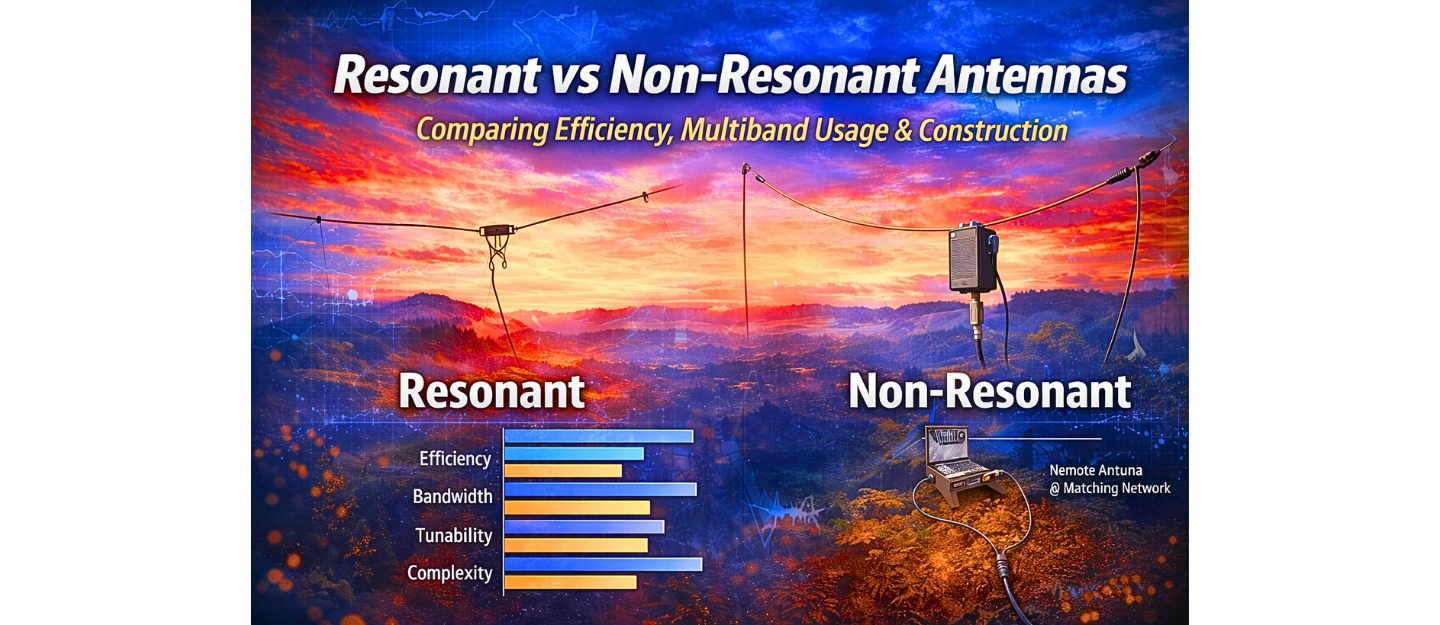
Resonant vs Non-Resonant antennas serve the same goal, they move RF energy efficiently between transmitter and air. They do so with different design philosophies and tradeoffs. Understanding how each type behaves, how you build them, and how they perform across use cases helps you pick the right antenna for shack, field, or expedition use. Moreover, because radio is physics-driven, choosing the right topology saves time on the air and reduces headaches in the feedline.
What “resonant” and “non-resonant” actually mean
A resonant antenna presents a purely resistive feedpoint impedance at a designed frequency, in short, it naturally “accepts” power at that frequency without reactive cancellation. Conversely, a non-resonant antenna does not present that convenient resistive point; instead it shows reactive components that vary with frequency. You must use matching networks, wideband techniques, or tuners to make a non-resonant antenna transfer power efficiently across the radio’s output.
How resonance works (physics, concisely)
Resonance arises when electrical length aligns with the wavelength so currents and voltages form standing waves with constructive reinforcement. Consequently, a half-wave dipole resonates when each leg equals about a quarter wavelength, producing a feedpoint that looks mostly resistive. Off-resonant lengths introduce reactance that absorbs or reflects energy unless counteracted. In short, resonance simplifies matching and maximizes transfer efficiency at target frequencies.
How non-resonant antennas work
Non-resonant antennas rely on matching networks, high feedline impedance strategies, or broad-banded techniques to present usable impedance to the transmitter. Therefore, they often run through an antenna tuner (ATU) or use transformer networks to transform complex impedances to the radio’s expected load. Because the antenna is usually electrically longer or shorter than resonant lengths, it spreads current patterns and supports multi-band behavior when matched correctly.
Performance comparison (quick reference)
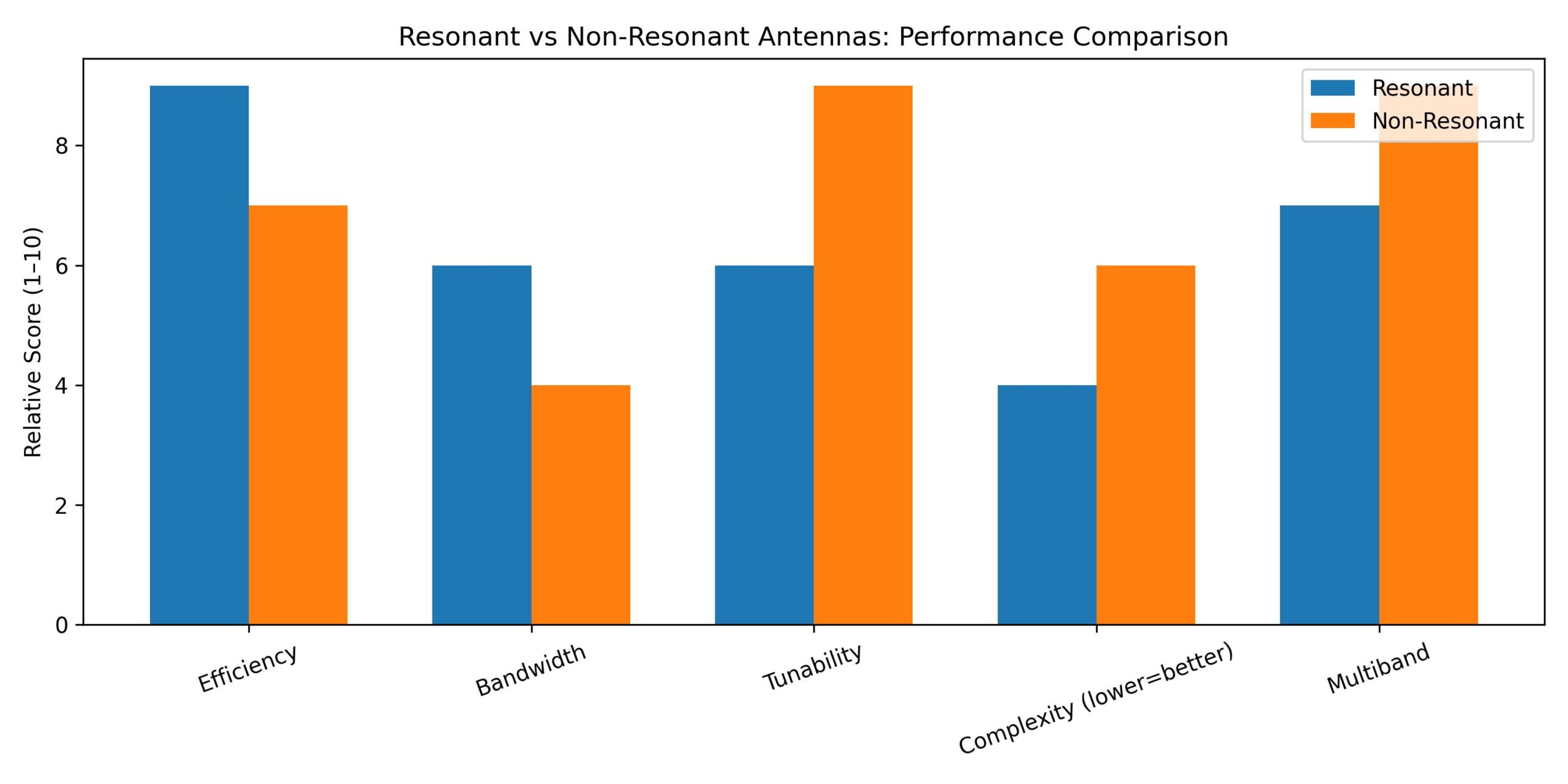
Below you’ll find a compact performance chart that compares resonant and non-resonant designs across practical metrics engineers care about. The chart uses a relative 1–10 scale where higher means better performance for the metric shown.
Interpreting the performance numbers
First, resonant antennas score high in efficiency because they naturally convert transmitter power to radiated energy at the design frequency. Second, they show moderate bandwidth; therefore you often retune or use traps for multi-band operation.
Third, resonant forms demand moderate tuning, and they remain simpler to match than many non-resonant options. Meanwhile, non-resonant antennas trade a bit of raw efficiency for broader frequency coverage and versatile multiband operation when paired with good matching.
Construction: Resonant antenna (practical build)
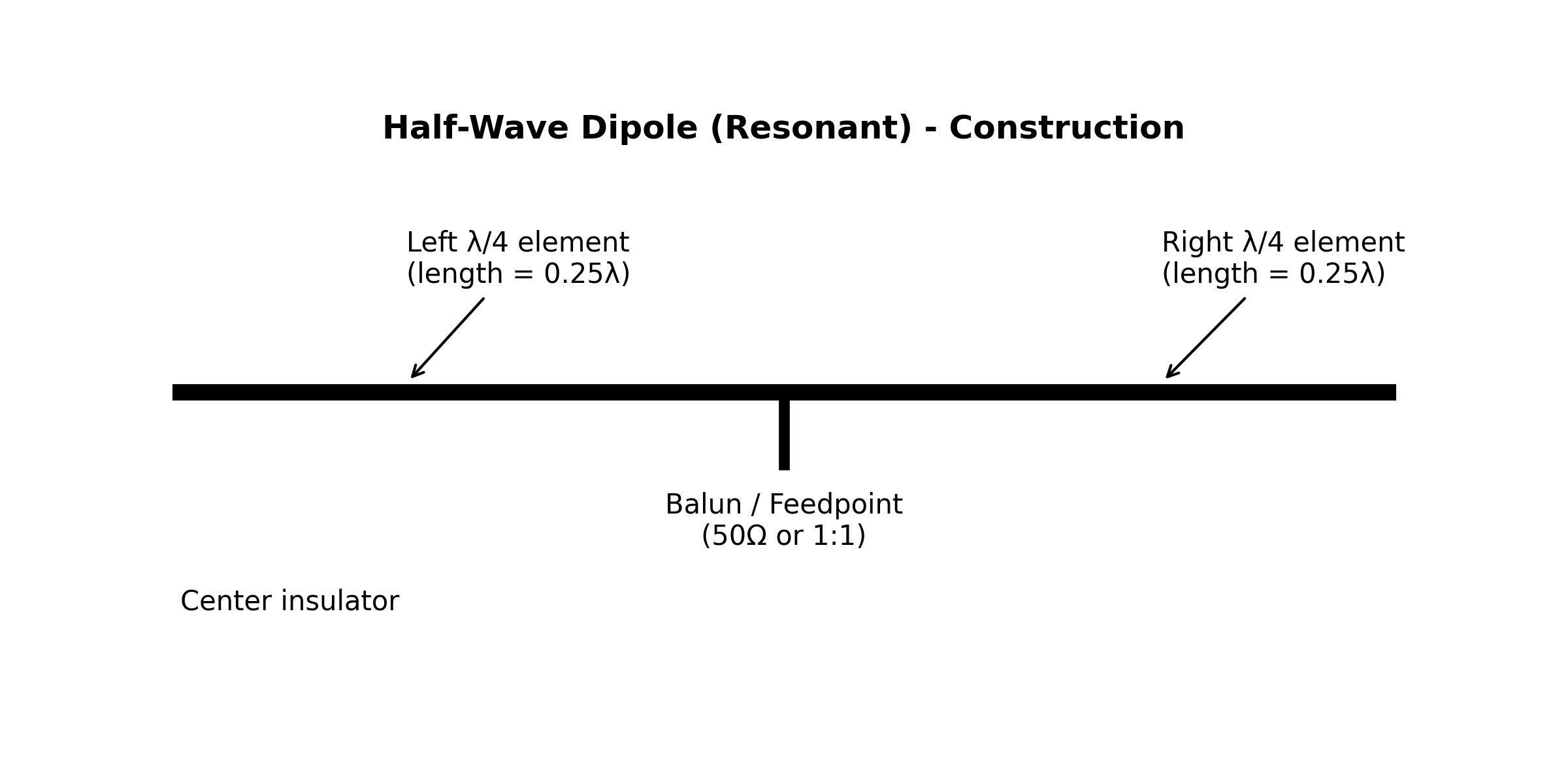
A classic half-wave dipole remains one of the most efficient and repeatable resonant antennas to build. For construction:
- Select the target frequency and calculate physical length using the standard formula: total length (meters) ≈ 143 / frequency (MHz).
- Cut each leg to about 0.25λ accounting for wire insulation and end effects.
- Use a robust center insulator; then attach a short feedline segment and a 1:1 current balun to prevent common-mode currents.
- Use quality strain relief, and install end insulators for the two legs.
- Support the dipole at or near its center at a height that balances takeoff angle and mechanical convenience; higher yields lower takeoff angle and often better DX.
Construction: Non-resonant antenna (practical build)
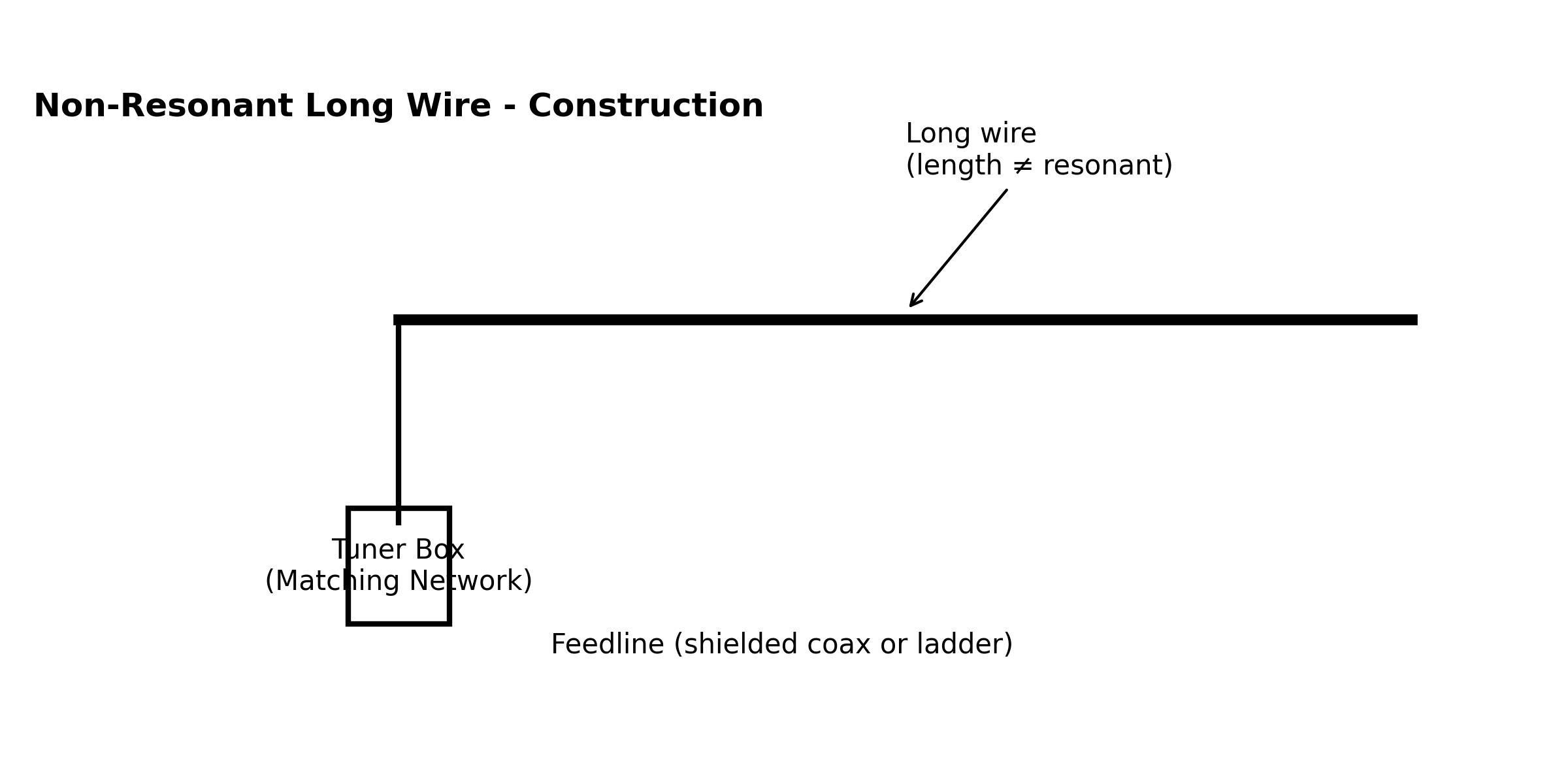
A non-resonant long wire or off-center fed wire often gives broad frequency coverage with simple mechanical layout. For construction:
- Choose a length that fits your site; the length may not correspond to λ/2 for the bands you want.
- Install a durable feedline from the radio to the tuner or matching box placed at the antenna feedpoint or at the shack, depending on loss budget.
- Use a wideband matching network (balanced/unbalanced transformer or an L-network inside the ATU).
- If you feed high impedances with ladder line, use a remote tuner or a good home-run ladder to minimize loss before tuning.
- Anchor and strain relieve the antenna at multiple points to withstand wind and ice; mechanical reliability matters as much as electrical performance.
Multiband use: resonant approaches
Resonant antennas become multiband when you either:
- Use traps tuned to isolate resonant sections at higher bands, or
- Deploy parallel resonant elements, or
- Use end-loading or folding techniques to compress physical length while preserving resonant behavior.
Therefore, many operators favor trap dipoles or fan dipoles for multiband operation because they preserve good efficiency on each intended band with predictable feedpoint impedance. Consequently, you trade design complexity and weight for hands-off multiband performance.
Multiband use: non-resonant approaches
Non-resonant antennas naturally lend themselves to multiband use when paired with an antenna tuner or a wideband matching strategy. For example, a long wire fed with ladder line and matched by an ATU covers many bands with acceptable efficiency. Moreover, non-resonant approaches often allow single-antenna deployment for portable and expedition use because you avoid physically reconfiguring elements between bands.
Feedline and matching tradeoffs
If you put matching at the antenna (remote tuner or balanced transformer), you reduce feedline loss but increase maintenance and exposure. Conversely, matching at the shack through an ATU means you may carry complex impedances down the feedline, and that can cause loss if you use lossy coax. Therefore, use ladder line or low-loss feed for non-resonant systems with remote matching. Many hams prefer a center-fed dipole with a short, well-matched feedline for resonant antennas.
Noise, Nulling, and Receive Performance
Resonant antennas often show cleaner, predictable receive patterns and nulls that operators use for interference mitigation. Therefore, you can orient a dipole or beam to minimize local noise. Non-resonant wires may pick up more common-mode noise unless you use proper baluns and chokes; however, because they can be longer and higher, they sometimes outperform short resonant setups on weak-signal work when matched properly.
Practical examples and use cases
- For contesting and DX where transmit efficiency and predictable SWR matter, use a resonant dipole or beam and then push the rig’s power.
- For portable SOTA activations where a single antenna must cover multiple bands, use a non-resonant long wire with a compact internal tuner or a multi-tapped matchbox.
- For small lots or HOA restrictions, use shortened resonant elements with loading coils and accept some efficiency loss to meet mechanical constraints.
Maintenance, Longevity, and Field Repair
Resonant antennas typically need fewer adjustments once installed correctly, so field repairs focus on mechanical fixes. Conversely, non-resonant systems require routine tuning checks and occasional retuning if you change the feedline or the environment. Therefore, plan for easy access to tuners and keep spares of common parts like baluns, coax, and feedpoint connectors.
Advanced topics (brief paths for deeper study)
Consider the following if you want to push performance:
- Model antennas with NEC-based software to see current distribution and feedpoint impedance across bands.
- Design broadband matching transformers with calculated turns ratios to minimize loss.
- Experiment with end-loading versus center-loading for small-space resonant designs.
- Study common-mode currents and install chokes where feedline radiation distorts your pattern.
Resonant vs Non-Resonant Antennas
When it comes to Resonant vs Non-Resonant Antennas, choose resonant antennas when you want efficiency, simple matching, and predictable performance. Choose non-resonant antennas when you need multiband flexibility, site-constrained lengths, or the convenience of a single-antenna solution that an ATU can tame. In many deployments, hybrid strategies work best: use resonant antennas where efficiency matters and non-resonant antennas when flexibility matters more.
Please consider Donating to help support this channel