

Understanding antenna performance is essential for anyone serious about radio communication. Whether operating on HF, VHF, or shortwave frequencies, the antenna system often determines how well a station performs. Even a powerful transmitter cannot compensate for a poorly designed or poorly installed antenna.
Different antenna types, dipole, vertical, loop, and beams each offer unique radiation patterns, efficiency characteristics, and installation requirements. Factors such as antenna height, ground conductivity, radial systems, and environmental conditions significantly influence how effectively an antenna radiates and receives signals.
Choosing the right antenna requires understanding how these variables interact. A properly installed antenna system can dramatically increase communication range, improve signal strength, and reduce noise. This guide explains how the most common antenna types perform and how installation choices influence real-world results.
New to antenna systems? See our Complete Guide to Ham Radio Antennas.
Why Antenna Performance Matters
In radio systems, the antenna acts as the interface between electrical energy and electromagnetic waves. The transmitter delivers RF energy to the antenna, which then radiates that energy into space.
Poor antenna performance can lead to several problems:
• Reduced transmitted signal strength
• Poor reception sensitivity
• Increased noise levels
• Inefficient power transfer
• Limited communication range
Because antenna systems determine how effectively signals leave and enter a station, they often provide the greatest improvement potential in any radio setup.
In many cases, upgrading or optimizing an antenna produces far greater performance gains than increasing transmitter power.
Key Factors That Affect Performance
Several physical and environmental factors influence how antennas behave. These include height, ground conditions, surrounding structures, and the presence of ground radials.
The most important performance factors include:
Antenna Height
Height above ground strongly affects radiation patterns and takeoff angles. Antennas placed higher above ground typically radiate signals more efficiently and experience fewer ground losses.
Ground Conductivity
Soil type greatly affects antennas that interact with the earth, particularly vertical antennas. Moist, mineral-rich soil conducts RF energy better than dry or rocky terrain.
Nearby Objects
Metal structures, buildings, and power lines can detune antennas or distort radiation patterns.
Radial Systems
Ground radials create an artificial ground plane for vertical antennas and significantly improve efficiency by reducing energy loss into the soil.
Understanding these variables helps explain why two identical antennas can perform very differently depending on how and where they are installed.
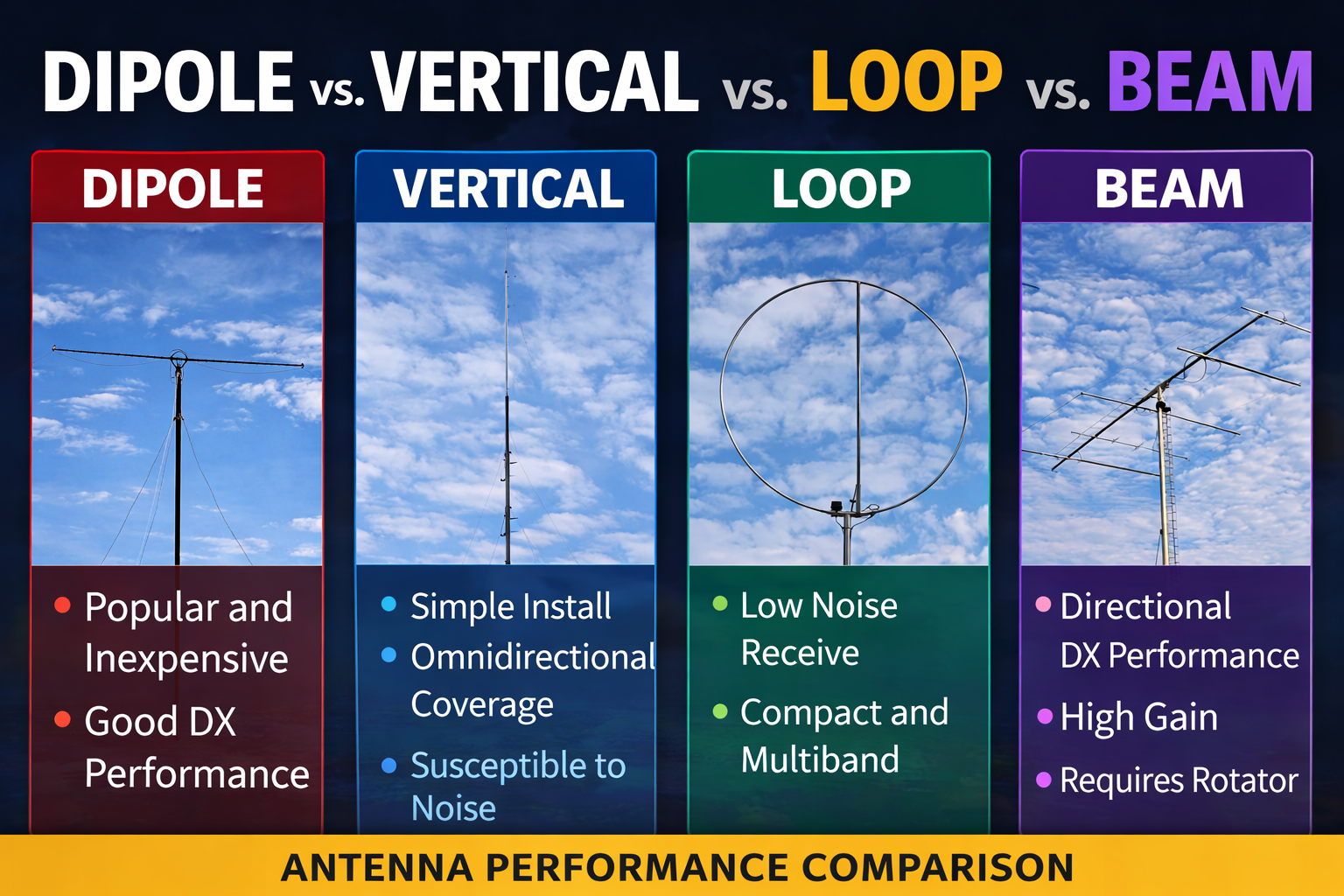
Dipole Antenna Performance
The dipole antenna is one of the most widely used antennas in amateur radio and many commercial radio systems. Its simplicity, reliability, and predictable radiation pattern make it an excellent general-purpose antenna.
A typical half-wave dipole consists of two equal-length conductors extending from a central feed point. When energized with RF energy, the antenna radiates primarily broadside to the wire.
Key performance characteristics of dipole antennas include:
• Balanced design with minimal ground interaction
• Bidirectional radiation pattern
• Moderate gain relative to isotropic antennas
• No need for ground radials
One of the most important factors affecting dipole performance is height above ground. When installed too close to the ground, the antenna’s radiation pattern becomes distorted and energy is absorbed by the earth.
Optimal dipole performance generally occurs when the antenna is installed at least half a wavelength above ground. At this height:
• Radiation efficiency improves
• Takeoff angles decrease
• Long-distance propagation improves
Lower installations—such as quarter-wavelength heights—still function well but favor higher-angle radiation. This makes them more suitable for regional communication rather than long-distance DX.
Ground conductivity can also influence dipole performance. While dipoles do not require radials, poor ground conditions may still slightly reduce efficiency due to increased RF absorption.
Vertical Antenna Performance
Vertical antennas are popular because they provide omnidirectional coverage, radiating signals equally in all directions around the antenna.
This makes vertical antennas especially useful for:
• HF DX communication
• Mobile installations
• Shortwave listening
• Limited space environments
Unlike dipoles, vertical antennas rely heavily on ground interaction. Because the antenna is oriented perpendicular to the earth, a significant portion of the RF return path travels through the ground.
Without a proper radial system, much of the transmitted energy is lost as heat in the soil.
A well-designed radial system dramatically improves vertical antenna efficiency.
Typical radial recommendations include:
• At least 16 radials for good performance
• Quarter-wavelength radial length when possible
• More radials for improved ground conductivity
In high-performance installations, operators sometimes use 32 or even 60+ radials to maximize efficiency.
Vertical antennas do not benefit from elevation as dramatically as horizontal antennas. Raising a vertical slightly above ground can help reduce ground losses and improve impedance matching, but most performance gains come from improving the radial system.
Vertical antennas typically produce lower takeoff angles than dipoles at similar heights, making them particularly effective for long-distance HF communication.
Loop Antenna Performance
Loop antennas offer unique characteristics that make them valuable in certain operating environments.
Loops may be built in several configurations:
• Small magnetic loops
• Full-wave horizontal loops
• Multi-band wire loops
One major advantage of loop antennas is their ability to reject certain types of noise. Because they respond primarily to magnetic fields rather than electric fields, they can provide improved signal-to-noise ratios in urban environments.
Loop antennas also have several practical benefits:
• Naturally balanced operation
• Minimal ground interaction
• No need for radial systems
• Reduced susceptibility to electrical noise
Large horizontal loops—often installed as full-wavelength or multi-wavelength antennas—can produce complex radiation patterns depending on their shape and height.
Height still affects loop performance. Installing a loop at least a quarter-wavelength above ground improves efficiency and helps establish more predictable radiation patterns.
Small magnetic loops, on the other hand, are often used at lower heights and can still perform surprisingly well due to their unique electromagnetic characteristics.
However, loops can be sensitive to nearby conductive objects, which may detune the antenna and shift its resonant frequency.
Beam Antenna Performance
Beam antennas are directional antennas designed to concentrate energy in a specific direction. The most common example is the Yagi-Uda beam antenna used widely in amateur radio and television reception.
Beam antennas achieve gain by using multiple elements arranged along a boom. These elements interact to reinforce radiation in one direction while suppressing it in others.
Major advantages of beam antennas include:
• High forward gain
• Excellent front-to-back ratio
• Improved signal-to-noise performance
• Directional signal control
Because beams concentrate RF energy in a focused direction, they are particularly effective for long-distance communication.
Height plays a major role in beam antenna performance. Installing a beam antenna at greater elevations improves several key factors:
• Lower takeoff angles
• Reduced ground reflections
• Clearer radiation patterns
• Improved DX performance
For HF beams, heights of one to two wavelengths above ground can significantly enhance performance.
Unlike vertical antennas, beam antennas do not require ground radials because they operate well above the ground and rely on directional element interactions rather than ground reflections.
However, beams require careful mechanical installation and alignment to maintain their directional properties.
How Antenna Height Influences Radiation
Antenna height influences both radiation efficiency and the angle at which signals leave the antenna.
Lower antennas tend to produce high-angle radiation patterns. These signals reflect off the ionosphere and return to Earth relatively close to the transmitting station.
Higher antennas produce lower-angle radiation patterns. Lower angles allow signals to travel farther across the Earth’s surface before returning. For HF communication, low-angle radiation is especially important for long-distance DX contacts.
Typical height recommendations include:
Hustler Trap Verticals 4BTV 5BTV 6BTV• Dipole: ½ wavelength or higher
• Vertical: ground-mounted with radials
• Loop: ¼ wavelength or higher
• Beam: 1–2 wavelengths for optimal DX
Even modest increases in antenna height can produce noticeable performance improvements.
For example, raising a dipole from 20 feet to 40 feet on the 20-meter band can significantly improve radiation efficiency and communication range.
Ground Radials and Their Role in Vertical Antennas
Ground radials form a critical part of many vertical antenna systems. Because the earth itself is a relatively poor conductor, RF energy can be lost when current flows through the soil. Radials provide a low-resistance path that improves the efficiency of the antenna system.
Radials function as a conductive ground plane that reflects RF energy upward rather than allowing it to dissipate into the earth. Benefits of radial systems include:
• Reduced ground losses
• Improved radiation efficiency
• Better impedance stability
• Stronger transmitted signals
Even a small radial system can dramatically improve vertical antenna performance.
Adding additional radials gradually increases efficiency, though the greatest improvements typically occur within the first 16–32 radials.
Operators often install radials directly on the ground or slightly buried beneath the soil to reduce visibility and protect them from damage.
Antenna Performance Comparison
The following table summarizes key differences between the most common antenna types.
| Antenna Type | Directionality | Height Importance | Radials Required | Typical Use |
|---|---|---|---|---|
| Dipole | Bidirectional | High | No | General HF communication |
| Vertical | Omnidirectional | Moderate | Yes | HF DX and portable setups |
| Loop | Variable | Moderate | No | Low-noise environments |
| Beam | Highly directional | Very high | No | Long-distance DX |
Each antenna type offers advantages depending on operating goals, available space, and installation constraints.
Choosing the Right Antenna for Your Station
Selecting the best antenna requires balancing several practical considerations.
Important questions include:
• How much space is available for installation?
• Is directional control necessary?
• Is long-distance DX a priority?
• Low noise levels high in the area?
• Can a tower or tall support be installed?
In many stations, operators eventually use multiple antennas optimized for different purposes.
For example:
• A dipole for general HF operation
• A vertical for DX coverage
• A loop for low-noise reception
• A beam for directional long-distance contacts
Combining antenna types allows operators to adapt to changing propagation conditions and communication goals.
Practical Tips for Maximizing Antenna Performance
Even small improvements in installation can significantly enhance antenna performance.
Consider the following best practices:
• Install antennas as high as safely possible
• Use quality feedline with low signal loss
• Maintain proper impedance matching
• Install adequate radial systems for vertical antennas
• Keep antennas away from large metal structures
• Use proper grounding for safety and noise reduction
Regular inspection and maintenance also help ensure antennas continue operating at peak efficiency.
Weather, corrosion, and mechanical stress can gradually degrade antenna performance over time.
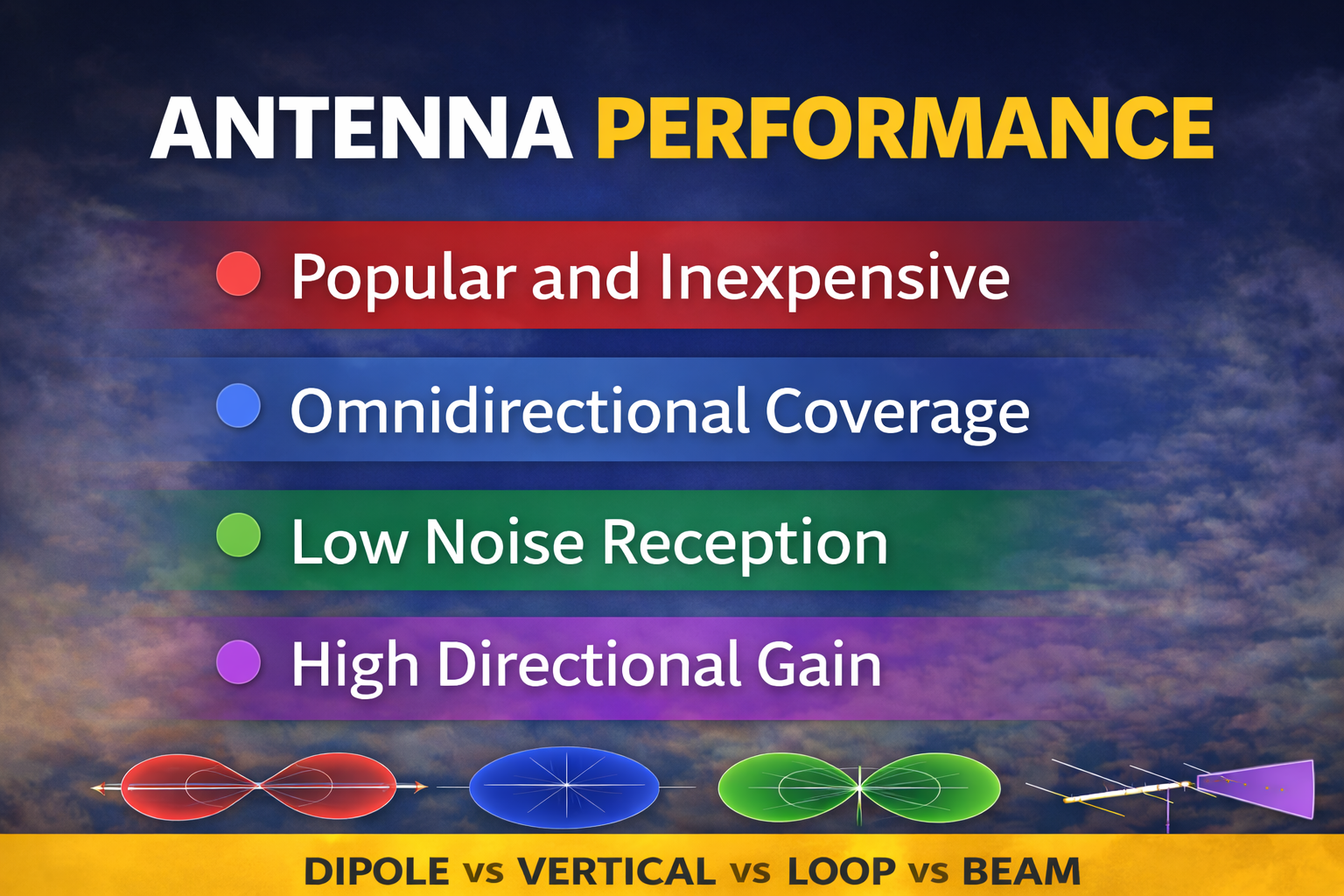
Antenna Performance: Dipole vs Vertical vs Loop vs Beam
Antenna performance depends on far more than just antenna type. Height, ground conditions, installation quality, and environmental factors all influence how effectively an antenna radiates and receives signals.
Dipole antennas provide reliable performance with simple installation and minimal ground interaction. Vertical antennas offer omnidirectional coverage but require well-designed radial systems to achieve maximum efficiency. Loop antennas perform well in noisy environments and offer flexible installation options. Beam antennas deliver the highest gain and directional control for long-distance communication.
Understanding these differences allows radio operators to choose the best antenna system for their needs and operating environment. With careful design and installation, the antenna system becomes the most powerful tool for improving overall radio performance.
A well-optimized antenna not only increases signal strength but also enhances reception quality, reduces noise, and expands communication range—making it one of the most valuable upgrades any radio operator can implement.
FAQ
What antenna height gives the best performance?
Antenna height greatly affects radiation efficiency and signal propagation. In general, installing a horizontal antenna such as a dipole at least ½ wavelength above ground produces significantly better performance. At this height, the antenna generates a lower takeoff angle, which improves long-distance communication. Lower installations still work but typically favor higher-angle radiation that is better suited for regional contacts.
Why do vertical antennas need ground radials?
Vertical antennas rely on the ground to complete the electrical circuit for RF current. Without ground radials, much of the transmitted energy is absorbed by the soil and lost as heat. Ground radials act as an artificial ground plane that improves efficiency and reduces signal loss. Installing 16 or more quarter-wave radials can dramatically increase vertical antenna performance.
Is a dipole antenna better than a vertical antenna?
Neither antenna is universally better; each serves different purposes. Dipole antennas generally provide higher efficiency and require no ground radials, making them simple and reliable for general HF operation. Vertical antennas provide omnidirectional coverage and often produce lower takeoff angles, which can be advantageous for long-distance DX communication.
Are loop antennas good for noisy environments?
Yes. Loop antennas are often favored in locations with high electrical noise. Because they respond primarily to the magnetic component of radio waves, they can reject some types of electrical interference generated by power lines, electronic devices, and urban environments. This characteristic often results in a better signal-to-noise ratio compared with many other antenna types.
What antenna type is best for long-distance DX communication?
Directional beam antennas generally provide the best performance for long-distance DX communication. Beam antennas concentrate RF energy in a specific direction, producing significant forward gain and improved signal strength. When installed high above ground—often one to two wavelengths high—beam antennas produce low takeoff angles that enhance long-distance propagation.
Do beam antennas require ground radials?
No. Beam antennas typically operate high above ground and rely on their directional element design rather than ground interaction. Because of this, they do not require radial systems like vertical antennas. Instead, beam performance depends more on proper height, alignment, and structural installation to maintain an accurate radiation pattern.
Does antenna type affect reception as well as transmission?
Yes. Antennas influence both transmitted and received signals. A more efficient antenna not only radiates signals more effectively but also improves sensitivity when receiving weak signals. Directional antennas such as beams can also help reduce interference by rejecting signals from unwanted directions, improving overall reception quality.
About the Author
Vince, W2KU, is a licensed Extra class amateur radio operator and the founder of Ham Shack Reviews. He was named Amateur of the Year in 2026 for contributions to practical amateur radio education and equipment evaluation.
He primarily operates HF, knows propagation very well, operates mobile and handhelds daily. Vince exchanges QSL cards for DXCC, contest confirmation, and award tracking and is the club QSL manager. His guidance focuses on practical operating procedures, accurate logging, and real-world amateur radio practices.
Paypal article donate:Please consider Donating to help support this channel