
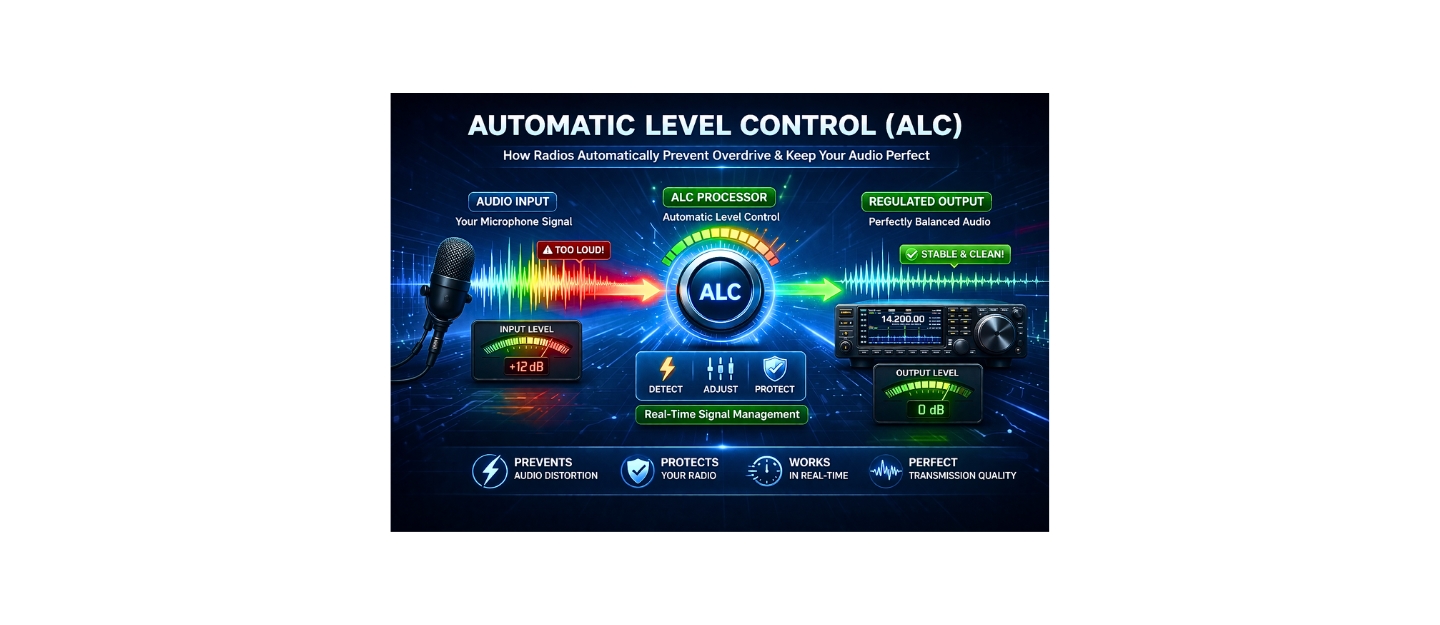
Automatic Level Control (ALC) is one of the most misunderstood and frequently misused features in modern amateur radio transceivers. While it exists to protect transmitter components and maintain stable output, improper use can significantly degrade signal quality, introduce distortion, and reduce overall communication effectiveness.
Many operators unknowingly drive ALC too hard, believing it improves power or clarity. In reality, excessive ALC activity often produces the opposite result. This article explains how ALC works at a technical level, how to set it properly for different operating modes, and how to avoid the common mistakes that prevent clean, efficient transmissions.
If you want a deeper explanation of controls, Try Complete Guide to Receiver Controls, where each control is explained in detail with practical tuning examples.
Automatic Level Control (ALC) Explained
Automatic Level Control is a feedback system inside a transceiver that monitors transmitter output and reduces gain when signal levels exceed a predefined threshold.
Its primary roles include:
- Preventing overdrive of the transmitter stages
- Protecting final amplifier components
- Maintaining consistent output power
- Limiting distortion caused by excessive input levels
When input audio or RF drive becomes too high, the ALC circuit automatically reduces gain to keep the signal within safe operating limits.
How ALC Works Inside a Transceiver
ALC functions as a closed-loop control system that continuously adjusts transmitter gain.
The process works as follows:
- A portion of the transmitted signal is sampled
- The sample is compared to a reference level
- If the signal exceeds that level, corrective feedback is generated
- Gain is reduced in real time to bring the signal back within limits
This process happens continuously during transmission. However, ALC is reactive rather than predictive, meaning distortion can still occur before correction is applied if the signal is driven too hard.
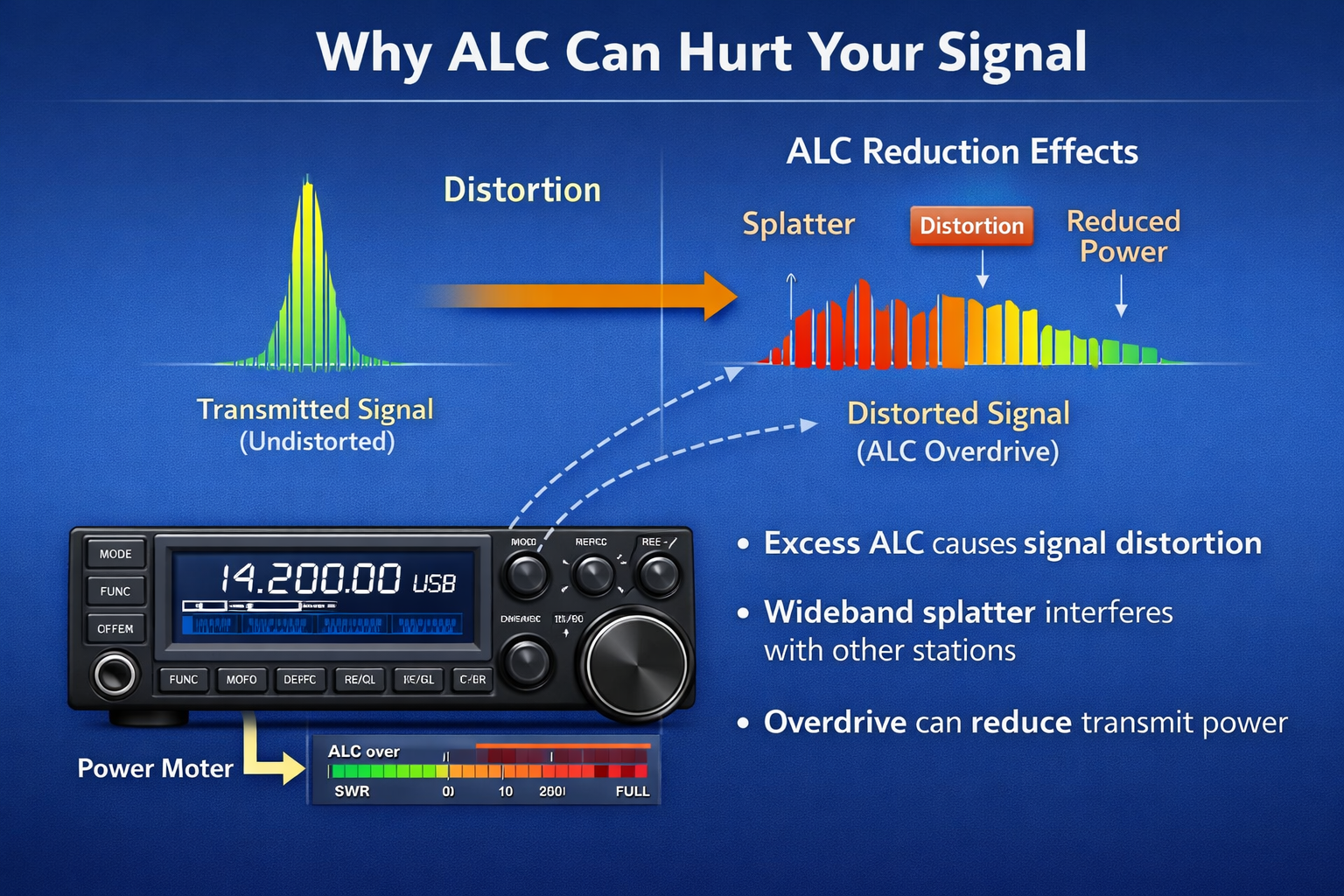
Why ALC Can Hurt Your Signal
Although the Automatic Level Control is designed to protect the transmitter, excessive ALC activity introduces several performance problems.
Common negative effects include:
- Audio distortion and clipping
- Signal splatter into adjacent frequencies
- Reduced intelligibility
- Increased transmitted bandwidth
- Poor performance in digital modes
A properly configured station uses ALC as a safety mechanism—not as a primary control for output power.
Testing and Real-World Performance Context
Accurate ALC setup requires reliable measurement tools. A dummy load allows safe transmitter testing without radiating a signal, making it possible to observe ALC behavior under controlled conditions.
In practical station setups, operators often verify ALC performance using equipment like the MFJ-264 Dry Dummy Load to ensure stable impedance and repeatable measurements during tuning and testing.
Proper ALC Settings for SSB Operation
For single sideband (SSB), the goal is to keep ALC activity minimal while maintaining strong, clear audio.
Best practices include:
- Adjust microphone gain so ALC barely moves
- Avoid sustained ALC peaks during speech
- Use compression conservatively
- Monitor transmitted audio using a second receiver if possible
Ideal ALC behavior for SSB includes only occasional movement during voice peaks, with no continuous engagement. This ensures clean modulation and optimal signal clarity.
ALC in Digital Modes (FT8, RTTY, PSK31)
Digital modes require a different approach to ALC management. ALC should show little to no movement during digital transmission. Digital signals are continuous and sensitive to distortion. When ALC engages, it alters the waveform and reduces decoding efficiency.
Best practices include:
- Set audio input levels low
- Increase output power using the radio’s power control, not audio drive
- Verify signal cleanliness using monitoring tools
Maintaining minimal ALC activity is critical for reliable digital communication.
ALC vs Speech Compression
ALC and speech compression serve entirely different purposes, though they are often confused.
- ALC protects the transmitter by reducing gain when overloaded
- Compression increases average audio power by boosting lower-level signals
Using excessive compression alongside heavy ALC results in distorted, overprocessed audio that performs poorly on the air. Balanced use of both systems produces the best results.
How to Set ALC Correctly Step by Step
Setting ALC properly requires a methodical approach.
For SSB:
- Set RF power to the desired level
- Reduce microphone gain to minimum
- Speak normally into the microphone
- Slowly increase mic gain
- Stop when ALC just begins to move
- Verify signal quality if possible
For digital modes:
- Start with low audio output
- Increase gradually until desired power is reached
- Ensure ALC remains inactive
This approach ensures clean output without distortion.
Common ALC Mistakes That Reduce Performance
Most ALC-related issues are caused by improper setup rather than equipment limitations.
Common mistakes include:
- Driving ALC continuously into high levels
- Using ALC as a substitute for proper gain control
- Overdriving digital audio inputs
- Ignoring signal monitoring
- Combining excessive compression with heavy ALC
Avoiding these mistakes significantly improves transmitted signal quality.
About the Author
Vince, W2KU, is a licensed Extra class amateur radio operator and the founder of Ham Shack Reviews. The club committee named him Amateur of the Year in 2026 for his contributions to amateur radio education and equipment evaluation.
Real-World Operating Experience
In practical operation, stations that maintain minimal ALC consistently produce the cleanest and most effective signals. Lower distortion results in improved readability and better performance over distance, even when operating at modest power levels.
Operators who reduce ALC often receive better signal reports and experience improved success in both DX and local communication.
ALC and External Amplifiers
When using external amplifiers, proper ALC management becomes even more critical.
Important considerations include:
- Excessive drive can damage amplifier components
- Some amplifiers provide ALC feedback to the transceiver
- Manual drive control is often more reliable than relying solely on ALC
Careful adjustment ensures both performance and equipment protection.
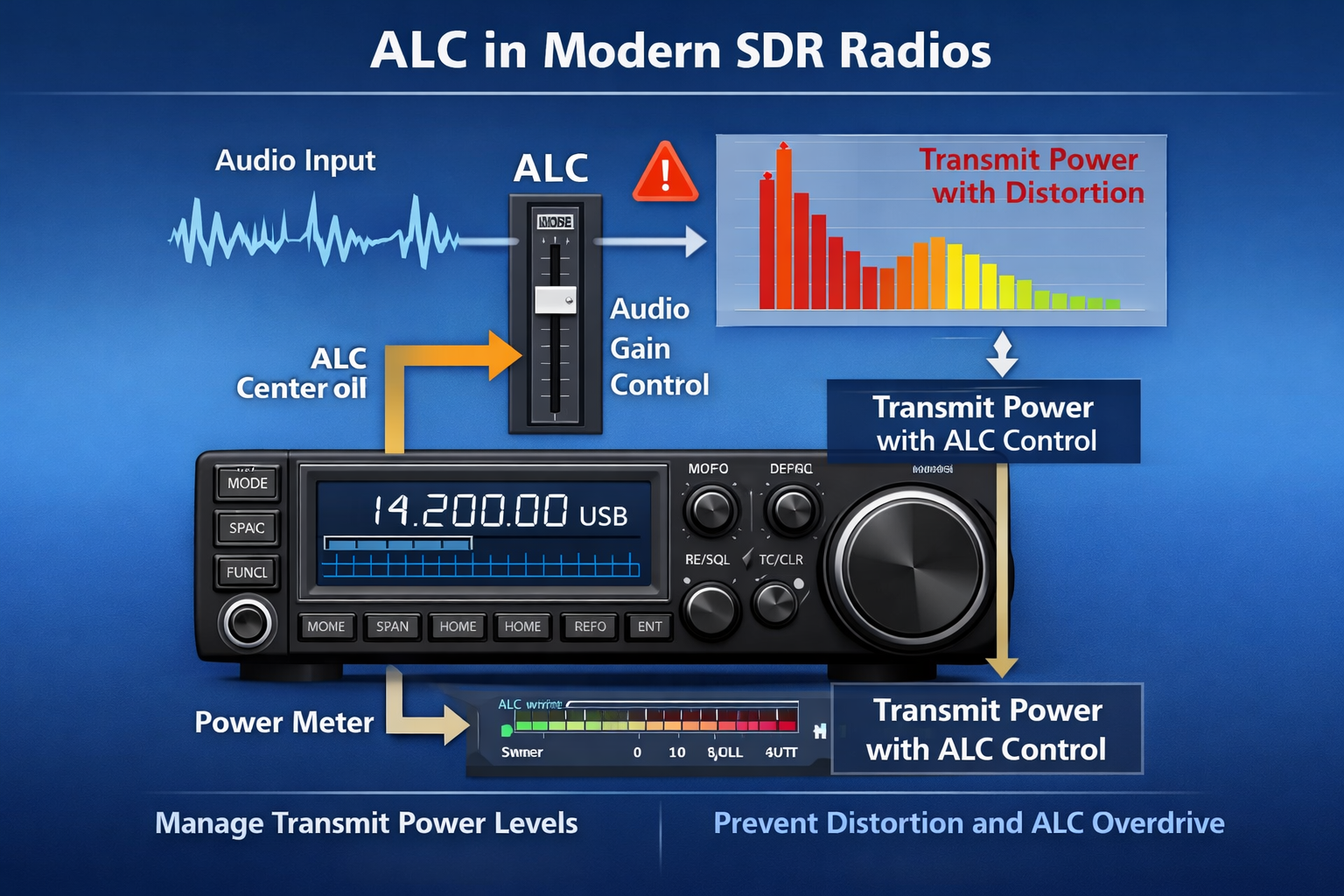
ALC in Modern SDR Radios
Software-defined radios (SDRs) provide improved ALC handling compared to older analog designs.
Advantages include:
- Faster response times
- More precise gain control
- Advanced monitoring capabilities
Despite these improvements, the core principle remains unchanged: minimal ALC produces the best signal quality.
When ALC Is Actually Useful
ALC performs best when used as a protective mechanism rather than a control tool.
It is useful for:
- Preventing accidental overdrive
- Protecting transmitter components
- Stabilizing output during peaks
It should not be relied upon to maximize power or improve audio quality.
Related Concepts That Affect ALC Performance
Understanding ALC requires knowledge of related systems.
Important topics include:
- Microphone gain and RF gain interaction
- Speech compression behavior
- Intermodulation distortion (IMD)
- Signal bandwidth control
- Grounding and RF feedback
These factors all influence how ALC behaves in real operation.
Frequently Asked Questions
Do I want ALC movement on SSB?
Yes, but only slight movement during peaks.
Is more ALC better?
No. More ALC usually means more distortion.
What is ideal ALC for digital modes?
Little to no ALC activity.
Can ALC cause splatter?
Yes. Overdriving ALC increases bandwidth and distortion.
Does ALC improve signal strength?
No. Proper gain staging improves signal effectiveness.
Editorial Integrity
This guide is based on real-world operating experience, practical station testing, and established RF engineering principles. No manufacturer sponsorship or external influence affects the recommendations provided.
Please consider Donating to help support this channel