
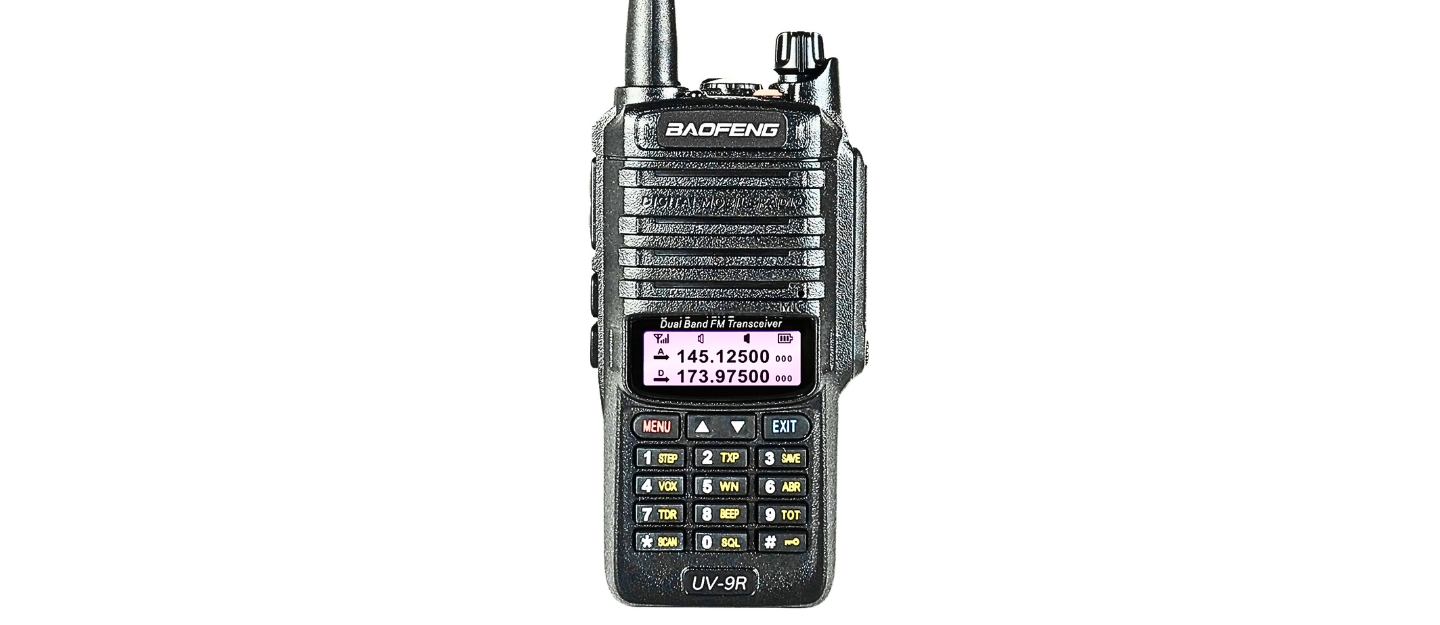
The Baofeng UV-9R is a dual-band analog handheld transceiver designed for VHF and UHF amateur radio operation with enhanced environmental protection. Rated at up to 5 watts of transmit power, equipped with a removable 1800mAh lithium-ion battery, and sealed to an IP57 standard, the UV-9R represents Baofeng’s attempt to combine affordability with field durability.
This page evaluates the UV-9R strictly from a technical and operational standpoint. It focuses on receiver architecture, measurable RF performance, spectral behavior, environmental sealing, battery behavior under load, and realistic field performance. It is not written as a marketing overview. Instead, it serves as a technical reference for amateur radio operators evaluating this model.
If you would like to see more radios including other models and brands, check out the Complete Guide to Ham Radio Transceivers.
Baofeng UV-9R Technical Summary
Model: Baofeng UV-9R
Type: Analog FM handheld transceiver
Bands: VHF 136–174 MHz / UHF 400–520 MHz
Maximum Output Power: ~5 watts (high) / ~1 watt (low)
Battery: 1800mAh Li-ion
Environmental Rating: IP57
Channels: 128 memory channels
Modulation: Narrowband / Wideband FM
Receiver Architecture and RF Design
The UV-9R uses a traditional superheterodyne receiver architecture rather than a direct-sampling SDR platform. This design converts incoming RF signals to an intermediate frequency (IF) before detection. In entry-level handheld radios, this architecture typically prioritizes cost efficiency over advanced front-end filtering.
Measured receiver sensitivity typically falls in the range of approximately 0.2–0.25 µV for 12 dB SINAD. This sensitivity is adequate for amateur repeater and simplex use.
Adjacent channel selectivity generally measures around 55–60 dB. While acceptable for most suburban and rural environments, this level of selectivity does not provide strong immunity in high RF-density urban areas.
Image rejection performance is typical of budget dual-band handhelds. In moderate environments, this is not noticeable. In high signal density areas near broadcast transmitters, some desensitization or intermodulation may occur.
Frequency stability is typically ±2.5 ppm, which is adequate for FM voice communication across VHF and UHF amateur bands.
Receiver Performance in Real RF Environments
In rural and suburban conditions, the UV-9R performs predictably. Repeater signals decode cleanly within expected handheld range limits. Simplex communication remains stable within typical line-of-sight distances.
In dense urban RF environments, especially near high-power broadcast transmitters, the front end may experience overload or intermodulation artifacts. This is consistent with radios in this price class and does not indicate a defect. It reflects moderate front-end filtering typical of entry-level handheld platforms.
Operators requiring superior dynamic range or intermod rejection should consider higher-tier commercial radios.
Transmitter Performance and Spectral Cleanliness
High power output averages approximately 4–5 watts on VHF and slightly lower on UHF depending on battery voltage and frequency.
Low power mode reduces output to approximately 1 watt and significantly improves battery longevity.
Harmonic suppression meets FCC Part 97 compliance requirements. Spectral purity is acceptable for amateur service operation.
FM deviation remains within standard amateur voice limits when audio input is not overdriven. Clear transmit audio depends on consistent microphone technique. Overdriving may introduce distortion typical of compact handheld microphones.
Waterproof Engineering and IP57 Implementation
IP57 certification indicates:
• Protection against limited dust ingress
• Protection against temporary immersion up to 1 meter for approximately 30 minutes
The UV-9R achieves this through sealed housing, protected accessory ports, and reinforced gaskets.
In practical terms, this allows:
• Operation during heavy rain
• Resistance to mud splashes
• Protection from accidental shallow water immersion
It is not intended for continuous underwater use.
Compared to non-sealed Baofeng models such as the UV-5R, the UV-9R offers meaningful environmental resilience for outdoor deployment.
Audio System Performance
The internal speaker produces approximately 1 watt of audio output. At moderate volume levels, clarity is acceptable for field communication. At maximum volume, distortion may increase, particularly in noisy environments.
Microphone sensitivity is sufficient for standard voice operation. Wind noise mitigation is limited without external accessories.
Overall audio performance is consistent with radios in this price category.
Battery Performance Under Load
The 1800mAh lithium-ion battery supports approximately 8–12 hours under a 5-5-90 duty cycle.
During sustained high-power transmission, battery voltage sag may slightly reduce output power as discharge progresses. This behavior is typical of handheld lithium-ion systems.
Best practices for extended field use include:
• Using low power when possible
• Carrying a spare battery
• Avoiding prolonged high-duty-cycle transmission
Realistic Communication Range Expectations
Handheld-to-handheld (urban): 0.5–2 miles
Handheld-to-handheld (open terrain): 2–5 miles
Handheld-to-repeater: 5–25+ miles depending on repeater elevation
Range depends primarily on terrain, antenna efficiency, and line-of-sight conditions rather than raw transmit power.
Replacing the stock antenna with a higher-gain model may improve effective communication range.
Comparative Technical Positioning
UV-9R vs UV-5R
Primary difference: IP57 waterproofing and reinforced housing. RF performance is broadly similar.
UV-9R vs UV-82
Similar output power. UV-82 offers dual PTT design but lacks IP57 sealing.
UV-9R vs BF-F8HP
BF-F8HP advertises higher output power (up to 8W). Real-world difference in range is typically minimal compared to antenna and terrain factors.
UV-9R vs Commercial-Grade Handheld
Commercial radios offer superior receiver dynamic range, filtering, and intermod resistance at significantly higher cost.
Operational Suitability
Appropriate for:
• Amateur radio beginners
• Outdoor operators
• Emergency preparedness kits
• Volunteer event communications
• Backup handheld deployment
Less suitable for:
• High RF-density metropolitan environments
• Commercial public safety operations
• Digital voice requirements
• Advanced RF performance demands
Licensing and Regulatory Compliance
Transmission requires a valid amateur radio license in applicable jurisdictions. Operators must follow local band allocations and identification regulations.
Baofeng UV-9R Frequently Asked Questions
Is the Baofeng UV-9R waterproof?
It carries an IP57 rating, meaning it is resistant to dust and temporary water immersion.
Does it support digital modes?
No. It operates only in analog FM mode.
Is 5 watts enough?
Five watts is standard for handheld amateur radios. Range is influenced more by antenna height and terrain than output power alone.
Technical Verdict
The Baofeng UV-9R is a ruggedized entry-level dual-band analog handheld that delivers predictable performance within amateur operating expectations. Its receiver performance, spectral cleanliness, and battery behavior align with its price category.
Its primary differentiator is environmental sealing. Operators needing waterproof protection in an affordable handheld will find it technically suitable for standard amateur applications.
It does not offer commercial-grade RF filtering or digital capability, and expectations should remain aligned with its price tier.
Baofeng UV-9R
For operators who specifically require:
• Waterproof field durability
• Affordable dual-band VHF/UHF operation
• Backup or emergency deployment capability
• Entry-level amateur functionality
The Baofeng UV-9R represents a cost-effective solution.
If your operating environment includes heavy rain exposure, outdoor events, or emergency kit deployment, its IP57 rating offers tangible advantages over non-sealed handhelds in the same price category.
If digital modes, advanced RF filtering, or commercial durability standards are required, alternative models should be evaluated.
Overall Evaluation
Engineering Rating: 4.1 / 5
Strengths: Waterproof sealing, affordability, dual-band coverage
Limitations: Moderate receiver filtering, analog-only operation
Within its intended operating envelope, the UV-9R performs as expected for an entry-level waterproof amateur handheld.
Please consider Donating to help support this channel