
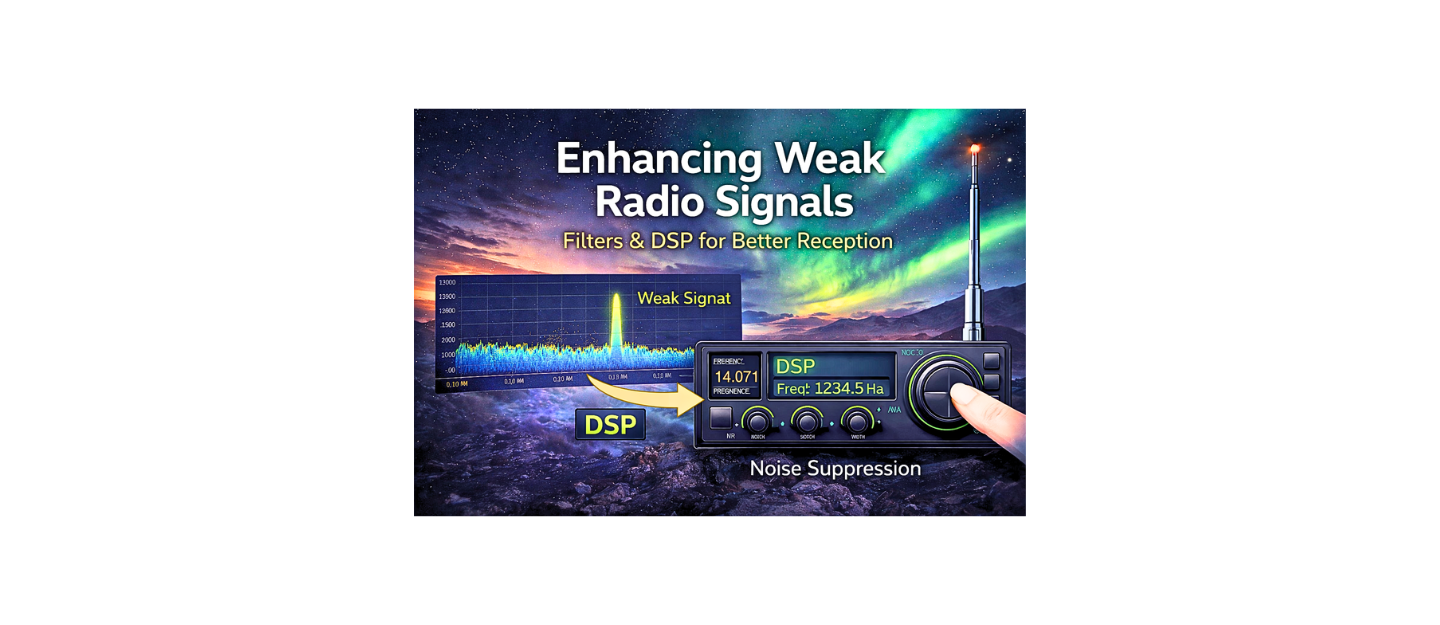
Weak signal reception is one of the most technically demanding and rewarding aspects of radio communication. Whether operating on HF bands, monitoring VHF propagation, or decoding digital modes, the ability to extract intelligible information from signals buried in noise separates experienced operators from those who struggle under marginal conditions.
Weak signals are not simply low in volume, hey exist near or below the noise floor, meaning the receiver must distinguish meaningful information from random RF energy. This introduces a fundamental engineering challenge: separating signal from noise without distorting the desired information.
Because of this, improving weak signal performance is not about brute-force amplification. Instead, it is about improving signal-to-noise ratio (SNR) through intelligent filtering, noise suppression, and system optimization.
Modern radios and SDR platforms provide an unprecedented level of control through features like noise blankers, notch filters, preamplifiers, dynamic noise reduction (DNR), and digital signal processing (DSP). When properly combined, these tools allow operators to recover signals that would otherwise be completely unintelligible.
If you want a deeper explanation of controls like RF gain, squelch, AGC, and filters, see the
Complete Guide to Receiver Controls, where each control is explained in detail with practical tuning examples.
Understanding Weak Signals and Signal-to-Noise Ratio (SNR)
Weak signal performance is governed almost entirely by signal-to-noise ratio. While signal strength is often displayed on an S-meter, it is not the determining factor in readability.
A strong signal buried in heavy noise may be unreadable, while a weak signal in a quiet environment may be perfectly copyable. Therefore, SNR—not signal strength is the true performance metric.
| Description | Importance | |
|---|---|---|
| Signal Strength | Absolute received power (dBm, S-units) | Secondary |
| Noise Floor | Total background RF energy | Critical |
| SNR | Difference between signal and noise | Primary factor |
A change as small as 3 dB in SNR can significantly improve intelligibility. This is why experienced operators focus on reducing noise rather than simply increasing gain.
Noise sources include atmospheric static, man-made electrical interference, thermal noise, and internally generated receiver noise. Each of these must be addressed using different techniques.
Noise Blanker (NB): Eliminating Impulse Noise)
Impulse noise consists of short-duration, high-amplitude spikes that can completely mask weak signals. These pulses are typically broadband and repetitive, making them especially disruptive in HF environments.
Common sources include automotive ignition systems, power line arcing, switching power supplies, and industrial electrical equipment. These noise bursts often repeat at regular intervals, making them particularly difficult to ignore without proper filtering.
A noise blanker operates by detecting these pulses and temporarily muting the receiver during their occurrence. Because impulse noise is extremely brief, this blanking process removes noise while preserving most of the desired signal.
Technically, the noise blanker works in the intermediate frequency (IF) stage and uses amplitude threshold detection. When a pulse exceeds a defined level, the receiver briefly gates the signal path off.
Proper adjustment is critical. Too aggressive, and the desired signal is clipped. Too weak, and the noise remains.
Notch Filter: Removing Narrowband Interference
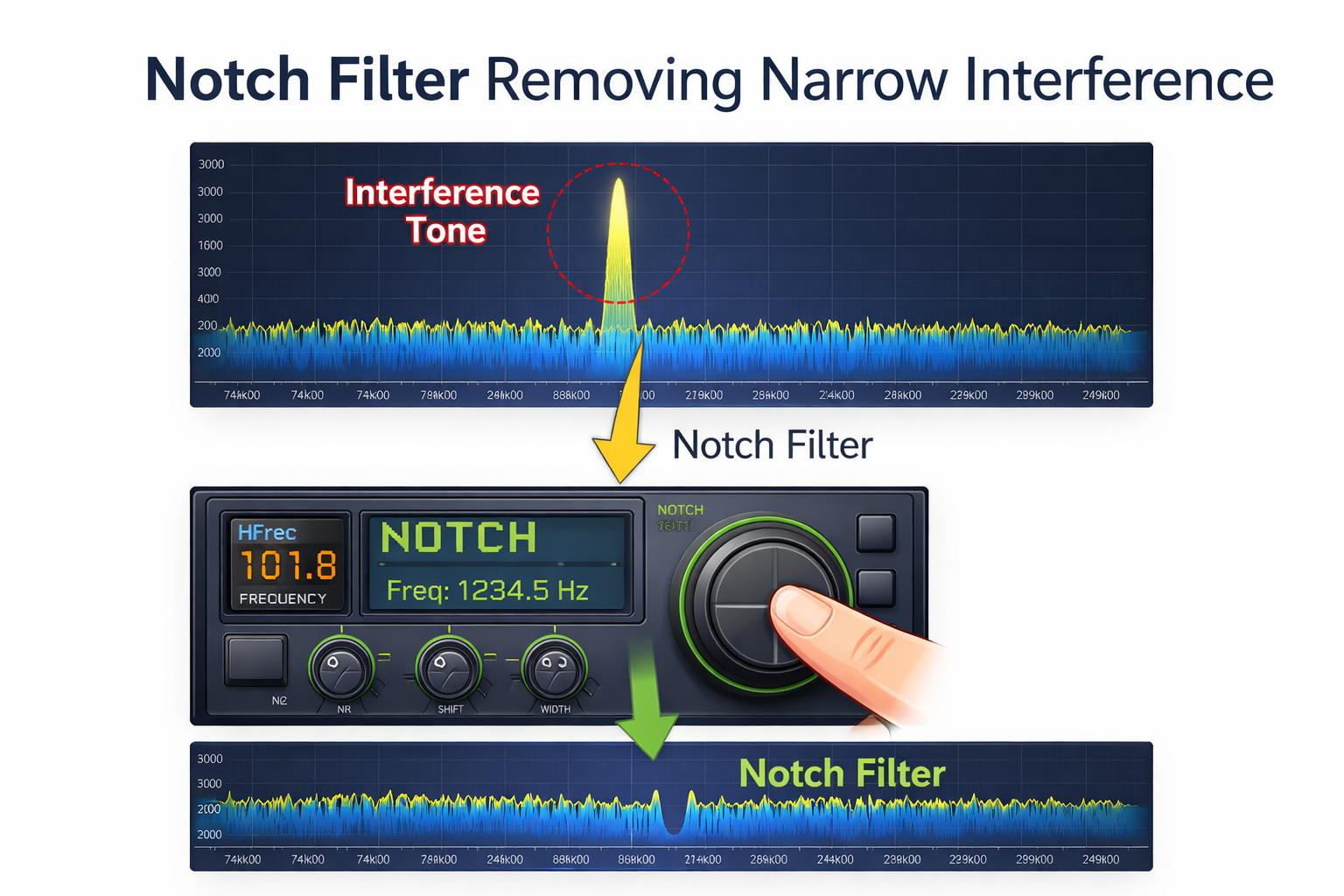
Notch filters are used to eliminate continuous narrowband interference such as heterodynes, carriers, or tuner artifacts that sit directly on top of your signal.
Unlike wide filtering, a notch filter removes a very small slice of frequency while leaving surrounding audio intact. This makes it extremely precise and valuable in crowded band conditions.
Operators can use either manual notch filters or automatic notch filters (ANF). Manual filters allow direct frequency targeting, while ANF systems use DSP algorithms to automatically detect and suppress interfering tones.
Modern DSP notch filters analyze the signal in real time and subtract sinusoidal components, effectively removing unwanted tones without significantly degrading the desired signal.
Preamplifier (Preamp): Increasing Signal Without Destroying SNR
A preamplifier boosts incoming signal levels before they reach the receiver’s internal stages. However, its effectiveness depends entirely on its noise figure.
Noise figure (NF) measures how much noise the amplifier introduces. Lower values are better and indicate minimal added noise.
| Device Type | Typical Noise Figure |
|---|---|
| High-quality LNA | 0.5–1 dB |
| Average preamp | 2–4 dB |
| Poor amplifier | 5 dB or higher |
A properly designed low-noise amplifier can significantly improve weak signal reception, especially when compensating for feedline loss.
However, in noisy environments, a preamp can actually degrade performance by amplifying noise along with the signal.
Best practice is to use preamps selectively and place them as close to the antenna feedpoint as possible.
Dynamic Noise Reduction (DNR): Audio-Level Enhancement
Dynamic noise reduction works after demodulation and focuses on improving audio clarity rather than RF signal quality.
It analyzes incoming audio and suppresses random noise patterns while preserving structured signals like human speech. This is achieved through adaptive filtering techniques such as spectral subtraction and statistical noise modeling.
DNR is particularly effective for voice communications, making weak signals easier to understand during long listening sessions. However, excessive DNR can introduce artifacts and distort audio, so moderate settings are recommended.
Digital Signal Processing (DSP): Precision Control Over Signal Extraction
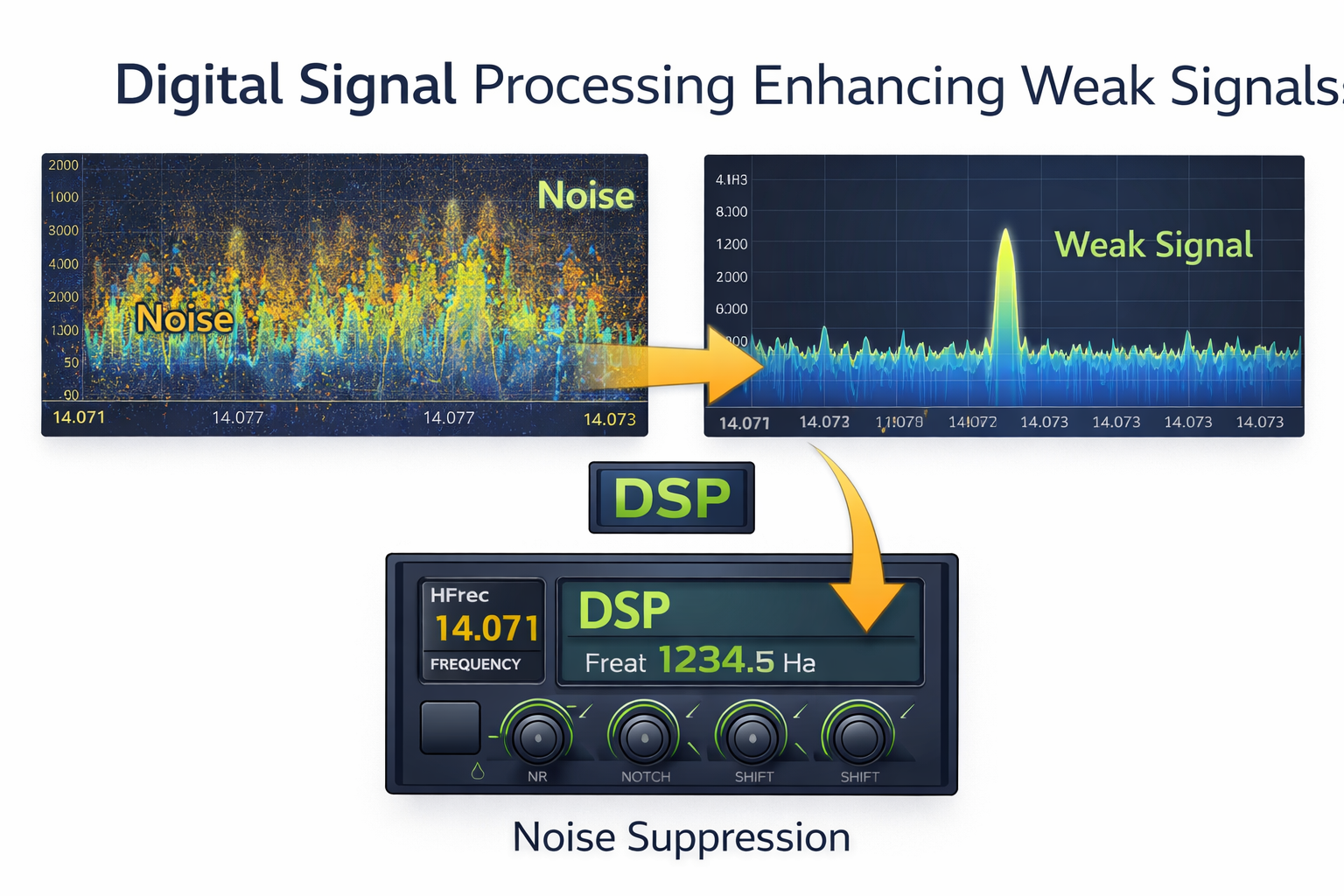
Digital signal processing is the most powerful tool available for weak signal enhancement in modern radios. Once signals are converted into digital form, DSP allows extremely precise manipulation using mathematical algorithms.
DSP enables narrow bandwidth filtering, adaptive noise reduction, automatic gain control, and advanced notch filtering. Most systems rely on Fast Fourier Transform (FFT) processing to analyze signals in the frequency domain. This allows the receiver to isolate desired signals and suppress noise with high precision.
One of the most effective DSP strategies is bandwidth reduction. Narrowing the filter reduces the total noise energy entering the receiver, significantly improving SNR.
Combining Techniques for Maximum Effect
The best results in weak signal reception come from combining multiple techniques rather than relying on a single feature. An optimized signal chain includes antenna optimization, low-noise amplification, noise blanking, narrow filtering, notch filtering, DSP processing, and audio-level noise reduction.
Each stage targets a different type of interference, creating a layered defense against noise. This approach allows operators to adapt to changing band conditions and maximize intelligibility.
SDR vs Traditional Receivers for Weak Signals
Software-defined radios offer significant advantages in weak signal scenarios due to their reliance on digital processing.
| Feature | SDR | Traditional Receiver |
|---|---|---|
| DSP Capability | Extremely advanced | Limited |
| Visualization | Real-time waterfall | None |
| Filtering Precision | Very high | Moderate |
| Adaptability | Dynamic | Fixed |
The ability to visually identify weak signals using a waterfall display gives SDR users a major advantage, especially in crowded bands.
Advanced Weak Signal Techniques
Beyond receiver settings, system-level improvements provide the greatest gains in weak signal performance. Directional antennas improve gain and reduce noise pickup. Optimizing antenna height and polarization enhances signal capture. Eliminating local noise sources reduces the noise floor.
Operating during optimal propagation conditions and using narrowband digital modes further increases success rates. These techniques often outperform adjustments made within the radio itself.
Common Mistakes That Degrade Weak Signals
Common operator mistakes include excessive use of preamps, overly wide filters, aggressive DSP settings, ignoring local noise sources, and focusing only on signal strength instead of SNR.
Avoiding these mistakes can result in immediate performance improvements.
Final Thoughts To Boost Weak Signals
Boosting weak signals is not about increasing volume—it is about improving clarity. The most effective operators understand how to control noise, apply filtering strategically, and use DSP intelligently.
With the right combination of tools and techniques, even the weakest signals can become readable and useful.
FAQ: Boosting Weak Radio Signals
What is the best way to boost weak radio signals?
Improve signal-to-noise ratio by reducing noise using filtering and DSP.
Does increasing gain improve weak signal reception?
No, because it amplifies both signal and noise equally.
When should you use a preamp in ham radio?
In low-noise environments or when compensating for feedline losses.
What does DSP do for weak signals?
It enhances signals using filtering, noise reduction, and adaptive processing.
How do you reduce noise in radio reception?
Use filters, eliminate interference sources, and optimize antenna systems.
Is antenna or radio more important for weak signals?
The antenna system usually has the greatest impact on performance.
About the Author
Vince, W2KU, is a licensed Extra class amateur radio operator and the founder of Ham Shack Reviews. The committee named him Amateur of the Year in 2026 for his contributions to amateur radio education and equipment evaluation.
He primarily operates HF, knows propagation very well, operates mobile and handhelds daily. Vince exchanges QSL cards for DXCC, contest confirmation, and award tracking and is the club QSL manager. His guidance focuses on practical operating procedures, accurate logging, and real-world amateur radio practices.
Please consider Donating to help support this channel