
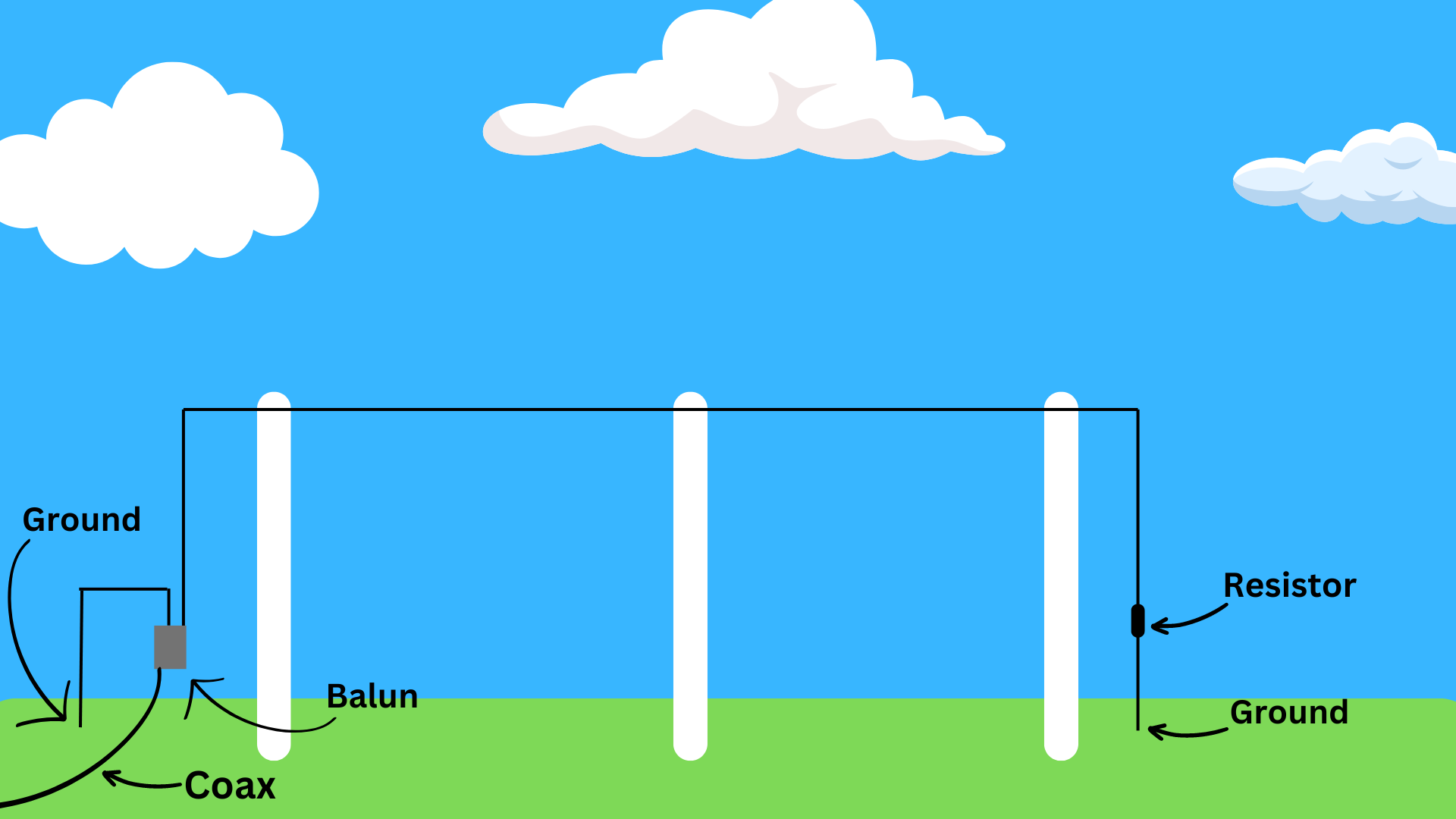
How to build a beverage antenna to improve your reception of low band signals? . These antennas have been around since the 1960s and continue to be the go-to choice for enthusiasts seeking excellent performance and simplicity in construction.
Advantages of Beverage Antennas
Beverage antennas provide several key advantages over other types of receiving antennas. Furthermore, these antennas excel in offering improved reception capabilities, allowing enthusiasts to detect weak signals even in challenging conditions. With their enhanced performance, Beverage antennas are highly effective in low band DXing, where capturing distant signals can be particularly challenging.
One of the standout features of Beverage antennas is their simple construction, making them accessible to both seasoned enthusiasts and newcomers to the hobby. They can be easily built using inexpensive materials, resulting in considerable cost savings. Once installed, Beverage antennas require minimal adjustments, offering convenience and ease of maintenance.
Beverage antennas are known for their directionality and low noise floor. Whether you’re aiming to receive signals from the United States or populous areas of the Pacific and Asia, Beverage antennas exhibit exceptional performance in a diverse range of geographic locations.
“Beverage antennas offer impressive reception capabilities, simple construction, and versatile coverage. They are a top choice for DXing enthusiasts seeking improved signal detection.”
Overall, Beverage antennas provide a winning combination of improved reception, simple construction, and wide coverage. Pair one with a radio that has a good receiver like the Elecraft K4, and you will have a winning combination.
Building a Beverage Antenna
When it comes to building a Beverage antenna, there are a few tips and tricks you should keep in mind. The length and height of the antenna play crucial roles in its performance. Experts recommend a length of around 270 feet for a short Beverage antenna, as this provides optimum results for low band DXing. Additionally, positioning the wire several feet above the ground is essential to avoid interference and ensure optimal reception.
To connect the Beverage antenna to the receiver, you will need a balun or transformer. A 9:1 transformer is often recommended for transforming the impedance from the Beverage wire to the receiver. Using the correct components is crucial for achieving optimal results. Also, you should consider using binocular cores and ferrite beads to enhance the performance of your Beverage antenna.
Beverage Antenna Length Recommendations by Band
Beverage antenna length directly affects directivity and performance. Longer antennas produce stronger directionality and improved signal-to-noise ratio on lower frequencies.
Typical recommended lengths:
160 meters — 500 to 1000 feet preferred, 300 feet minimum
80 meters — 300 to 700 feet ideal
40 meters — 150 to 400 feet effective
Short Beverage (general coverage) — about 270 feet
Longer antennas provide better low-angle reception and improved rejection of signals from unwanted directions. When space is limited, shorter lengths still provide useful directional performance but with reduced gain and front-to-back ratio.
Typical Beverage Antenna Dimensions and Performance
Beverage antennas can vary widely in length depending on frequency and available space. Longer antennas provide stronger directivity and better low-angle reception.
Typical performance ranges:
100–300 feet — short Beverage, moderate directivity
300–600 feet — strong directivity, excellent low band reception
600–1000+ feet — maximum DX performance and signal discrimination
Height above ground is usually between 4 and 10 feet. Lower heights generally improve directional performance and reduce noise pickup.
Termination resistance is commonly between 400 and 600 ohms, with 470 ohms being a widely used standard value.
Tips for Building a Beverage Antenna:
- Choose a length of around 270 feet for a short Beverage antenna.
- Position the wire several feet above the ground to avoid interference.
- Use a balun or transformer, such as a 9:1 transformer, to connect the antenna to the receiver.
- Consider using binocular cores and ferrite beads for optimal performance.
Following these tips and utilizing the right components, you can construct a highly effective Beverage antenna to enhance your low band DXing experience.
| Tips and Tricks | Considerations |
|---|---|
| Length of the antenna | Around 270 feet for a short Beverage antenna |
| Height of the antenna | Several feet above the ground |
| Connection to the receiver | Using a balun or transformer, such as a 9:1 transformer |
| Optimizing performance | Using binocular cores and ferrite beads |
Beverage Antenna Termination and Ground System
Proper termination is critical for correct antenna operation. The termination resistor absorbs RF energy traveling along the wire, preventing signal reflection and preserving directional performance.
Termination system components:
470 ohm resistor to ground (typical value)
Dedicated ground rod at termination end
Low resistance earth connection
Poor grounding or missing termination will cause:
Loss of directivity
Higher noise
Reduced signal clarity
Bidirectional reception
Step by Step Instructions
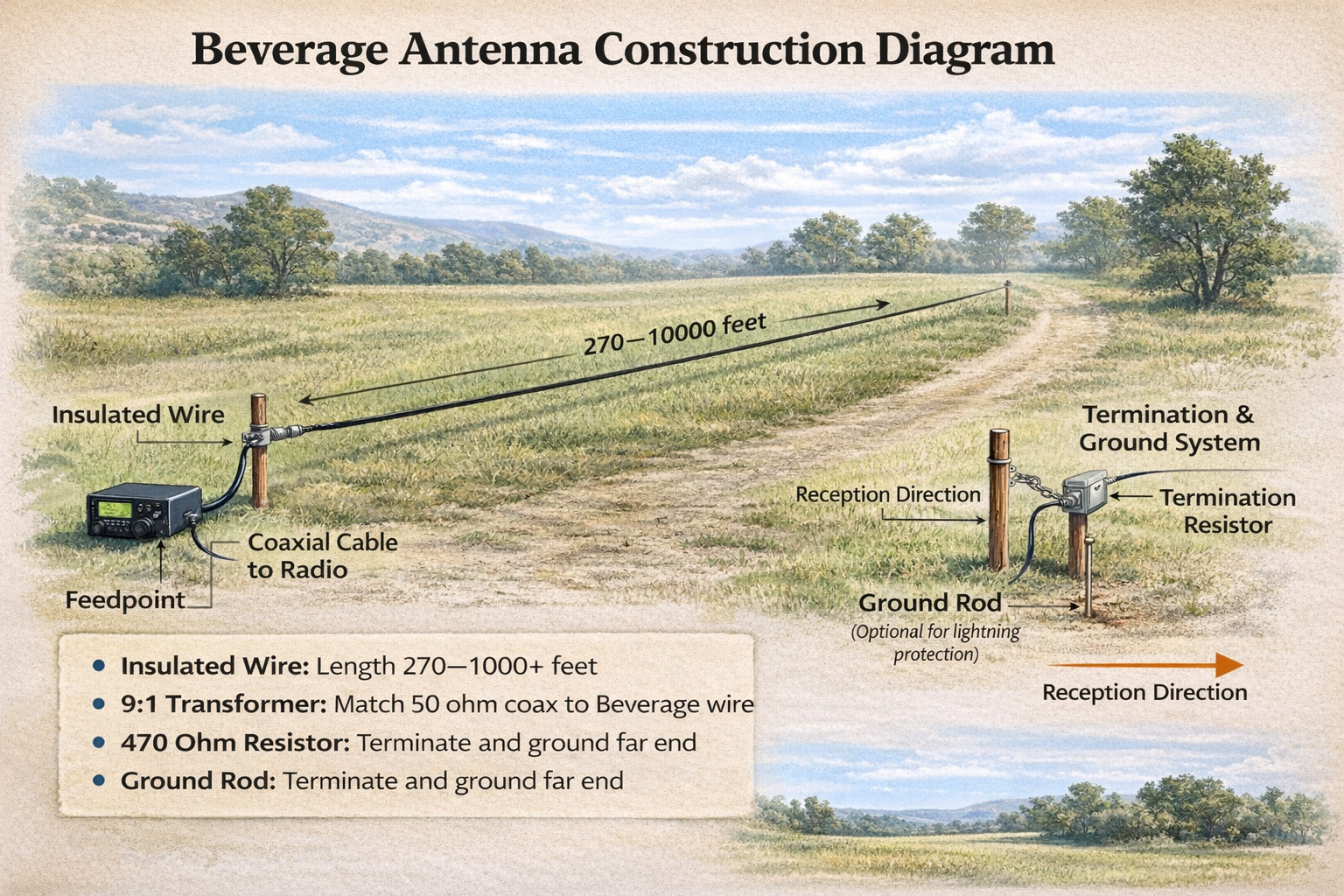
Choose a Location: Select a location for your Beverage antenna that is away from noise sources and where you have sufficient space to run a long wire in a straight line. Ideally, the wire should be as long as possible and run in the direction of the stations you want to receive.
What Direction Should a Beverage Antenna Point?
A Beverage antenna receives strongest signals from the direction the wire runs toward. The antenna should be installed pointing toward the geographic area you want to monitor most often.
Examples:
Point northeast from North America to receive Europe
Point west to receive Pacific or Asia
Point south for Caribbean and South America
Because Beverage antennas are highly directional, many operators install multiple antennas in different directions and switch between them for maximum coverage.
Gather Materials:
- Insulated wire: Use a long length of insulated wire (ideally at least 270-1000 feet long).
- Wooden or fiberglass posts: These will serve as supports for the wire.
- Insulators: Needed to attach the wire to the support posts.
- Coaxial cable: For connecting the Beverage antenna to your receiver.
- Grounding wire: Optional but recommended for lightning protection.
How Beverage Antenna Termination Controls Direction
A Beverage antenna is a traveling-wave antenna, which means signals move along the wire in one direction. The termination resistor at the far end absorbs signal energy and prevents reflections that would otherwise travel back toward the feedpoint.
This termination is what creates directionality.
If the termination resistor is removed, the antenna becomes bidirectional and loses its strong front-to-back rejection. When properly terminated, the antenna receives strongest signals from the direction the wire points toward.
Typical termination values range from 400 to 600 ohms, with 470 ohms commonly used for most soil conditions. Proper grounding at the termination point is critical for correct operation.
Beverage Antenna Directional Pattern
A properly terminated Beverage antenna is strongly directional. It receives signals best from the direction the wire points toward the termination resistor.
Key directional characteristics:
Strong forward reception
Very low rear response
Excellent side rejection
Low radiation angle for long distance reception
This directional behavior allows operators to target specific geographic regions while reducing noise and interference from other directions.
For example:
Wire pointing northeast → best reception from northeast
Signals from behind antenna → greatly reduced
Install Support Posts: Install wooden or fiberglass support posts at each end of the intended wire run. Ensure that they are securely anchored and are tall enough to support the wire at an appropriate height (typically 4-8 feet above the ground).
Run the Wire: Attach one end of the insulated wire to an insulator on the first support post. Run the wire in a straight line to the second support post and attach it securely with another insulator. Keep the wire as straight and level as possible, and avoid sharp bends or kinks.
Adjust Height: Ideally, the wire should be elevated 4-8 feet above the ground. You can adjust the height slightly to optimize reception based on local terrain and conditions.
Connect Coaxial Cable: Connect one end of a length of coaxial cable to the wire at the feed point (near one of the support posts). The other end of the coaxial cable will connect to your receiver.
Grounding (Optional): Consider grounding the coaxial cable to provide protection against lightning strikes and static buildup. Run a ground wire from each end of the wire to a suitable ground rod or grounding system. The far end of the wire should terminate with a 470 ohm resistor inline to ground.
Tune and Test: Once the Beverage antenna is installed, connect the coaxial cable to your receiver and tune to a frequency of interest.
Fine-Tuning: You can fine-tune the performance of the Beverage antenna by adjusting its length, direction, and height above the ground. Experiment with different configurations to achieve the best results for your specific location and listening preferences.
Common Beverage Antenna Installation Problems and Fixes
Even properly built Beverage antennas may not perform well if installation details are incorrect. Most performance problems are caused by grounding, termination, or environmental factors.
Common issues include:
Weak directionality — termination resistor not properly grounded
High noise levels — poor ground conductivity or nearby electrical noise sources
Low signal strength — antenna too short for desired band
No improvement over other antennas — wire installed too high above ground
Inconsistent performance — poor or corroded ground connections
Improving ground quality at both feedpoint and termination locations often produces the most noticeable performance improvement.
Beverage Antenna vs Other Receiving Antennas
Compared to other low-band receiving antennas, Beverage antennas offer unique advantages in noise reduction and directional performance.
- Beverage vs vertical receiving antenna:
- Lower noise floor
- Better long-distance signal discrimination
- Strong directional response
- Beverage vs loop antennas:
- Better front-to-back ratio
- Greater sensitivity to low-angle signals
- Requires more space
- Beverage vs active receive antennas:
- No amplification noise
- Handles strong signals better
- No power required
Each antenna type has advantages, but Beverage antennas remain one of the best choices for serious low-band DX reception.
Real-World Beverage Antenna Performance by Frequency Band
Beverage antennas provide the greatest performance advantage on low-frequency bands where atmospheric noise is highest and signal levels are weakest.
Typical performance expectations:
160 meters — excellent long-distance reception and strong noise reduction
80 meters — strong directional improvement and reduced interference
40 meters — moderate improvement depending on antenna length
Above 30 MHz — limited benefit compared to other antenna types
Because Beverage antennas favor low-angle signal arrival, they excel at receiving distant stations while reducing local noise sources. This makes them one of the most effective receiving antennas for low band DXing.
Testing and Comparing Antennas
When it comes to experimenting with antennas, it’s crucial to conduct A-B testing and comparisons to accurately evaluate their performance. This ensures that you make informed decisions based on reliable data rather than relying on subjective opinions or misconceptions. Many antenna myths and misconceptions can mislead you, leading to false conclusions about their effectiveness.
By utilizing direct measurements and employing multiple testing methods. You can obtain a comprehensive understanding of how different the antennas perform. A-B testing, where you compare two antennas by measuring their reception capabilities under the same conditions. In addition to, being particularly effective in identifying the strengths and weaknesses of each antenna.

“Comparing antennas through A-B testing allows you to discern the subtle differences in performance, which can be crucial when choosing the most effective configuration for your specific needs.”
Common Antenna Myths and Misconceptions
There are several myths and misconceptions that can cloud your judgment. It’s essential to debunk these misconceptions and avoid falling victim to false assumptions. Here are a few common antenna myths:
- Myth 1: Larger antennas always outperform smaller antennas.
- Myth 2: Antennas with more elements deliver better reception.
- Myth 3: Expensive antennas guarantee superior performance.
- Myth 4: Antenna positioning doesn’t significantly affect reception.
By dispelling these myths and approaching antenna testing with an open mind, you can make well-informed decisions based on accurate data and objective evaluations.

Comparison Table: A-B Testing Results
| Antenna Model | Reception Range (MHz) | Signal Strength (dB) | Interference Resistance |
|---|---|---|---|
| Antenna A | 0-30 | 20 | High |
| Antenna B | 0-25 | 18 | Medium |
| Antenna C | 0-35 | 22 | Low |
Table 1: A-B Testing Results
The table above presents the results of A-B testing conducted on three different antennas: Antenna A, Antenna B, and Antenna C. The testing included assessing each antenna’s reception range, signal strength, and interference resistance. Additionally, the data revealed that Antenna C outperformed the others in terms of reception range and signal strength. While Antenna A demonstrated higher interference resistance.
When comparing antennas, it’s crucial to look beyond misconceptions and subjective opinions. Gathering accurate data through A-B testing and consulting reliable sources can guide you in selecting the most suitable antenna for your specific requirements. Remember, the best antenna is the one that consistently delivers optimal performance.
Key Takeaways:
- A Beverage antenna can greatly enhance the reception of low band DXing signals.
- Beverage antennas offer advantages such as improved reception and simple construction.
- Consider factors like antenna length, height, and the use of balun and transformers when building a Beverage antenna.
- To accurately compare antennas, conduct A-B testing and consult reliable sources to avoid myths and misconceptions.
- Building a Beverage antenna remains a reliable and high-performing solution for low band DXing.
Is a Beverage Antenna Worth Building?
For operators focused on low-band DX reception, few antennas provide the same combination of performance, simplicity, and reliability.
A properly installed Beverage antenna delivers:
Exceptional weak signal reception
Very low noise floor
Strong directional control
Reliable long-distance performance
For serious DX listening on 160m, 80m, or medium wave, a Beverage antenna is one of the most effective receiving antennas available.
Common Beverage Antenna Installation Mistakes
Installing the antenna too high above ground
Using poor grounding at termination point
Wire not straight or uneven height
Incorrect termination resistance
Running wire near power lines or buildings
Using transmitting coax instead of receive feed isolation
Correct installation is essential for achieving maximum directional performance and lowest noise.
How to Build a Beverage Antenna
DXing enthusiasts highly recommend How to build a beverage antenna for the low band. In addition to its numerous advantages in terms of reception capabilities, simplicity of construction, and wide coverage areas make it an appealing option. By following the appropriate tips and tricks and utilizing the right components, such as baluns and transformers, DXers can construct a highly effective Beverage antenna.
Conducting tests and comparisons is crucial to ensure optimal performance of the antenna. This allows for accurate evaluation and the avoidance of common myths and misconceptions surrounding antenna effectiveness. However, it is important to rely on reliable sources and expert advice for accurate information.
Beverage antennas continue to be a popular solution for low band DX performance. With their reliable and high-performing characteristics, they provide DXers with a reliable method for pulling in the weak and distant stations.
Frequently Asked Questions About Beverage Antennas
How long should a Beverage antenna be?
Longer antennas provide stronger directionality. Most range from 300 to 1000 feet depending on available space.
Does a Beverage antenna transmit?
No. Beverage antennas are receive-only antennas designed for low noise signal reception.
Why is a termination resistor required?
It absorbs RF energy to prevent signal reflections and maintain directional performance.
How high should the wire be?
Typically 4 to 10 feet above ground for best performance.
Which bands work best?
160 meter, 80 meter, and medium wave frequencies.