
Ham Radio Digital Modes Explained: Complete Guide
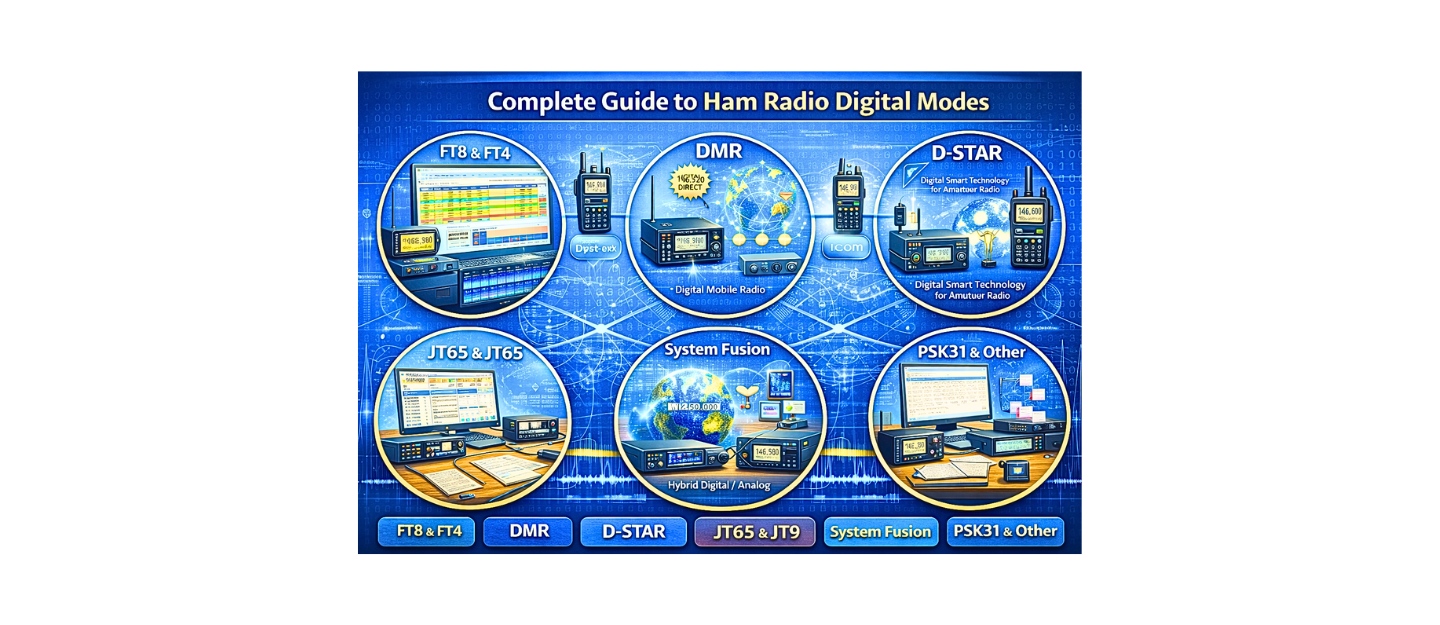
What Are Ham Radio Digital Modes
Ham radio digital modes are communication methods that transmit encoded data instead of voice, allowing reliable communication under weak signal conditions and limited bandwidth. By combining radio equipment with computer software, digital modes enable operators to decode signals that would be unreadable using traditional voice transmission.
Digital operation has become one of the most important advancements in amateur radio because it allows efficient communication across long distances, even in noisy or poor propagation conditions.
Modern digital operation combines radio equipment, computer processing, and specialized software. Together, these systems analyze, encode, transmit, receive, and decode structured data streams. Understanding how digital modes work, how they differ, and how to configure your station correctly allows you to take full advantage of their capabilities.
Why Digital Modes Matter in Amateur Radio
Digital modes have changed how amateur radio operators communicate by improving signal reliability and efficiency. In real-world operation, digital communication allows operators to:
- Make contacts under weak signal conditions
- Operate effectively with low power
- Communicate in crowded band conditions
- Exchange structured data quickly and accurately
For many operators, digital modes provide capabilities that are not possible with voice communication alone.
What Are Digital Modes
A digital mode is a communication method where information is transmitted as encoded data rather than spoken audio or manually keyed tones. The radio still transmits RF energy, but the modulation carries structured digital information that software interprets and converts back into readable text or data.
Digital modes are designed to maximize efficiency. Many operate with very narrow bandwidth, allowing multiple signals to share limited spectrum. Others are optimized for extremely weak signal detection, enabling contacts across long distances with very low power.
Most digital modes transmit structured messages such as call signs, signal reports, grid locations, and short text exchanges. Some support full conversational messaging, file transfer, or email over radio links.
Key Digital Mode Terms Every Operator Should Know
- Waterfall Display – Visual representation of signals across frequency
- Decoding Software – Programs that interpret digital signals
- Signal-to-Noise Ratio (SNR) – Measure of signal strength vs noise
- Time Synchronization – Required for modes like FT8 and FT4
- Audio Interface – Connects radio and computer
Understanding these terms makes it easier to configure and operate digital systems effectively.
Why Digital Modes Are So Effective
Digital communication systems use mathematical encoding and error correction to preserve information even when signals are weak or distorted. This allows reliable decoding when signal levels fall below the noise floor where voice communication would fail.
Digital modes provide advantages such as:
- Extreme weak signal performance
- Narrow bandwidth operation
- Automatic error detection
- Consistent message formatting
- Efficient spectrum usage
- Low power communication capability
These characteristics make digital modes especially useful during poor propagation conditions, crowded bands, or portable operation.
How Digital Signals Are Generated
In most amateur radio digital setups, a computer generates audio tones representing encoded data. These tones are fed into the transceiver’s microphone or data input. The radio then modulates and transmits them like any other audio signal.
On receive, the radio outputs audio to the computer. Software analyzes the incoming tones, extracts encoded information, and displays decoded text or data to the operator.
The radio handles RF transmission and reception, while the computer performs digital encoding and decoding.
Computer and Software Requirements
Digital operation requires software capable of generating and decoding specific digital modes. Each mode uses unique signal structures, timing, and encoding schemes. Programs must match the mode being transmitted.
Many software packages also provide:
- Waterfall displays for signal visualization
- Frequency control integration
- Logging automation
- Signal reporting tools
- Message macros
A properly configured computer-radio interface is essential for stable operation.
Audio Interfaces and Signal Levels
The connection between radio and computer must provide clean audio in both directions. This is typically accomplished through a sound card interface or built-in USB audio system.
Correct audio level adjustment is critical. Excessive audio causes distortion and splatter, while insufficient audio reduces decoding reliability. Proper gain staging ensures accurate signal transmission and reception.
Digital modes require stable, distortion-free audio more than high power or wide bandwidth.
Common Digital Mode Setup Mistakes
- Audio levels set too high causing distortion
- Incorrect sound card selection
- Poor grounding or RF interference
- Improper transmit power settings
- Misconfigured software
Avoiding these issues ensures clean signals and reliable decoding.
Waterfall Displays and Signal Identification
Most digital software includes a waterfall display showing signal strength across frequency over time. Signals appear as visual patterns that help operators identify active frequencies and tune precisely.
Different digital modes produce distinct visual signatures. Experienced operators can often recognize a mode by its waterfall appearance before decoding it.
Waterfall displays allow precise frequency selection and efficient band monitoring.
Popular Weak Signal Digital Modes
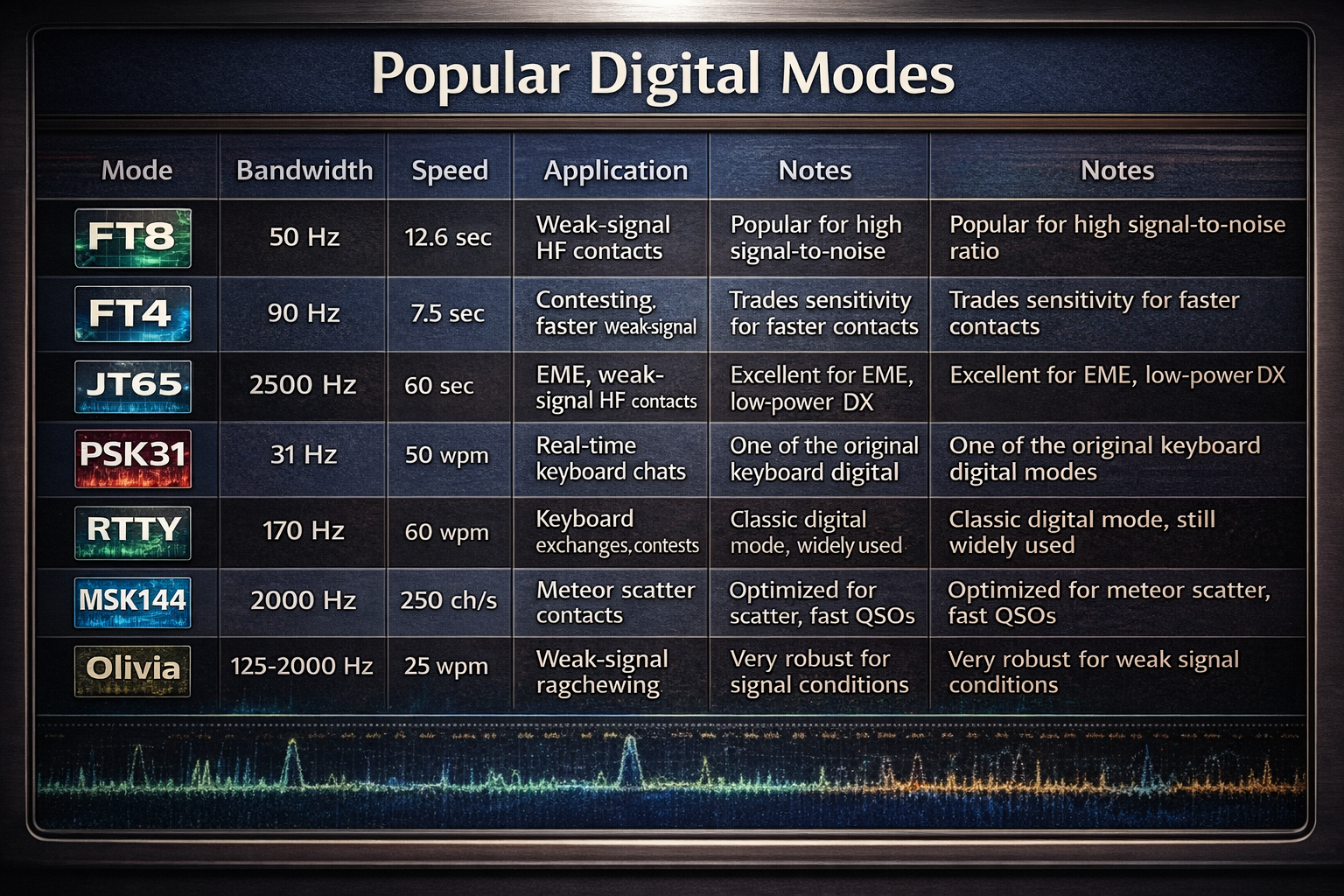
Some digital modes are designed specifically for weak signal communication. These modes use precise timing and structured message formats to extract information from extremely faint signals.
FT8 is one of the most widely used weak signal modes. It allows rapid automated exchanges and operates effectively at very low signal levels. FT4 provides similar performance with faster exchange timing.
These modes are highly structured and typically used for contact confirmation rather than extended conversation.
Quick Comparison of Popular Digital Modes
| Mode | Speed | Best Use | Signal Strength |
|---|---|---|---|
| FT8 | Medium | Weak signal DX | Extremely weak |
| FT4 | Fast | Contests | Weak |
| RTTY | Medium | Contesting | Moderate |
| PSK31 | Slow | Conversation | Weak |
| Olivia | Slow | Noisy conditions | Very weak |
FT4 Digital Mode
FT4 is a fast digital communication mode designed for efficient weak-signal contacts on crowded HF bands. It was developed by the same team that created FT8 and is integrated into popular digital software such as WSJT-X. FT4 prioritizes speed, allowing operators to complete contacts more quickly than with slower weak-signal modes.
Unlike FT8, which uses a 15-second transmit/receive cycle, FT4 operates on a 7.5-second sequence. This shorter cycle allows more QSOs to occur in the same time period, making FT4 particularly popular during radio contests and high-activity operating events.
FT4 still maintains strong weak-signal performance but sacrifices a small amount of sensitivity compared with FT8. In practical operation, FT4 typically decodes signals about 3–4 dB weaker than traditional modes, but not quite as weak as FT8.
Key characteristics of FT4 include:
- 7.5-second transmit/receive cycle
- Faster QSO completion
- Designed for contesting and rapid exchanges
- Integrated in WSJT-X and compatible software
- Effective weak-signal performance
Because of its speed, FT4 is commonly used during major HF contests where operators want to maximize the number of contacts in a limited time.
Typical FT4 operating frequencies include segments on bands such as 80m, 40m, 30m, 20m, 17m, and 15m, though exact frequencies may vary depending on regional band plans.
Operators who already use FT8 can easily transition to FT4 since the setup process, software, and interface requirements remain largely the same.
FT2 Digital Mode
FT2 uses very short transmission intervals to enable extremely rapid message exchange as a high-speed digital mode. Although it shares conceptual similarities with other weak-signal modes, FT2 emphasizes speed over sensitivity.
FT2 uses a two-second transmit/receive cycle, allowing very quick exchanges between stations. Because of the extremely short transmission window, the mode requires accurate timing and a clean, stable signal path.
The faster cycle means FT2 can support a very high contact rate, which makes it appealing for specialized operating environments where rapid exchanges are desirable. However, the mode generally requires stronger signals than FT4 or FT8 due to the shorter transmission interval.
Typical characteristics of FT2 include:
- Two-second transmit/receive cycle
- Extremely fast contact capability
- Requires accurate station timing
- Less weak-signal sensitivity than FT4 or FT8
- Designed for rapid communication exchanges
Although operators use FT2 less often than FT8 or FT4, it demonstrates how digital signal processing continues to expand the capabilities of modern amateur radio.
As digital modes continue to evolve, modes like FT2 highlight the growing trend toward efficient, computer-assisted communication techniques in amateur radio.
Timing Programs for Digital Modes
Precise timing is essential for digital communication modes such as FT8, FT4, and other structured weak-signal protocols. These modes rely on synchronized transmit and receive periods so that stations begin and end transmissions at exactly the same time.
If a station’s system clock is off by more than about one second, digital decoding may fail or signals may appear in the wrong time slot.
For this reason, digital operators commonly use time synchronization software that automatically adjusts the computer’s clock using internet time servers.
Popular timing programs include:
- Dimension 4 – A lightweight Windows time synchronization program widely used by radio operators.
- Meinberg NTP – A highly accurate Network Time Protocol client used for precise clock synchronization.
- NetTime – A simple NTP-based utility that keeps system clocks synchronized with internet time servers.
These programs periodically check trusted time sources and adjust the system clock to maintain accurate synchronization.
Accurate timing provides several benefits for digital mode operation:
- Reliable decoding of weak signals
- Correct transmit slot alignment
- Improved QSO success rates
- Reduced decoding errors
Most modern digital mode software also includes a built-in display showing the time offset between the station clock and received signals, helping operators confirm their system timing remains within acceptable limits.
Maintaining accurate timing is one of the simplest yet most important steps in ensuring successful operation with modern digital communication modes.
Why Accurate Timing Is Critical
Digital modes like FT8 and FT4 rely on precise timing synchronization between stations. Even small timing errors can prevent successful decoding or cause transmissions to fall outside expected time slots.
Maintaining accurate system time ensures reliable communication and consistent digital performance.
Conversational Digital Modes
Other digital modes support real-time keyboard communication between operators. These modes allow longer text exchanges and more flexible conversation.
RTTY is one of the oldest digital modes and remains widely used, especially in contests. PSK31 is known for narrow bandwidth and conversational capability. Olivia and similar modes provide excellent noise resistance and readability.
Conversational modes require active operator participation rather than automated message exchange.
Digital Messaging and Data Transfer
Some digital systems support email, file transfer, and message relay through radio networks. These systems allow communication when internet connectivity is unavailable.
Digital messaging can be used for emergency communication, remote operation support, and information relay. Structured data transfer expands amateur radio beyond simple text exchange.
Bandwidth and Spectrum Efficiency
Ham radio digital modes typically use less bandwidth than voice communication. Narrow bandwidth allows more simultaneous signals within a given frequency range.
Efficient spectrum use is especially important during crowded band conditions or emergency operations where many stations must share limited frequencies.
Power Levels and Signal Discipline
Digital modes often require less transmit power than voice operation. Because many modes are sensitive to distortion, operators must use appropriate power levels and maintain clean signal quality.
Excessive power or improper audio settings can create interference and reduce decoding reliability for other stations.
Operating discipline is essential for effective digital communication.
Ham Radio Digital Modes Operating Practice
Successful digital operation requires attention to signal quality, frequency placement, and software configuration. Operators must monitor signal bandwidth, maintain clean audio levels, and follow established band usage practices.
Careful tuning and proper setup ensure reliable communication and minimize interference.
Integration With Modern Transceivers
Many modern transceivers include built-in sound cards and USB connectivity, simplifying digital setup. These radios can transmit and receive digital audio directly through a single connection to the computer.
Integrated digital capability reduces wiring complexity and improves signal stability.
Digital Modes and Propagation
Propagation still affects digital communication, but digital decoding often succeeds under conditions where voice fails. Weak signal digital modes are especially effective during marginal propagation.
Understanding propagation patterns helps operators select appropriate bands and frequencies for digital activity.
How Digital Modes Work During Poor Propagation
Digital modes excel during poor propagation conditions because advanced decoding algorithms can extract information from extremely weak signals. Even when voice communication fails due to fading or noise, digital signals may still be decoded successfully.
This makes digital operation especially valuable during low solar activity, nighttime operation, or marginal band conditions.
Portable and Remote Digital Operation
Digital modes are well suited to portable and remote stations because they require modest power and limited bandwidth. Many operators use digital modes in field operations where efficient communication is essential.
Digital communication also supports remote station control and monitoring.
Advantages of Digital Communication
Digital modes provide reliable communication under challenging conditions. They support efficient spectrum use, enable weak signal contacts, and allow structured data transmission.
For many operators, digital modes expand communication possibilities beyond traditional voice operation.
Limitations and Considerations
Digital modes depend on computers, software configuration, and stable audio interfaces. Proper setup requires attention to technical detail. Some modes restrict message flexibility due to structured transmission formats.
Despite these limitations, digital communication remains one of the most powerful tools available to amateur operators.
Choosing the Right Digital Mode
Different digital modes serve different purposes. Some emphasize weak signal performance, others support conversation, and some enable structured messaging. The best choice depends on operating goals, propagation conditions, and station configuration.
Understanding mode characteristics allows operators to select the most effective communication method for each situation.
Pros and Cons of Digital Modes
Pros:
- Excellent weak signal performance
- Efficient use of bandwidth
- Low power operation
- Reliable communication in poor conditions
Cons:
- Requires computer and software
- Setup complexity for beginners
- Limited conversational flexibility in some modes
- Dependence on accurate timing
Complete Guide to Ham Radio Digital Modes
Complete Guide to Ham Radio Digital Modes, they represent one of the most significant advancements in amateur radio communication. By combining radio transmission with computer-based signal processing, digital operation enables reliable communication across weak signals, crowded spectrum, and challenging environments. Operators who understand digital technology gain powerful tools for efficient, flexible, and modern radio communication across the amateur bands.
Frequently Asked Questions About Digital Modes
What is the most popular ham radio digital mode?
FT8 is currently the most widely used digital mode due to its strong weak-signal performance.
Do digital modes require internet?
No, communication occurs over radio, but internet may be used for time synchronization and logging.
What power level is needed for digital modes?
Many digital modes work effectively at low power levels, often under 50 watts.
Are digital modes better than voice?
They are more efficient under weak conditions but less flexible for conversation.
About the Author
Vince, W2KU, is a licensed Extra class amateur radio operator and the founder of Ham Shack Reviews. The club committee named him Amateur of the Year in 2026 for his contributions to amateur radio education and equipment evaluation.
He primarily operates HF, knows propagation very well, operates mobile and handhelds daily. Vince exchanges QSL cards for DXCC, contest confirmation, and award tracking and is the club QSL manager. His guidance focuses on practical operating procedures, accurate logging, and real-world amateur radio practices.
Please consider Donating to help support this channel