
Complete Guide to Two-Way Radios
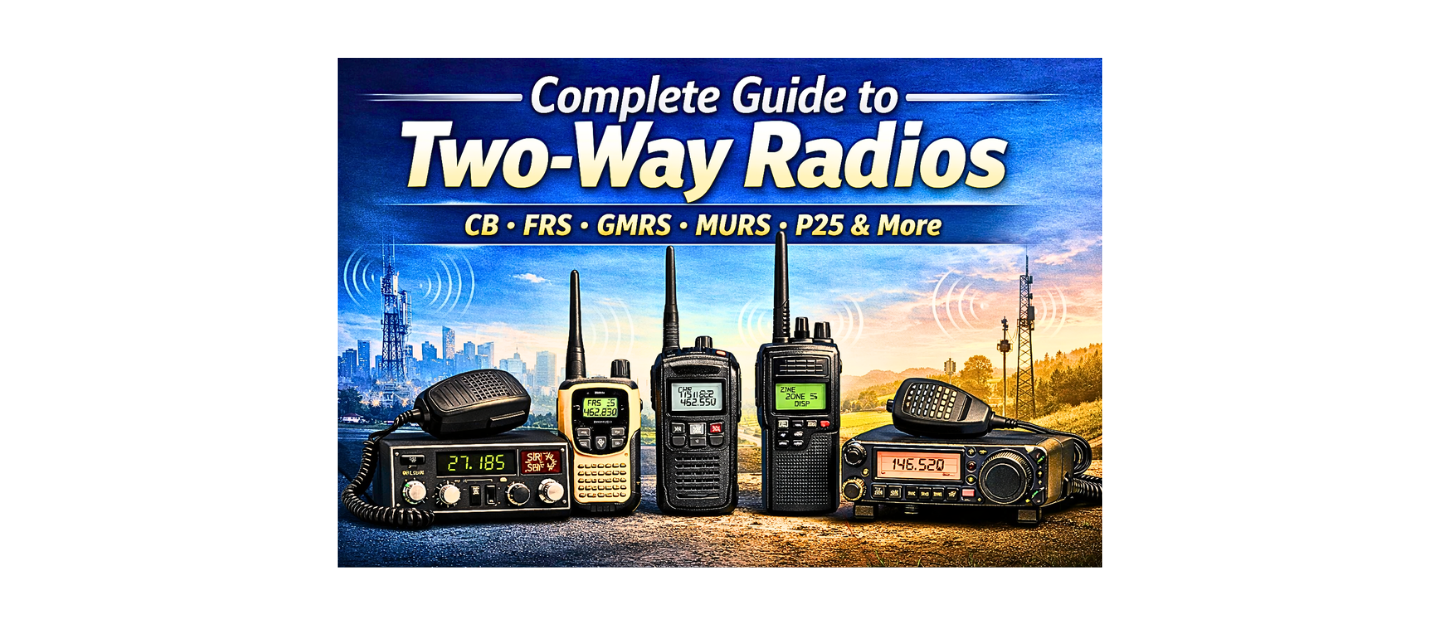
Complete Guide to Two-Way Radios show Two-way radios and how they allow people to communicate instantly without relying on cellular networks or internet infrastructure. These systems transmit voice directly between radios using radio frequencies, making them reliable for emergency communication, outdoor activities, professional operations, and hobby use.
Unlike smartphones, two-way radios operate independently of commercial networks. When infrastructure fails or coverage disappears, radios can still provide dependable communication across local areas, job sites, or even long distances depending on the system used.
Understanding the different types of two-way radios helps users select equipment that fits their needs while staying compliant with regulations. This guide explains how two-way radios work, the major radio services available in the United States, and how to choose the right radio for your situation.
Complete Guide to Two-Way Radios
A two-way radio is a communication device that can both transmit and receive radio signals. When a user presses the push-to-talk (PTT) button, the radio switches from receive mode to transmit mode and sends voice signals over a designated radio frequency.
Most consumer radios operate in half-duplex mode. Only one person can speak at a time on a given channel. When the user releases the PTT button, the radio returns to receive mode and allows others to respond.
Two-way radios consist of several key components:
• A transmitter that converts voice into radio signals
• A receiver that converts incoming signals back into audio
• An antenna that radiates and receives radio waves
• A power source such as a battery or external supply
• Control circuitry for channel selection and audio processing
These components work together to create a direct communication link between radios operating on the same frequency and signaling system.
How Two-Way Radios Work
Two-way radios convert sound into radio waves through a process called modulation. When a user speaks into the microphone, the radio converts the voice signal into an electrical signal. The transmitter then modulates that signal onto a radio frequency carrier.
The antenna radiates this signal into the air as electromagnetic waves. Any radio tuned to the same frequency and signaling configuration can receive the transmission.
The receiving radio demodulates the signal, converts it back into audio, and sends it to the speaker.
Several factors influence communication range and quality:
• Transmitter power
• Antenna efficiency
• Terrain and obstacles
• Radio frequency band
• Environmental noise and interference
Higher power and better antennas generally increase range, but terrain and buildings can still block or weaken signals.
Major Types of Two-Way Radio Services
Several radio services exist in the United States for different uses. Each service operates in specific frequency ranges and follows distinct regulatory rules set by the Federal Communications Commission (FCC).
Citizens Band (CB) Radio
Citizens Band radio operates in the 27 MHz high-frequency band and provides license-free communication for the general public. CB radios have long served truck drivers, off-road groups, and hobbyists who want simple short-range communication.
CB radio uses amplitude modulation (AM) and single sideband (SSB) modes across 40 channels. Because CB operates in the HF band, signals sometimes travel long distances during favorable atmospheric conditions.
Typical CB communication range varies from a few miles with mobile radios to much farther when propagation conditions allow.
Key CB characteristics include:
• No license required
• 40 channels between 26.965 MHz and 27.405 MHz
• Maximum legal power of 4 watts AM or 12 watts SSB
• Mobile and base station equipment widely available
CB radio remains popular for highway communication and recreational off-road travel.
Family Radio Service (FRS)
Family Radio Service provides short-range communication using handheld radios in the UHF band around 462 and 467 MHz. FRS radios require no license and work well for families, events, and outdoor activities.
These radios use fixed antennas and limited power levels to keep operation simple and prevent interference with other services.
FRS radios typically operate at power levels up to 2 watts depending on the channel. Under normal conditions, communication range spans approximately one mile or less in urban environments and several miles in open terrain.
Common uses for FRS radios include:
• Family outings
• Hiking groups
• Campgrounds
• Event coordination
• Short-range recreational communication
FRS radios provide simple, affordable communication without regulatory complexity.
General Mobile Radio Service (GMRS)
General Mobile Radio Service operates in the same UHF frequency range as FRS but allows higher power levels and repeater operation. GMRS requires an FCC license, but the license covers an entire family.
GMRS radios can transmit up to 50 watts depending on the equipment used. Many systems also use repeaters that extend communication range significantly.
GMRS systems commonly support:
• Mobile radios installed in vehicles
• Handheld radios
• Base stations
• Repeater networks
Because GMRS allows higher power and external antennas, communication range often exceeds that of FRS radios, especially when repeaters are available.
GMRS has become increasingly popular for emergency preparedness, off-road groups, and community communication networks.
Marine Radios
Marine radios provide reliable ship-to-ship and ship-to-shore communication using the marine VHF radio service operating between 156 and 162 MHz. These radios are designed specifically for the marine environment and include waterproof construction, corrosion-resistant components, and dedicated channels used worldwide for navigation, safety, and operational communication. Unlike cell phones, marine radios allow vessels to communicate instantly with nearby boats, marinas, bridges, locks, and emergency services even when far from cellular coverage.
Marine VHF radios also play a critical role in maritime safety. Channel 16 (156.8 MHz) serves as the international distress, safety, and calling channel monitored by the U.S. Coast Guard and other vessels. Modern radios often include Digital Selective Calling (DSC), which can transmit a vessel’s identity and GPS location during emergencies. Because of their reliability and standardized channels, marine radios remain essential equipment on recreational boats, commercial vessels, and coastal operations.
Common uses of marine radios
• Distress and emergency communication with the Coast Guard
• Ship-to-ship communication between nearby vessels
• Contacting marinas, harbormasters, and bridge operators
• Weather alerts and marine safety broadcasts
• Navigation coordination in busy waterways
• Fishing fleet coordination and offshore communication
• Docking assistance and marina approach communication
• Monitoring Channel 16 for safety calls and emergency traffic
Multi-Use Radio Service (MURS)
Multi-Use Radio Service operates in the VHF band near 151 and 154 MHz. MURS requires no license and supports a wide range of business and personal applications.
Unlike FRS, MURS radios may use removable antennas, which can improve performance in certain situations. However, MURS limits transmitter power to 2 watts.
The service includes five available channels and supports both voice communication and data transmissions.
MURS often appears in:
• Retail store communication systems
• Warehouse operations
• Farm and ranch communication
• Small business coordination
Because the VHF band can perform well outdoors, MURS sometimes offers better range in rural areas compared with UHF handheld radios.
Project 25 (P25) Public Safety Radio
Project 25 represents a digital radio standard used primarily by public safety agencies, government organizations, and large infrastructure operators.
P25 systems provide secure and reliable communication for police, fire departments, emergency services, and federal agencies. These radios operate in multiple frequency bands and support advanced features such as encryption, trunking, and interoperability.
Key features of P25 systems include:
• Digital voice communication
• Strong resistance to interference
• Encryption for secure communication
• Large trunked network capability
• Interoperability across agencies
Because P25 systems require specialized infrastructure and coordination, they typically serve government and professional users rather than general consumers.
Amateur (Ham) Radio
Amateur radio provides one of the most versatile two-way communication platforms available. Licensed operators can transmit across multiple frequency bands ranging from HF to microwave frequencies.
Ham radio operators experiment with different communication modes, build equipment, and communicate with other operators around the world.
The service supports numerous communication methods including:
• Voice communication
• Morse code
• Digital modes
• Satellite communication
• Long-distance HF propagation
Amateur radio requires passing an FCC licensing exam, but the privileges gained allow extensive experimentation and global communication capabilities.
Analog vs Digital Two-Way Radios
Two-way radios use either analog or digital transmission methods. Analog radios transmit voice using continuous wave modulation such as FM or AM. These systems remain simple, widely compatible, and easy to operate.
Digital radios convert voice into digital data before transmission. Digital systems often deliver clearer audio, improved noise rejection, and additional features such as text messaging and encryption. Many modern radio systems support both analog and digital operation to maintain compatibility with older equipment.
Two-Way Radio Frequency Bands
Two-way radios operate across several frequency bands, each with unique propagation characteristics.
Low-frequency and HF signals can travel long distances due to atmospheric reflection, while VHF and UHF signals typically provide reliable local communication.
Common two-way radio bands include:
HF (3–30 MHz)
Used by CB and amateur radio for long-distance communication.
VHF (30–300 MHz)
Used by MURS, amateur radio, marine radio, and many commercial systems.
UHF (300–1000 MHz)
Used by FRS, GMRS, public safety radios, and many digital systems.
Higher frequencies generally support smaller antennas and clearer communication in urban environments, while lower frequencies may perform better over longer distances.
Factors That Affect Radio Range
Many variables influence how far two-way radios can communicate.
Transmitter power plays an important role, but it does not determine range alone. Antenna quality and height often have a larger impact on signal coverage.
Terrain also significantly affects radio performance. Mountains, dense forests, buildings, and metal structures can block or reflect signals. Even the ground beneath your antenna plays a part in its performance.
Weather conditions sometimes influence signal propagation, especially on lower frequency bands where atmospheric effects become more significant.
Users who want maximum range often improve antenna systems and choose frequencies appropriate for the environment.
Choosing the Right Two-Way Radio
Selecting the correct radio depends on several practical considerations.
First, determine whether the radio service requires a license. FRS and MURS allow license-free operation, while GMRS and amateur radio require FCC licensing.
Next, consider the communication distance needed. Short-range activities may only require handheld radios, while longer distances may require higher power radios or repeater systems.
Environment also matters. UHF radios generally perform better in cities and buildings, while VHF systems often work well in open rural terrain.
Durability and battery life also influence equipment choices, particularly for field use or emergency preparedness.
Legal and Regulatory Considerations
Two-way radios must operate within FCC regulations. These rules define allowed frequencies, power limits, and licensing requirements for each radio service.
Using radios outside their authorized frequencies or exceeding legal power limits can cause interference and may result in regulatory penalties.
Users should always verify that their equipment complies with the specific radio service they intend to use.
Following these rules ensures reliable operation and prevents interference with other radio users.
Why Two-Way Radios Remain Important
Despite the widespread use of smartphones, two-way radios remain essential communication tools. They operate independently of cellular networks, provide instant push-to-talk communication, and function reliably in remote areas or emergency situations.
Public safety agencies, industrial operations, transportation systems, and hobbyists continue to rely on radio communication because it remains simple, resilient, and efficient.
As technology evolves, digital radio systems continue to improve audio quality, coverage, and interoperability while maintaining the core advantages that have defined two-way radio communication for decades.
Two-way radios remain one of the most dependable communication technologies ever developed, providing reliable communication when other systems fail.
Comparing Two-Way Radio Services
Each two-way radio service serves a different purpose, and understanding the differences helps users choose the right equipment.
FRS radios work best for short-range personal communication. Families, hikers, and event staff often use these radios because they require no license and operate with simple handheld equipment. However, fixed antennas and limited transmitter power restrict their range.
GMRS radios provide greater capability. Higher power limits, detachable antennas, and repeater support allow much larger coverage areas. Off-road groups, preparedness communities, and rural families often use GMRS systems to maintain reliable communication across several miles.
MURS radios operate in the VHF band and sometimes perform better in open outdoor environments. Farms, warehouses, and retail businesses often rely on MURS because it requires no license while still allowing external antennas for improved performance.
CB radio operates in the HF band and remains widely used by truck drivers and off-road communities. Although CB typically offers shorter ground-wave communication ranges than some VHF or UHF systems, favorable atmospheric conditions can occasionally allow signals to travel hundreds or even thousands of miles.
Amateur radio provides the most flexibility of any two-way radio service. Licensed operators can communicate locally using handheld radios or reach worldwide stations using HF equipment and directional antennas. Because amateur radio supports many operating modes and frequency bands, it attracts experimenters and emergency communication volunteers.
P25 radio systems represent the professional end of the spectrum. Public safety agencies rely on these digital systems for secure, mission-critical communication across large regional networks.
Choosing the correct radio service depends on the communication distance required, whether licensing is acceptable, and whether the user needs simple handheld radios or more advanced systems with repeaters and base stations.
Frequently Asked Questions
What is the difference between FRS and GMRS radios?
FRS radios operate license-free with lower power and fixed antennas. GMRS radios require an FCC license but allow higher power, detachable antennas, and repeater use, which greatly increases range.
How far can two-way radios reach?
Most handheld radios communicate between one and five miles depending on terrain, antenna efficiency, and transmitter power. Mobile radios or repeater systems can extend communication much farther.
Do two-way radios require a license?
FRS and MURS radios do not require a license. GMRS and amateur radio require an FCC license. CB radio does not require a license but must follow FCC operating rules.
Are two-way radios useful for emergencies?
Yes. Two-way radios communicate directly between devices without cellular networks, which makes them valuable during disasters or when cell service fails.
What is the best two-way radio for beginners?
FRS radios are the easiest option for beginners because they require no license and are simple handheld devices.
After adding those two sections your article will be complete enough for a pillar page.
If you want, I can also show you a very easy 2-minute trick that can help this article rank faster for “two way radios.”
About the Author
Vince, W2KU, is a licensed Extra class amateur radio operator and the founder of Ham Shack Reviews. He was named Amateur of the Year in 2026 for contributions to practical amateur radio education and equipment evaluation.
He primarily operates HF, knows propagation very well, operates mobile and handhelds daily. Vince exchanges QSL cards for DXCC, contest confirmation, and award tracking and is the club QSL manager. His guidance focuses on practical operating procedures, accurate logging, and real-world amateur radio practices.
Please consider Donating to help support this channel