
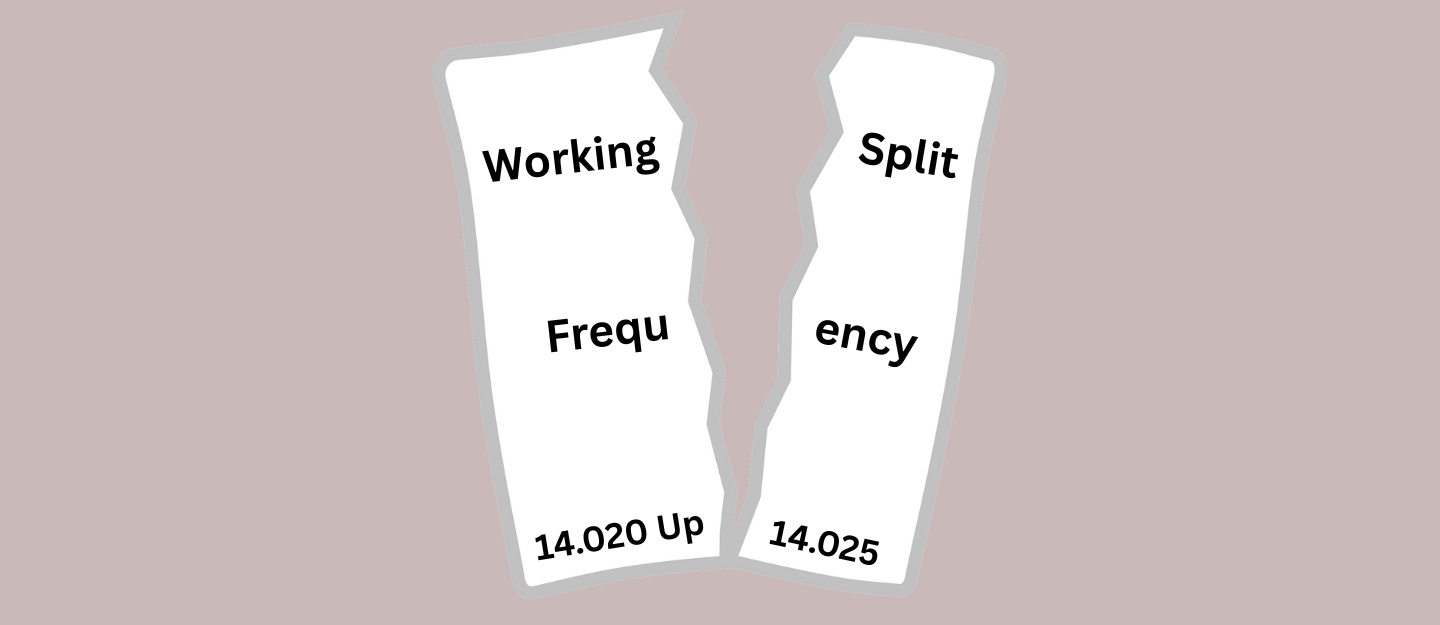
Why DX Uses Split Frequency, this technique is one of the most important concepts in serious HF operating, especially during pileups. Understanding why DX stations use split frequency and how to use it yourself can dramatically increase your success rate, reduce interference, and make you a more effective operator.
At its core, split operation separates transmit and receive frequencies. The DX station transmits on one frequency while listening on another. This simple shift solves one of the biggest problems in amateur radio: hundreds or thousands of stations trying to call on the same frequency at once. In high-demand situations, simplex operation quickly collapses into noise, making communication inefficient or impossible.
New to the hobby? Start with our Complete Guide to Ham Radio Fundamentals.
Split frequency is a ham radio operating technique where a station transmits on one frequency while listening on another, allowing efficient communication during heavy pileups.
How Split Frequency Looks on the Band
A DX station occupies a single transmit frequency while the pileup spreads across a range above or below it. Instead of everyone calling on one frequency, signals are distributed across several kilohertz. The DX operator tunes across that range, selecting individual stations from the spread. Operators who place their signal slightly outside the densest part of the pileup often have a higher chance of being heard because they are easier to isolate.
What Is Split Frequency Operation
Split frequency operation means the transmitting station, typically the DX station, listens on a different frequency than it transmits on. This creates a clear separation between where the DX is sending its signal and where it is receiving incoming calls.
Example:
DX transmits on 14.195 MHz
DX listens on 14.200–14.205 MHz
Operators calling the DX must transmit within that listening range, not on the DX transmit frequency.
This is typically announced using phrases such as:
Listening up 5
Up 5 to 10
Listening 200 to 205
This separation ensures that the DX signal remains clear while the pileup is distributed across a wider section of the band.
Why DX Stations Use Split Frequency
The primary reason for split operation is pileup control, but the underlying technical benefits are equally important. When a rare station appears, hundreds or even thousands of operators may attempt to make contact simultaneously.
If all of those stations transmit on the same frequency, the result is signal overlap, distortion, and complete loss of intelligibility. The receiver cannot isolate individual signals because they occupy the same spectral space.
Split operation distributes those signals across multiple frequencies. This allows the DX operator to tune through the pileup and isolate individual callers. It effectively converts a chaotic signal mass into a series of selectable signals.
Another key advantage is receiver performance. Even high-end radios struggle when dozens of signals occupy the same frequency. By spreading callers out, filters and DSP systems can function as intended.
Split operation also reduces interference. The DX transmit frequency remains relatively clean, making it easier for operators to hear the DX clearly. Without split, the DX signal would be constantly covered by callers.
Finally, split provides operational control. The DX operator can shift listening frequencies, manage regions, and adapt to changing conditions. This level of control is essential during large pileups.
How Split Frequency Works in Practice
In real-world operation, a DX station will establish a fixed transmit frequency and then define a listening range. Stations attempting to make contact spread themselves across that range.
The DX operator then tunes across the listening frequencies, selecting calls one at a time. This process allows them to work stations efficiently without being overwhelmed.
Experienced operators observe patterns in how the DX tunes. Some move steadily upward, others downward, and some jump between clusters. Recognizing these patterns provides a significant advantage.
The most important behavior is listening. Successful operators spend far more time listening than transmitting, using that time to understand the flow of the pileup.
Simple vs Split Operation Comparison
| Feature | Simplex Operation | Split Operation |
|---|---|---|
| TX/RX Frequency | Same | Different |
| Pileup Behavior | Chaotic | Controlled |
| Signal Clarity | Poor in pileups | Much better |
| DX Efficiency | Low | High |
| Best Use | Local contacts | Rare DX / contests |
Split operation is essential in high-demand scenarios because it transforms disorder into a manageable structure.
How to Operate Split Correctly
Operating split correctly begins with discipline. The first step is always to listen to the DX station and understand their instructions.
Tune to the DX transmit frequency and determine where they are listening. Set your radio’s split function so that your transmit frequency falls within that listening range.
Avoid transmitting directly in the densest part of the pileup. Instead, position your signal slightly outside the main cluster. This increases the likelihood that the DX operator will hear you clearly.
Timing is critical. Transmitting at the right moment, particularly when the DX finishes a contact, can significantly improve your chances.
Common Split Commands
| DX Instruction | Meaning |
|---|---|
| Up 5 | Transmit 5 kHz higher |
| Up 5–10 | Spread between 5–10 kHz |
| Listening 200–205 | Specific frequency range |
| Split | Use separate TX and RX frequencies |
Advanced Split Techniques
Advanced operators rely on strategy rather than power. One of the most effective techniques is tail ending, where you transmit immediately after a QSO concludes. This brief moment often provides a clear path to the DX.
Offset positioning involves transmitting slightly above or below the main concentration of callers. This reduces competition and improves signal clarity.
Pattern recognition is another critical skill. Many DX operators follow consistent tuning patterns. By identifying these patterns, you can anticipate where they will listen next.
Timing consistently outperforms raw power. A carefully timed transmission will often succeed where a stronger but poorly timed signal fails.
Experienced DX operators often spend several minutes listening before making a single call, because understanding the pileup pattern is more important than transmitting immediately.
Why You’re Not Getting Through (And How to Fix It)
Many operators struggle with split operation not because of weak signals, but because of poor technique. Transmitting on the wrong frequency, calling continuously without listening, or following the crowd instead of positioning strategically all reduce your chances. The most effective approach is to slow down, observe the DX operator’s pattern, and transmit only when you are confident you are within the correct listening window.
Common Mistakes Operators Make
The most common mistake is transmitting on the DX transmit frequency instead of the listening frequency. This not only prevents success but also causes interference.
Other mistakes include calling continuously without listening, ignoring DX instructions, and relying on power instead of technique. Many operators fail because they do not adapt to the behavior of the pileup.
Effective operation requires awareness, patience, and precision.
Equipment Setup for Split Operation
Modern transceivers provide built-in support for split operation using dual VFOs. Typically, VFO A is set to the DX transmit frequency, while VFO B is set to the listening frequency.
Enabling split mode allows the operator to transmit on one frequency while receiving on another. This configuration is essential for proper operation.
Advanced radios offer additional features such as dual receive and spectrum displays. These tools allow operators to visualize the pileup and make more informed decisions.
When Split Frequency Is Used
Split frequency is primarily used during high-demand situations such as DXpeditions, rare station activations, and major contests. In these scenarios, the number of callers makes simplex operation impractical.
For everyday contacts, split is rarely necessary. Its use is reserved for situations where efficiency and control are critical.
Propagation and Split Frequency
Propagation conditions have a direct impact on how split operation behaves. Strong propagation can spread signals across a wide range, while weaker conditions compress signals into narrower clusters.
DX operators may adjust their listening frequencies based on propagation to target specific regions. Understanding these effects allows operators to position their signals more effectively.
Knowledge of propagation enhances split operation by providing insight into where signals are most likely to be heard. Being familiar with split frequency techniques when you need it will be a great benefit.
Real-World Example
Consider a DX station operating on 20 meters with a transmit frequency of 14.195 MHz and a listening range of 14.200 to 14.205 MHz.
In this scenario, most operators cluster near the lower edge of the listening range. A more effective strategy is to transmit slightly above the main cluster and time the call carefully.
This approach increases the likelihood of being heard because it avoids direct competition with the majority of callers.
Why Split Frequency Increases Your Success Rate
Operators who understand split frequency operate with intention rather than guesswork. They identify the correct listening frequencies, avoid interference, and time their transmissions effectively.
This leads to higher success rates, reduced frustration, and more efficient use of time. Split operation rewards those who listen carefully and adapt to changing conditions.
Final Thoughts
Split frequency operation is one of the most important skills in amateur radio. It enables DX stations to manage large numbers of callers while maintaining clarity and efficiency. Understanding why DX use split frequency and how to operate it correctly is one of the fastest ways to improve your success on the air.
Mastery of split operation requires practice, observation, and strategic thinking. Operators who develop these skills will consistently outperform those who rely solely on power or persistence.
FAQ
What does listening up 5 mean?
It means the DX station is transmitting on one frequency and listening 5 kHz higher
Why do DX stations use split frequency?
To manage pileups, reduce interference, and improve communication efficiency
Do I transmit on the DX frequency?
No, you must transmit on the listening frequency
How do I find where the DX is listening?
Listen carefully and observe the tuning pattern
Is more power important?
Timing and positioning matter more than power
What is split mode on a radio?
It allows different transmit and receive frequencies
How do I set split frequency on my radio?
Set VFO A to the DX transmit frequency, VFO B to the listening frequency, then enable split mode so your transmit and receive frequencies are different.
About the Author
Vince, W2KU, is a licensed Extra class amateur radio operator and the founder of Ham Shack Reviews. The committee named him Amateur of the Year in 2026 for his contributions to amateur radio education and equipment evaluation.
He primarily operates HF, knows propagation very well, operates mobile and handhelds daily. Vince exchanges QSL cards for DXCC, contest confirmation, and award tracking and is the club QSL manager. His guidance focuses on practical operating procedures, accurate logging, and real-world amateur radio practices.
Please consider Donating to help support this channel