
EZNEC Antenna Modeling Software functions as a practical NEC-based antenna modeling suite that engineers, hams, and antenna experimenters use to predict how wire antennas behave. Therefore, it converts geometric wire definitions into electrical parameters, and then it simulates current distribution, input impedance, radiation patterns, gain, and near/far fields.
EZNEC antenna modeling software implements Method of Moments numerical techniques, it solves Maxwell’s equations for thin-wire structures with high fidelity when you respect modeling constraints.
For a deeper look at logging programs, digital mode software, contest tools, and station control applications, see the Complete Guide to Ham Radio Software.
What EZNEC Antenna Modeling Calculates
EZNEC does not just display antenna patterns—it calculates the electrical behavior of the antenna system using numerical methods. It determines feedpoint impedance (resistance and reactance), standing wave ratio across frequency, and full radiation patterns in both azimuth and elevation planes.
It also computes current distribution along each wire segment, which shows how RF energy flows through the antenna. This is essential for identifying inefficiencies, loading effects, and interaction between elements.
Because these results are derived from solving Maxwell’s equations numerically, they represent real physical behavior. When models are built correctly, the output closely matches measured antenna performance.
Core Capabilities and Outputs
EZNEC computes feedpoint impedance, SWR curves, and radiation patterns in both azimuth and elevation planes. In addition, it produces gain numbers, front-to-back ratios, and current distribution plots that help you diagnose antenna behavior.
You can evaluate interactions between elements, effects of height over ground, and the impact of loading or traps. Furthermore, you can export tabular data and plots for comparison, and therefore the tool integrates well into iterative design workflows.
What EZNEC Actually Calculates
EZNEC does not just display antenna patterns—it calculates the electrical behavior of the antenna system using numerical methods. It determines feedpoint impedance (resistance and reactance), standing wave ratio across frequency, and full radiation patterns in both azimuth and elevation planes.
It also computes current distribution along each wire segment, which shows how RF energy flows through the antenna. This is essential for identifying inefficiencies, loading effects, and interaction between elements.
Because these results are derived from solving Maxwell’s equations numerically, they represent real physical behavior. When models are built correctly, the output closely matches measured antenna performance.
How the NEC Engine Works (Concise Technical View)
At its core, EZNEC discretizes each conductive element into many segments, and then it formulates and solves a system of linear equations representing the boundary conditions on the wire surfaces. Therefore, the program computes segment currents and then integrates those currents to determine far-field radiation.
Meanwhile, ground is modeled either as a perfect reflector or with real ground parameters using Sommerfeld-Norton approximations. As a result, the simulator captures ground loss, image currents, and elevation-angle shifts that affect real-world performance.
Segmentation Accuracy and Why It Matters
Segmentation controls how accurately EZNEC represents an antenna. Each wire is divided into smaller segments, and current is calculated at each segment. If too few segments are used, the current distribution becomes inaccurate, leading to incorrect impedance and gain results.
As a baseline, use at least 10 segments per wavelength. For reliable modeling, 20 to 30 segments per wavelength is preferred, especially near feedpoints or loading components where current changes rapidly.
A practical method to confirm accuracy is to increase segmentation and compare results. If impedance and radiation patterns remain stable, the model has converged and can be trusted.
Segmentation Accuracy and Why It Matters
Segmentation controls how accurately EZNEC represents an antenna. Each wire is divided into smaller segments, and current is calculated at each segment. If too few segments are used, the current distribution becomes inaccurate, leading to incorrect impedance and gain results.
As a baseline, use at least 10 segments per wavelength. For reliable modeling, 20 to 30 segments per wavelength is preferred, especially near feedpoints or loading components where current changes rapidly.
A practical method to confirm accuracy is to increase segmentation and compare results. If impedance and radiation patterns remain stable, the model has converged and can be trusted.
Preparing a Model (Practical Steps)
First, define a coordinate system and place wires with precise endpoints. Next, choose an appropriate segmentation density, for example, aim for at least 10 segments per wavelength on the highest frequency of interest. Consequently, you avoid numerical dispersion and ensure smoother current approximations.
Then, specify feedpoint location, drive type, and source impedance. In addition, set ground parameters that match your soil: conductivity and dielectric constant materially affect low-frequency performance. Finally, validate the model by checking that computed feedpoint resistance and reactance behave sensibly across nearby frequencies.
Example: Modeling a Center-Fed Half-Wave Dipole
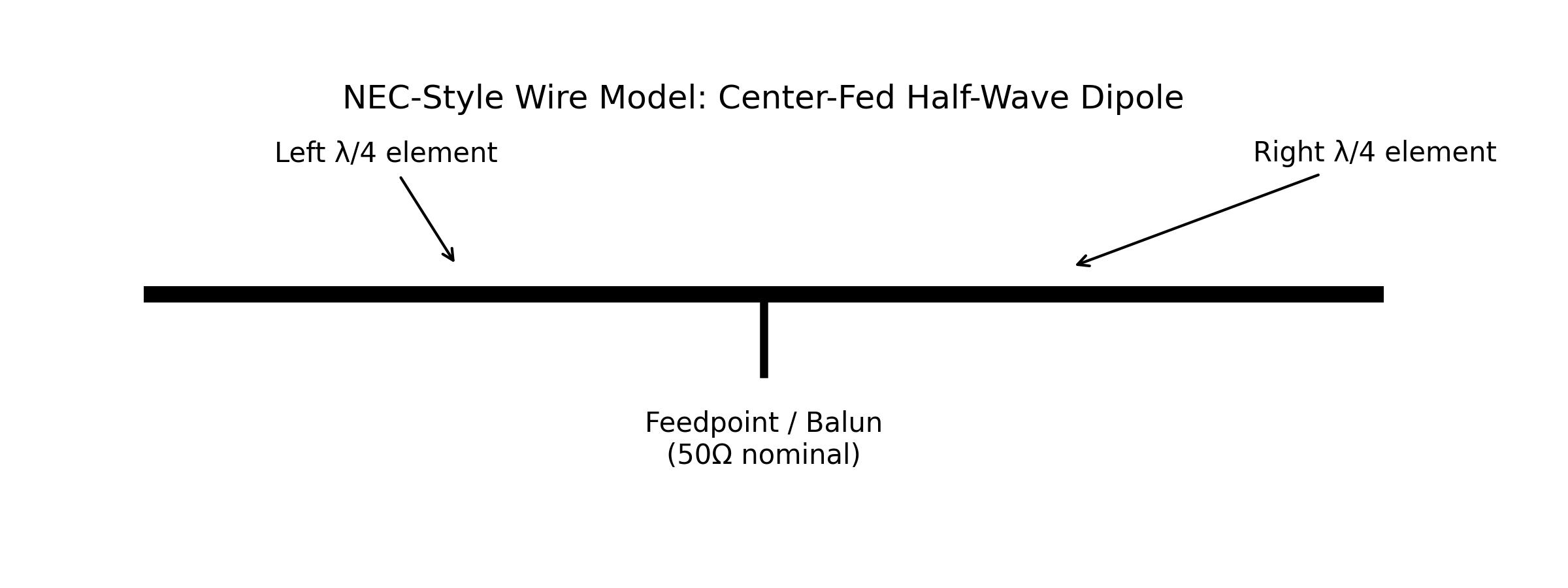
To model a typical dipole, set each leg length to approximately 0.25λ at your target frequency. Therefore, create a two-wire geometry with a center feed, and then define a small feed gap or current source at the center segment.
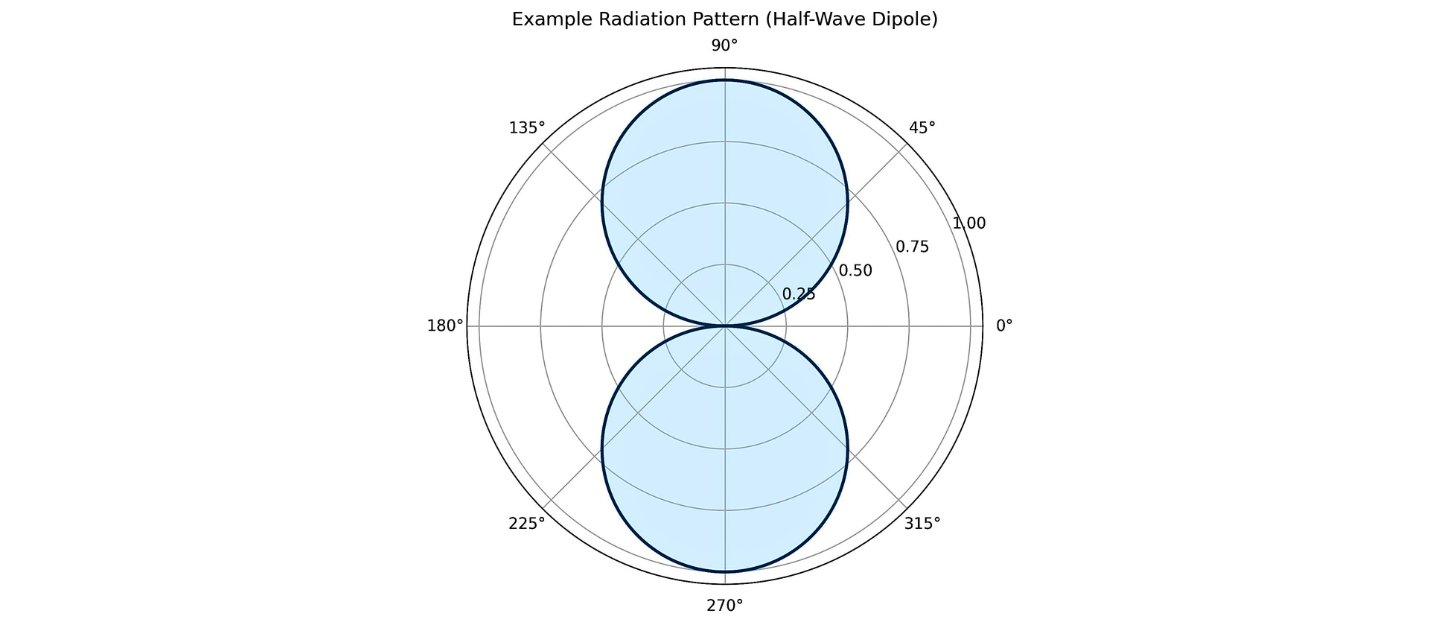
Next, set a fine segmentation and run frequency sweeps to observe resonance shifts due to end effects. Moreover, check the azimuth and elevation radiation patterns to confirm the expected broadside lobes. You can use the provided radiation pattern image as a sanity check when you simulate a similar geometry.
Why Real Antennas Do Not Match Perfect Models
Even with a correct model, real antennas rarely behave exactly like simulations. Environmental factors and construction details introduce differences that are not fully captured in simplified models.
Ground conditions, nearby objects, feedline radiation, and build tolerances all affect performance. For example, a dipole modeled in free space will resonate differently when installed over real ground due to image currents and loss.
The correct approach is to model first, then measure the antenna in the real world and adjust parameters until both align. This process produces highly accurate final designs.
Ground Modeling: Why It Matters
Ground dramatically changes antenna performance on lower HF bands. Therefore, EZNEC offers multiple ground models: free-space, perfect ground, and real ground with conductivity and dielectric. If you model coastal or marshy sites, set higher conductivity to reflect salt-water conditions; consequently, your modeled feedpoint resistance and gain will increase relative to poor soil. Meanwhile, always compare free-space runs to real-ground runs to isolate ground effects.
Ground Conductivity and Its Impact on Performance
Ground conditions significantly affect antenna efficiency and radiation angle, especially on lower HF bands. High-conductivity environments such as saltwater locations improve gain and reduce ground loss.
Poor soil conditions, such as dry or rocky ground, increase losses and raise the radiation angle, reducing long-distance performance. These effects are often underestimated but can dramatically change real-world results.
For accurate modeling, set ground conductivity and dielectric values to match your installation site. Comparing free-space and real-ground simulations helps isolate how much performance is affected by ground interaction.
Segmentation, Convergence, and Numerical Stability
Segmentation controls accuracy. Therefore, excessive segmentation increases matrix size and computation time without meaningful accuracy gains beyond convergence. Conversely, too few segments produce spiky current distributions and inaccurate gain.
As a rule of thumb, use at least 10 segments per wavelength for basic models, and increase to 20–30 per wavelength for precision work near feedpoints or in regions of rapid current change. Moreover, watch matrix condition numbers and rerun with varying segmentation to confirm result stability.
Advanced Modeling: Arrays, Mutual Coupling, and Interaction
EZNEC simulates arrays with element spacing, phasing, and mutual coupling. Consequently, you can design Yagis, phased arrays, and stacked elements while observing pattern steering, impedance shifts, and coupling loss. Use parameter sweeps to explore spacing vs gain tradeoffs, and then optimize for front-to-back ratio or side-lobe suppression. In addition, include support structures and nearby objects as approximate wires to evaluate scattering and pattern distortion.
Loading and Matching Networks
When you add coils, traps, or loading, model them as discrete series or parallel impedances. Therefore, you can predict resonant shifts and loss introduced by real components. For complex matching networks, extract impedance at the feedpoint and then design an appropriate transformer or L-network. Meanwhile, remember that modeled component loss directly degrades predicted efficiency, so use conservative loss figures for coils and capacitors.
Practical Tips for Real-World Correlation
Always validate simulated results with real-world measurements. Therefore, record actual feedpoint impedance using an antenna analyzer and compare it with modeled values. If the numbers diverge, check ground parameters, segmentation, and element diameter assumptions. Moreover, account for feedline placement and common-mode currents by modeling the feedline or adding a choke and reevaluating. In practice, iterative modeling and measurement converge quickly when you control variables systematically.
Advantages of EZNEC
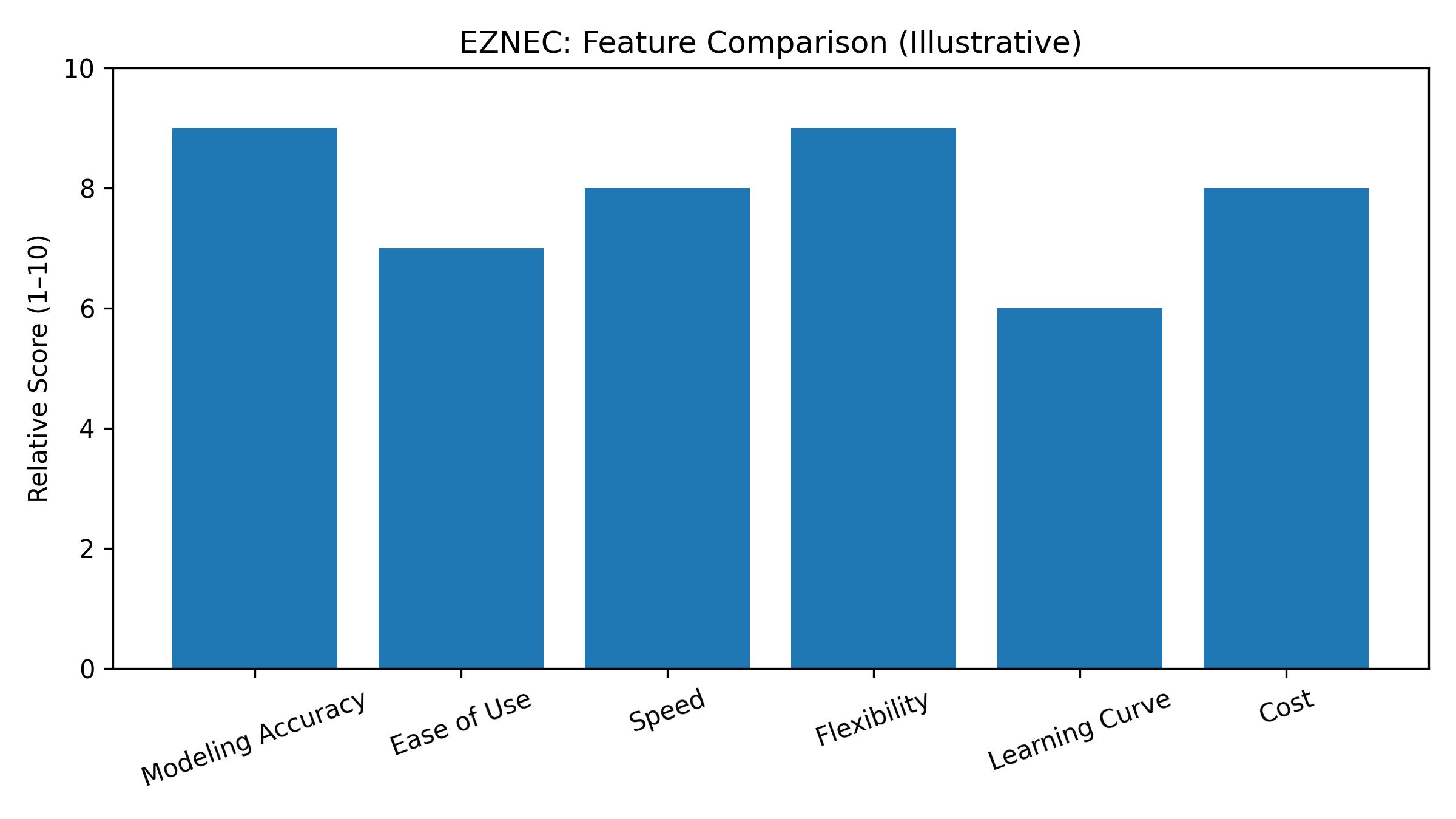
EZNEC excels at providing clear, repeatable predictions for wire antennas. Therefore, designers save time and materials by testing configurations digitally first. Moreover, the software’s NEC foundation produces physics-based results that scale across frequency and geometry. Additionally, built-in visualization tools make pattern analysis intuitive, and consequently you can communicate designs unambiguously to collaborators or reviewers.
Limitations and Things to Watch
EZNEC focuses on thin-wire approximations and therefore it may not model large planar structures, filled dielectrics, or complex 3D metallic objects with full fidelity. As a result, for very thick conductors or detailed mechanical structures you should complement NEC models with full-wave 3D solvers. In addition, remember that component and connector losses, mounting hardware, and feedline radiation can alter real-world results; therefore, incorporate conservative loss estimates in simulations.
Typical Workflows and Best Practices
A robust workflow looks like this. First, sketch a baseline antenna and model it in EZNEC with conservative ground and loss assumptions. Next, perform frequency sweeps and parameter sensitivity checks for element length, height, and feedpoint impedance. Then, design matching networks and rerun the model including component losses. Finally, build a scale prototype or full-size antenna, measure with an analyzer, and iterate until modeled and measured results match within acceptable tolerances.
Using EZNEC with Optimization Tools
Advanced users link EZNEC output to external optimizers or scripts that vary geometry and search for maxima in gain, F/B ratio, or impedance match. Therefore, automated optimization finds surprising, efficient configurations that manual iteration might miss. When you automate, constrain design variables to physically realizable ranges to avoid non-buildable solutions.
Common EZNEC Modeling Mistakes
Several common mistakes lead to inaccurate simulations and confusion. Using too few segments per wavelength is one of the most frequent issues, along with placing the feedpoint incorrectly or ignoring ground effects entirely.
Other errors include unrealistic wire diameters, failing to sweep frequency for resonance, and assuming simulation results automatically match real-world performance.
Correcting these issues significantly improves both modeling accuracy and actual antenna performance.
Practical Tips for Reliable Results
Consistent modeling practices are essential for accurate results. Always verify convergence by increasing segmentation and comparing outputs. Use realistic ground parameters and include loss where possible.
When modeling arrays, pay close attention to spacing and coupling, as small changes can produce large performance differences. Most importantly, validate models with real-world measurements whenever possible.
EZNEC Antenna Modeling Software
EZNEC Antenna Modeling Software: remains a cornerstone tool for antenna designers who want physics-based predictions without excessive complexity. Therefore, if you plan to design or optimize an antenna, start with EZNEC to narrow choices, and then validate with measured data. If you like, I can now:
Frequently Asked Questions
What does EZNEC calculate in antenna modeling?
EZNEC calculates feedpoint impedance, SWR across frequency, radiation patterns, gain, and current distribution along antenna elements. These outputs allow accurate prediction of antenna performance before construction.
How accurate is EZNEC compared to real antennas?
When models are built correctly with proper segmentation and ground settings, EZNEC can closely match real-world measurements. Differences usually come from environmental factors and installation variables.
What segmentation settings should I use in EZNEC?
A minimum of 10 segments per wavelength is required, but 20 to 30 segments per wavelength is recommended for accurate modeling, especially near feedpoints and loading components.
How does ground affect EZNEC results?
Ground conditions significantly impact antenna efficiency and radiation angle. High-conductivity ground improves performance, while poor soil increases loss and raises takeoff angle.
Can EZNEC model antenna arrays and Yagis?
Yes, EZNEC can simulate arrays, including Yagi antennas, and accurately model mutual coupling, spacing effects, and directional gain.
What are common mistakes when using EZNEC?
Common mistakes include poor segmentation, incorrect feedpoint placement, ignoring ground effects, and assuming simulations perfectly match real-world results without validation.
About the Author
Vince, W2KU, is a licensed Extra class amateur radio operator and the founder of Ham Shack Reviews. He was named Amateur of the Year in 2026 for contributions to practical amateur radio education and equipment evaluation.
He knows propagation very well, operates mAobile and handhelds daily. Vince exchanges QSL cards for DXCC, contest confirmation, and award tracking and is the club QSL manager. His guidance focuses on practical operating procedures, accurate logging, and real-world amateur radio practices.
Please consider Donating to help support this channel