
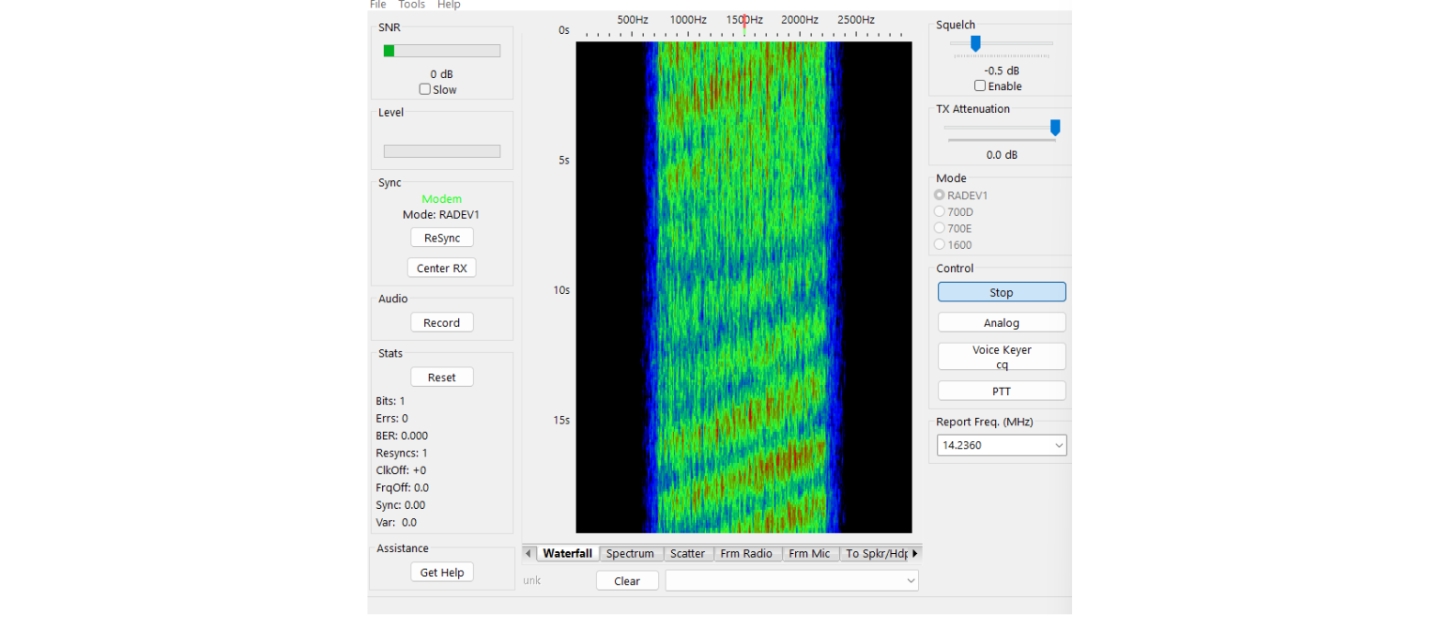
FreeDV is an open-source digital voice mode designed specifically for HF amateur radio communication. Instead of transmitting analog voice waveforms like traditional Single Sideband, FreeDV converts speech into compressed digital data and sends that data through a spectrally efficient modem. As a result, operators can often maintain intelligible communication at signal levels where analog SSB becomes noisy, distorted, or unreadable.
Unlike proprietary digital voice systems, FreeDV uses Codec2, a fully open speech compression algorithm developed for extremely low bitrate operation. Because Codec2 remains open source, the amateur radio community can study, modify, and improve it. Therefore, FreeDV aligns directly with the experimental and technical foundation of amateur radio.
Most importantly, FreeDV changes how voice behaves under weak-signal HF conditions. Analog SSB gradually degrades into noise as signal strength drops. In contrast, FreeDV produces clean, noise-free recovered audio until it reaches a decoding threshold. Once the signal falls below that threshold, intelligibility drops quickly. This digital threshold effect defines FreeDV operation.
FreeDV is not simply digital SSB. Instead, it represents a fundamentally different communication model based on compression, forward error correction, and modern multi-carrier modulation.
How FreeDV Works from Microphone to Antenna
FreeDV begins by capturing audio from your microphone through a computer interface. The software analyzes the speech signal and compresses it using Codec2. Depending on the selected mode, the encoded bitrate typically ranges from approximately 700 bits per second to about 2400 bits per second.
For comparison, uncompressed voice audio can exceed 64,000 bits per second. Therefore, Codec2 achieves extremely high compression efficiency while preserving intelligibility.
After compression, FreeDV applies forward error correction. This step adds structured redundancy so that the receiving station can reconstruct speech even if noise or fading corrupts parts of the signal. Because HF propagation introduces selective fading and impulsive noise, this protection significantly improves reliability.
Next, the protected digital bitstream feeds into the modem stage. Most modern FreeDV modes use Orthogonal Frequency Division Multiplexing. OFDM divides the signal into multiple carriers that share the same channel bandwidth. Since each carrier transmits a portion of the data stream, the system becomes more resilient to frequency-selective fading.
Interleaving spreads data across time so short bursts of interference do not destroy entire speech frames. On the receiving end, the demodulator extracts the digital data, corrects errors, and reconstructs speech through the Codec2 decoder.
When signal-to-noise ratio remains above the decoding threshold, the recovered audio sounds stable and quiet.
Digital Communications Engineering: SNR, Eb/N0, and Error Protection
Digital voice reliability depends on signal-to-noise ratio at the receiver, but deeper performance depends on energy-per-bit to noise density ratio, expressed as Eb/N0. Lower bitrate modes concentrate more energy into each transmitted bit, effectively improving decoding margin without increasing transmit power.
Forward error correction introduces redundancy that allows the receiver to repair damaged data. However, stronger error protection reduces net information rate and increases latency. Therefore, robust weak-signal modes trade voice naturalness for reliability.
OFDM carrier spacing and symbol timing determine resistance to multipath fading. Narrow carrier spacing improves frequency selectivity but increases sensitivity to frequency drift. Accurate frequency stability improves decode consistency.
These relationships explain why proper mode selection and transmitter stability directly influence communication success.
Measurable Technical Performance Characteristics
Voice Bitrate
Approximately 700 to 2400 bits per second depending on mode.
Occupied Bandwidth
Typically between 1.1 and 1.6 kHz.
Decoding Threshold
Weak-signal modes can decode near 0 dB SNR in narrow bandwidth measurement. Higher fidelity modes require stronger signals.
Latency
Typically ranges from 300 milliseconds to about 1 second depending on buffering and interleaver depth.
Forward Error Correction Overhead
A substantial portion of transmitted data protects speech frames from errors.
Peak-to-Average Power Ratio
Multi-carrier modulation produces high peak levels that require linear amplification.
These metrics define FreeDV as a narrowband, weak-signal optimized digital voice system.
FreeDV Operating Modes Compared
700D prioritizes weak-signal reliability using strong error correction and very low bitrate.
1600 balances audio clarity and robustness for general HF communication.
2020 provides improved voice fidelity but requires stronger signals and stable propagation.
Lower bitrate increases decode margin. Higher bitrate improves sound quality.
Mode Selection Decision Guide
Use:
700D when signals are weak or marginal.
1600 when signals are moderate and stable.
2020 when signals are strong and fading is minimal.
Switch to more robust modes if QSB increases.
Mode selection directly determines communication reliability.
FreeDV Compared to Analog SSB
FreeDV uses digital modulation with error correction. SSB uses analog amplitude modulation. It occupies narrower bandwidth. SSB occupies wider bandwidth. FreeDV produces noise-free audio until threshold. SSB gradually degrades.
It requires computer integration. SSB requires only a radio. FreeDV drops out abruptly when signal fails. SSB fades gradually. Each system performs best under different propagation conditions.
Step-by-Step FreeDV Station Setup
Install FreeDV software on your computer.
Connect your HF transceiver using USB or sound card interface.
Set the transceiver to USB mode.
Disable speech compression and audio processing.
Adjust transmit audio so ALC does not engage.
Adjust receive audio for stable decoding.
Select appropriate FreeDV mode.
Coordinate contact using analog voice before switching to digital.
Correct audio level adjustment is the single most important setup factor.
Transmitter Linearity and Spectral Purity
Digital signals require clean linear amplification. Overdriving transmitters produces intermodulation distortion that spreads energy and corrupts digital constellations.
Experienced operators maintain amplifier headroom and avoid compression. Clean signals decode more reliably than high-power distorted signals.
Spectral purity determines digital performance.
Audio Sampling and Sound Card Calibration
Digital voice quality depends on accurate audio sampling and level control. Consistent sampling rates prevent timing distortion. Proper microphone gain prevents clipping artifacts that error correction cannot repair.
Controlled, consistent speech improves codec modeling and intelligibility.
Digital Voice Timing and Conversational Operation
Processing delay introduces latency. Operators must pause slightly longer between transmissions to prevent overlap and ensure complete message reception.
Proper timing becomes part of effective digital voice operation.
Amplifier Headroom and Peak Power Behavior
OFDM produces high instantaneous peaks. Amplifiers must operate below compression limits. Reduced power with high linearity improves decoding more than maximum output with distortion.
Antenna System Influence on Decode Stability
Antenna efficiency improves signal strength, but radiation pattern stability also affects decoding. Multipath phase rotation can disrupt carriers. Stable antenna performance improves demodulator tracking.
System performance depends on the entire RF path.
Calling Frequencies for FreeDV Activity
14.236 MHz on 20 meters
7.190 MHz on 40 meters
3.625 MHz on 80 meters
21.313 MHz on 15 meters
Operators typically coordinate in analog voice before digital operation.
Real-World Weak-Signal Operating Example
Under marginal propagation, stations more than 1,000 miles apart may find SSB unreadable. Switching to FreeDV 700D often produces intelligible speech. However, rapid fading may still cause brief dropouts due to threshold decoding behavior.
Propagation Behavior and Range Expectations
FreeDV follows standard ionospheric propagation. However, error correction allows intelligibility at lower effective SNR than analog SSB readability.
Stable paths produce best performance.
Conditions Where FreeDV May Fail
Rapid deep fading
Frequency instability
Overdriven transmitters
Severe multipath distortion
Incorrect mode selection
Understanding limitations improves results.
FreeDV Compared to Weak-Signal Data Modes
Structured digital modes exchange data rather than voice. FreeDV provides conversational speech while maintaining digital efficiency. It bridges analog voice and automated digital messaging.
Adoption and Real-World Usage Trends
FreeDV adoption grows steadily but remains less common than analog voice due to configuration complexity and coordinated operation requirements. Activity clusters around known frequencies and scheduled contacts.
Digital voice remains an active area of amateur experimentation.
Future Evolution of Digital HF Voice
Advances in speech modeling, adaptive error correction, and signal processing will continue improving intelligibility and efficiency. Open-source development ensures continued innovation.
Who Benefits Most from FreeDV
Weak-signal DX operators
Experimenters
QRP operators
Digital mode enthusiasts
Who May Prefer Analog SSB
Casual operators
Stations without computer integration
Rapidly changing propagation environments
Frequently Asked Questions
What is FreeDV used for?
FreeDV enables digital voice communication on HF bands, especially under weak-signal conditions.
Is FreeDV better than SSB?
FreeDV excels in stable weak-signal conditions. SSB performs better during rapid fading.
How much power is required?
Many operators succeed using less power than required for comfortable SSB readability.
Why does audio drop out?
Dropouts occur when signal-to-noise ratio falls below decoding threshold.
Is FreeDV legal?
Yes, it operates within standard amateur radio voice emission privileges.
FreeDV Engineering Verdict?
FreeDV demonstrates how modern digital signal processing transforms HF voice communication. Compression reduces required data rate. Forward error correction increases resilience. Multi-carrier modulation improves performance in fading environments.
When properly configured, FreeDV enables intelligible voice communication at signal conditions that challenge analog SSB readability. However, it requires disciplined setup, linear transmission, and technical understanding.
FreeDV does not replace SSB. It expands what HF voice communication can achieve.
This is the complete operational, engineering, and practical reality of FreeDV digital voice on HF.