
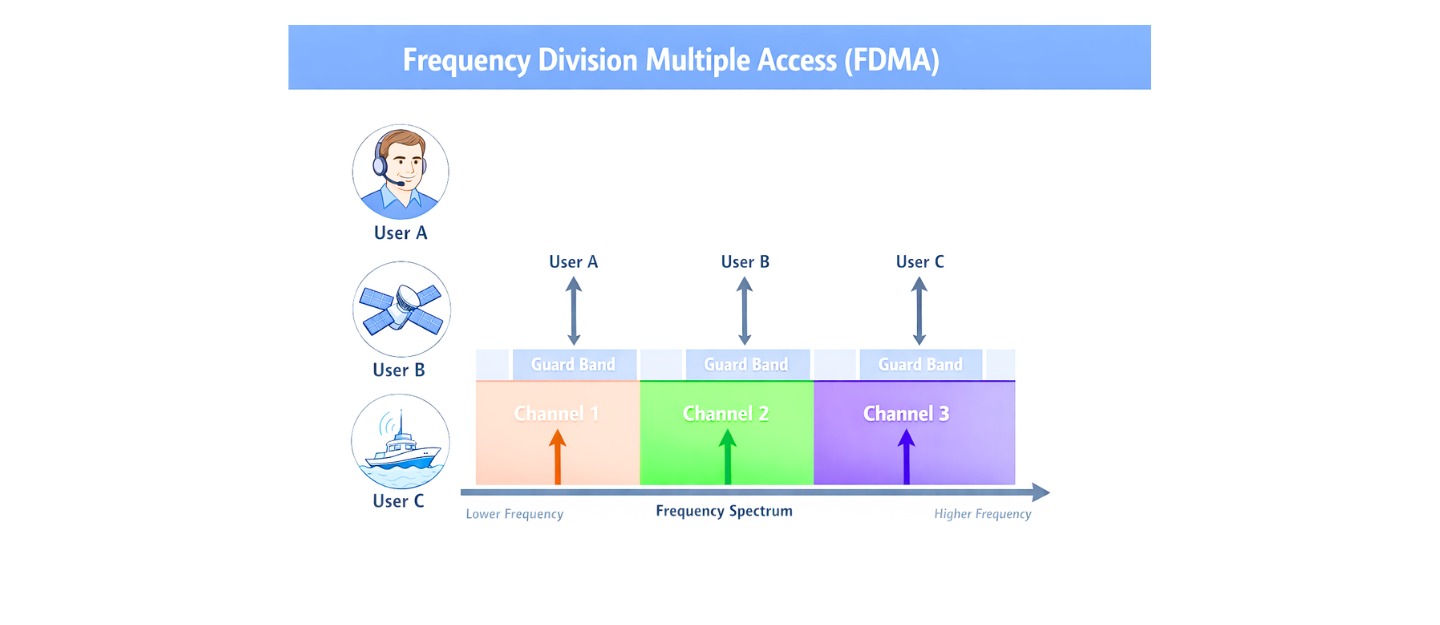
Frequency Division Multiple Access (FDMA) is one of the most fundamental techniques used in communication systems to allow multiple users to share the same transmission medium at the same time. By dividing available bandwidth into separate frequency channels, FDMA enables simultaneous communication without signal overlap or interference.
Although newer access methods dominate modern cellular networks, FDMA remains an essential concept in radio engineering and continues to play a major role in satellite communication, marine radio, and specialized wireless systems.
New to the hobby? Start with our Complete Guide to Ham Radio Fundamentals
FDMA Definition in One Sentence
Frequency Division Multiple Access (FDMA) is a communication method that divides available radio spectrum into separate frequency channels so multiple users can transmit simultaneously without interference, with each user assigned a dedicated frequency for the duration of their transmission.
What Is Frequency Division Multiple Access (FDMA)
Frequency Division Multiple Access is a channel access method that divides a communication spectrum into individual frequency bands. Each user is assigned a dedicated frequency channel for the entire duration of their transmission.
Because each user operates on a separate frequency, multiple transmissions can occur simultaneously without interfering with one another. This fixed frequency allocation makes FDMA simple, stable, and predictable.
Unlike time-sharing systems, FDMA does not require users to take turns transmitting. Each user maintains continuous access to their assigned channel until communication ends.
How FDMA Works
FDMA operates by splitting a large frequency band into smaller sub-channels. Each channel is assigned to a specific user or communication link.
To prevent signals from overlapping, small unused frequency gaps called guard bands separate adjacent channels. These guard bands act as buffers that reduce interference between transmissions.
Once a user receives a channel assignment, that frequency remains dedicated for the entire session. No switching or scheduling is required, which simplifies system design and reduces transmission delays.
This continuous allocation makes FDMA especially suitable for voice communication and steady data streams that require consistent bandwidth.
Real World Example of FDMA
A simple example of FDMA can be seen in marine VHF radio communication. Each vessel transmits on an assigned channel frequency. When one ship communicates on Channel 16, another ship must use a different channel to transmit at the same time. Because each communication occurs on a separate frequency, both conversations can happen simultaneously without interfering with each other.
Early analog cellular networks operated the same way. Each phone call occupied a dedicated frequency channel for the entire duration of the call.
Channel Allocation in FDMA Systems
In FDMA networks, a central controller or base station assigns frequency channels to users. Each channel includes both the required signal bandwidth and a guard band to protect adjacent channels.
For example, if a transmission requires 25 kHz of bandwidth and a 5 kHz guard band is needed, each channel consumes 30 kHz of spectrum. The number of users a system can support depends directly on total available bandwidth.
Early analog cellular systems relied heavily on FDMA, with each voice call occupying a dedicated narrowband channel. Today, FDMA is still widely used in satellite communication and certain specialized radio services where predictable bandwidth is critical.
isualizing Frequency Channel Separation
Imagine the total available spectrum as a highway divided into separate lanes. Each lane represents a frequency channel assigned to a specific user. Small gaps between lanes act as guard bands, preventing signals from overlapping. As long as each user stays within their assigned lane, traffic flows smoothly without collisions.
This structure allows many transmissions to occur simultaneously while maintaining signal clarity.
Advantages of FDMA
FDMA provides several operational benefits that explain its long-standing use in communication systems.
Continuous transmission is one of its primary strengths. Because users retain exclusive access to their assigned frequency, there is no need for timing coordination or transmission scheduling.
System design is relatively simple compared to more complex access methods. FDMA does not require tight synchronization or advanced signal processing to separate users.
Performance is also highly predictable. Each user operates independently on a fixed channel, which helps maintain consistent voice quality and stable data throughput.
Disadvantages of FDMA
Despite its advantages, FDMA has limitations that reduce its efficiency in modern communication environments.
Guard bands consume valuable spectrum, reducing total channel capacity. Because each channel remains reserved even when inactive, unused bandwidth cannot be reassigned dynamically.
FDMA also lacks flexibility. Users cannot easily share unused capacity, which leads to inefficient spectrum utilization during periods of low activity.
Compared to modern access techniques, FDMA supports fewer simultaneous users within the same bandwidth.
FDMA vs TDMA vs CDMA
Time Division Multiple Access allows multiple users to share the same frequency by transmitting in different time slots. This improves spectral efficiency because no guard bands are required between channels.
Code Division Multiple Access allows all users to transmit simultaneously across the same frequency band using unique digital codes to separate signals.
FDMA differs by dedicating a fixed frequency channel to each user. While this reduces flexibility, it eliminates the need for time synchronization or complex signal separation.
FDMA therefore offers simplicity and low latency, while TDMA and CDMA provide higher capacity and better spectrum utilization.
Comparison of FDMA, TDMA, and CDMA
Access Method | Resource Shared | Separation Method | Efficiency | Complexity
FDMA | Frequency | Different frequency channels | Moderate | Low
TDMA | Time | Time slots on same frequency | High | Moderate
CDMA | Code | Unique digital codes | Very High | High
FDMA separates users by frequency, TDMA separates users by time, and CDMA separates users by coded signals. Each method balances efficiency, complexity, and performance differently depending on system requirements.
Practical Applications of FDMA
FDMA remains widely used in systems where stable, continuous communication is essential.
Satellite communication frequently relies on FDMA to maintain consistent channel quality over long distances. Dedicated frequency allocation simplifies receiver design and ensures predictable performance.
Marine radio communication uses FDMA for reliable ship-to-ship and ship-to-shore transmissions. The fixed channel structure supports dependable voice communication in critical environments.
Some trunked radio and broadcast systems also employ FDMA because of its robustness and minimal processing requirements.
Industries That Still Use FDMA
FDMA continues to operate in many modern communication systems, including:
Satellite uplink and downlink communication
Marine VHF radio channels
Aircraft communication bands
Analog broadcast radio systems
Private radio networks
Point-to-point microwave links
These systems rely on FDMA because of its stability, predictable performance, and low processing requirements.
Spectrum Efficiency and Guard Bands
Spectrum efficiency is a key consideration in any multiple access system. FDMA requires guard bands between channels to prevent interference, which reduces usable bandwidth.
Engineers work to minimize guard band size through improved filtering and signal control. However, FDMA cannot achieve the same spectral efficiency as systems that share frequency dynamically.
Even so, FDMA provides consistent throughput. When traffic demand is steady and predictable, dedicated frequency allocation can be more practical than dynamic sharing.
Why FDMA Still Matters Today
Although modern cellular networks rely more heavily on TDMA, CDMA, and OFDMA, FDMA remains important in many specialized communication systems.
Its predictable performance, low latency, and straightforward implementation make it ideal for applications that require stable connections and minimal system complexity.
Understanding FDMA also provides essential background knowledge for studying newer access technologies, many of which evolved from FDMA principles.
Frequently Asked Questions About FDMA
What is FDMA used for?
FDMA is used in satellite communication, marine radio, aviation communication, and early cellular systems to allow multiple users to transmit simultaneously on different frequencies.
Is FDMA analog or digital?
FDMA can be used in both analog and digital communication systems. It refers to how frequency channels are assigned, not the signal type.
Why are guard bands needed in FDMA?
Guard bands prevent adjacent frequency channels from overlapping and interfering with each other.
Is FDMA still used in cellular networks?
Modern cellular systems primarily use more efficient access methods, but FDMA principles are still used within hybrid systems and specialized communication networks.
Key FDMA Takeaways
FDMA assigns each user a dedicated frequency channel
Guard bands prevent signal overlap
Channels remain fixed during communication
FDMA provides continuous transmission
Spectrum efficiency is lower than modern methods
Related Communication Technologies
Time Division Multiple Access (TDMA)
Code Division Multiple Access (CDMA)
Orthogonal Frequency Division Multiple
Summary of Frequency Division Multiple Access
Frequency Division Multiple Access divides a communication spectrum into separate frequency channels, allowing multiple users to transmit simultaneously without interference.
While guard bands reduce efficiency and fixed channel allocation limits flexibility, FDMA provides continuous transmission, predictable performance, and simple system design.
For satellite communication, marine radio, and other specialized wireless systems, FDMA remains a practical and reliable access method. Understanding how FDMA works helps explain the evolution of modern communication technologies and the ongoing need for efficient spectrum management.
Please consider Donating to help support this channel