
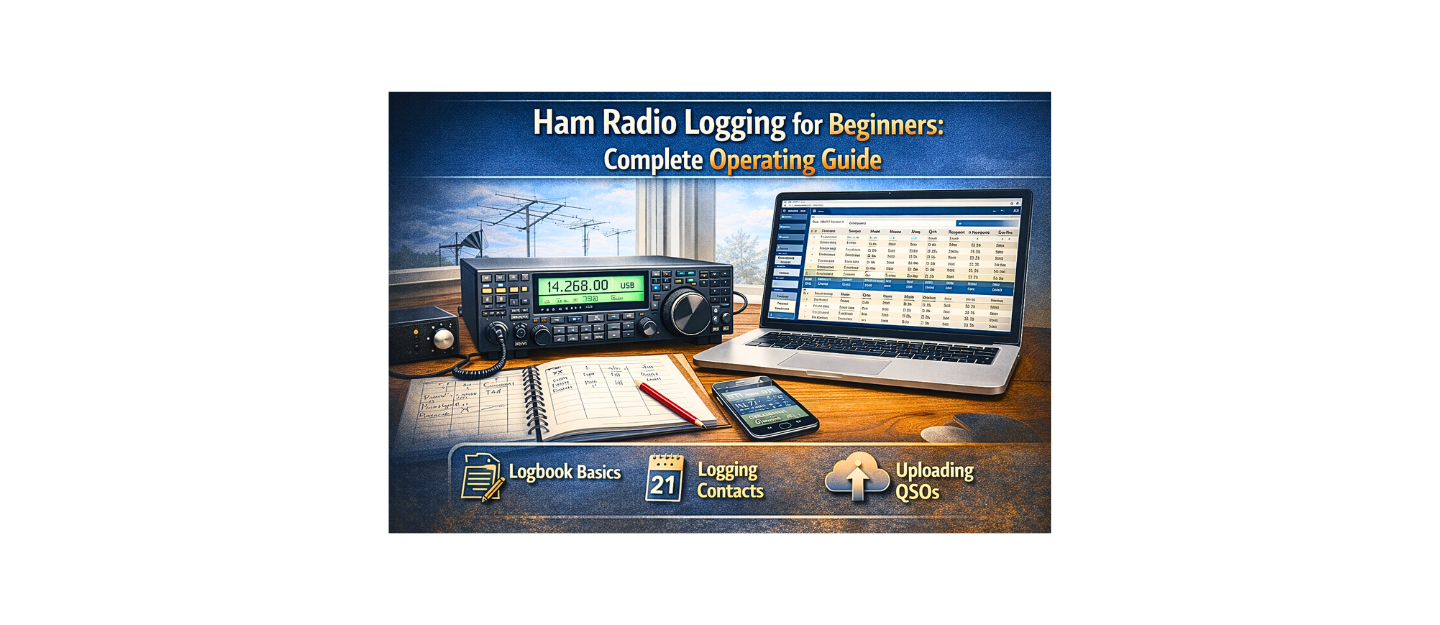
Ham radio logging forms one of the core operating practices in amateur radio. Every contact made on the air represents a communication event that can be recorded, confirmed, analyzed, and sometimes used for awards or contests. For beginners, learning how to log contacts correctly helps build good operating habits while improving station organization.
A logbook records important details about each communication. These details help operators confirm contacts, track operating activity, and analyze radio performance over time. Logging also supports award programs such as DXCC, Worked All States, and contest scoring systems that require accurate contact records.
In earlier decades, amateur radio operators recorded contacts using paper logbooks. Today, modern operators increasingly use digital logging software that automatically records data, integrates with radios, and synchronizes logs with online databases.
Understanding how logging works and what information to record ensures that contacts remain verifiable and useful long after the communication ends.
What Ham Radio Logging Means
Ham radio logging refers to the process of recording information about each contact made on the air. These records document communication events and serve as proof of a completed contact.
Each log entry typically contains several pieces of information:
- Callsign of the contacted station
- Date and time of the contact
- Frequency or band used
- Mode of communication
- Signal report exchanged
- Location or grid square if known
Maintaining an accurate log ensures that contacts can be verified later when submitting award applications or confirming contacts through QSL cards.
Logs also help operators review past activity, identify propagation patterns, and track which regions or countries they have contacted.
Why Logging Matters in Amateur Radio
Although amateur radio regulations in many countries no longer require mandatory logging, most operators still maintain logs for practical reasons.
Logging provides several important benefits:
- Contact verification for awards programs
- Confirmation when exchanging QSL cards
- Contest scoring and validation
- Station performance analysis
- Propagation study and tracking
When pursuing awards such as DXCC or Worked All States, operators must provide detailed records showing when and how each contact occurred.
Without accurate logs, confirming these contacts becomes extremely difficult.
Information Recorded in a Ham Radio Log
Each log entry should contain enough information to uniquely identify a contact. Although different operators record slightly different details, most logs include a standard set of fields.
| Log Field | Purpose |
|---|---|
| Callsign | Identifies the station contacted |
| Date | Records when the contact occurred |
| Time (UTC) | Standardized time reference |
| Frequency or Band | Indicates operating frequency |
| Mode | Shows communication method |
| Signal Report | Indicates signal strength |
| Location/Grid | Provides station location data |
Many operators also include optional information such as:
- operator notes
- antenna used
- transmit power
- propagation observations
Recording these additional details can help diagnose station performance or analyze propagation conditions.
Paper Logbooks vs Digital Logging
New operators often wonder whether they should use a traditional paper logbook or digital logging software.
Both approaches have advantages.
| Logging Method | Advantages | Limitations |
|---|---|---|
| Paper logbook | Simple, reliable, no computer required | Manual data entry, harder to search |
| Digital logging | Automatic features, searchable database | Requires computer or software |
| Hybrid approach | Combines manual and digital methods | Requires duplicate logging |
Most modern amateur radio operators eventually adopt digital logging because software can automate many tasks and integrate with other radio systems.
Digital Logging Software
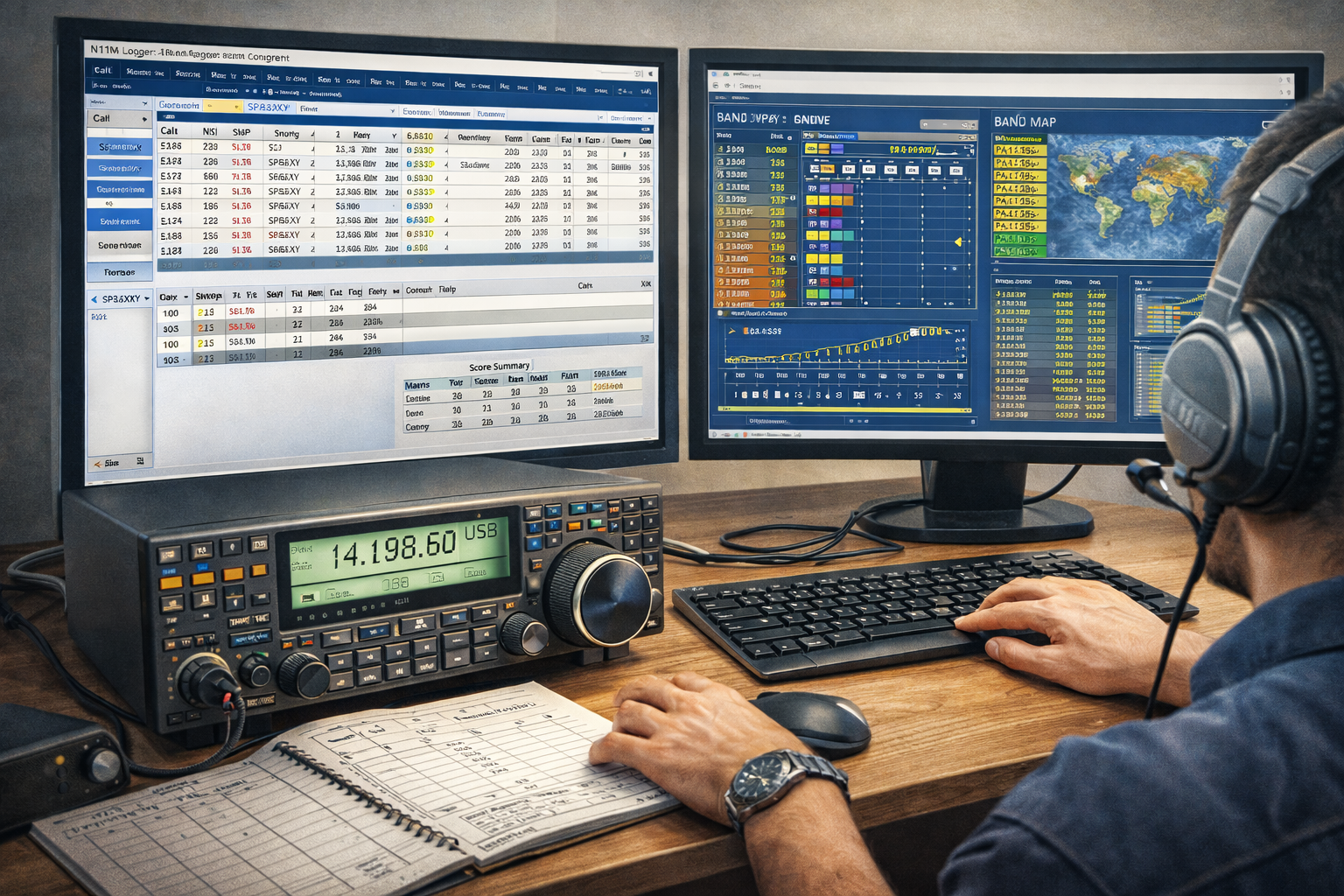
Digital logging software simplifies many aspects of amateur radio operation. These programs automatically record information, manage large contact databases, and integrate with other radio tools.
Common logging programs include:
- N1MM Logger+ for contest operation
- Log4OM for general logging and award tracking
- Ham Radio Deluxe for integrated station control
- DXKeeper for advanced logging management
These programs often include features such as:
- automatic time and date recording
- radio frequency integration via CAT control
- digital mode decoding integration
- award tracking tools
Because logging software can store thousands of contacts, it provides powerful search and analysis tools that paper logbooks cannot easily replicate.
Logging During Different Types of Operation
Logging practices vary depending on the type of amateur radio activity.
Casual operating often requires only basic contact information. Contest operation requires detailed logs because scoring depends on precise records.
Common operating scenarios include:
Casual contacts
Operators typically log callsign, time, band, and signal reports.
DX hunting
Logs may include location information and QSL confirmation status.
Contesting
Logs must record serial numbers, multipliers, and scoring data.
Digital modes
Software may automatically log contacts during communication.
Understanding the logging requirements for each activity helps operators maintain accurate records.
Logging for Amateur Radio Awards
Many amateur radio awards require operators to submit proof of confirmed contacts.
Popular awards include:
- DXCC (contacts with 100 countries)
- Worked All States
- Worked All Continents
- IOTA island contacts
Accurate logging allows operators to track which entities they have worked and which remain. Modern logging software often includes built-in award tracking tools that automatically update progress toward these goals.
Log File Formats and Data Sharing
Digital logs are typically stored in a standardized format called ADIF, which stands for Amateur Data Interchange Format. ADIF allows different logging programs to exchange data easily.
Important characteristics of ADIF include:
- standardized contact fields
- compatibility across logging software
- easy export and backup capability
Because ADIF files are widely supported, operators can migrate their log data between different software programs without losing contact information.
Logging and Online Confirmation Systems
Modern logging practices often involve uploading log data to online confirmation systems.
Two major systems include:
Logbook of the World (LoTW)
Operated by the ARRL, LoTW verifies contacts electronically and supports award applications.
eQSL
Provides digital QSL cards that confirm contacts through an online system. You have to print them if you want, and they will be on paper.
Uploading logs to these systems allows operators to confirm contacts automatically without exchanging physical QSL cards.
QRZ also has a logbook thats confirms with just a couple button pushes.
Best Practices for Accurate Logging
Accurate logs require attention to detail during operation.
Operators should follow several best practices:
- Use UTC time consistently
- Confirm callsigns carefully before logging
- Record frequency and mode accurately
- Back up digital logs regularly
- Verify contacts before submitting awards
Maintaining organized logs prevents errors that could invalidate contest scores or award submissions.
Common Logging Mistakes
Beginners sometimes make mistakes when first learning to log contacts.
Common errors include:
- logging incorrect callsigns
- forgetting to record UTC time
- using inconsistent band designations
- failing to back up digital logs
Fortunately, most logging software includes validation tools that help detect these mistakes before logs are submitted.
How Logging Improves Operating Skill
Beyond recordkeeping, logging can actually improve operating ability.
Reviewing logs over time allows operators to observe patterns such as:
- which bands perform best during certain times
- how antenna changes affect signal reports
- which regions appear most frequently in propagation openings
By analyzing logged contacts, operators gain deeper insight into radio performance and propagation behavior.
Logging During Digital Mode Operation
Digital modes often integrate directly with logging software.
Programs such as WSJT-X and FLDigi can automatically send contact information to a logging application once a QSO completes.
This integration provides several advantages:
- automatic logging reduces typing errors
- time synchronization improves accuracy
- frequency data records automatically
For operators who frequently use digital modes like FT8, automated logging greatly simplifies recordkeeping.
Data Backup and Log Security
Because digital logs represent years of contacts, protecting log data is extremely important. Operators should create backups regularly.
Recommended backup strategies include:
- saving copies on external drives
- cloud storage synchronization
- periodic ADIF exports
Maintaining multiple backups prevents accidental data loss due to hardware failure.
Ham Radio Logging for Beginners
Ham radio logging remains an essential practice for amateur radio operators. Although logging methods have evolved from handwritten notebooks to advanced digital databases, the core purpose remains the same: documenting communication events accurately.
For beginners, learning how to maintain a reliable logbook builds strong operating habits and supports future activities such as award chasing, contesting, and propagation study.
By recording contacts carefully and using modern logging tools, operators create a permanent record of their radio experience while improving their understanding of how amateur radio communication works.
Frequently Asked Questions
What information should be recorded in a ham radio log
A ham radio log typically records callsign, date, UTC time, frequency or band, mode, and signal reports exchanged during the contact.
Do amateur radio operators have to keep logs
In many countries logging is not legally required, but most operators keep logs for contesting, awards, and contact verification.
What is ADIF in ham radio logging
ADIF is a standardized file format used to store and exchange amateur radio log data between different logging programs.
Can logging software connect directly to a radio
Yes. Many logging programs use CAT control to read frequency and mode information directly from the transceiver.
Why is UTC time used in ham radio logs
UTC provides a universal time standard that allows operators around the world to record contacts consistently regardless of local time zones.
What is the best logging method for beginners
Beginners often start with simple digital logging software because it automatically records information and simplifies contact management.
About the Author
Vince, W2KU, is a licensed Extra class amateur radio operator and the founder of Ham Shack Reviews. He was named Amateur of the Year in 2026 for contributions to practical amateur radio education and equipment evaluation.
He knows propagation very well, operates mobile and handhelds daily. Vince exchanges QSL cards for DXCC, contest confirmation, and award tracking and is the club QSL manager. His guidance focuses on practical operating procedures, accurate logging, and real-world amateur radio practices.
Please consider Donating to help support this channel