
Introduction to Ham Radio Antennas
Introduction to Ham Radio Antennas show the most important part of any radio station because they determine how efficiently your signal leaves the transmitter and how clearly incoming signals are received. While many operators focus heavily on radios, power levels, or accessories, the antenna system ultimately controls real-world performance. Therefore, understanding how antennas work and how to choose the right one can dramatically improve communication range, signal clarity, and operating success.
An antenna converts electrical energy into electromagnetic radiation and vice versa. In simple terms, it launches your signal into the air and captures signals arriving from distant stations. However, antenna performance depends on multiple physical and electrical factors including height, orientation, length, surrounding environment, and frequency. Consequently, even a modest radio connected to an efficient antenna often outperforms a high-power radio connected to a poor one.
Furthermore, antennas behave differently across frequency bands. Because wavelength determines physical antenna dimensions, each band requires specific design considerations. As a result, operators must match antenna design to operating goals, available space, and desired communication distance.
How Ham Radio Antennas Work
Every antenna operates by creating an oscillating electromagnetic field that propagates outward through space. When alternating current flows through a properly sized conductor, it produces a changing electric and magnetic field. These fields detach from the antenna and travel at the speed of light. Meanwhile, receiving antennas intercept those same fields and convert them back into electrical signals.
However, efficient radiation occurs only when antenna length relates properly to wavelength. Therefore, antennas are commonly built as fractions of a wavelength such as quarter-wave, half-wave, or five-eighths wave. Because resonance allows maximum energy transfer, antennas cut to the correct electrical length radiate more efficiently and require less matching.
Additionally, current distribution along the antenna determines radiation pattern and efficiency. Some designs concentrate radiation outward at low angles for long-distance communication, while others radiate more upward for regional coverage. Consequently, antenna geometry directly shapes communication behavior.
Major Types of Ham Radio Antennas
Dipole Antennas
4
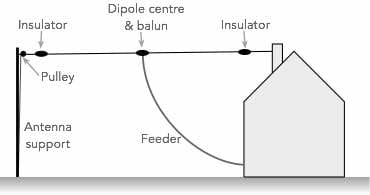
The dipole is one of the most widely used antennas because it combines simplicity, efficiency, and predictable performance. It consists of two equal conductive elements fed at the center. Because current flows symmetrically, the antenna radiates broadside to the wire.
Dipoles are naturally resonant when cut to half wavelength. Therefore, they often require minimal matching when installed properly. In addition, they provide balanced radiation patterns that work well for general communication.
However, dipole performance depends heavily on height above ground. As elevation increases, radiation angle decreases, which improves long-distance communication. Consequently, raising a dipole often produces dramatic performance improvement.
Vertical Antennas
4
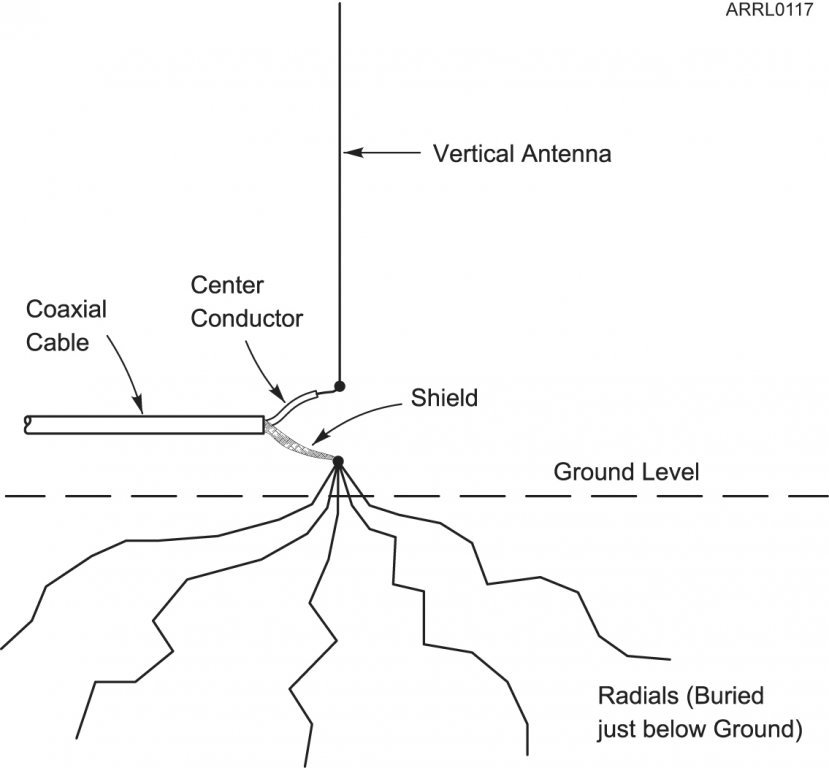
Vertical antennas radiate equally in all horizontal directions, which makes them ideal for omnidirectional coverage. Because they produce low takeoff angles when installed correctly, they are especially effective for long-distance ground wave and DX communication.
Most vertical antennas require a ground system or radial network. These radials form the return path for current and stabilize radiation efficiency. Without adequate ground structure, performance decreases significantly. Therefore, proper radial installation is essential.
Vertical antennas are also popular for limited space installations. Since they require less horizontal area than dipoles, they fit well on rooftops or small properties. Meanwhile, their omnidirectional pattern eliminates the need for mechanical rotation.
Yagi Beam Antennas
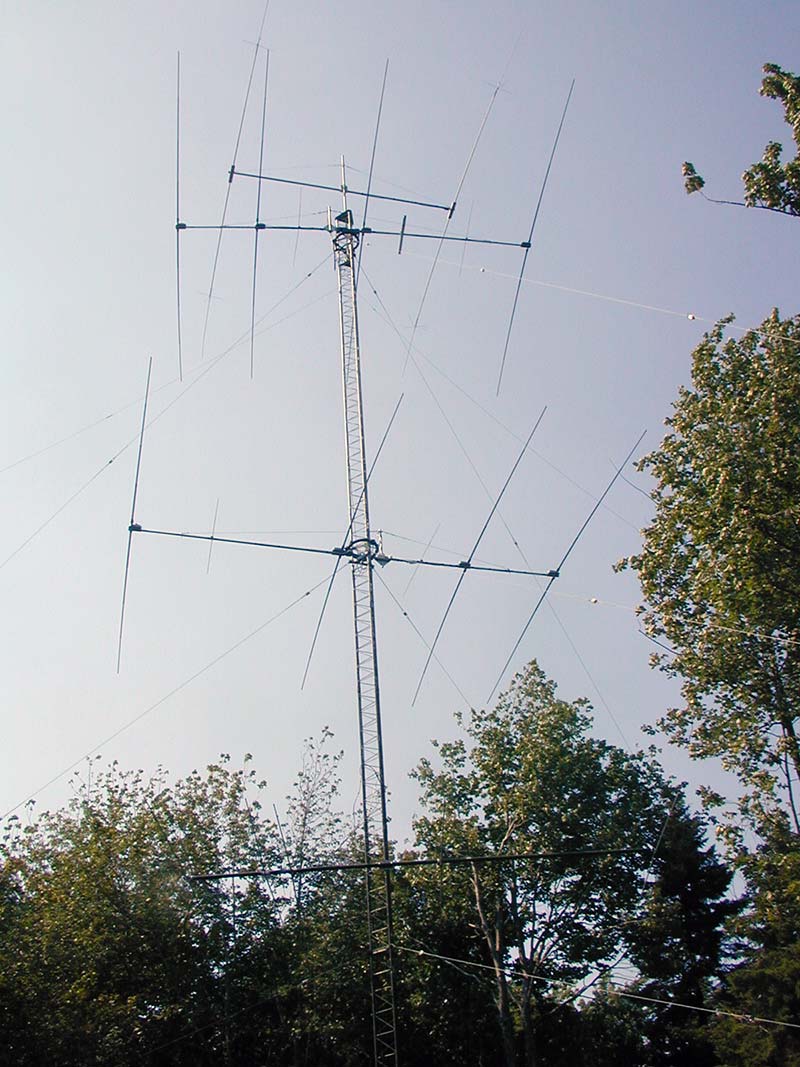
Yagi antennas are directional arrays designed to concentrate energy in one primary direction. They consist of multiple parallel elements including a driven element, reflector, and one or more directors. Because these elements interact electromagnetically, they focus radiation forward and suppress it behind the antenna.
Directional gain allows stronger signals in the desired direction. Consequently, Yagi antennas excel for long-distance communication and weak signal work. Operators can rotate the antenna to aim toward specific stations, which dramatically improves performance.
However, beam antennas require mechanical support structures and rotation systems. Therefore, installation complexity and cost are higher compared to simpler designs.
Loop Antennas

Loop antennas form closed conductive paths that support circulating current. Because of this current flow pattern, loops often exhibit lower noise reception compared to open wire antennas. Consequently, they perform well in electrically noisy environments.
Full-size loops can operate efficiently across multiple bands depending on shape and feed method. Meanwhile, magnetic loops offer compact size for limited space installations, although they require precise tuning.
Loop radiation patterns vary depending on orientation and shape. Therefore, installation geometry influences both gain and directionality.
End-Fed Wire Antennas
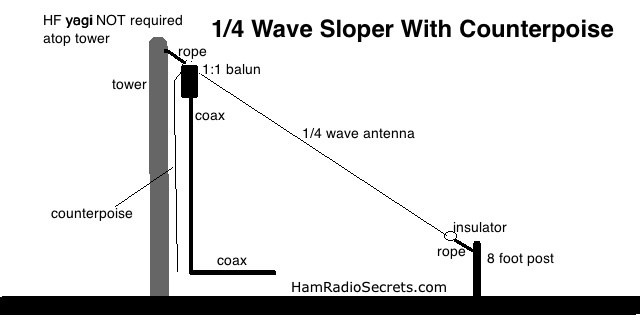
End-fed antennas connect at one end rather than the center. Because they require only one support point, they are extremely convenient for portable operation and limited installations.
However, impedance at the feedpoint is often very high. Therefore, matching networks or transformers are required for efficient operation. When matched properly, end-fed antennas can perform comparably to center-fed designs.
Their ease of deployment makes them especially popular for field operation, emergency setups, and temporary installations.
Antenna Polarization and Orientation
Polarization describes the orientation of the radiated electric field. Horizontal antennas produce horizontally polarized signals, while vertical antennas produce vertical polarization. Matching polarization between transmitting and receiving stations improves signal strength significantly.
In addition, ground reflections and propagation conditions influence effective polarization at long distances. Therefore, some operators choose polarization based on communication type rather than theoretical efficiency.
Orientation also determines radiation direction. For example, a horizontal dipole radiates strongest broadside to the wire, while a vertical radiates equally in all directions.
Antenna Height and Radiation Angle
Height above ground strongly affects radiation angle. Low antennas produce higher elevation angles suitable for regional communication. Meanwhile, higher antennas produce lower takeoff angles that support long-distance propagation.
Therefore, increasing height is one of the most effective ways to improve performance. Even modest elevation increases can produce measurable signal improvement.
Ground conductivity also influences radiation behavior. Poor ground conditions may reduce efficiency, while good conductivity enhances signal strength.
Standing Wave Ratio and Impedance Matching
Standing wave ratio indicates how effectively power transfers from transmitter to antenna. When impedance mismatch occurs, some energy reflects back toward the transmitter. Therefore, maintaining low SWR improves efficiency and protects equipment.
Matching can be achieved through antenna tuning, length adjustment, or matching networks. Because resonance does not always equal perfect match, tuning ensures optimal energy transfer.
Feedlines and Signal Loss
Feedline type and length influence signal delivery. Coaxial cable is widely used because it is shielded and convenient. However, all feedlines introduce loss, especially at higher frequencies.
Therefore, minimizing feedline length and using high-quality cable preserves signal strength. In addition, proper connectors and weatherproofing prevent performance degradation.
Choosing the Right Antenna
Selecting an antenna depends on operating goals, space availability, and frequency band. For example, operators seeking simplicity may prefer dipoles or end-fed wires. Meanwhile, those pursuing long-distance performance may choose verticals or directional beams.
Environmental conditions also influence selection. Urban noise may favor loops, while open terrain may favor verticals or beams.
Common Installation Mistakes
Improper grounding, insufficient height, and poor feedline connections frequently reduce antenna performance. In addition, placing antennas near conductive structures can distort radiation patterns.
Therefore, careful installation planning is essential for optimal results.
Safety Considerations
Antenna installation involves electrical and structural hazards. Adequate clearance from power lines is critical. In addition, proper lightning protection and grounding reduce risk to equipment and structures.
Weather exposure must also be considered. Secure mounting and durable materials ensure long-term reliability.
Final Perspective on Introduction to Ham Radio Antennas
Introduction to Ham Radio Antennas defines the true capability of a ham radio station. While radios generate signals, antennas determine how effectively those signals travel. Therefore, understanding antenna theory, design, and installation transforms operating results dramatically.
Because each antenna type offers distinct advantages, choosing the correct design requires matching equipment to operating goals and environment. As knowledge increases, operators can experiment with different configurations and observe real-world performance changes.
Ultimately, mastering antenna systems unlocks the full potential of amateur radio communication.