
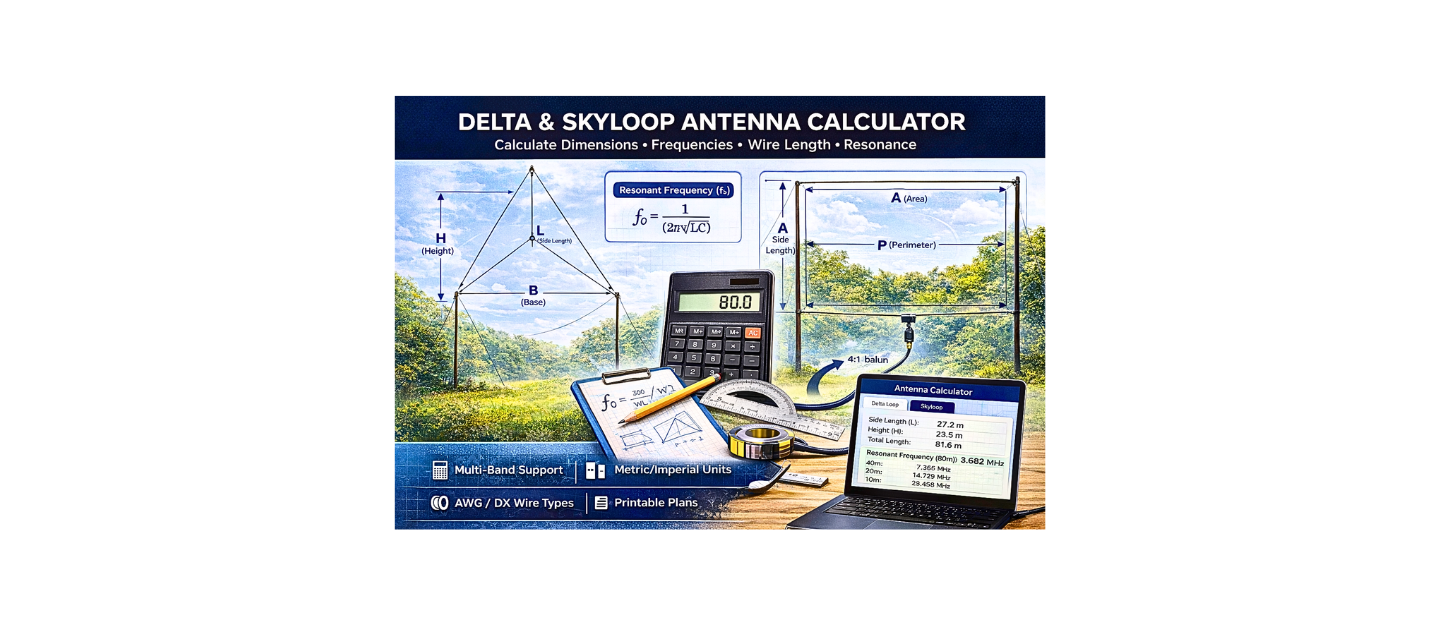
Loop Antenna Calculator
Use this loop antenna calculator to determine the correct full-wave loop length for delta loops, square loops, and skyloop antennas. Enter your operating frequency, wire type, and height above ground to get accurate real-world dimensions you can use when building your antenna.
This tool applies practical correction factors that most basic calculators ignore, including wire insulation effects and low-height resonance shifts. The result is a more accurate starting point, reducing the amount of trimming required during final tuning.
Ham Shack Reviews
Loop Antenna Calculator
Total Loop Length:
Delta Loop (each side):
Skyloop (each side):
Delta Loop vs Skyloop
A delta loop uses a triangular shape and is often mounted vertically or sloped. It can provide both horizontal and vertical polarization depending on feedpoint location and orientation. This makes it a versatile antenna for both local and DX communication.
A skyloop is typically an irregular or square-shaped horizontal loop installed in trees. It is easier to deploy in natural environments and performs well for multi-band operation, especially when used with a tuner.
Both designs use the same total loop length, but their shape and installation height affect radiation patterns and impedance.
Best Bands for Loop Antennas
Now that you have your loop dimensions, the next step is understanding which bands your antenna will perform best on.
Full-wave loop antennas are naturally resonant on their fundamental frequency and also operate efficiently on harmonic frequencies. This means a loop cut for one band can often be used on multiple bands with good performance, especially when paired with a tuner.
A loop designed for 20 meters is one of the most common configurations because it provides excellent multi-band coverage. It will typically perform well on 20 meters as the primary band, while also working effectively on 10 meters and 15 meters due to harmonic resonance. With a tuner, it can often be used on 40 meters as well.
Lower frequency loops, such as those designed for 40 meters or 80 meters, require significantly more space but offer strong regional communication performance. These bands are especially effective at night and are well suited for NVIS propagation when the antenna is installed at lower heights.
Higher frequency bands such as 20 meters, 15 meters, and 10 meters are ideal for long-distance DX communication. When a loop antenna is installed at greater heights above ground, these bands produce lower radiation angles, allowing signals to travel much farther.
The relationship between height and wavelength is critical. A loop installed below approximately 0.2 wavelengths will favor high-angle radiation, making it excellent for local and regional contacts. As height increases beyond 0.25 wavelengths, the radiation angle lowers, improving DX performance.
For most operators, a 20 meter loop provides the best balance between size, performance, and multi-band capability. It offers strong DX potential while still being manageable to install in typical backyard or portable setups.
Understanding Your Results
The calculator provides total loop length along with individual side lengths for both delta and square configurations. These values represent the physical wire length required to achieve resonance near your selected frequency.
Always cut your wire slightly longer than calculated, typically by 2 to 3 percent, and trim it gradually while checking with an antenna analyzer. Environmental factors such as nearby trees, ground conductivity, and feedline configuration will influence the final tuning point.
Typical feedpoint impedance for a full-wave loop is around 100 to 120 ohms, so a 4:1 balun is commonly used for efficient matching.
Practical Build Tips
Building a loop antenna is straightforward, but small details make a big difference in performance. Keep wire tension even, avoid sharp bends at corners, and use strong support points to maintain shape.
Height plays a major role in how the antenna performs. Lower installations favor higher-angle radiation for regional communication, while higher installations improve long-distance DX performance.
Placement also matters. Try to keep the loop away from large metal objects and power lines, and use quality feedline to minimize losses.
Multi-Band Operation
Full-wave loop antennas naturally resonate on harmonic frequencies, allowing operation on multiple bands without changing the antenna length. For example, a loop cut for 20 meters will also operate on 10 meters and 40 meters with proper matching.
This makes loop antennas an excellent choice for operators who want a simple, efficient multi-band solution without complex switching systems.
Final Thoughts
Loop antennas are one of the most efficient and versatile designs available to amateur radio operators. With proper sizing and installation, they offer strong performance across multiple bands and operating conditions.
Using an accurate calculator like this gives you a reliable starting point, reducing guesswork and helping you get on the air faster with a well-performing antenna.
Please consider Donating to help support this channel