
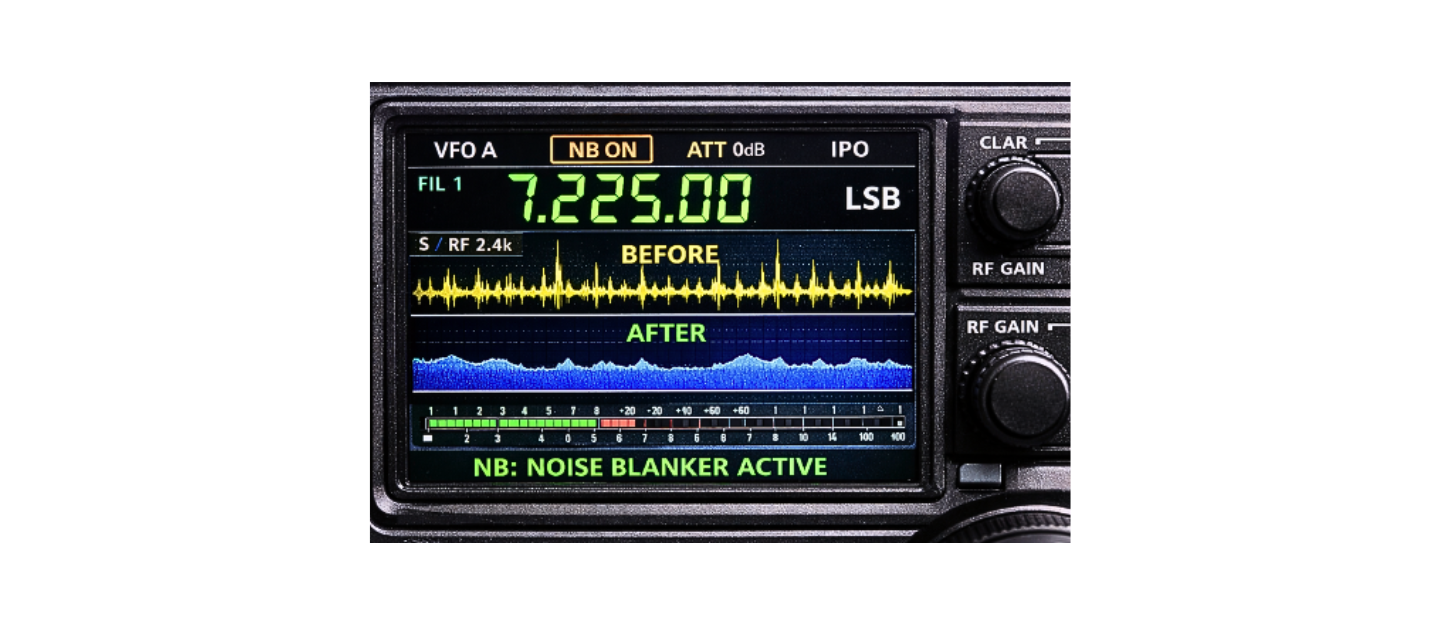
Understanding how to control receiver noise blanker is essential for effective amateur radio operation. Electrical interference, ignition systems, switching power supplies, and nearby electronic devices can produce pulse-type noise that interferes with signal reception. These noise sources often create sharp bursts of interference that can overwhelm weak signals and make communication difficult.
One of the most effective tools for dealing with this type of interference is the noise blanker. Most modern amateur radio transceivers include a noise blanker circuit specifically designed to suppress short-duration electrical pulses before they reach the audio stages of the receiver. When configured correctly, a noise blanker can significantly improve signal clarity and reduce listener fatigue.
Unlike general noise reduction systems that target continuous background noise, the noise blanker focuses specifically on impulse noise. Understanding how this filter works and how to adjust it properly allows operators to improve reception under challenging operating conditions.
If you want a deeper explanation of receiver controls such as RF gain, AGC, squelch, and bandwidth filters, see the Complete Guide to Receiver Controls, where each control is explained in detail with practical tuning examples.
What Is a Noise Blanker in Amateur Radio
A noise blanker is a specialized receiver circuit designed to suppress short bursts of impulse noise that appear in radio signals. These bursts typically originate from electrical systems such as vehicle ignition systems, power lines, electric fences, and industrial equipment.
Impulse noise differs from atmospheric noise or broadband static because it occurs as extremely short, high-energy pulses. These pulses can momentarily overpower the receiver and produce loud popping or crackling sounds in the audio output.
It works by identifying these sudden spikes in signal amplitude and temporarily muting or removing them before they reach the audio stages of the receiver. Because impulse noise pulses are usually very short in duration, blanking the signal for a fraction of a millisecond can eliminate the interference without noticeably affecting the desired signal.
This technique allows the receiver to maintain signal clarity while suppressing repetitive electrical noise.
How NB Circuits Work
Their circuits typically operate within the intermediate frequency (IF) stage of the receiver. This location allows the circuit to detect large amplitude spikes before they propagate through the rest of the signal processing chain.
The basic operation involves three stages:
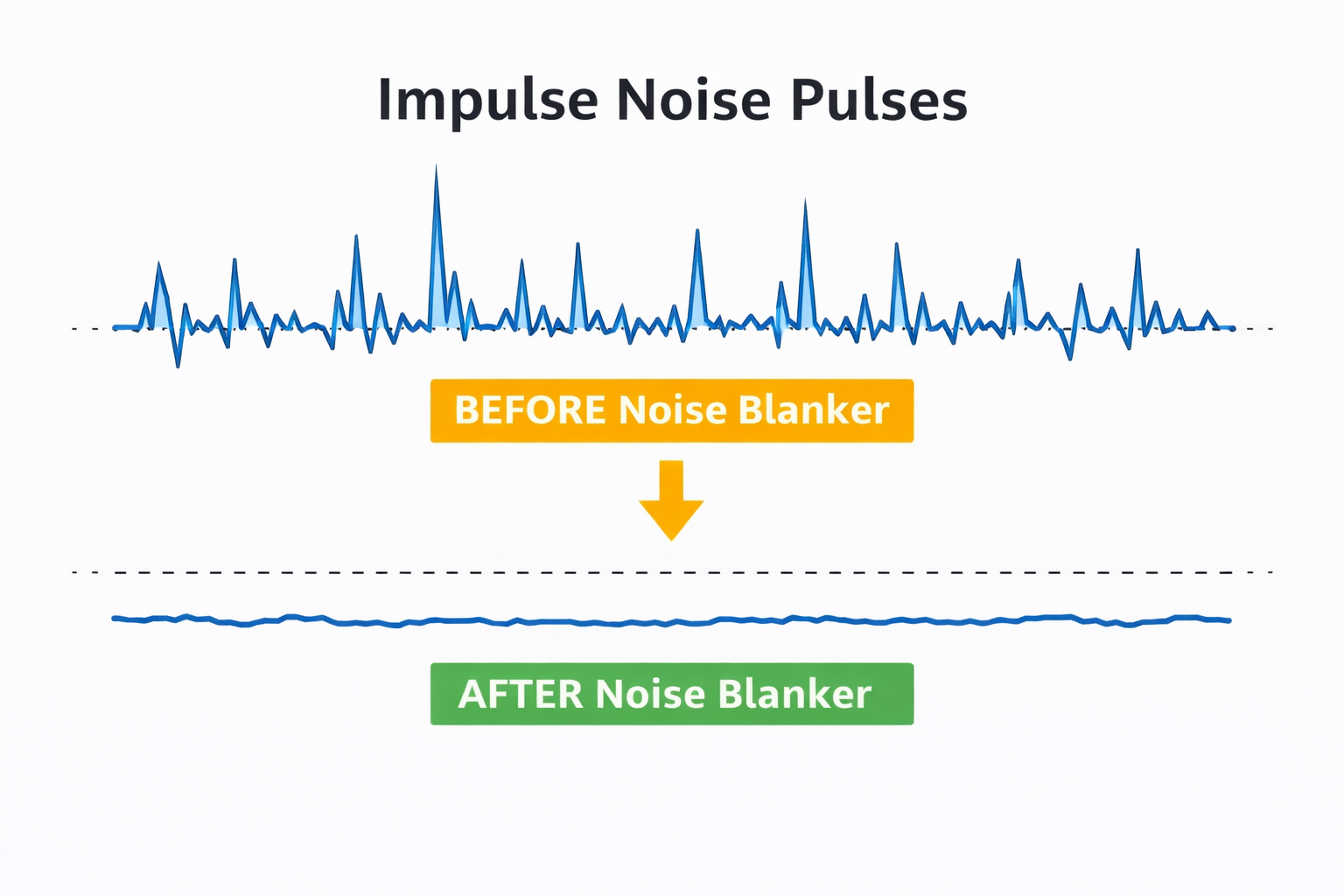
Impulse Detection
The receiver monitors incoming signals for sudden amplitude spikes that exceed a predetermined threshold. These spikes are characteristic of impulse noise rather than normal modulation.
Trigger Generation
When the circuit detects a spike, it triggers a blanking pulse that temporarily disables the receiver’s signal path for a very short period of time.
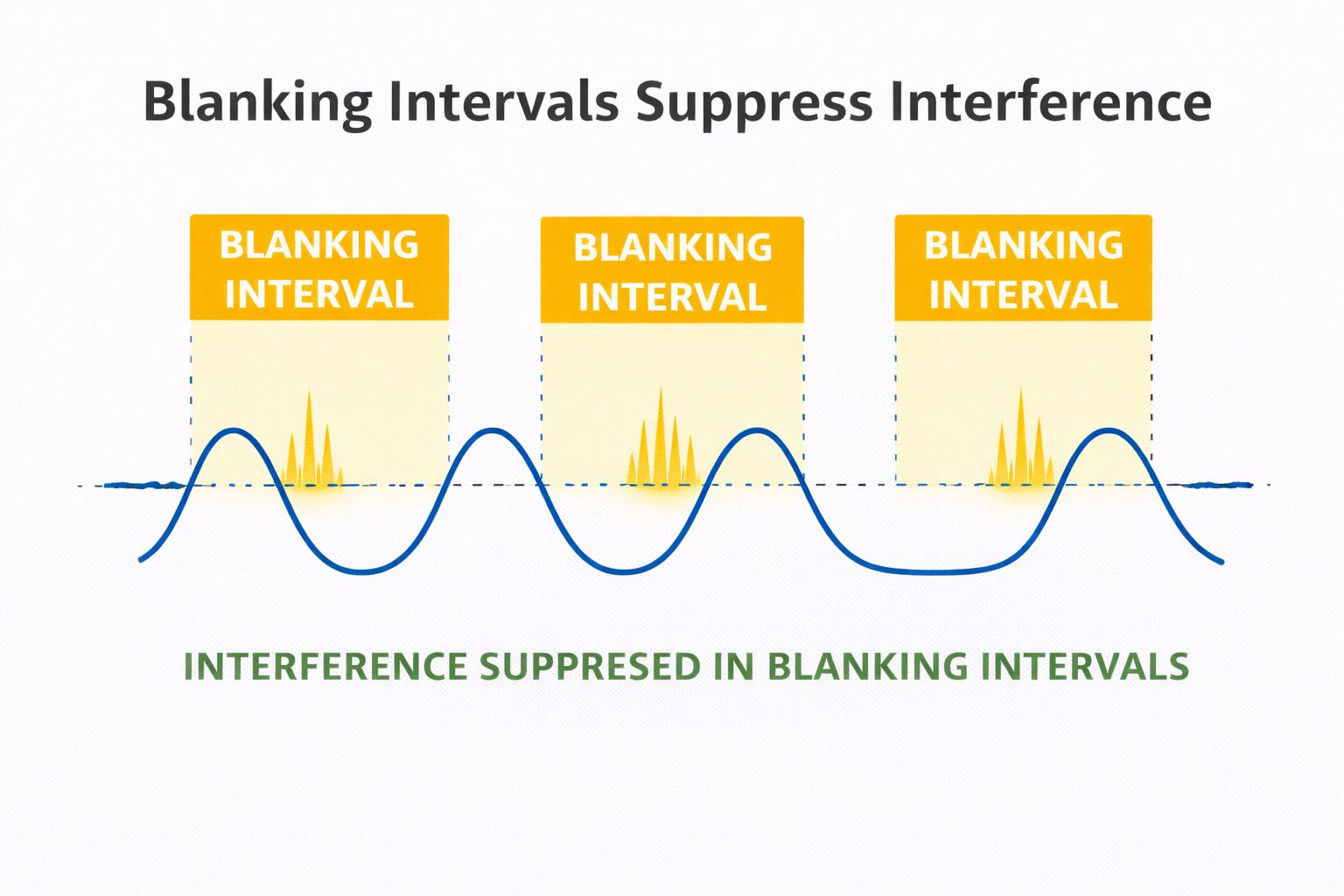
Signal Blanking
During the blanking interval, the receiver suppresses the incoming signal. Because the impulse noise pulse is extremely short, the blanking action removes the interference before it reaches the audio output.
After the blanking interval ends, the receiver immediately resumes normal signal processing. This entire process occurs extremely quickly, often within microseconds, allowing the receiver to suppress noise without noticeably affecting normal voice or CW signals.
Common Sources of Impulse Noise
Impulse noise can originate from a variety of electrical devices and environmental sources. Understanding the origin of the interference helps determine whether a noise blanker will be effective.
Typical impulse noise sources include:
• Automotive ignition systems
• Power line arcing and electrical discharge
• Electric fence controllers
• Switching power supplies
• Industrial machinery
• Electric motors and relays
These sources generate repetitive electrical pulses that appear across a wide range of frequencies. Because impulse noise often repeats at regular intervals, the noise blanker can effectively suppress it.
Mobile operators frequently encounter ignition noise when operating from a vehicle. In these situations, enabling the noise blanker can dramatically improve reception.
How to Enable the Noise Blanker
Most amateur radio transceivers include a dedicated noise blanker control or menu option. Depending on the radio model, the control may be labeled NB, NB1/NB2, or simply Noise Blanker.
Activating the NB typically requires only a single button press or menu selection. Once enabled, the receiver begins detecting impulse noise and applying blanking pulses automatically.
Some radios provide multiple noise blanker modes or adjustable blanking levels. These options allow operators to optimize the circuit for different types of noise environments.
Operators should enable the noise blanker only when impulse noise is present, as unnecessary blanking can sometimes reduce signal quality.
Adjusting Noise Blanker Settings for Best Results
Proper adjustment of the noise blanker is important for achieving optimal performance. If the blanking level is set too low, impulse noise may still pass through the receiver. If the setting is too aggressive, the blanker may suppress portions of the desired signal.
To adjust the Them effectively:
• Begin with the lowest blanking level available
• Gradually increase the blanking strength while monitoring the received signal
• Stop increasing the level once impulse noise disappears
• Reduce the setting slightly if signal distortion becomes noticeable
Careful adjustment ensures that the noise blanker removes interference while preserving signal fidelity.
In crowded band conditions, excessive blanking can also reduce the strength of nearby signals. For this reason, operators should always verify that the blanker is not degrading reception.
Noise Blanker vs DSP Noise Reduction
Modern radios often include multiple noise reduction technologies, and it is important to understand how these systems differ.
Noise blankers and digital signal processing (DSP) noise reduction serve different purposes.
| Feature | Noise Blanker | DSP Noise Reduction |
|---|---|---|
| Target Noise Type | Impulse noise | Continuous background noise |
| Typical Sources | Ignition systems, power lines | Atmospheric noise, band noise |
| Processing Method | Signal blanking | Digital filtering algorithms |
| Effect on Signal | Removes short pulses | Reduces steady noise levels |
Noise blankers work best against short electrical pulses, while DSP filters are more effective against continuous noise sources.
For best results, many operators use both systems together.
Combining Noise Blanker with Other Receiver Filters
They often work best when combined with other receiver filtering techniques. Modern transceivers provide multiple filtering options designed to address different types of interference.
For example:
DSP Noise Reduction
After the noise blanker removes impulse noise, DSP filters can reduce steady background noise and improve signal intelligibility.
Automatic Notch Filters
Notch filters remove narrowband interference such as carrier tones from nearby transmitters.
Bandwidth Filters
Adjusting receiver bandwidth helps isolate the desired signal while reducing adjacent channel interference. Using these filters together allows operators to address multiple interference sources simultaneously.
When to Use a Noise Blanker
They are most effective in environments where impulse noise is present. Operators often encounter this type of interference during mobile operation or in locations near electrical equipment.
Situations where noise blankers are particularly useful include:
• Mobile operation near vehicle ignition systems
• Operation near electric fences or industrial equipment
• Urban environments with electrical infrastructure
• Locations near switching power supplies
In contrast, noise blankers provide little benefit when interference is dominated by atmospheric noise or broadband static. In those cases, DSP noise reduction or narrower bandwidth filters may provide better results.
Understanding the type of noise present helps determine whether the noise blanker should be enabled.
Limitations of Noise Blanker Circuits
Although, effective against impulse noise, they are not a universal solution for all types of interference.
Some limitations include:
• Ineffective against continuous broadband noise
• Potential signal distortion if set too aggressively
• Reduced effectiveness in extremely noisy environments
In certain cases, impulse noise may occur so frequently that blanking pulses begin to affect normal signal reception. When this occurs, operators may need to reduce the blanking level or disable the feature entirely.
Despite these limitations, noise blankers remain one of the most valuable receiver tools for dealing with electrical interference.
Frequently Asked Questions
What does a noise blanker do in a ham radio?
A noise blanker suppresses short bursts of impulse noise caused by electrical interference. It detects sudden signal spikes and temporarily blanks the signal before the noise reaches the audio output.
When should I use a noise blanker?
Noise blanker work best when dealing with impulse noise from sources such as vehicle ignition systems, power lines, and electric motors.
Does a noise blanker remove static noise?
No. Noise blankers target impulse noise only. Continuous background noise is better handled by DSP noise reduction filters.
Can a noise blanker distort signals?
Yes. If the blanking level is set too high, the circuit may suppress portions of the desired signal. Proper adjustment prevents this problem.
What is the difference between NB1 and NB2 on some radios?
Some radios provide multiple blanker modes designed to handle different types of impulse noise. One mode may target short pulses while another handles longer noise bursts.
Should I leave the noise blanker on all the time?
No. Operators should enable the noise blanker only when impulse noise is present. Leaving it on unnecessarily can sometimes reduce signal clarity.
About the Author
Vince, W2KU, is a licensed Extra class amateur radio operator and the founder of Ham Shack Reviews. He was named Amateur of the Year in 2026 for contributions to practical amateur radio education and equipment evaluation.
He primarily operates HF, knows propagation very well, operates mobile and handhelds daily. Vince exchanges QSL cards for DXCC, contest confirmation, and award tracking and is the club QSL manager. His guidance focuses on practical operating procedures, accurate logging, and real-world amateur radio practices.
Please consider Donating to help support this channel