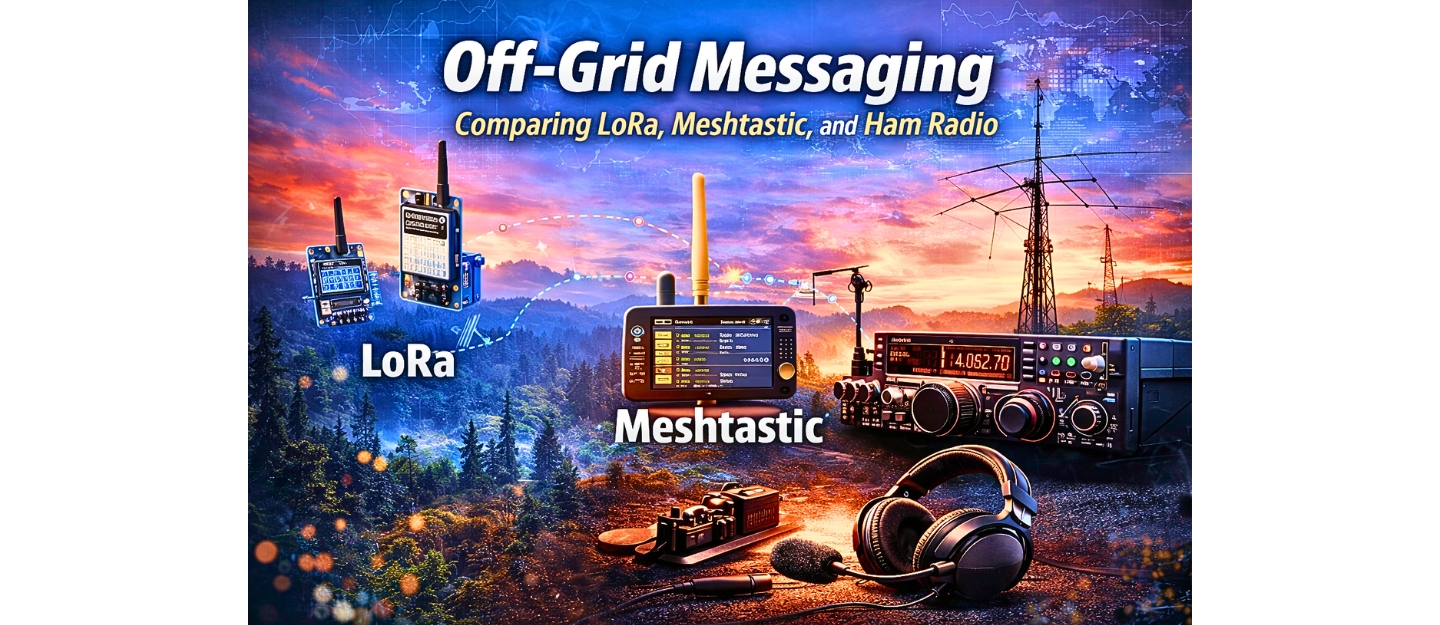
Off-grid messaging enables people to communicate when commercial infrastructure fails, becomes unreliable, or never existed in the first place. Therefore, emergency preparedness groups, outdoor enthusiasts, and technical operators increasingly rely on independent systems. Moreover, these systems operate without cellular towers, internet backbones, or centralized providers. As a result, users gain resilience, autonomy, and predictable performance under adverse conditions.
Three technologies dominate modern off-grid messaging discussions: LoRa, Meshtastic, and Ham Radio. Although each approach moves data without traditional networks, they differ radically in architecture, capability, legality, and technical complexity. Consequently, choosing the right solution requires a deep technical comparison rather than surface-level feature lists.
Core Requirements of Off-Grid Messaging Systems
Off-grid messaging systems must move information reliably across distance and terrain. Therefore, designers prioritize link budget, interference tolerance, power efficiency, and scalability. Systems must balance throughput against range because physics forces tradeoffs between bandwidth and sensitivity. Meanwhile, practical deployments also demand simplicity, durability, and predictable behavior under load.
Security, latency, and network topology also shape real-world usefulness. As a result, point-to-point systems behave very differently from mesh networks or store-and-forward architectures. Understanding these fundamentals clarifies why LoRa, Meshtastic, and Ham Radio excel in different roles.
LoRa as a Physical Layer Messaging Technology
LoRa operates as a low-power, long-range modulation scheme rather than a complete messaging system. Therefore, it defines how bits travel over RF, not how users discover nodes or route messages. LoRa uses chirp spread spectrum modulation, which spreads energy across time and frequency. Consequently, receivers achieve high sensitivity and decode signals well below the noise floor.
This modulation favors extremely low data rates. As a result, LoRa trades throughput for range and power efficiency. A single packet may take hundreds of milliseconds to transmit, but the link can span kilometers with milliwatts of output power. Moreover, LoRa radios tolerate interference well, which makes them effective in crowded ISM bands.
However, LoRa alone does not define addressing, routing, acknowledgments, or encryption standards. Therefore, developers must layer protocols on top of it. In practice, this limitation pushed the community toward frameworks like Meshtastic and LoRaWAN, each solving different problems.
Meshtastic as a LoRa-Based Mesh Network
Meshtastic builds a complete decentralized messaging network on top of LoRa radios. Consequently, it transforms raw RF links into a self-forming, self-healing mesh. Each node periodically broadcasts packets, relays traffic for others, and stores recent messages for delivery. Therefore, users gain multi-hop range extension without fixed infrastructure.
Meshtastic prioritizes simplicity and low power consumption. As a result, nodes often run on microcontrollers with small batteries or solar charging. Moreover, the protocol intentionally limits message size and frequency to preserve airtime and reduce collisions. This design keeps the mesh stable even as node counts increase.
However, Meshtastic sacrifices latency and throughput. Therefore, messages may take seconds or minutes to propagate across large meshes. Additionally, heavy traffic can degrade performance because LoRa’s long airtime amplifies collisions. Consequently, Meshtastic works best for short text messages, GPS beacons, and situational awareness rather than continuous data streams.
Ham Radio as a Broad Communications Ecosystem
Ham Radio represents an entire regulatory and technical framework rather than a single protocol. Therefore, it spans frequencies from HF through microwave bands and supports analog, digital, and hybrid modes. Unlike LoRa-based systems, Ham Radio operates under licensed spectrum with defined privileges and responsibilities.
Because of this flexibility, Ham Radio supports vastly higher data rates or vastly longer distances depending on band and mode. For example, HF digital modes enable global messaging without repeaters, while VHF and UHF packet systems support regional networking. Consequently, operators can tailor systems to mission requirements instead of forcing a single architecture.
Moreover, Ham Radio supports established store-and-forward systems, digipeaters, gateways, and formal emergency networks. As a result, it scales from local tactical messaging to continent-spanning infrastructure. However, this capability introduces complexity, training requirements, and regulatory constraints that LoRa-based systems avoid.
Range and Propagation Comparison
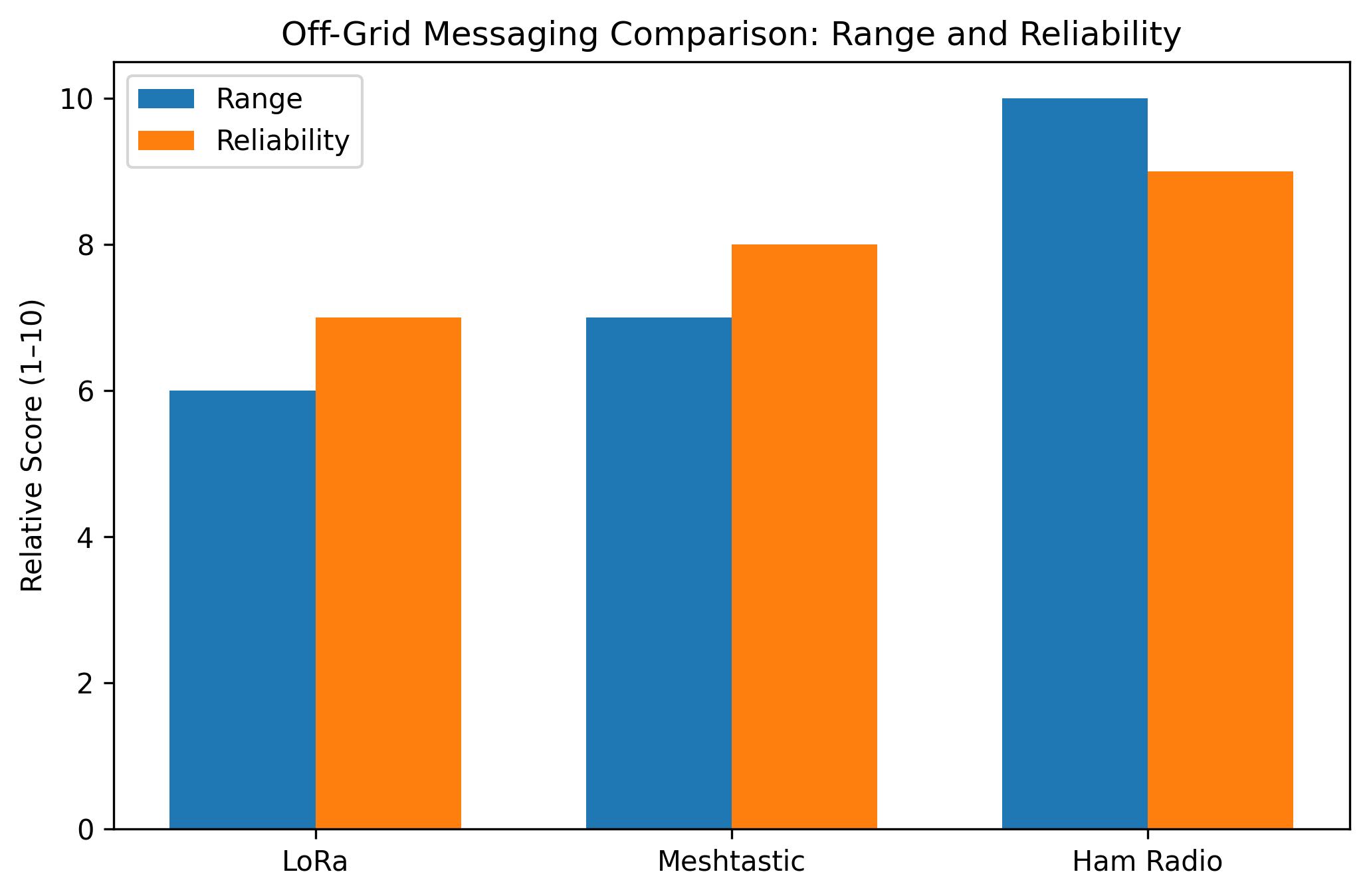
LoRa and Meshtastic typically operate in unlicensed sub-GHz bands, which favor ground-wave and diffraction over terrain. Therefore, they perform well in urban clutter and hilly environments at short to medium distances. In contrast, Ham Radio exploits frequency diversity to overcome geography. Consequently, HF links bypass terrain entirely via ionospheric reflection, while VHF and UHF rely on line-of-sight and repeater placement.
In practical terms, LoRa excels at local coverage with minimal infrastructure. Meanwhile, Meshtastic extends that coverage incrementally through dense node deployment. However, Ham Radio uniquely supports both local and global communication depending on configuration. Therefore, it remains unmatched when distance becomes the primary requirement.
Power Consumption and Energy Budget
Energy efficiency defines off-grid viability. LoRa radios draw extremely low current in receive and transmit modes. Consequently, battery-powered nodes can operate for weeks or months. Meshtastic inherits this advantage by enforcing strict duty cycles and message limits.
Ham Radio equipment, however, consumes significantly more power. Therefore, operators must plan energy systems carefully, especially for HF transmitters. Nevertheless, modern digital modes mitigate this disadvantage by using weak-signal techniques and low duty cycles. As a result, skilled operators can maintain long-range links with surprisingly modest power budgets.
Network Scalability
Meshtastic networks scale horizontally by adding nodes. However, as node density increases, airtime contention also increases. Therefore, performance eventually degrades unless users manage traffic discipline carefully. LoRa alone does not solve this issue because physics constrains channel capacity.
Ham Radio networks scale differently. Instead of many identical nodes, they use hierarchy. Consequently, repeaters, gateways, and scheduled nets control congestion. Moreover, experienced operators coordinate usage through conventions rather than automated protocols. This human-in-the-loop model adds robustness but requires discipline and training.
Security and Message Integrity
Security expectations differ sharply between systems. Meshtastic supports encryption at the application layer, which protects message content from casual interception. However, metadata such as timing and node presence remains observable. LoRa by itself provides no inherent encryption unless implemented by higher layers.
Ham Radio regulations often prohibit encryption for general communications. Therefore, confidentiality becomes limited by law. However, message integrity and authentication can still occur through procedural controls, callsign verification, and redundancy. As a result, Ham Radio favors transparency and reliability over secrecy.
Skill Level and Deployment Complexity
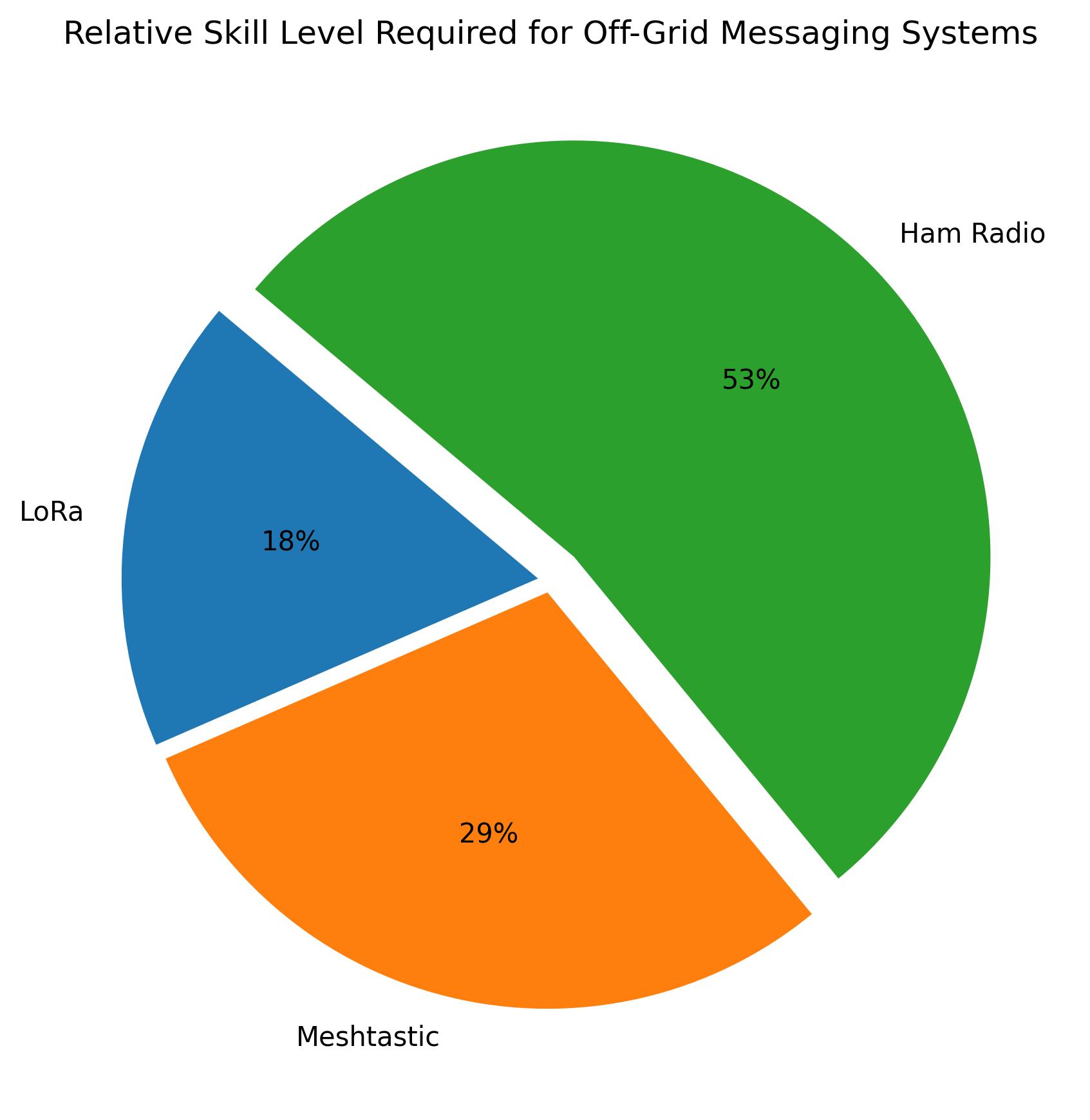
LoRa and Meshtastic appeal to users seeking rapid deployment. Therefore, minimal licensing and configuration barriers exist. Users flash firmware, set parameters, and communicate within minutes. Additionally, community-driven tooling simplifies onboarding.
Ham Radio demands greater investment. Operators must obtain licenses, learn operating practices, and understand RF fundamentals. However, this barrier produces highly skilled participants. Consequently, Ham Radio networks often outperform simpler systems during prolonged emergencies.
Choosing the Right Technology for the Mission
No single technology dominates every off-grid messaging scenario. Therefore, mission requirements should drive selection. If users need lightweight, low-power, local messaging with minimal setup, Meshtastic provides an elegant solution. If developers need raw long-range links embedded into custom systems, LoRa offers a flexible physical layer.
However, if the mission requires wide-area coverage, interoperability, and resilience across days or weeks, Ham Radio delivers unmatched capability. Moreover, combining these systems often produces the best results. For example, Meshtastic can handle local coordination while Ham Radio bridges regions or continents.
Off-Grid Messaging
Off-grid messaging succeeds when technology aligns with physics, regulation, and human behavior. LoRa demonstrates how modulation efficiency extends range with minimal energy. Meshtastic proves that decentralized meshes work when traffic stays disciplined. Ham Radio shows that trained operators and flexible spectrum access still matter in a digital world.
Therefore, understanding these systems at a technical level allows operators to design resilient communication strategies rather than relying on hype. As infrastructure fragility increases, these off-grid tools become less niche and more essential.
Please consider Donating to help support this channel