
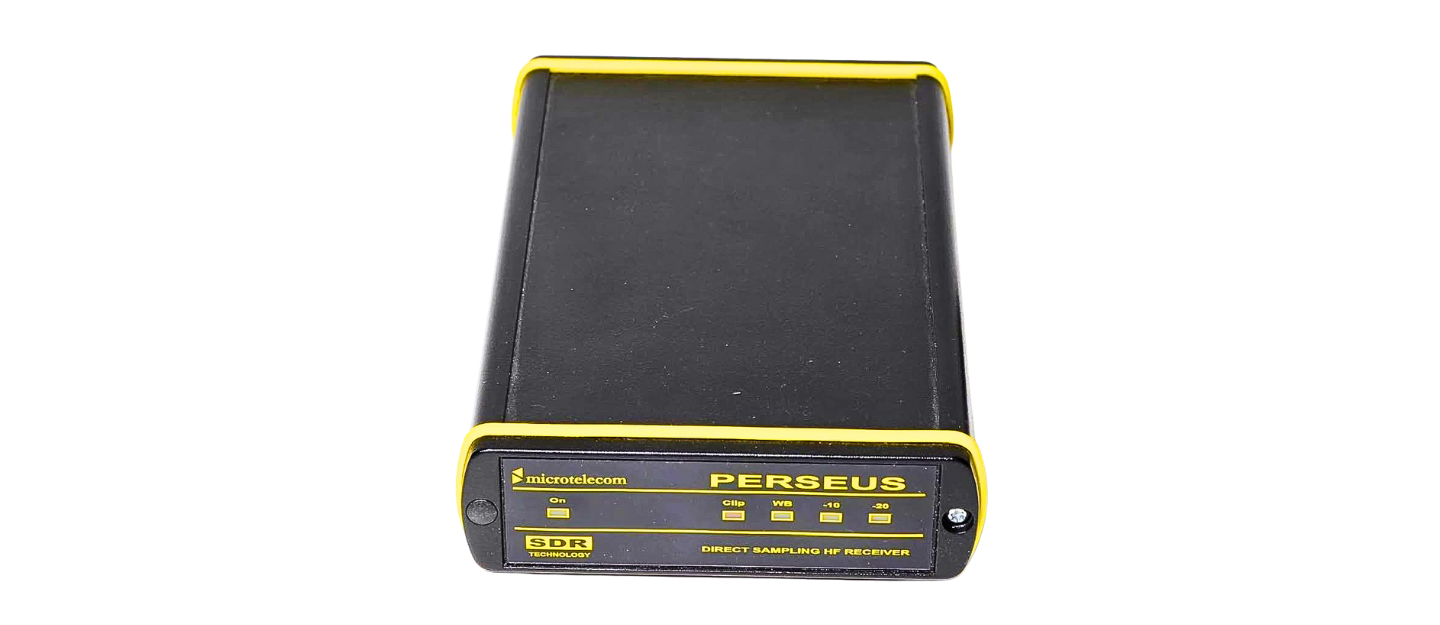
The Perseus SDR Receiver is a direct sampling SDR that interests serious listeners and technical users. Therefore, it emphasizes performance, accuracy, and clean signal handling across VLF and HF bands. It uses direct RF sampling instead of traditional superheterodyne conversion. Consequently, it avoids many distortion and image issues common in older receiver designs.
Direct Sampling Architecture
The receiver digitizes signals directly at the antenna input stage. Therefore, it removes multiple analog conversion stages entirely. This approach preserves weak signals near strong transmitters. Moreover, it significantly reduces phase noise and unwanted spurious responses during reception.
Frequency Coverage and Tuning Precision
The Perseus covers approximately 10 kHz through 30 MHz continuously. Additionally, it provides extremely fine tuning resolution for narrowband work. This precision benefits VLF experimentation and weak signal monitoring. However, it still supports wide spectrum displays without sacrificing responsiveness.
Dynamic Range and Signal Handling
High dynamic range defines the Perseus receiver design. Consequently, it performs well in crowded HF environments. Strong broadcast stations rarely desensitize the receiver front end. Moreover, users experience minimal intermodulation in high RF locations.
Front-End Filtering and Protection
The Perseus includes carefully engineered front-end filtering. Therefore, it limits out-of-band energy before digitization occurs. This protection helps prevent ADC overload conditions. However, sensitivity remains excellent across the entire frequency range.
Software-Based Control System
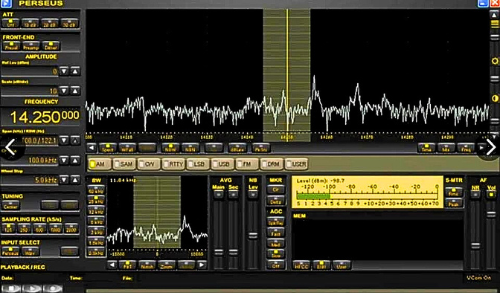
The receiver relies on PC-based control software for operation. Therefore, flexibility exceeds most standalone receivers. Users adjust bandwidth, demodulation modes, and display parameters easily. Additionally, waterfall and spectrum views assist signal identification and analysis.
Wideband Recording Capabilities
The Perseus supports wideband IQ recording across large frequency segments. Thus, users can capture entire bands for later analysis. This feature benefits DXers and researchers alike. Moreover, playback allows careful study of transient or weak signals.
VLF Reception Performance
The Perseus performs exceptionally well at very low frequencies. Therefore, it suits natural radio research and VLF monitoring applications. Frequency stability remains strong over long monitoring sessions. Additionally, low internal noise enhances weak signal visibility.
HF Monitoring and Utility
HF listeners benefit from strong selectivity and clean baseband output. Consequently, adjacent channel interference remains well controlled. Amateur operators can monitor multiple signals simultaneously. Moreover, digital modes decode reliably using external software.
Frequency Accuracy and Clock Stability
The internal oscillator provides solid frequency stability for general use. However, external reference inputs improve precision further. Therefore, laboratory and monitoring tasks become more accurate. This flexibility supports demanding technical applications.
Build Quality and Connectivity
The Perseus hardware features a solid, professional enclosure. Additionally, it uses quality connectors for reliable RF connections. USB connectivity enables fast data transfer rates. Thus, real-time spectrum operation remains smooth and responsive.
Learning Curve and Intended Audience
The Perseus targets experienced users and experimenters. Therefore, beginners may encounter a learning curve initially. However, advanced operators gain exceptional control and insight. Moreover, the receiver rewards careful configuration and experimentation.
Perseus SDR Receiver
The Perseus remains a benchmark VLF-HF SDR receiver. Therefore, many users still respect it despite newer competitors. Its design prioritizes performance over simplicity. Ultimately, it serves serious listeners who demand precision and stability.
Please consider Donating to help support this channel