
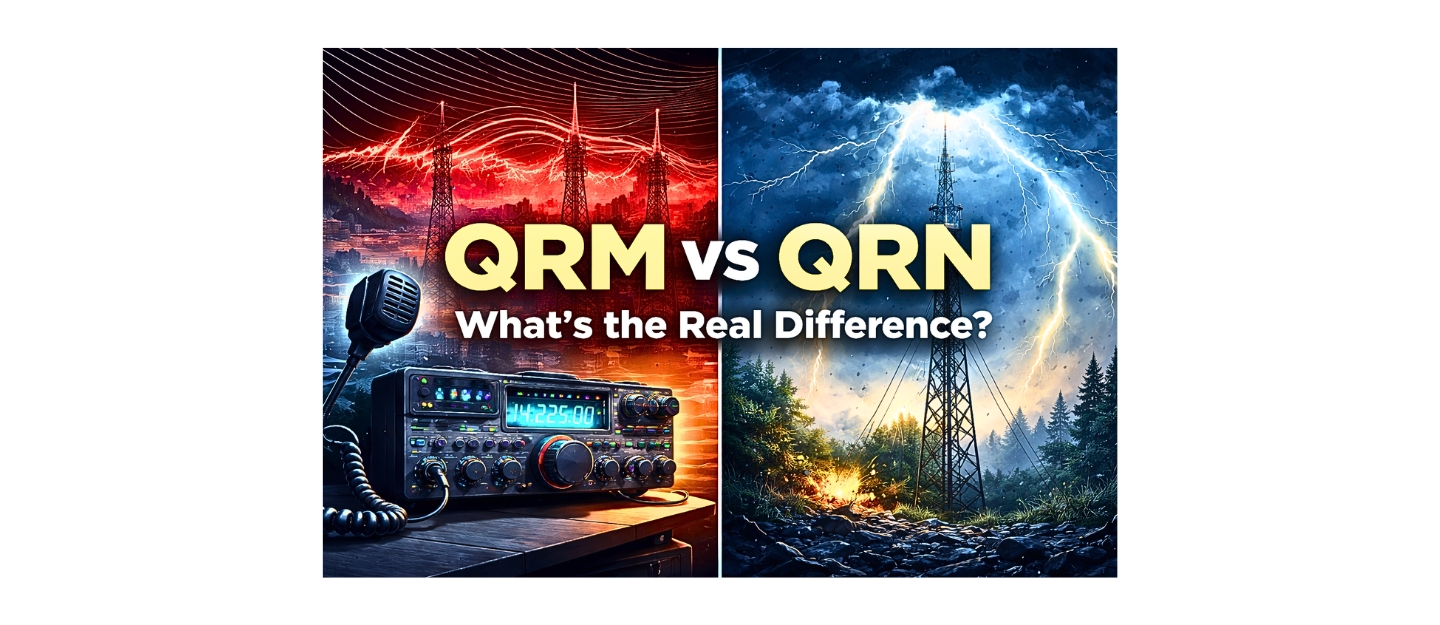
Understanding QRM vs QRN in Radio Communications
Radio operators hear QRM vs QRN every day. However, not all interference comes from the same source. Some noise originates from human-made devices, while other noise comes from natural electrical activity. Therefore, understanding the difference between QRM and QRN helps operators diagnose problems faster and improve signal clarity.
Both terms come from the Q-signal system used in radio communication. Originally, operators used these codes to communicate quickly and efficiently. Today, however, the terms have expanded beyond simple shorthand. They now describe two fundamentally different types of interference that affect reception, transmission quality, and operating strategy.
Because interference directly impacts signal readability, station performance depends on correctly identifying its cause. Consequently, knowing whether noise is QRM or QRN determines how you fix it, how you filter it, and sometimes whether you can eliminate it at all.
Want to learn more about propagation? Try Complete Guide to Ham Radio Propagation
What Is QRM
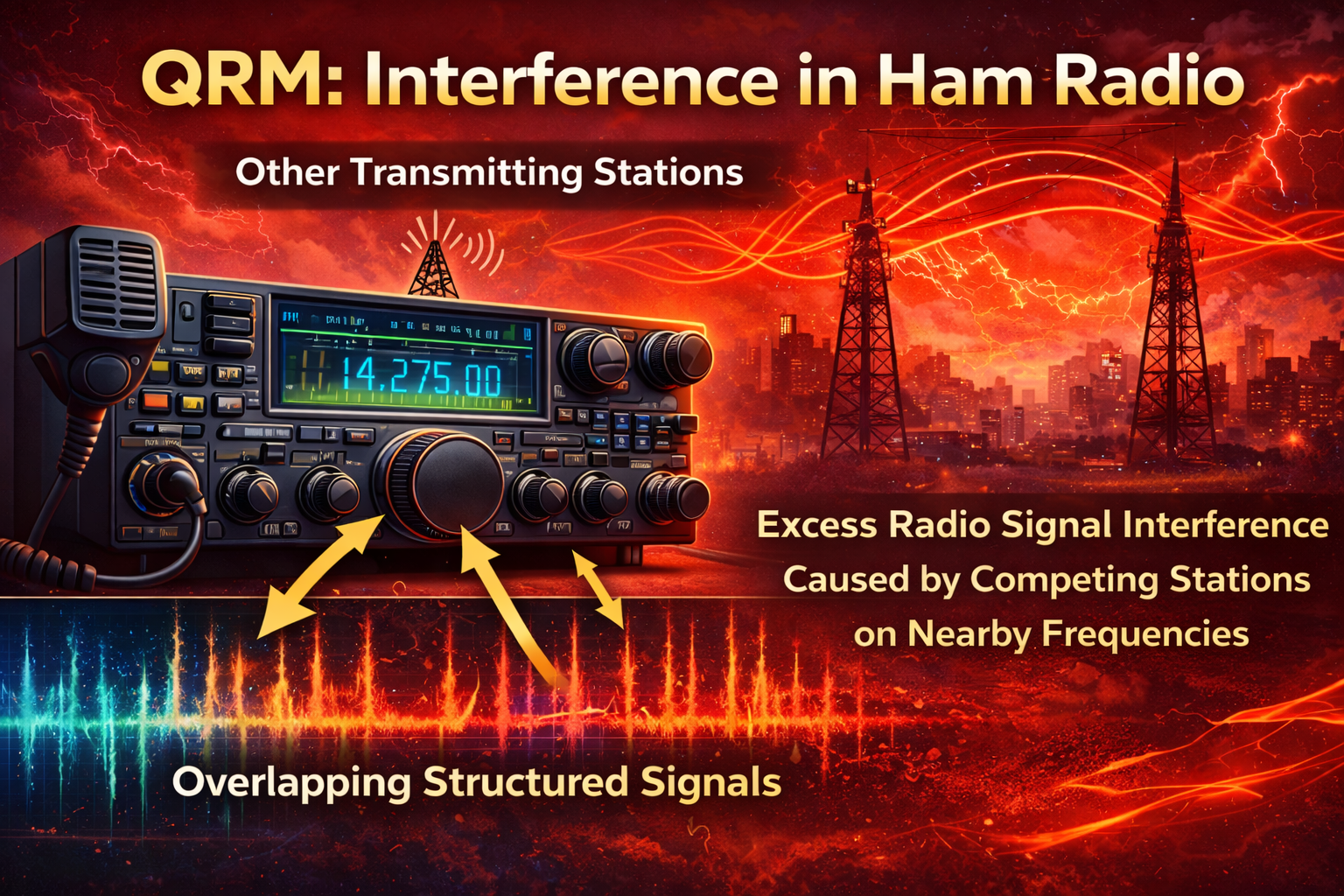
QRM refers to interference caused by other transmitting stations. In simple terms, it means human-generated radio signals disrupt your reception. Whenever two or more transmitters operate on nearby frequencies, their signals can overlap. As a result, receivers struggle to separate the desired signal from unwanted ones.
This type of interference typically appears as voices, digital tones, or carrier signals competing with the station you want to hear. For example, during contests or pileups, multiple operators transmit simultaneously. Consequently, the receiver hears a mixture of signals instead of one clear transmission.
QRM can also occur when nearby transmitters overload a receiver’s front end. Even if they operate on different frequencies, strong signals can spill into adjacent bands. Therefore, high signal density environments often produce significant QRM.
Unlike natural noise, QRM usually has structure. You can often identify voices, Morse code, or digital modulation buried within the interference. Because it contains intentional transmissions, QRM tends to follow patterns related to operator activity, band conditions, and time of day.
Additionally, QRM often increases when propagation improves. When bands open, more stations appear. As a result, signal crowding rises, and interference grows more intense.
What Is QRN
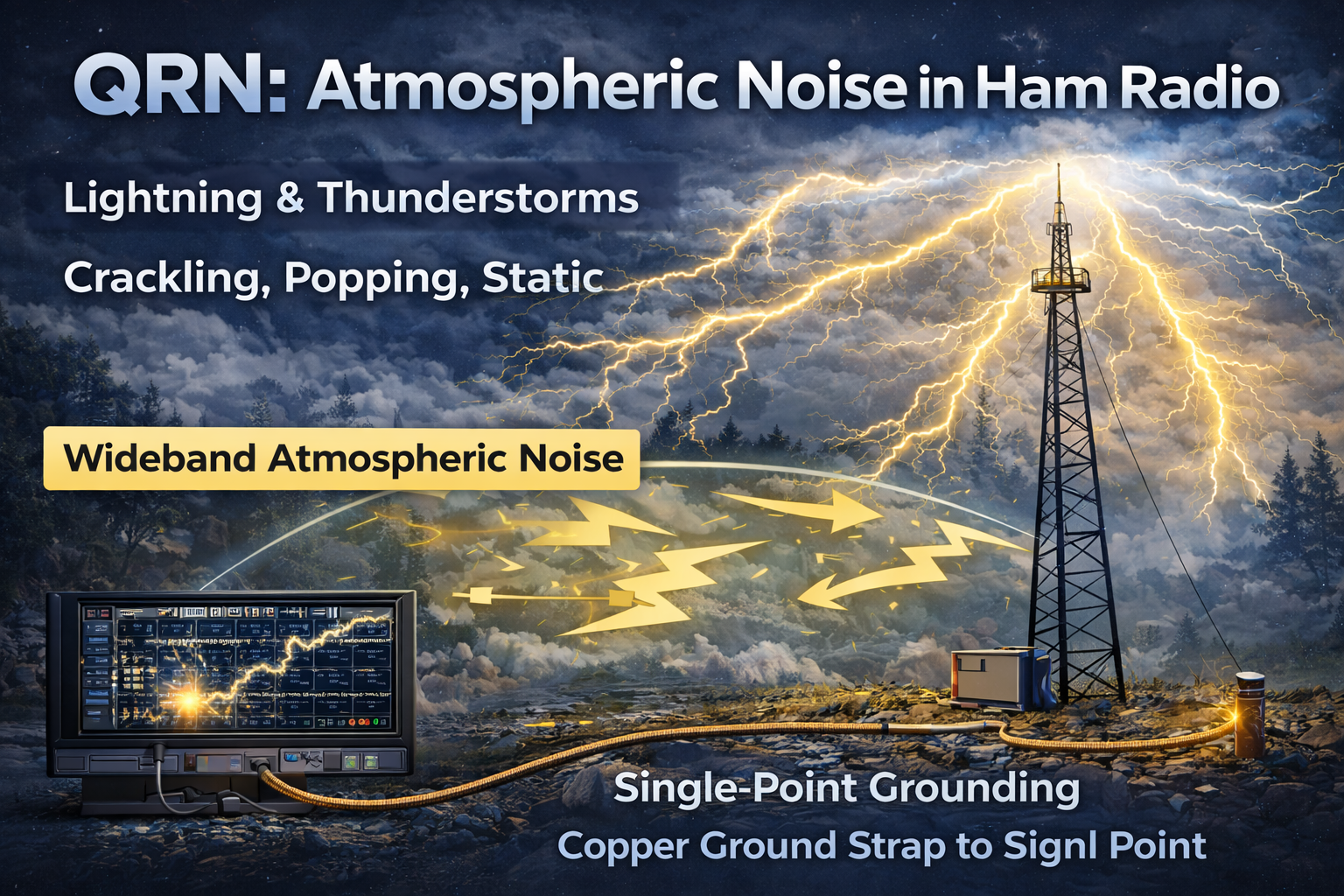
QRN refers to natural atmospheric noise. Instead of coming from transmitters, this interference originates from electrical activity in nature. Lightning discharges generate broadband radio energy that travels long distances. Consequently, receivers detect bursts of static even when storms occur hundreds of miles away.
This type of noise sounds very different from QRM. Instead of voices or tones, QRN appears as crackling, popping, or rushing static. Moreover, it often arrives in irregular bursts rather than continuous signals.
Thunderstorms represent the most common source. However, solar activity also contributes to QRN. For example, geomagnetic disturbances and solar radiation can produce background noise across wide frequency ranges. Therefore, QRN levels often vary with weather patterns and solar cycles.
Unlike QRM, QRN does not follow operator activity. Instead, it follows environmental conditions. When thunderstorms intensify, noise levels rise. Meanwhile, when atmospheric conditions stabilize, QRN decreases.
Because QRN originates outside human control, operators cannot eliminate it entirely. However, they can manage its impact through equipment design and operating technique.
Typical QRN Noise Levels
Atmospheric noise on lower HF bands can exceed S7 to S9 during active thunderstorms.
Quiet rural environments may measure S1 to S3 background noise, while urban electrical environments often exceed S5 due to man-made interference.
Quick Comparison: QRM vs QRN
Source
Human transmitters | Natural electrical activity
Signal structure
Voices / tones / carriers | Random broadband static
Frequency impact
Localized or band specific | Wideband
Primary solution
Frequency management | Noise reduction techniques
Control
Often manageable | Not controllable
Why the Difference Matters
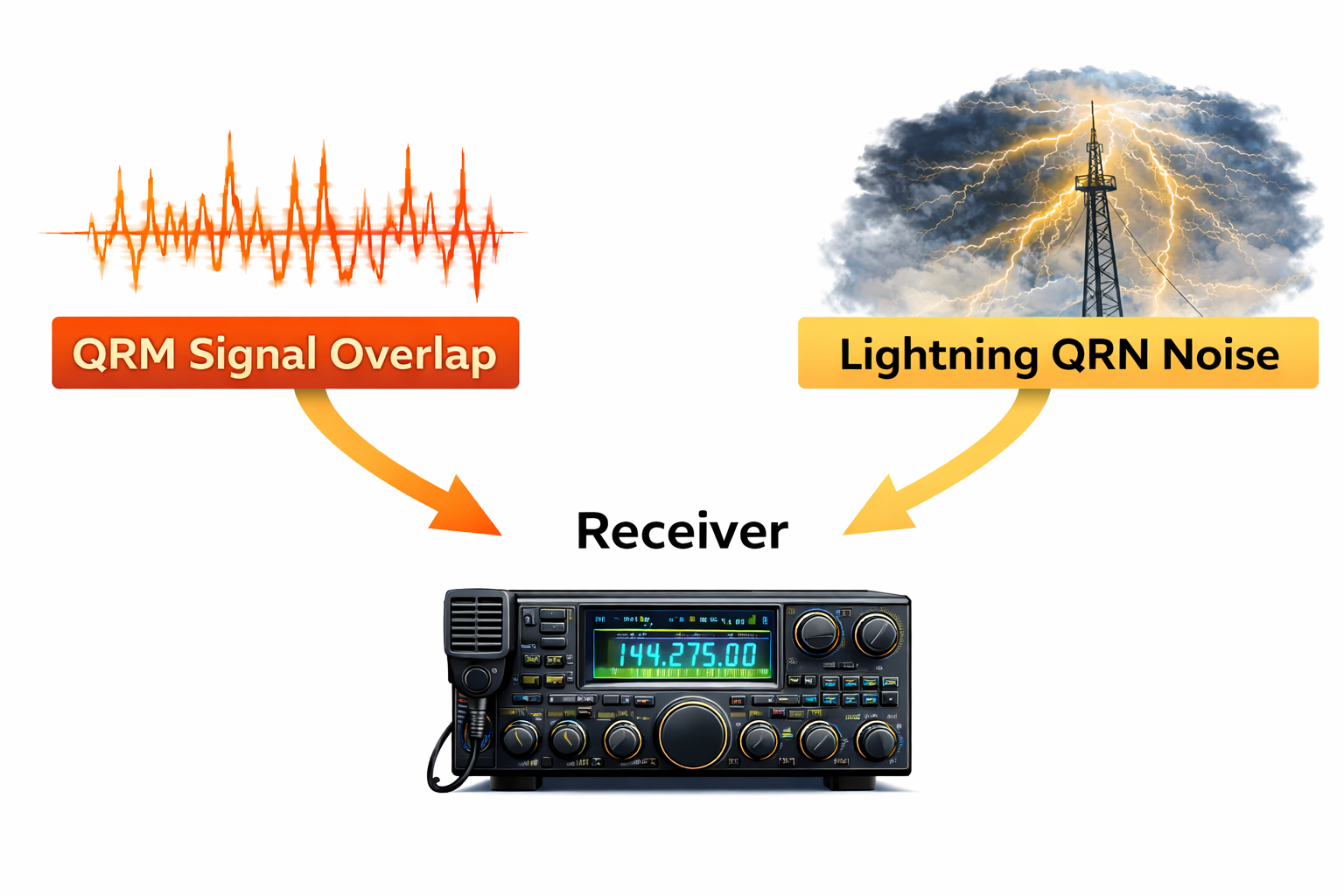
Correctly identifying interference changes everything about your response. If noise comes from other operators, you can often change frequency, adjust filters, or wait for band activity to decrease. However, if noise comes from lightning or atmospheric disturbance, those methods may not work.
Therefore, diagnosis becomes the first and most important step. Operators who recognize the source of interference avoid wasting time on ineffective solutions. Additionally, they protect equipment by understanding environmental risks.
For example, strong QRN often indicates nearby thunderstorms. Consequently, elevated noise can warn operators of lightning risk to antennas and feedlines. Meanwhile, heavy QRM indicates crowded band conditions, which require operational adjustments rather than safety precautions.
Because each type of interference behaves differently, successful operating depends on distinguishing between them quickly.
How QRM Sounds on the Air
QRM typically has identifiable structure. You may hear overlapping voices, distorted digital signals, or continuous carrier tones. Moreover, these sounds often change when stations begin or stop transmitting.
For example, contest weekends produce dense QRM. Signals appear across the band simultaneously. Consequently, receivers struggle to isolate individual transmissions.
Additionally, QRM may fade in and out with propagation. When distant stations strengthen, interference increases. Conversely, when propagation weakens, QRM decreases.
Because QRM originates from transmitters, its presence often aligns with operating schedules. Therefore, busy evening hours may produce more interference than quiet early mornings.
How QRN Sounds on the Air
QRN has a distinctive sound pattern. Instead of structured signals, operators hear random bursts of static. These bursts may crack sharply, roll continuously, or pop irregularly.
Lightning produces extremely wideband energy. As a result, QRN often affects multiple frequencies simultaneously. Even when you tune across the band, noise may remain constant.
Furthermore, QRN intensity can rise suddenly. When storms intensify, noise levels may spike within minutes. Meanwhile, when storms move away, interference gradually fades.
Because atmospheric noise spreads broadly, filtering often reduces its impact only partially. Consequently, operators must rely on noise mitigation techniques rather than frequency changes alone.
Physical Sources of QRM
Human technology creates most QRM. Radio transmitters, electronic devices, and communication systems all produce radio energy. Whenever these signals overlap with your operating frequency, interference occurs.
Common sources include nearby amateur stations, commercial transmitters, and high-power broadcast facilities. Additionally, poorly shielded electronics can radiate unintended signals. For example, switching power supplies and digital equipment sometimes generate emissions that fall within radio bands.
Urban environments often produce higher QRM levels. Because many transmitters operate in close proximity, signal density increases dramatically. Therefore, operators in populated areas frequently encounter persistent interference.
Physical Sources of QRN
Natural electrical processes generate QRN. Lightning remains the primary source. Each lightning discharge releases a massive electromagnetic pulse. Consequently, receivers detect bursts of energy across wide frequency ranges.
Atmospheric turbulence also contributes. Electrical charge separation within clouds creates radio emissions even without visible lightning. Therefore, QRN may appear before storms become obvious.
Solar radiation represents another factor. When solar activity increases, energetic particles interact with Earth’s magnetic field. As a result, background noise levels rise, particularly on lower frequencies.
Because these processes occur globally, QRN can travel great distances. Operators may hear noise generated thousands of miles away.
Frequency Dependence of QRM vs QRN
Both types of interference affect different frequency ranges in different ways. However, their patterns differ significantly.
QRM depends on band usage. When many operators use a specific band, interference increases. Therefore, popular frequencies experience more QRM.
QRN, however, affects lower frequencies more strongly. Atmospheric noise decreases as frequency rises. Consequently, high-frequency bands often experience less QRN than low-frequency bands.
Because of this difference, operators sometimes change bands to escape QRN. However, they may encounter increased QRM instead. Therefore, choosing the best frequency requires balancing both factors.
How Equipment Responds to QRM vs QRN
Receivers respond differently to structured signals versus random noise. Filters, noise blankers, and digital signal processing each target specific interference types.
Narrow filters reduce QRM by isolating desired signals. Because interfering transmissions occupy specific frequencies, filtering can separate them effectively.
Noise blankers help reduce QRN. They detect sudden spikes and suppress them before audio processing. Consequently, lightning crashes become less disruptive.
Modern digital signal processing improves both situations. However, its effectiveness depends on the noise characteristics. Therefore, understanding the interference source helps operators choose appropriate settings.
Operating Strategies for Managing QRM
Operators often manage QRM through frequency selection. Moving slightly up or down the band may reduce overlapping signals. Additionally, using narrower bandwidth improves selectivity.
Directional antennas also help. By orienting the antenna away from interfering stations, operators reduce unwanted signal strength. Consequently, desired signals become easier to hear.
Timing also matters. Operating during less crowded periods reduces interference. Therefore, many operators schedule activities during quieter band conditions.
Operating Strategies for Managing QRN
Because QRN originates from natural sources, elimination is rarely possible. However, operators can reduce its impact.
Improved grounding reduces noise pickup. Proper station grounding helps dissipate unwanted electrical energy. Consequently, receivers operate more quietly.
Balanced antennas also help. They reject common-mode noise more effectively. Therefore, properly designed antenna systems often reduce QRN significantly.
Noise blankers and digital noise reduction provide additional improvement. While they cannot remove all atmospheric noise, they often make signals more intelligible.
Common Misconceptions About QRM vs QRN
Many operators confuse electrical noise from household devices with QRN. However, interference from appliances is technically human-generated. Therefore, it behaves more like QRM even when it sounds like static.
Another misconception involves severity. Some believe QRM is always worse than QRN. In reality, both can be equally disruptive. Severe thunderstorms can produce noise levels that completely overwhelm reception.
Additionally, some assume filtering solves all interference. However, filtering cannot fully eliminate broadband atmospheric noise. Therefore, equipment alone cannot solve every problem.
How Receivers Detect QRN Noise Pulses
Noise blankers monitor the incoming signal for rapid amplitude spikes that occur faster than normal modulation. When a spike is detected, the receiver momentarily suppresses or gates the signal before audio processing. This prevents lightning impulse energy from reaching the audio stage while preserving the desired signal.
Why Skilled Operators Identify Interference Quickly
Experienced operators develop the ability to recognize interference instantly. They listen for structure, rhythm, and pattern. Consequently, they respond appropriately without trial and error.
This skill improves operating efficiency. Instead of adjusting controls randomly, operators apply targeted solutions. Moreover, rapid diagnosis prevents unnecessary equipment changes.
Professional communication environments rely heavily on this capability. Reliable communication depends on consistent signal clarity. Therefore, understanding interference types forms a core technical competency.
Real-World Operating Scenario
Imagine tuning into a weak distant station. Suddenly, loud voices appear on the same frequency. Because the interference contains recognizable speech, you identify QRM. Therefore, you change frequency slightly and restore clear reception.
Now imagine hearing constant crackling across the entire band. No matter where you tune, noise persists. Because the interference lacks structure and affects all frequencies, you identify QRN. Consequently, you activate noise reduction and continue operating.
This contrast demonstrates why accurate identification matters.
How QRM vs QRN Affect Different Modes
Voice communication suffers differently than digital modes. Structured interference often disrupts voice intelligibility quickly. However, digital modes may decode through moderate QRM.
QRN, however, affects signal-to-noise ratio broadly. Therefore, weak digital signals may fail completely during intense atmospheric noise.
Morse code often remains readable through moderate QRM. However, heavy QRN can mask individual elements. Consequently, operators adjust speed and filtering accordingly.
Technical Summary of the Core Difference
QRM originates from intentional radio transmissions. QRN originates from natural electrical activity. Therefore, QRM reflects human communication density, while QRN reflects environmental conditions.
QRM has structure and identifiable patterns. QRN produces random broadband noise. Consequently, mitigation strategies differ significantly.
QRM often changes with operator activity. QRN changes with weather and atmospheric processes.
Why Mastering Interference Knowledge Improves Station Performance
Operators who understand interference achieve better communication reliability. They configure equipment more effectively. Moreover, they operate more safely during severe weather.
Strong technical awareness supports advanced station design. Grounding systems, antenna selection, and filtering strategies all depend on accurate interference assessment. Therefore, knowledge directly influences performance.
In high-performance radio environments, interference management becomes a defining skill. Consequently, mastering the difference between QRM and QRN represents a foundational capability for serious operators.
Technical References
Q-signal definitions originate from International Radiotelegraph Convention procedures and remain standard terminology in amateur radio operating practice.
Atmospheric radio noise characteristics are documented in ITU-R P.372 recommendations on radio noise.
Receiver noise mitigation techniques follow standard superheterodyne and DSP signal processing principles used in modern communication receivers.
Final Understanding of QRM vs QRN
QRM and QRN both disrupt radio communication. However, they arise from completely different physical processes. One reflects human activity, while the other reflects natural electrical energy.
Because their behavior differs, operators must respond differently. Therefore, recognizing the type of interference quickly leads to better operating decisions.
Ultimately, clear communication depends not only on signal strength but also on interference awareness. When operators understand the real difference between QRM and QRN, they control their operating environment more effectively and maintain reliable radio performance under any conditions.
About the Author
Vince, W2KU is a licensed Extra class amateur radio operator and the founder of Ham Shack Reviews. He earned the Amateur of the year award in 2026. He regularly tests fixed, mobile and handheld radios in real operating conditions, including repeater use, mobile installations, and digital network communication. His reviews focus on real-world performance, reliability, and practical setup so operators can choose equipment that works when it matters most.
FAQ About QRM vs QRN Radio Interference
Is QRM the same as QRN in ham radio?
No, they are completely different types of interference. QRM comes from human-generated radio transmissions, while QRN comes from natural electrical activity in the atmosphere. Therefore, QRM reflects operating conditions on the band, whereas QRN reflects environmental conditions like lightning or solar disturbance. Because their sources differ, operators must use different methods to manage each one.
Can I eliminate QRM completely?
You usually cannot eliminate QRM entirely, but you can often reduce it significantly. Changing frequency, narrowing receiver bandwidth, and using directional antennas all help limit interference from other stations. However, if the band is crowded, some level of signal overlap may remain. Therefore, operators focus on improving selectivity rather than expecting total elimination.
Can I eliminate QRN completely?
No, QRN cannot be fully eliminated because it originates from natural atmospheric electrical activity. However, proper grounding, balanced antennas, and noise reduction circuits can reduce its impact. While these measures improve readability, they cannot remove all broadband static. Therefore, operators manage QRN rather than eliminate it.
Why does QRN get worse at night or during storms?
QRN increases when atmospheric electrical activity rises. Thunderstorms generate powerful electromagnetic pulses that travel long distances, so even distant lightning can raise noise levels. Additionally, nighttime propagation sometimes enhances low-frequency noise travel. Therefore, operators often notice stronger QRN during storm systems or unstable weather conditions.
Why does QRM increase when band conditions improve?
When propagation improves, more stations become audible across greater distances. As a result, signals that were previously too weak to hear suddenly become strong enough to interfere. Therefore, better band openings often bring heavier congestion. Although improved propagation helps long-distance communication, it also increases the chance of overlapping transmissions.
Does QRM damage radio equipment?
Normal QRM does not damage equipment because it consists of ordinary radio signals. However, extremely strong nearby transmitters can overload receiver front ends or cause intermodulation distortion. Therefore, proper filtering and station layout help protect sensitive equipment in high signal environments.
Does QRN indicate lightning danger to my antenna?
Strong QRN often suggests nearby or regional lightning activity. Because lightning produces intense electromagnetic energy, elevated static levels may signal increased strike risk. Therefore, operators should monitor conditions carefully and disconnect antennas during severe storms to protect equipment and ensure safety.
Which frequencies suffer most from QRN?
Lower frequencies typically experience stronger atmospheric noise. Longwave, medium wave, and lower HF bands collect more energy from lightning and natural electrical processes. As frequency increases, atmospheric noise generally decreases. Therefore, operators often move to higher bands when QRN becomes excessive.
How do I tell the difference between electrical appliance noise and QRN?
Household electrical noise usually sounds steady or repetitive, while QRN sounds random and impulsive. Appliances often produce continuous buzzing, whining, or rhythmic interference. In contrast, atmospheric noise produces irregular crackling or sharp bursts. Therefore, consistent patterns usually indicate local electrical sources rather than natural noise.
Which radio modes handle QRM and QRN best?
Different modes tolerate interference differently. Morse code often remains readable through moderate QRM because operators can distinguish signal patterns. Digital modes can also decode weak signals if interference stays within error correction limits. However, heavy QRN reduces signal-to-noise ratio across wide bandwidths, which can disrupt both digital and voice communication. Therefore, operators choose modes based on current noise conditions.
Does better grounding reduce both QRM and QRN?
Proper grounding improves overall station performance, but it affects each interference type differently. Grounding can reduce noise pickup and improve receiver stability, which helps with QRN. However, grounding does not stop other stations from transmitting, so it does not eliminate QRM. Therefore, grounding supports noise control but does not replace good operating practice.
Why do experienced operators identify QRM and QRN so quickly?
Experienced operators recognize sound patterns, signal behavior, and environmental clues. Because QRM contains structured transmissions and QRN produces random static, trained listeners distinguish them almost immediately. As a result, they apply the correct solution without trial and error. This skill improves communication reliability and station efficiency.
Please consider Donating to help support this channel