
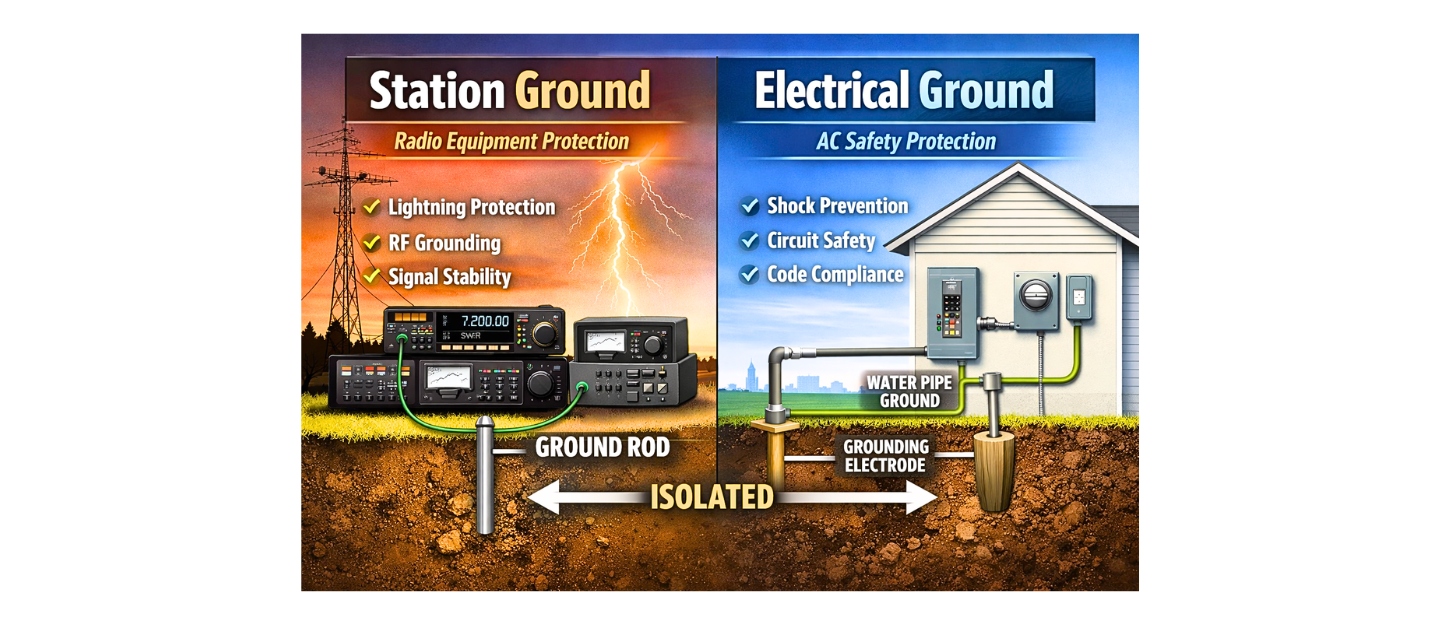
Station ground vs electrical ground are often treated as the same thing, but they serve completely different purposes in a radio installation. Understanding how they differ — and how they must work together — is essential for electrical safety, lightning protection, RF stability, and equipment protection.
Many operators assume that connecting their radio equipment to the home electrical ground automatically provides proper station grounding. In reality, the electrical grounding system protects people from shock and fire, while the station ground controls radio frequency behavior and manages surge energy.
Confusing these systems can create ground loops, introduce noise, damage equipment, and in severe cases provide a destructive path for lightning energy through sensitive radio gear.
Understand what each grounding system does and bond them together correctly to build a safe, high-performance station.
What Is a Station Ground?
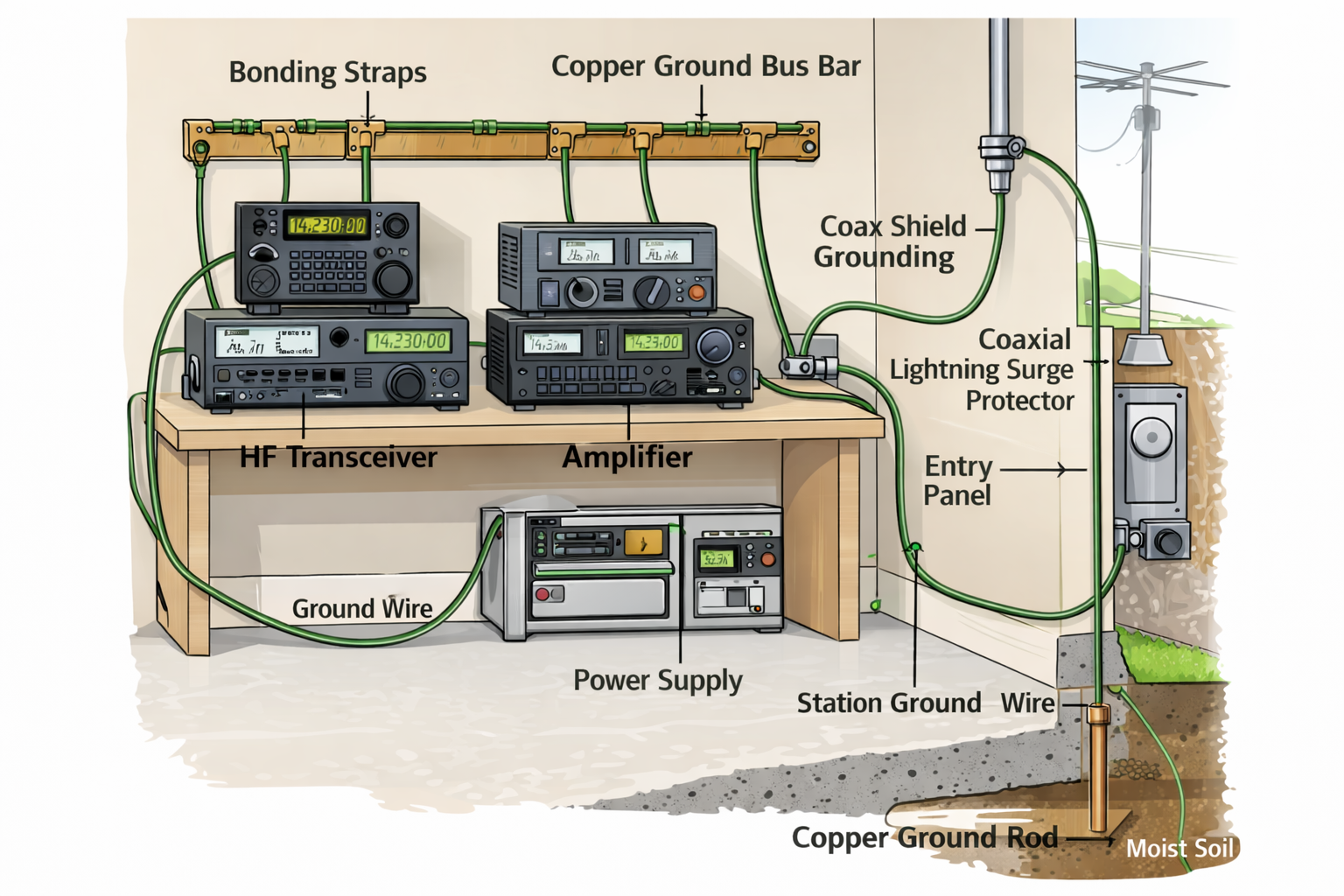
A station ground is a dedicated grounding reference used to control radio frequency energy and equalize electrical potential between all equipment in a radio operating environment.
Typically, you implement it by using a copper ground bus bar or grounding plate that bonds every piece of station equipment together with short, low-impedance conductors. This creates a common reference potential so RF energy does not flow unpredictably through chassis, feedlines, control cables, or accessory wiring.
The primary purposes of a station ground include stabilizing RF behavior, reducing electrical noise, protecting equipment from surge energy, and providing a controlled reference point for the entire radio system.
A station ground is not primarily a safety ground. Its main function is RF control and surge management within the radio installation.
What Is an Electrical Ground?
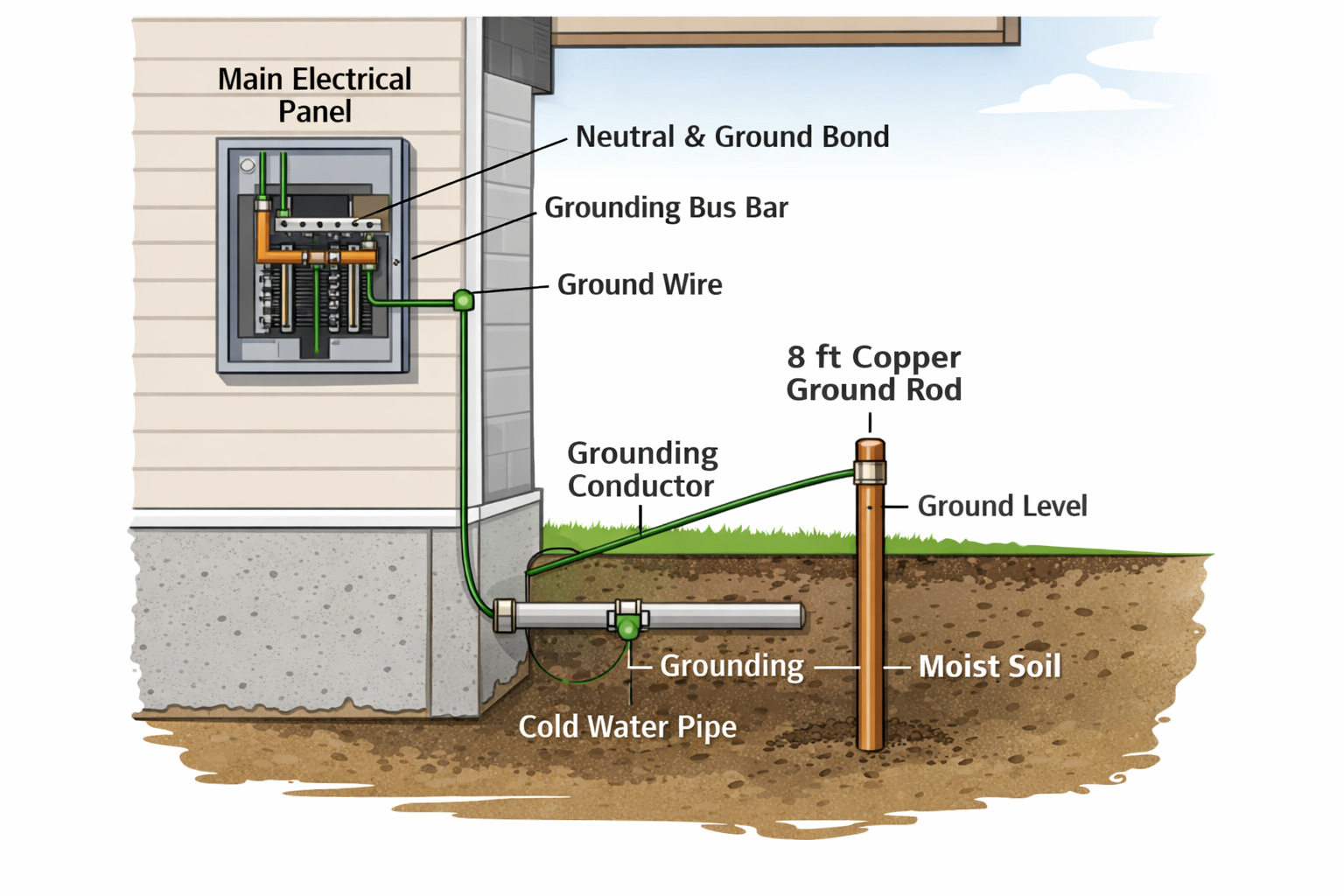
An electrical ground is part of the building’s power distribution safety system. It provides a low-resistance path for fault current to return to earth and ensures that exposed metal surfaces cannot remain energized if an electrical fault occurs.
The electrical grounding system typically includes ground rods or grounding electrodes, a grounding conductor, bonding at the main service panel, and equipment grounding conductors connected throughout the building.
Its primary purpose is human safety and fire prevention. If a hot conductor contacts a metal chassis, the electrical ground provides a path that allows protective devices such as circuit breakers to trip and remove dangerous voltage.
Electrical codes require electrical grounding as part of the building infrastructure.
Station Ground vs Electrical Ground — Key Differences
| Feature | Electrical Grounding | Station Equipment Grounding | RF Ground |
|---|---|---|---|
| Primary purpose | Protect people and property from electrical faults | Equalize voltage between equipment and prevent ground loops | Provide an effective RF return path for proper antenna operation |
| Type of current handled | 50/60 Hz fault current and surge current | Stray voltage, static charge, and transient currents | Radio frequency (RF) currents |
| Safety role | Critical life-safety protection required by code | Reduces shock risk and equipment damage | Limited direct safety role (mainly performance related) |
| RF performance role | Minimal direct impact on RF performance | Helps reduce noise and interference | Essential for efficient antenna radiation and low SWR |
| Physical location | Building electrical service panel, ground rod system | Inside the shack (ground bus bar or plate) bonded to service ground | At antenna feedpoint, radial field, counterpoise, or RF return path |
| Code requirement | Required by electrical codes (NEC) | Not always specifically defined but must be bonded to electrical ground | Not required by electrical code |
| Lightning protection role | Provides main path for lightning energy to earth | Helps equalize potential and route surge safely when bonded | Helps dissipate RF energy but not a primary lightning protection system |
| Should they be bonded | Yes — must bond to all other grounding systems | Yes — single point bond to electrical ground | Yes — must ultimately bond to the common grounding system |
Station Ground vs Electrical Ground: The Core Difference
The difference between these two systems is fundamental.
Electrical grounding protects people from electrical faults and prevents fire hazards.
Station grounding controls RF behavior and protects equipment from surge energy.
Electrical grounding handles power system faults at low frequency.
Station grounding manages radio frequency currents and transient energy.
Electrical grounding is part of building wiring.
Station grounding is part of the radio system.
Both systems connect to earth, but they exist for completely different reasons.
Why Operators Often Confuse the Two Systems
Confusion occurs because both systems involve conductive paths to earth and both are called “ground.” It is easy to assume that any connection to earth performs all grounding functions.
However, electrical current and radio frequency energy behave differently. Low-frequency fault current follows resistance. RF current follows impedance, which includes inductance and conductor geometry.
A conductor that works perfectly for electrical safety may perform poorly for RF control. This is why you must install a dedicated station grounding system even when the building already has proper electrical grounding.
Safety Ground vs RF Ground Behavior
Electrical grounding is designed to carry large fault current at 50 or 60 Hz and dissipate lightning surge energy safely.
RF grounding must control high-frequency currents that respond strongly to conductor length, width, and inductance. Long wires may have low resistance but high RF impedance, making them ineffective for RF control.
Station grounding therefore emphasizes short conductors, wide copper strap, and minimal inductance to maintain a low-impedance path for RF energy.
The Single-Point Ground Principle
One of the most important grounding concepts in radio installations is the single-point ground.
A single-point ground ensures that all equipment shares the same electrical reference potential and that surge energy enters and exits the system at one controlled location.
If multiple ground references exist, voltage differences can develop between equipment during surge events. Current will attempt to equalize those differences through whatever path is available, often through radios, power supplies, and feedlines.
A properly designed station bonds all equipment to one common bus, which then bonds to the building grounding electrode system.
Lightning Protection and Grounding
Lightning is one of the primary reasons proper station grounding is critical.
A lightning strike or nearby surge can raise ground potential dramatically. If you do not bond equipment to a common reference, voltage differences develop instantly between system components.
Those voltage differences force current through radio equipment as it attempts to equalize potential. This is a common cause of catastrophic equipment failure.
Proper station grounding provides a controlled path to earth and helps ensure that all connected components rise and fall together in potential during a surge event.
Ground Loops and Why They Occur
Ground loops occur when multiple conductive paths exist between equipment and ground. These loops allow circulating current to flow, which can introduce noise, hum, or unintended RF coupling.
To operate your radio safely and reliably, you must understand how these systems interact and bond them into a single unified grounding network.
A single bonded grounding system eliminates loop formation and stabilizes electrical potential across the station.
Bonding the Station Ground to the Electrical Ground
This is one of the most misunderstood and most important requirements.
A station ground must always be bonded to the building electrical grounding electrode system. Separate, unbonded grounds create dangerous voltage differences during surge events.
When lightning or fault current raises one ground system to a different potential than another, current will attempt to equalize them, often through equipment.
Bonding ensures that all grounding systems rise and fall together, preventing destructive current flow through the station.
Station Ground Installation Best Practices
Install a copper ground bus bar near the operating position.
Bond all equipment to the bus using short conductors.
Use wide copper strap or heavy conductors where possible.
Bond the station bus to the building grounding electrode system.
Ground feedlines at the building entry point.
Avoid long or coiled grounding conductors.
Common Grounding Mistakes
Using separate ground rods without bonding them together.
Connecting equipment randomly to multiple grounding points.
Using long thin wires for RF grounding conductors.
Allowing coax shields to become primary grounding paths.
Ignoring surge entry points where feedlines enter the building.
How to Test and Verify Proper Grounding
Visual inspection should confirm that all equipment bonds to a single bus and that the station bus connects to the building grounding electrode system.
Continuity testing can verify electrical bonding, but low resistance alone does not guarantee proper RF performance. Conductor geometry and length must also be considered.
Professional lightning protection testing may be appropriate for critical installations.
Practical Example of a Proper Ham Station Grounding Layout
All equipment bonded to a copper station ground bus.
Bus bonded to the building grounding electrode system.
Feedlines grounded at entry panel.
Entry panel bonded to same grounding system.
Ground rods bonded together and to electrical service ground.
This configuration creates a unified grounding system with controlled surge paths.
Frequently Asked Questions
Do I need a station ground if my home is electrically grounded?
Yes. Electrical grounding does not control RF behavior.
Can I install a separate ground rod for my station?
Only if it is bonded to the main grounding system.
Does station grounding improve RF noise performance?
Yes, when implemented correctly.
Is bonding required for lightning protection?
Yes, bonding equalizes potential during surge events.
About the Author
Vince is a licensed amateur radio operator and the founder of Ham Shack Reviews. He regularly tests mobile and handheld radios in real operating conditions, including repeater use, mobile installations, and digital network communication. His reviews focus on real-world performance, reliability, and practical setup so operators can choose equipment that works when it matters most.
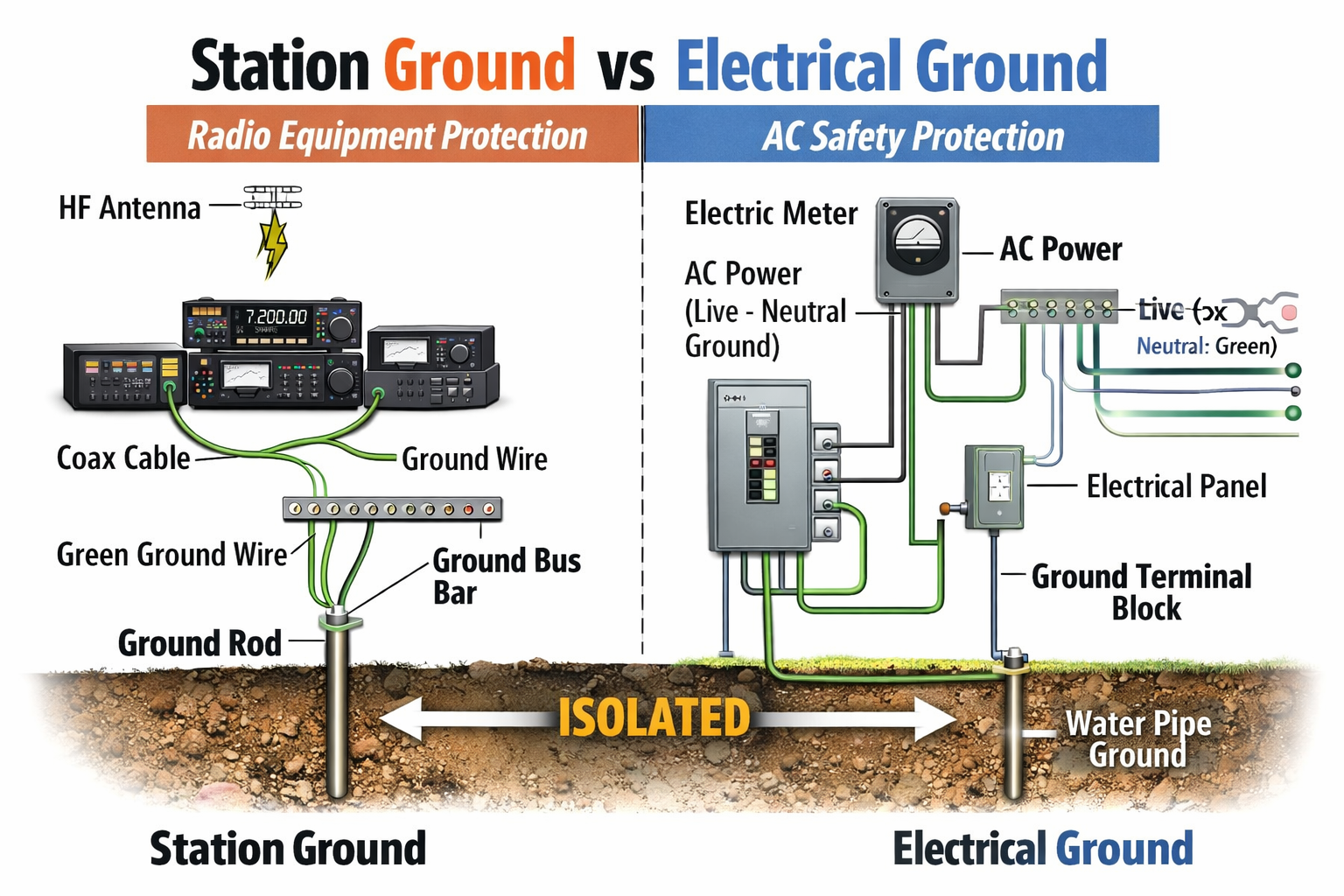
Station Ground vs Electrical Ground
Station Ground vs Electrical Ground serve different but equally essential roles. Electrical grounding protects people and structures from electrical faults. Station grounding stabilizes RF behavior and provides controlled surge management for sensitive equipment.
To operate your radio safely and reliably, you must understand how these systems interact and bond them into a single unified grounding network.
A properly grounded station protects equipment, improves performance, and reduces risk. It is one of the most important foundations of a professional radio installation.
Please consider Donating to help support this channel