
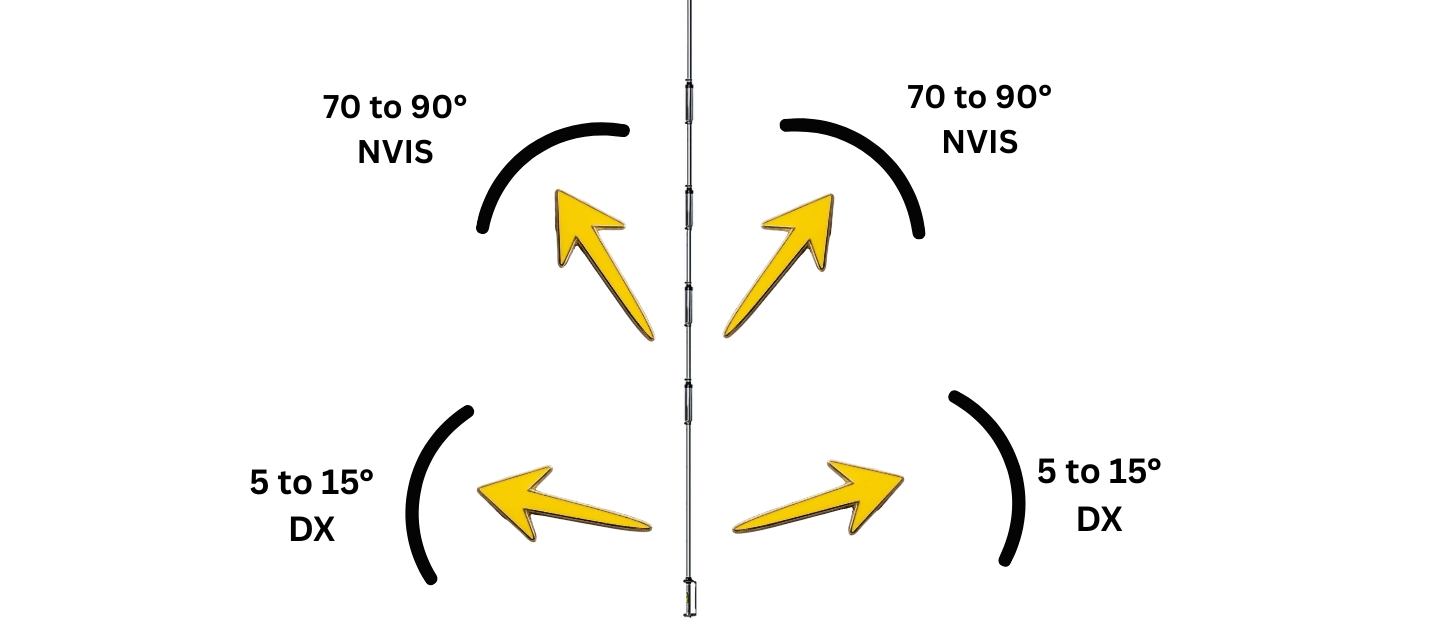
Antenna takeoff angle plays a vital role in determining how well your signal travels and where it is heard. In simple terms, the takeoff angle is the angle above the horizon at which most of your transmitted power leaves the antenna.
Lower takeoff angles send signals farther across the globe, while higher angles focus energy closer to home. Understanding this concept helps every ham operator choose the right antenna height and type for their communication goals.
👉 Understanding signal efficiency also requires knowing how impedance affects your antenna system. Learn more in our guide to ham radio antennas.
Antenna Takeoff Angle and DX Performance
For operators focused on long-distance communication, takeoff angle is often more important than transmitter power. A properly positioned antenna with a low radiation angle can outperform a high-power station with a poor angle.
This is especially true on bands like 20 meters, 15 meters, and 10 meters, where ionospheric propagation favors shallow angles. Even small adjustments in antenna height can dramatically improve DX results.
What Is a Antenna Take-off Angle
When an antenna radiates, its energy spreads in multiple directions. However, most of that energy concentrates in certain patterns or lobes. The main lobe, where most power is radiated, defines the takeoff angle.
The Earth’s atmosphere and ionosphere bend and reflect radio waves, that angle determines how signals travel over distance. For example, a 10-degree takeoff angle might bounce off the ionosphere and reach another continent, while a 60-degree angle is better suited for regional contacts.
Why Takeoff Angle Matters
Takeoff angle affects both range and reliability. Lower angles typically favor long-distance or DX communication, especially on higher frequency bands such as 20 meters and above. In contrast, higher angles work better for near-vertical incidence skywave (NVIS) propagation, which covers short to medium distances on lower bands like 40 or 80 meters. Because every antenna interacts with the ground and surroundings differently, changing the height or design of an antenna can shift its takeoff angle dramatically.
How Antenna Height Influences Takeoff Angle
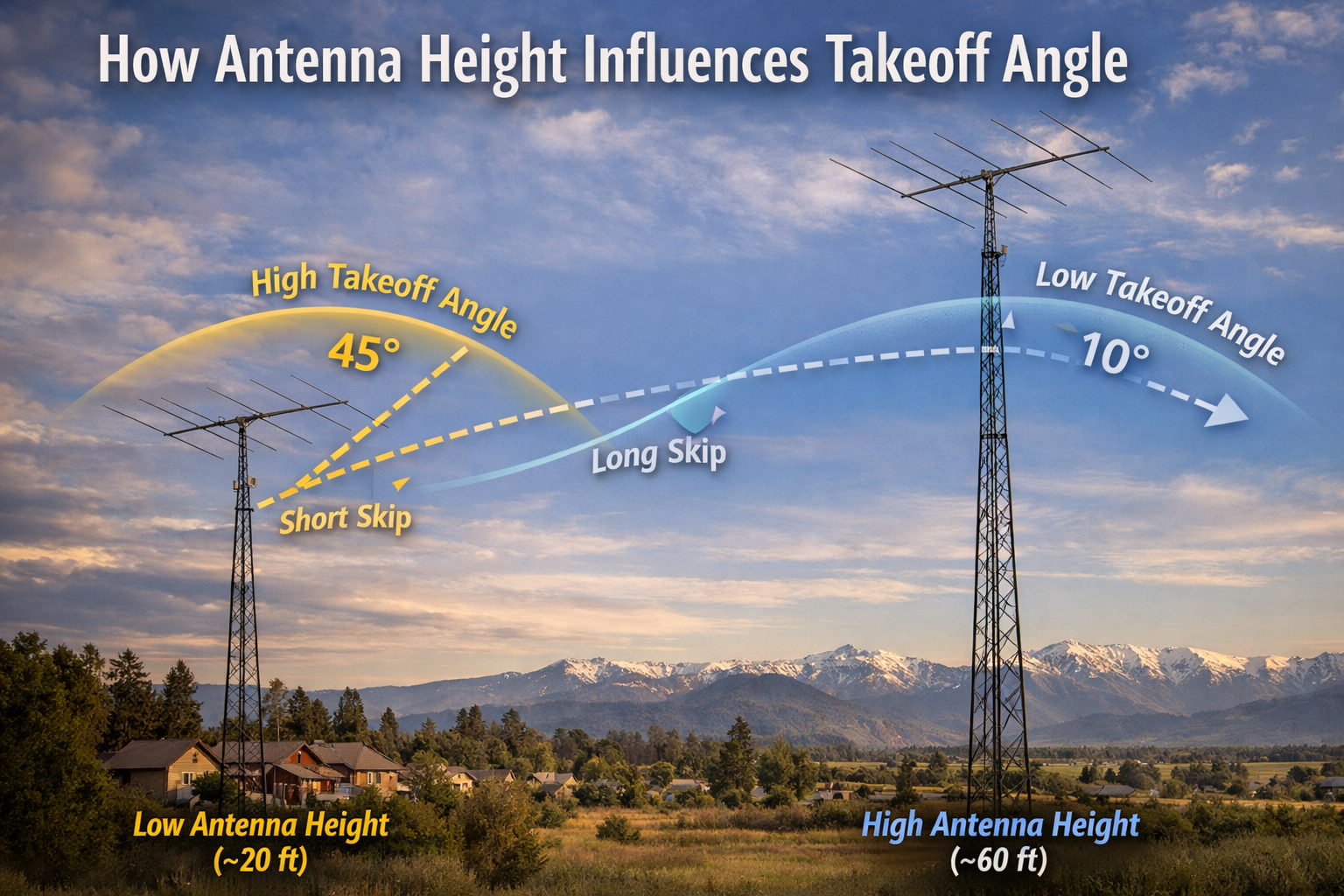
Antenna height is one of the main factors controlling takeoff angle. When an antenna sits close to the ground, the ground reflection combines with the direct radiation, creating an interference pattern. This pattern can either raise or lower the main lobe. For instance, a dipole about one-quarter wavelength high produces a high takeoff angle, ideal for local coverage.
As you raise the antenna to half a wavelength or more, the angle decreases, improving long-distance performance. Therefore, adjusting height is one of the simplest ways to optimize signal direction.
Takeoff Angle by Band (Critical Insight Most Articles Miss)
Takeoff angle behavior changes with frequency, meaning the same antenna height performs differently across bands.
For example, a dipole at 30 feet behaves very differently on 40 meters than it does on 10 meters. On lower bands, that height may produce a high-angle pattern, while on higher bands it may create a lower takeoff angle suitable for DX.
Because of this, antenna height should always be evaluated in terms of wavelength, not just physical height. This is why multi-band performance often feels inconsistent without proper planning.
Ground Conductivity and Environment
Although height plays a major role, the ground under the antenna also matters. Poor soil conductivity, rocky terrain, or dry sand can raise the effective takeoff angle. Meanwhile, moist or conductive ground lowers it, helping radiate more efficiently at low angles.
Additionally, nearby structures, trees, or other antennas can distort the pattern. Consequently, site selection and grounding are just as important as antenna design.
Common Takeoff Angle Mistakes
Many operators struggle with poor performance due to simple setup mistakes.
Placing antennas too low is one of the most common issues, especially for operators trying to work DX. While low antennas are easier to install, they often produce high takeoff angles that limit distance.
Another mistake is ignoring surrounding objects. Nearby buildings, trees, and metal structures can distort radiation patterns and shift the effective takeoff angle.
Finally, many operators focus on power instead of geometry. Increasing power rarely fixes a poor radiation angle, but adjusting antenna height often does.
Choosing the Right Takeoff Angle
A good takeoff angle depends on your communication goals and operating band. Generally, lower angles are best for long-distance (DX) communication, while higher angles are more effective for regional or near-vertical coverage. For example, a takeoff angle between 5° and 15° allows signals to travel thousands of miles by bouncing off the ionosphere, ideal for worldwide DX contacts.
Mid-range angles between 20° and 40° provide reliable coverage over a few hundred to a thousand miles, useful for state or regional nets. Higher angles between 60° and 90° favor near-vertical incidence skywave (NVIS) propagation, perfect for local and emergency communications.
Typical Takeoff Angles:
- 5°–15°: Long-distance DX communication
- 20°–40°: Regional or inter-state coverage
- 60°–90°: NVIS and local communications
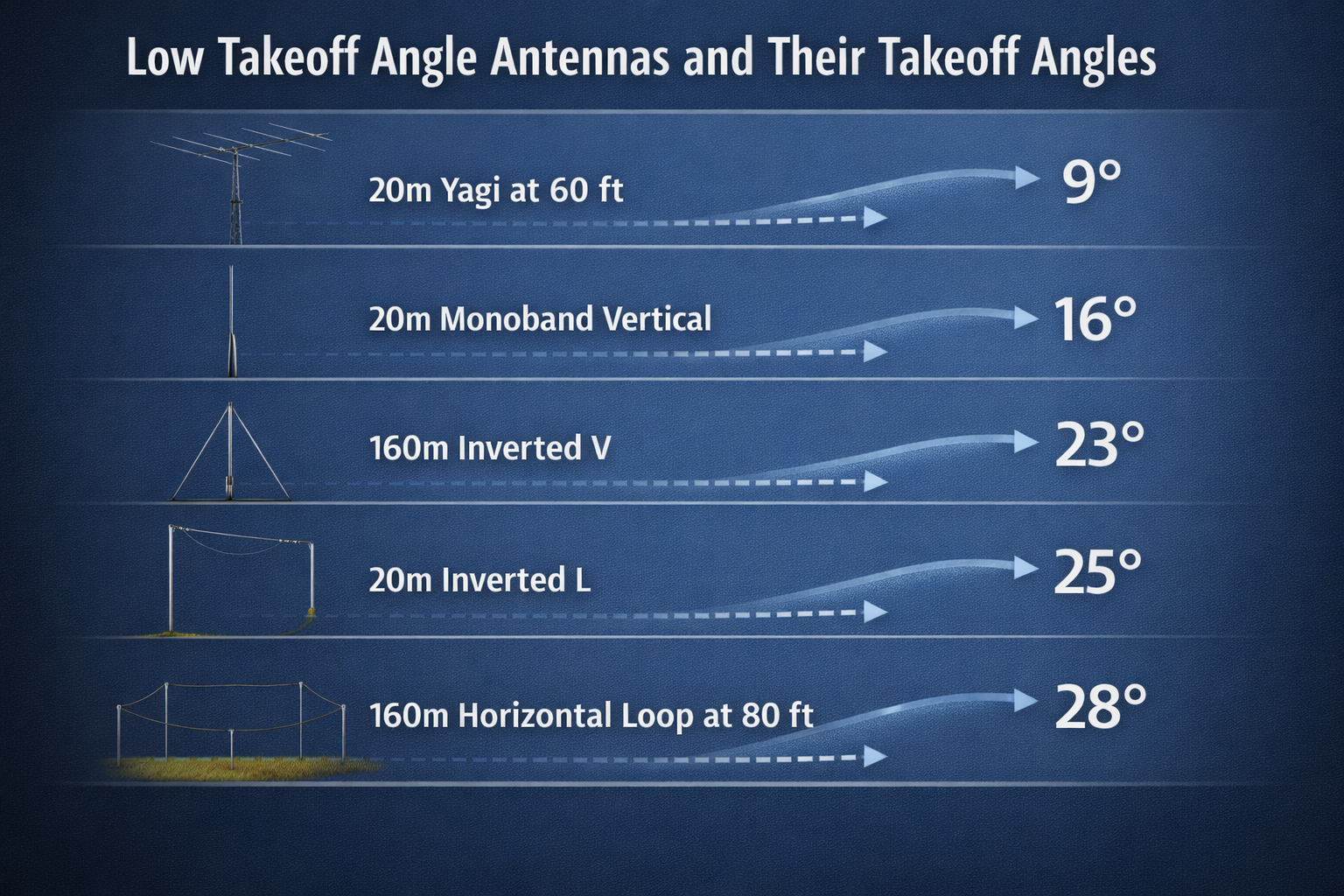
Practical Ways to Lower Your Takeoff Angle
Improving takeoff angle does not always require new equipment. Small adjustments can make a significant difference.
Raising the antenna height is the most effective method. Even a modest increase can flatten the radiation pattern and improve long-distance performance.
Using better ground conditions or relocating the antenna to a more open area can also help. Reducing nearby obstructions improves pattern consistency.
For operators limited by space, choosing antenna designs known for lower radiation angles, such as vertical antennas or elevated dipoles, can improve results without major structural changes.
Measuring and Predicting Takeoff Angles
Modern modeling software, such as antenna simulators, allows operators to predict radiation patterns before installation. These tools show how frequency, height, and ground type influence takeoff angle.
After installation, operators can test performance by observing signal reports, reverse beacon networks, or known propagation paths. By experimenting and adjusting setup parameters, they can fine-tune the antenna for the best possible signal in real-world conditions.
Real-World Operator Insight
Experienced operators often discover that improving antenna placement delivers better results than upgrading equipment. Stations running modest power frequently achieve global contacts simply by optimizing antenna height and takeoff angle.
This highlights a key principle in radio operation: signal geometry often matters more than raw power.
Final Thoughts
Understanding antenna takeoff angles transforms average setups into optimized communication systems. By managing height, location, and design, operators can control how their signals travel, either reaching across continents or strengthening local networks.
The radio propagation depends on angles as much as power, mastering takeoff angle gives any ham operator the confidence to communicate farther, clearer, and more effectively under all conditions.
Frequently Asked Questions
What is the best takeoff angle for DX?
The best takeoff angle for long-distance DX communication is typically between 5° and 15°, allowing signals to travel far across the ionosphere.
Does antenna height affect takeoff angle?
Yes, antenna height is one of the most important factors. Higher antennas generally produce lower takeoff angles, improving long-distance performance.
Can you change takeoff angle without raising the antenna?
Yes, ground conditions, antenna design, and nearby obstructions can influence takeoff angle, although height remains the most effective adjustment.
Is a low takeoff angle always better?
No, low angles are best for DX, but higher angles are better for regional and emergency communication using NVIS propagation.
About the Author
Vince, W2KU, is a licensed Extra class amateur radio operator and the founder of Ham Shack Reviews. The committee named him Amateur of the Year in 2026 for his contributions to amateur radio education and equipment evaluation.
He primarily operates HF, knows propagation very well, operates mobile and handhelds daily. Vince exchanges QSL cards for DXCC, contest confirmation, and award tracking and is the club QSL manager. His guidance focuses on practical operating procedures, accurate logging, and real-world amateur radio practices.
Please consider Donating to help support this channel