

Kenwood TM-D750A Quick Answer (Featured Snippet)
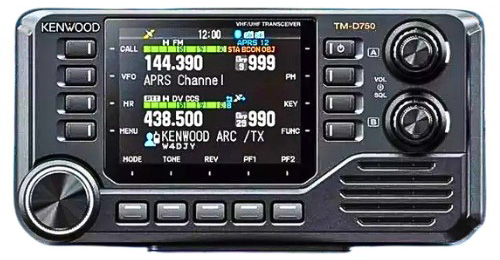
The Kenwood TM-D750A is a fully integrated triband mobile amateur radio covering the 144 MHz, 220 MHz, and 430 MHz bands. It combines APRS packet communication, D-STAR digital voice networking, built-in GPS positioning, wireless LAN connectivity, and simultaneous dual reception into a single self-contained system. Because these features operate without external controllers or interface hardware, the TM-D750A functions as a complete mobile communication platform capable of voice, data, tracking, and digital networking from one radio.
If you would like to see more radios including other models and brands, check out the Complete Guide to Ham Radio Transceivers.
Introduction to the Kenwood TM-D750A
The Kenwood TM-D750A represents one of the most technologically integrated mobile amateur radios ever produced for everyday operators. Instead of simply expanding band coverage or adding isolated features, Kenwood designed this radio as a unified communication system. It merges analog voice operation, digital networking, real-time data transmission, and location awareness into a single mobile transceiver.
Mobile amateur radio has evolved far beyond simple repeater communication. Operators now rely on packet data, digital voice networks, automatic position reporting, and wireless connectivity. Consequently, radios that integrate these functions directly into the hardware provide substantial operational advantages. The TM-D750A addresses this shift by embedding networking capability, GPS positioning, and digital communication protocols directly into the radio’s architecture.
Because the system integrates these technologies internally, operators do not need separate GPS receivers, digital voice interface boxes, packet controllers, or network bridges. Installation becomes simpler, system reliability improves, and operating capability expands significantly.
Kenwood also engineered the TM-D750A to operate equally well in mobile and stationary environments. The compact RF deck, detachable control head, and independent dual receivers allow installation in vehicles, emergency response platforms, and base station setups without compromise.
Review Summary and Overall Verdict
The Kenwood TM-D750A stands at the high end of mobile amateur radio capability because it combines multiple communication technologies into one cohesive platform. It delivers triband coverage, advanced APRS packet operation, direct D-STAR digital networking, wireless LAN connectivity, integrated GPS tracking, and simultaneous dual reception.
Most mobile radios require external hardware to achieve this level of functionality. The TM-D750A eliminates those requirements. As a result, it reduces installation complexity while expanding operational capability.
Operators who want a fully network-capable mobile communication system will find the TM-D750A exceptionally powerful. Its design supports everyday repeater use, digital voice networking, vehicle tracking, emergency communication coordination, and packet radio operation without additional equipment.
In practical terms, this radio replaces multiple separate devices while improving integration and reliability.
What Makes the Kenwood TM-D750A Different From Traditional Mobile Radios
Many mobile radios provide dual-band coverage or basic digital features. However, most still rely on external devices for advanced communication tasks. For example, typical APRS operation requires a separate GPS receiver and packet controller. Digital voice networking often requires interface modules or hotspot devices. Wireless connectivity typically depends on external hardware.
The TM-D750A eliminates these dependencies. Its internal architecture includes a KISS TNC for packet radio, an integrated GPS receiver for position tracking, and built-in wireless networking for digital communication access.
Because these components operate within the radio itself, configuration becomes more straightforward. System reliability improves because fewer external cables and devices are involved. Furthermore, power management becomes simpler because the entire communication system runs from a single unit.
Kenwood also designed the user interface to support this level of integration. The color display, voice guidance system, and logical menu structure help operators manage complex features without requiring extensive technical setup during operation.
Tri-Band Frequency Coverage and Practical Operating Advantages
The TM-D750A operates across three major amateur VHF and UHF bands:
2 meters: 144–148 MHz
1.25 meters: 222–225 MHz
70 centimeters: 420–450 MHz
Each band serves different communication roles in real operating environments. The 2-meter band supports widespread repeater infrastructure and local communication. The 70-centimeter band offers dense repeater coverage and strong urban penetration. The 1.25-meter band often experiences lower congestion, which can improve signal clarity.
Because the TM-D750A covers all three bands, operators gain access to more repeaters, more simplex channels, and more operating flexibility. In emergency communication scenarios, this expanded coverage allows operators to switch bands if one becomes congested or unavailable.
Tri-band coverage also benefits digital networking. Different repeaters and gateways may operate on different bands. Having access to all three increases connectivity options without requiring multiple radios.
Advanced APRS Capabilities and Packet Radio Operation
Automatic Packet Reporting System functionality forms one of the most powerful aspects of the TM-D750A. The radio supports full APRS protocol implementation, including position reporting, text messaging, telemetry, and network routing.
Because the radio includes a built-in KISS TNC, packet radio operation does not require external hardware. Operators can connect the radio directly to a computer for packet communication or configure it to operate as a standalone digipeater or iGate.
The integrated GPS receiver continuously provides accurate position data. Therefore, the radio can automatically transmit location updates at configurable intervals. This capability supports vehicle tracking, event coordination, search and rescue operations, and real-time situational awareness.
High-speed packet operation at both 1200 and 9600 bps allows flexible network integration. Consequently, the TM-D750A functions as both a communication device and a network infrastructure component.
D-STAR Digital Voice Networking and Connectivity
Digital voice networking significantly expands communication range beyond local repeaters. The TM-D750A supports D-STAR digital voice and data operation directly within the radio.
Wireless LAN, Bluetooth, and USB connectivity provide multiple network access options. Operators can connect to digital networks without requiring external hotspot devices.
Reflector Terminal Mode allows connection to D-STAR reflectors through a computer or compatible device. This enables worldwide communication through network linking while maintaining control from the radio itself.
Because digital networking capability is built into the radio, operators gain global communication access without adding hardware complexity.
Wireless LAN Integration and Modern System Connectivity
Wireless networking fundamentally changes mobile radio capability. Instead of connecting to digital networks through external adapters, the TM-D750A communicates directly through its internal wireless interface.
This allows seamless access to digital infrastructure and simplifies station design. USB-C connectivity further enhances system integration, supporting data transfer and firmware updates. MicroSD storage expands data logging and operational recording capacity.
These features position the TM-D750A as a modern communication platform rather than a traditional analog mobile radio.
Simultaneous Dual Reception and Operational Awareness
Independent dual receivers allow the TM-D750A to monitor two signals at the same time. Operators can track APRS traffic while monitoring a voice repeater, or listen to multiple communication channels simultaneously.
In emergency communication environments, this capability significantly improves situational awareness. Operators can maintain contact with command channels while monitoring field activity.
Because both receivers operate independently, signal monitoring does not require manual switching.
Display System and Mobile Usability
The 3.45-inch TFT color display provides high brightness and wide viewing angles. This ensures visibility in bright daylight and low-light environments.
The detachable control head allows flexible installation. The RF deck can be mounted in concealed locations while the control panel remains accessible. The integrated speaker improves audio clarity in mobile environments.
Voice guidance provides spoken feedback for operational changes, which enhances usability during vehicle operation.
Audio Performance and Receiver Quality
Kenwood radios are widely recognized for high-quality audio reproduction. The TM-D750A delivers clear, balanced audio that improves intelligibility in weak signal conditions.
Receiver performance supports reliable communication across varying signal strengths. Combined with digital networking and packet operation, this ensures consistent communication capability across different environments.
Pros and Cons of the Kenwood TM-D750A
Pros
Fully integrated APRS, GPS, and digital networking
Tri-band coverage including 220 MHz
Simultaneous dual reception
Wireless LAN connectivity
Standalone packet radio capability
Cons
Higher cost than basic mobile radios
Advanced feature set requires learning time
Digital networking depends on infrastructure availability
TM-D750A vs TM-D710G Comparison
| Feature | TM-D750A | TM-D710G |
|---|---|---|
| Bands | 144 / 220 / 430 MHz | 144 / 430 MHz |
| D-STAR | Built-in | Not supported |
| Wireless LAN | Yes | No |
| GPS | Built-in | Built-in |
| APRS | Advanced | Standard |
| Packet Radio | Full KISS TNC | Limited |
| USB-C | Yes | No |
| Network Access | Direct wireless | External hardware |
Buying Decision Guide
Choose the TM-D750A if you want an integrated digital communication platform that supports packet radio, digital voice networking, and automatic tracking. Choose a simpler dual-band radio if you only need local analog repeater communication.
Buyer Recommendation
Operators who want a single radio that handles voice communication, digital networking, APRS tracking, and packet radio without external devices will find the TM-D750A one of the most complete mobile communication solutions available.
Technical Specifications Overview
144–148 MHz
222–225 MHz
420–450 MHz
3.45 inch TFT display
Bluetooth
USB-C
Wireless LAN
MicroSD
Built-in GPS
APRS
D-STAR
KISS TNC
Internal Link Anchor Text
mobile antenna installation guide
APRS configuration tutorial
D-STAR beginner guide
mobile radio installation best practices
About the Author
Vince, W2KU, is a licensed Extra class amateur radio operator and the founder of Ham Shack Reviews. He was named Amateur of the Year in 2026 for his contributions to practical amateur radio education and equipment evaluation.
He actively operates HF, mobile and fixed stations and regularly tests mobile and handheld radios in real operating conditions, including repeater operation, vehicle installations, and digital network communication. His work focuses on RF performance, usability, and long-term reliability across everyday operating environments.
Through hands-on testing and real-world operation, his reviews help radio operators choose equipment that performs consistently when communication matters most.
Final Evaluation of the Kenwood TM-D750A
The Kenwood TM-D750A combines triband operation, APRS data communication, D-STAR digital voice, wireless networking, and integrated GPS into a single compact platform. Because it integrates advanced communication technology with practical mobile design, it delivers exceptional flexibility and performance.
Operators who need reliable, network-capable communication in both mobile and stationary environments will find the TM-D750A highly capable. Its combination of advanced features, modern connectivity, and proven audio performance positions it among the most versatile mobile transceivers available today.
Frequently Asked Questions About the Kenwood TM-D750A
Does it require external APRS hardware? No.
Does it support D-STAR directly? Yes.
Can it monitor two frequencies? Yes.
Does it include GPS? Yes.