

Tropospheric Ducting Explained: How It Works, When It Happens, and Why It Extends Radio Range
Tropospheric ducting is one of the most powerful and fascinating natural propagation mechanisms affecting VHF, UHF, and microwave radio communication. Under the right atmospheric conditions, radio signals that normally travel only line-of-sight can instead follow curved paths through the lower atmosphere, traveling hundreds or even thousands of miles beyond their expected range.
This phenomenon occurs in the troposphere — the lowest layer of Earth’s atmosphere — where temperature, humidity, and pressure gradients alter how radio waves bend. When these atmospheric changes become strong enough, they create a refractive boundary that traps radio waves between layers of air, forming a propagation channel known as a duct.
Signals entering this duct can travel long distances with relatively low loss, enabling extraordinary communication paths that would otherwise be impossible without satellites or repeaters.
Understanding tropospheric ducting allows radio operators, broadcasters, and engineers to predict unusual signal behavior, take advantage of long-distance openings, and manage interference caused by extended propagation.
Quick Answer: What Is Tropospheric Ducting?
Tropospheric ducting occurs when atmospheric layers trap radio waves and guide them along the Earth’s surface, allowing signals to travel far beyond normal line-of-sight range.
Quick Answer: Which Frequencies Are Affected Most?
Tropospheric ducting primarily affects VHF, UHF, and microwave frequencies, typically from about 30 MHz up to several GHz.
The Troposphere and Radio Propagation
The troposphere extends from the Earth’s surface to roughly 6 to 12 miles in altitude depending on location. This layer contains most of the atmosphere’s water vapor and weather activity, making it highly dynamic and variable.
Radio waves traveling through the troposphere are continuously refracted — or bent — due to small changes in air density. Under normal conditions, this bending slightly extends radio range beyond the geometric horizon.
However, when strong refractive gradients form, bending becomes extreme enough to trap radio waves between layers, forming a propagation duct.
How Tropospheric Ducting Works Physically
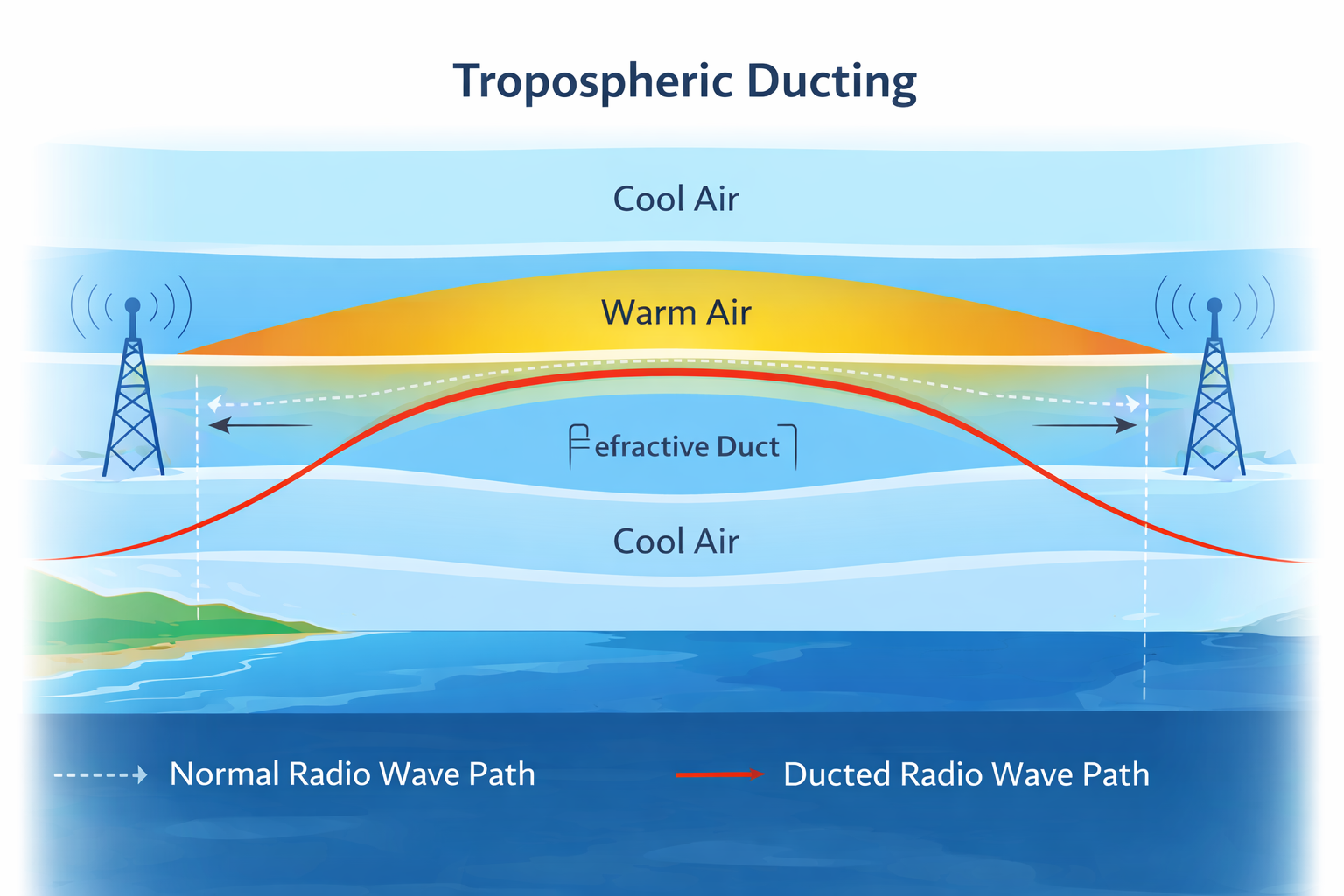
Tropospheric ducting occurs when the refractive index of air changes rapidly with height. Normally, air density decreases gradually with altitude, causing mild downward bending of radio waves.
When temperature or humidity changes sharply over a small vertical distance, the refractive index gradient becomes strong enough to bend radio waves back toward the Earth before they escape upward. This repeated bending traps the signal between two atmospheric boundaries.
The signal then travels along the curvature of the Earth inside this invisible atmospheric waveguide.
Temperature Inversions and Their Role
The most common cause of tropospheric ducting is a temperature inversion.
Normally, air temperature decreases with altitude. During an inversion, warmer air sits above cooler air near the surface. This creates a sharp density boundary that strongly refracts radio waves downward.
Temperature inversions often form:
Over land at night as ground cools
Over oceans where water temperature stabilizes air layers
Under high-pressure systems with sinking air
In calm weather with little vertical mixing
These stable layers are ideal for duct formation.
Humidity Gradients and Moisture Layers
Rapid changes in humidity also influence refractive index. Moist air is less dense than dry air at the same temperature. When humidity changes sharply with height, strong refractive gradients form.
This is especially common over oceans where evaporation creates moisture-rich air near the surface beneath drier air above.
These maritime ducts can persist for long periods and support extremely long propagation paths.
High-Pressure Systems and Atmospheric Stability
Persistent high-pressure systems compress and stabilize atmospheric layers. Sinking air warms and forms temperature inversions, while calm conditions prevent vertical mixing.
These stable conditions allow refractive layers to remain intact, increasing the probability and duration of tropospheric ducting events.
Types of Tropospheric Ducts
Surface ducts form when trapping occurs near ground level.
Elevated ducts form above the surface and may not be detectable from ground measurements alone.
Evaporation ducts form over warm ocean surfaces due to moisture gradients.
Each type supports long-distance propagation but behaves differently in altitude and stability.
Frequency Behavior in Ducting Conditions
Higher frequencies bend more strongly in refractive gradients. This makes VHF, UHF, and microwave signals particularly sensitive to ducting.
Typical affected services include:
FM broadcast
Television transmission
Marine VHF
Aviation communication
Amateur VHF and UHF bands
Radar systems
Point-to-point microwave links
Lower HF frequencies are usually unaffected because ionospheric propagation dominates their behavior.
When Tropospheric Ducting Is Most Likely
Tropospheric ducting commonly occurs under these conditions:
Clear skies with little wind
Strong high-pressure systems
Nighttime surface cooling
Early morning temperature inversions
Warm air over cool water
Stable summer weather patterns
Subtropical and coastal regions
Many of the strongest events occur overnight and peak near sunrise.
Geographic Regions With Frequent Ducting
Coastal regions and open ocean areas experience ducting most often due to stable marine air layers. Desert regions with strong nighttime cooling also produce frequent inversions.
Subtropical high-pressure belts are especially favorable environments.
Real-World Communication Distances
Under strong ducting conditions, VHF and UHF signals can travel hundreds to over a thousand miles with relatively low attenuation.
FM radio stations may be received far outside their normal coverage. Amateur operators may contact stations across entire countries or oceans using modest power.
Benefits of Tropospheric Ducting
Extended communication range without infrastructure
Improved reception of distant broadcast signals
Opportunities for long-distance amateur contacts
Enhanced maritime communication
Atmospheric research capability
For radio enthusiasts, ducting events provide rare and exciting long-range openings.
Problems and Interference Effects
While beneficial for long-distance communication, ducting can cause serious interference.
Signals from distant transmitters may appear in local coverage areas, creating frequency congestion. Broadcast and communication systems may receive unexpected overlapping signals from far outside intended service zones.
This can degrade reliability in regulated communication networks.
Predicting Tropospheric Ducting
Meteorological data provides clues to duct formation.
Indicators include:
Strong temperature inversions
Rapid humidity changes
Stable high-pressure systems
Warm air over cool surfaces
Low wind speeds
Weather models and atmospheric soundings help identify refractive layers.
Refractivity and Atmospheric Measurement
Radio refractivity describes how strongly air bends radio waves. It depends on temperature, pressure, and water vapor content.
Meteorologists measure refractivity gradients to determine whether super-refraction or ducting is present.
Negative refractivity gradients indicate potential trapping layers.
Tropospheric Scatter vs Tropospheric Ducting
Tropospheric scatter allows weak signals to travel beyond line-of-sight through atmospheric irregularities, it is far stronger and more efficient because signals are confined within a waveguide.
Scatter produces weak extended coverage. Ducting produces strong long-distance communication.
Practical Operating Strategy for Radio Operators
Monitor weather patterns for stable high-pressure systems.
Check coastal or marine temperature differences.
Listen during nighttime and early morning.
Scan VHF and UHF bands for distant signals.
Use directional antennas to exploit propagation paths.
Experienced operators actively search for ducting openings during favorable atmospheric conditions.
Equipment Performance During Ducting
Directional antennas significantly improve results. Low-noise receivers enhance weak signal detection. Stable frequency control helps identify distant stations accurately.
High antenna elevation can improve access to elevated ducts.
Common Misinterpretations
Tropospheric ducting is sometimes confused with ionospheric skip, sporadic-E propagation, or equipment malfunction. Unlike ionospheric reflection, ducting occurs entirely within the lower atmosphere.
Applications Beyond Amateur Radio
Radar horizon extension
Over-the-horizon detection
Marine safety communication
Long-range microwave links
Atmospheric research
Understanding ducting improves communication planning in many technical fields.
Frequently Asked Questions
How far can tropospheric ducting carry signals?
Distances can exceed 1,000 miles under strong conditions.
Does ducting happen every day?
No. It depends on specific atmospheric conditions.
Can ducting be predicted accurately?
It can be forecast probabilistically but not precisely.
About the Author
Vince is a licensed amateur radio operator and the founder of Ham Shack Reviews. He regularly tests mobile and handheld radios in real operating conditions, including repeater use, mobile installations, and digital network communication. His reviews focus on real-world performance, reliability, and practical setup so operators can choose equipment that works when it matters most.
Tropospheric Ducting
Tropospheric ducting demonstrates how atmospheric structure can dramatically reshape radio communication. By trapping radio waves within refractive layers of the troposphere, signals can travel vast distances far beyond normal line-of-sight limits. Understanding the meteorological conditions that produce ducting allows operators and engineers to predict unusual propagation, exploit extended communication paths, and manage interference caused by distant signals. As atmospheric science and radio technology continue to evolve, tropospheric ducting remains one of the most important natural mechanisms influencing VHF and UHF propagation.
Please consider Donating to help support this channel