
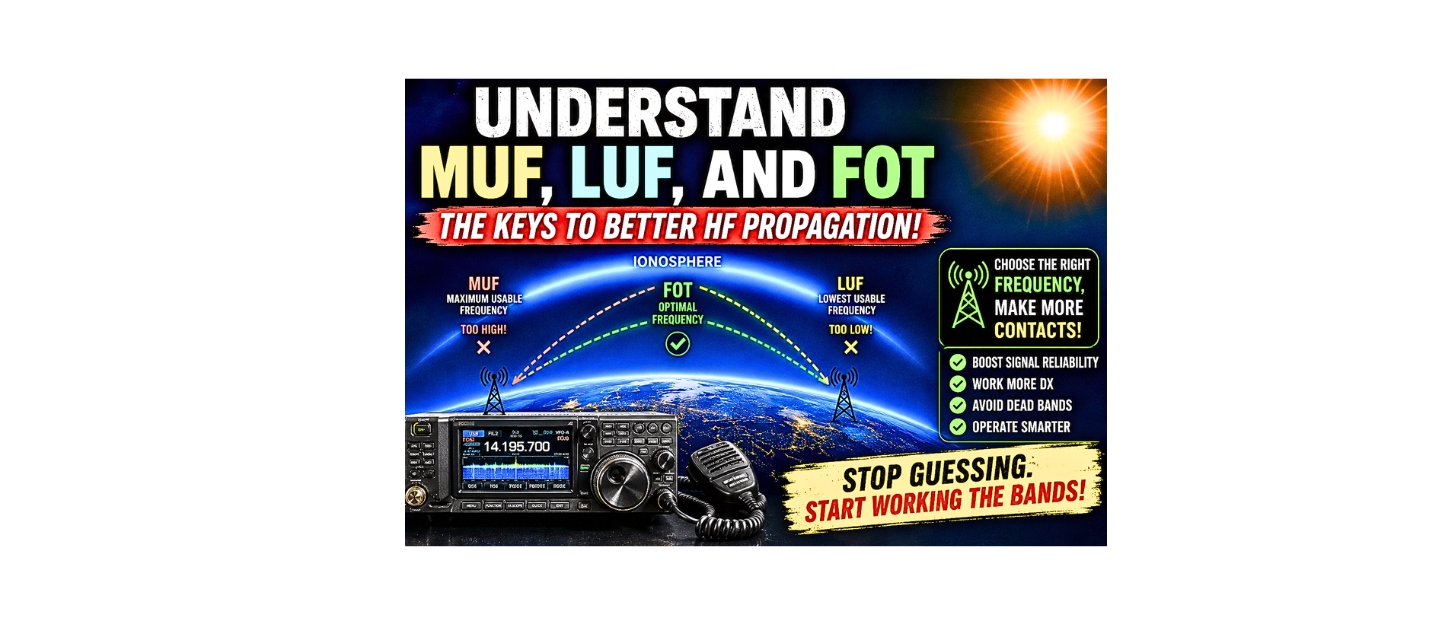
Amateur radio operators who understand MUF, LUF, and FOT to make better operating decisions and achieve more consistent long-distance communication. While antennas, power output, and equipment all contribute to station performance, the ionosphere ultimately determines whether a signal reaches a distant station or disappears into space. Learning how propagation changes throughout the day allows you to select the best amateur radio band instead of relying on trial and error.
Want to learn more about propagation? Try Complete Guide to Ham Radio Propagation
Understand MUF, LUF, and FOT
Three propagation terms form the foundation of HF operating: Maximum Usable Frequency (MUF), Lowest Usable Frequency (LUF), and Frequency of Optimum Transmission (FOT).
Together, they define the usable frequency window for a specific communication path. Understanding how these values change helps you recognize band openings, avoid dead frequencies, and improve your chances of making successful contacts.
Solar radiation, time of day, seasonal variations, and geomagnetic activity continuously affect the ionosphere. As these conditions change, the usable frequency range changes with them.
A band that supports worldwide DX during the afternoon may close completely after sunset, while another band becomes the better choice. Operators who understand these changes adapt quickly and spend more time making contacts.
Whether you enjoy chasing DX, participating in contests, activating parks, or simply talking with friends around the world, understanding MUF, LUF, and FOT provides the knowledge needed to choose the right frequency at the right time.
Want to learn more about propagation? Read our Complete Guide to Ham Radio Propagation.
Quick Answer
MUF, LUF, and FOT define the usable frequency window for HF communication. The Maximum Usable Frequency (MUF) identifies the highest frequency that will return to Earth over a specific path. The Lowest Usable Frequency (LUF) identifies the lowest frequency capable of reliable communication. The Frequency of Optimum Transmission (FOT) falls between those limits and represents the most dependable operating frequency for that path.
At a Glance
| Term | Meaning | Why It Matters |
|---|---|---|
| MUF | Maximum Usable Frequency | Highest frequency that returns to Earth |
| LUF | Lowest Usable Frequency | Lowest frequency that supports reliable communication |
| FOT | Frequency of Optimum Transmission | Most reliable operating frequency between the MUF and LUF |
What Is MUF?
The Maximum Usable Frequency (MUF) represents the highest radio frequency that the ionosphere can refract back to Earth for a specific communication path. When you transmit above the MUF, your signal passes through the ionosphere and continues into space instead of returning to Earth. As a result, reliable long-distance communication becomes impossible on that frequency.
The MUF changes continuously because the ionosphere constantly responds to solar radiation. During daylight hours, increased ionization strengthens the ionosphere and allows it to refract higher frequencies. These conditions often open the 15-meter and 10-meter amateur radio bands for long-distance contacts that would not be possible during periods of lower ionization.
After sunset, ionization gradually weakens. As the ionosphere loses energy, the MUF falls and higher-frequency bands begin to close. Operators often shift to lower HF bands because they continue to support reliable propagation after higher bands become ineffective.
Solar activity also plays an important role. Strong solar flux generally raises the MUF by increasing ionization, while geomagnetic disturbances can lower the MUF and reduce the number of usable frequencies. Successful operators monitor these changes and adjust their operating band as propagation evolves throughout the day.
Understanding LUF
The Lowest Usable Frequency (LUF) defines the lowest frequency capable of supporting reliable communication over a specific path. Signals transmitted below the LUF lose too much energy through ionospheric absorption before reaching their destination. Even if a signal leaves the antenna efficiently, excessive absorption can prevent successful communication.
Unlike the MUF, which establishes the upper operating limit, the LUF establishes the lower boundary of the usable propagation window. Reliable communication occurs only when your operating frequency remains between these two limits.
Atmospheric noise and ionospheric absorption both influence the LUF. During daylight hours, increased absorption often raises the LUF, reducing the effectiveness of lower-frequency bands. After sunset, absorption decreases, allowing lower bands to provide stronger and more reliable communication.
Geomagnetic disturbances can temporarily raise the LUF as well. When this happens, frequencies that normally perform well may no longer support dependable contacts. Recognizing these changing conditions helps operators avoid wasting time calling on bands that cannot support their signal.
Understanding FOT
The Frequency of Optimum Transmission (FOT) represents the most reliable operating frequency between the LUF and the MUF. Instead of operating near the highest possible frequency, many experienced operators choose the FOT because it offers the best balance between signal strength and propagation stability.
In many situations, the FOT falls at approximately 80 to 85 percent of the MUF. This operating range provides a margin of safety if ionospheric conditions change unexpectedly. Rather than losing the communication path when the MUF drops slightly, operators working near the FOT often maintain reliable communication.
For example, if the MUF reaches 18 MHz for a particular path, the FOT generally falls around 14 to 15 MHz. Under these conditions, the 20-meter amateur band often provides dependable performance while remaining safely below the upper propagation limit.
Although communication above the FOT sometimes succeeds, changing ionospheric conditions can quickly interrupt those contacts. Operating near the FOT usually delivers more consistent results, especially during periods of changing propagation.
Understand MUF, LUF, and FOT ad How They Work Together
Understand MUF, LUF, and FOT together to define the usable operating window for HF communication. Rather than viewing them as separate measurements, operators should consider them parts of the same propagation system.
The LUF establishes the lowest usable frequency, while the MUF establishes the highest usable frequency. The FOT identifies the most dependable operating frequency between those boundaries. As ionospheric conditions change throughout the day, all three values shift together, creating new operating opportunities while closing others.
When the MUF remains high and the LUF stays low, operators enjoy a wide range of usable frequencies. Multiple amateur radio bands may support reliable communication at the same time, creating excellent opportunities for DX contacts and extended operating sessions.
When the MUF falls and the LUF rises, the usable frequency window narrows. Operators must choose their frequencies more carefully because fewer bands remain capable of supporting reliable communication. Understanding this relationship helps you anticipate propagation changes, recognize new band openings, and move to a more effective frequency before conditions deteriorate.
Factors That Affect HF Propagation
Several natural forces continuously change the ionosphere, causing the MUF, LUF, and FOT to rise and fall throughout the day. By understanding these factors, amateur radio operators can anticipate changing band conditions and select frequencies that provide the greatest opportunity for successful communication.
Solar Activity
The Sun supplies the energy that ionizes Earth’s upper atmosphere. As solar radiation increases, ionization becomes stronger, allowing the ionosphere to refract higher radio frequencies back toward Earth. Strong ionization generally raises the MUF and expands the number of HF bands capable of supporting long-distance communication.
When solar activity decreases, ionization weakens and the MUF falls. Higher-frequency bands gradually close, requiring operators to move to lower frequencies that continue to propagate reliably. Monitoring solar conditions helps operators understand why band openings occur and when they are likely to change.
Time of Day
The ionosphere follows a daily cycle that directly affects HF propagation. During daylight hours, solar radiation strengthens ionization and supports higher operating frequencies. As evening approaches, ionization gradually decreases, lowering the MUF while often improving propagation on lower-frequency bands.
These predictable daily changes explain why operators regularly change bands throughout an operating session. Following the movement of the propagation window allows you to stay on the most productive frequencies as conditions evolve.
Seasonal Changes
Seasonal changes also influence propagation because daylight hours and solar illumination vary throughout the year. As these conditions change, the ionosphere responds differently, affecting both the usable frequency range and the duration of band openings.
Observing seasonal propagation patterns helps operators recognize when certain bands typically perform better and when they are less likely to support reliable communication.
Geomagnetic Activity
Geomagnetic disturbances can change propagation conditions within a short period. Increased geomagnetic activity may lower the MUF, raise the LUF, or reduce overall signal quality across multiple bands.
Because these events can develop quickly, operators who monitor propagation conditions can react faster by selecting frequencies that continue to support reliable communication.
Atmospheric Noise
Atmospheric noise also influences usable frequencies. Higher noise levels reduce the effectiveness of lower-frequency signals and may raise the LUF, while lower noise levels improve reception and expand the usable operating window.
Although atmospheric noise does not directly change the ionosphere, it affects how well operators receive weak signals, making it an important part of successful HF operation.
Tools for Tracking Propagation
Experience remains valuable, but modern propagation tools provide additional insight into changing ionospheric conditions. Many amateur radio operators use these resources to estimate propagation before calling CQ or beginning a scheduled contact.
Common propagation resources include:
- Solar Flux Index (SFI)
- A-index
- K-index
- MUF prediction charts
- Propagation maps
- Ionospheric models
- HF propagation forecasting software
Using these resources together provides a clearer picture of current band conditions. Comparing real-time propagation data with actual on-the-air results helps operators recognize changing trends and make better operating decisions.
Practical Amateur Radio Applications
Understand MUF, LUF, and FOT to provide practical benefits during everyday operation. Instead of relying on guesswork, operators can use propagation knowledge to improve efficiency and increase the likelihood of successful contacts.
DXing
Long-distance communication depends heavily on propagation. Knowing when the MUF rises allows DX operators to take advantage of higher amateur radio bands before conditions change. Operating near the FOT also improves communication reliability by providing a more stable propagation path.
Contesting
Contest operators constantly move between bands as propagation changes throughout the event. Understanding the relationship between the MUF, LUF, and FOT helps them identify productive bands more quickly and maintain higher contact rates.
Everyday Operating
Even casual operators benefit from understanding propagation. Rather than spending time calling on inactive bands, they can choose frequencies that currently support reliable communication and enjoy more productive operating sessions.
Emergency Communications
Reliable communication becomes especially important during emergency operations. Understanding propagation allows operators to select frequencies that provide dependable coverage as conditions change throughout the day.
Common Operating Mistakes
Many unsuccessful contacts result from selecting the wrong frequency instead of poor equipment performance. Avoiding several common mistakes can significantly improve operating success.
- Operating above the MUF and expecting the signal to return to Earth.
- Calling below the LUF where ionospheric absorption weakens the signal.
- Remaining on the same band after propagation conditions change.
- Ignoring solar and geomagnetic conditions before operating.
- Assuming today’s propagation will match yesterday’s conditions.
Recognizing these situations allows operators to adapt more quickly and spend more time making contacts.
Frequently Asked Questions
What does MUF stand for?
MUF stands for Maximum Usable Frequency, the highest frequency the ionosphere can refract back to Earth for a specific communication path.
What does LUF stand for?
LUF stands for Lowest Usable Frequency, the lowest frequency capable of supporting reliable communication over a specific path.
What does FOT stand for?
FOT stands for Frequency of Optimum Transmission and identifies the most reliable operating frequency between the MUF and the LUF.
Why does the MUF change during the day?
Solar radiation continuously changes ionization within the ionosphere. As ionization increases and decreases, the MUF rises and falls throughout the day.
Why won’t signals above the MUF reach distant stations?
Signals transmitted above the MUF pass through the ionosphere instead of refracting back toward Earth, preventing long-distance communication along that path.
Does solar activity affect HF propagation?
Yes. Solar activity directly influences ionization within the ionosphere, affecting the MUF, LUF, FOT, and overall propagation conditions.
Why do experienced operators use the FOT?
Operating near the FOT generally provides the best balance between signal strength and propagation reliability, reducing the chance of losing the communication path as conditions change.
Final Thoughts
Understand MUF, LUF, and FOT to remove much of the guesswork from HF operation. Instead of relying solely on experience, you can evaluate changing propagation conditions and select frequencies that offer the greatest opportunity for successful communication.
As you spend more time on the air, you will begin to recognize how solar activity, time of day, seasonal changes, and geomagnetic conditions influence the amateur radio bands. Combining that knowledge with real-time propagation information allows you to anticipate band openings, respond to changing conditions, and improve your operating results.
If your goal is working rare DX stations, competing in contests, supporting emergency communications, or even enjoying casual conversations, to understand MUF, LUF, and FOT willgives you a stronger understanding of HF propagation and helps you become a more confident and successful amateur radio operator.
Please consider Donating to help support this channel