
The voluntary band plan chart organizes amateur radio frequencies so different operating modes can coexist without interference. Instead of forcing operators into rigid rules, the plan relies on cooperation and good operating practice. When operators respect these informal boundaries, everyone can enjoy cleaner signals, fewer conflicts, and more predictable band activity.
Each segment of a band tends to attract specific modes such as CW, digital, SSTV, AM, or voice. Because these modes use different bandwidths and operating styles, separating them reduces interference. Narrow digital signals do not mix well with wide SSB transmissions, and weak signal DX work requires quieter spectrum than casual conversation. Therefore, voluntary band planning helps maintain order while still allowing flexibility.
Although no regulation requires strict compliance, experienced operators treat these allocations seriously. Respecting them demonstrates operating skill, courtesy, and awareness of how shared spectrum functions in practice.
Why Voluntary Band Plan Chart Exist
Voluntary Band Plan Chart organizes how different transmission modes share the amateur radio spectrum. Because many signals use different bandwidths and transmission methods, separating them into recommended frequency segments reduces interference and improves communication efficiency.
For example, narrow bandwidth modes such as CW require very little spectrum space, while voice transmissions use much wider bandwidth. If these signals occupy the same frequencies, both become difficult to copy. Band plans group similar signal types together so operators can communicate clearly without disrupting other activity.
Although voluntary band plans are not enforced regulations, they are widely accepted operating practices that help maintain order across shared frequency space.
How Band Plans Developed Over Time
Voluntary band planning developed gradually as amateur radio activity expanded and new transmission modes appeared. Early radio operation involved fewer signals and less congestion, but modern bands support voice, digital communication, image transmission, and automated systems simultaneously. Informal organization became necessary to prevent constant overlap.
Over time, commonly accepted operating areas formed through shared experience. Operators learned which segments worked best for specific activities, and those habits evolved into standardized band planning. What began as practical convenience eventually became an essential operating framework.
Why Voluntary Band Plans Exist
The Voluntary Band Plan Chart organizes how different transmission modes share the amateur radio spectrum. Because signals use different bandwidths and transmission methods, separating them into recommended frequency segments reduces interference and improves communication efficiency.
Narrow bandwidth modes such as CW require very little spectrum, while voice transmissions occupy much wider space. If these signals overlap, both become difficult to copy. Band plans group similar signal types together so operators can communicate clearly without disrupting other activity.
Although voluntary band plans are not regulations, they are widely accepted operating practices that help maintain order across shared frequency space.
Why Voluntary Band Planning Exists
Amateur radio bands carry many different types of signals simultaneously. Some operators chase rare DX, while others experiment with digital modes, run QRP stations, or enjoy vintage AM equipment. Without organization, these activities would constantly overlap.
Voluntary band planning solves this by encouraging similar modes to cluster together. Consequently, operators know where to listen for specific activities. Digital enthusiasts find digital signals. Weak signal operators find quiet space. Voice operators gather in predictable ranges.
This organization improves efficiency and reduces frustration. More importantly, it preserves the cooperative culture that has historically defined amateur radio.
How to Use a Band Plan Chart Effectively
A band plan chart is more than a reference list. It is a practical operating tool. Before transmitting, experienced operators check where they are in the band and confirm that their mode matches the typical activity in that segment.
Listening first always matters. Even when operating inside a recommended segment, existing activity takes priority. The band plan guides placement, but situational awareness determines actual operation.
Understanding typical calling frequencies also helps. Certain frequencies attract specific modes or serve as gathering points for specialized activity. Learning these locations speeds up band navigation and improves contact success.
Respecting Mode Separation and Signal Width
Different transmission types occupy different bandwidths. CW and many digital modes use very narrow signals. SSB occupies more space. AM and wide digital image modes occupy even more. When wide signals appear in narrow signal segments, they can disrupt multiple ongoing contacts at once.
Therefore, voluntary separation protects weaker signals and prevents unnecessary conflict. Operators who understand bandwidth behavior make better frequency choices and maintain cleaner spectrum.
Why Clean Transmission Matters
Operating in the correct segment is only part of good band practice. Signal quality also affects nearby activity. Over-driven audio, excessive power, or poor transmitter adjustment can cause splatter that extends beyond the intended bandwidth.
Clean transmission preserves the effectiveness of voluntary separation and protects nearby contacts from unintended interference.
The Role of Courtesy in Modern Amateur Radio
Voluntary Band Plan Chart planning works only when operators cooperate. Courtesy keeps the system functional. Listening before transmitting, avoiding occupied frequencies, and respecting common operating areas all reflect experienced practice.
Some operators feel band courtesy has weakened over time, yet consistent respectful behavior still defines strong operating standards. Every operator influences the on-air environment. When individuals operate responsibly, the entire band benefits.
Understanding Each HF and VHF Band Allocation
The following sections outline commonly recognized activity areas within each amateur band. These reflect widely observed operating practices and traditional usage patterns.
Regional Operating Differences
Although activity patterns are widely recognized, they are not identical everywhere. Local operating habits, regional propagation, and population density influence how heavily each segment is used. Some areas concentrate activity more tightly, while others spread it across wider ranges.
Observing local band behavior helps operators apply general band plan guidance more effectively in their specific region.
160 Meter Band Plan (1.8–2.0 MHz)
| Frequency Range | Primary Activity / Mode |
|---|---|
| 1.800 – 2.000 MHz | CW and SSB general operation |
| 1.810 MHz | Digital modes |
| 1.810 MHz | CW QRP |
| 1.843 – 2.000 MHz | SSB, SSTV, wideband modes |
| 1.910 MHz | SSB QRP |
| 1.995 – 2.000 MHz | Experimental |
| 1.999 – 2.000 MHz | Beacons |
80 Meter Band Plan (3.5–4.0 MHz)
| Frequency Range | Primary Activity / Mode |
|---|---|
| 3.570 – 3.600 MHz | RTTY and data |
| 3.590 MHz | RTTY/Data DX |
| 3.600 – 4.000 MHz | Phone |
| 3.790 – 3.800 MHz | DX window |
| 3.845 MHz | SSTV |
| 3.885 MHz | AM calling |
60 Meter Band Plan (Channelized)
| Channel Frequency | Primary Activity / Mode |
|---|---|
| 5.332 MHz | USB voice, CW, digital |
| 5.348 MHz | USB voice, CW, digital |
| 5.3585 MHz | USB voice, CW, digital |
| 5.373 MHz | USB voice, CW, digital |
| 5.405 MHz | USB voice, CW, digital |
USB bandwidth typically limited to 2.8 kHz.
40 Meter Band Plan (7.0–7.3 MHz)
| Frequency Range | Primary Activity / Mode |
|---|---|
| 7.040 MHz | RTTY/Data DX |
| 7.080 – 7.125 MHz | RTTY/Data |
| 7.125 – 7.300 MHz | Phone |
| 7.171 MHz | SSTV |
| 7.290 MHz | AM calling |
30 Meter Band Plan (10.1–10.15 MHz)
| Frequency Range | Primary Activity / Mode |
|---|---|
| 10.130 – 10.140 MHz | RTTY |
| 10.136 MHz | Digital |
| 10.140 – 10.150 MHz | Packet |
(Primarily narrowband data band)
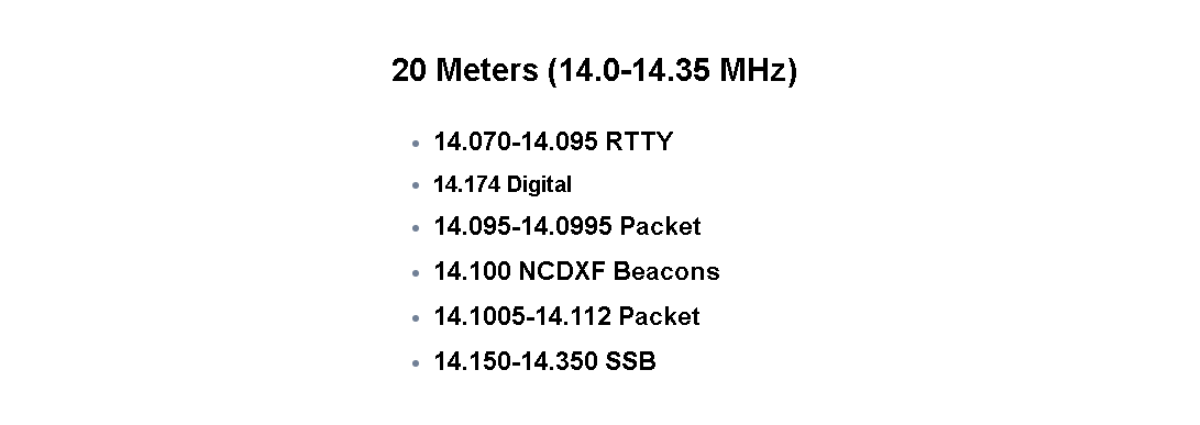
20 Meter Band Plan (14.0–14.35 MHz)
| Frequency Range | Primary Activity / Mode |
|---|---|
| 14.070 – 14.095 MHz | RTTY |
| 14.095 – 14.0995 MHz | Packet |
| 14.100 MHz | NCDXF beacons |
| 14.1005 – 14.112 MHz | Packet |
| 14.150 – 14.350 MHz | SSB |
| 14.174 MHz | Digital |
| 14.230 MHz | SSTV |
| 14.286 MHz | AM calling |
17 Meter Band Plan (18.068–18.168 MHz)
| Frequency Range | Primary Activity / Mode |
|---|---|
| 18.100 – 18.105 MHz | RTTY |
| 18.105 – 18.110 MHz | Packet |
| 18.110 – 18.168 MHz | Phone |
15 Meter Band Plan (21.0–21.45 MHz)
| Frequency Range | Primary Activity / Mode |
|---|---|
| 21.070 – 21.110 MHz | RTTY/Data |
| 21.200 – 21.450 MHz | Phone |
| 21.340 MHz | SSTV |
12 Meter Band Plan (24.89–24.99 MHz)
| Frequency Range | Primary Activity / Mode |
|---|---|
| 24.920 – 24.925 MHz | RTTY |
| 24.925 – 24.930 MHz | Packet |
| 24.930 – 24.990 MHz | SSB and SSTV |
10 Meter Band Plan (28.0–29.7 MHz)
| Frequency Range | Primary Activity / Mode |
|---|---|
| 28.000 – 28.070 MHz | CW |
| 28.070 – 28.150 MHz | RTTY |
| 28.150 – 28.190 MHz | CW |
| 28.200 – 28.300 MHz | Beacons |
| 28.300 – 29.300 MHz | Phone |
| 28.680 MHz | SSTV |
| 29.000 – 29.200 MHz | AM |
| 29.300 – 29.510 MHz | Satellite downlinks |
| 29.520 – 29.590 MHz | Repeater inputs |
| 29.600 MHz | FM simplex |
| 29.610 – 29.700 MHz | Repeater outputs |
6 Meter Band Plan (50–54 MHz)
| Frequency Range | Primary Activity / Mode |
|---|---|
| 50.000 – 50.100 MHz | CW and beacons |
| 50.060 – 50.080 MHz | Beacon subband |
| 50.100 – 50.300 MHz | SSB and CW |
| 50.100 – 50.125 MHz | DX window |
| 50.125 MHz | SSB calling |
| 50.300 – 50.600 MHz | All modes |
| 50.600 – 50.800 MHz | Nonvoice |
| 50.620 MHz | Digital calling |
| 50.800 – 51.000 MHz | Radio remote control |
| 51.000 – 51.100 MHz | Pacific DX window |
| 51.120 – 51.480 MHz | Repeater inputs |
| 51.500 – 51.600 MHz | Simplex |
| 51.620 – 51.980 MHz | Repeater outputs |
| 52.020 / 52.040 MHz | FM simplex |
| 52.525 MHz | Primary FM simplex |
| 52.540 MHz | Secondary FM simplex |
| 53.000 – 53.480 MHz | Repeater inputs |
| 53.500 – 53.980 MHz | Repeater outputs |
How to Use the Voluntary Band Plan Chart in Real Operation
Knowing the band plan is only useful if you apply it while operating. Before transmitting, always identify where you are within the band and confirm that your mode fits the normal activity in that segment. This simple habit prevents interference and helps maintain an orderly operating environment.
Listening first remains the most important step. Even when you are inside a recommended mode segment, existing activity always takes priority. If a frequency is occupied, move. The band plan shows where activity usually happens, but real-time listening determines where you should actually transmit.
Many operators also memorize common calling frequencies. These serve as gathering points where activity concentrates, making it easier to find contacts quickly. Once contact is made, stations usually move to another clear frequency so the calling channel remains open.
Understanding Signal Width and Why It Matters
Different operating modes occupy different amounts of spectrum. CW and most digital modes use very narrow signals, sometimes only a few hundred hertz wide. Single sideband voice signals are much wider. AM and image modes such as SSTV can be wider still.
Because wide signals cover more spectrum, they can disrupt several narrow-band contacts at once if placed in the wrong segment. That is why band plans group similar signal widths together. Narrow signals stay with narrow signals. Wide signals stay with wide signals. This separation protects weak stations and improves overall band efficiency.
When choosing a frequency, always consider how much spectrum your signal occupies, not just where your dial is set.
Why DX Windows and Calling Frequencies Exist
Some frequencies attract specialized activity. DX windows exist to help operators working long-distance or rare stations find quieter portions of the band. Weak signals are easier to hear when strong local signals stay clear of those areas.
Calling frequencies serve a different purpose. They act as meeting points. Operators listen there first to establish contact, then move away to continue the conversation. This prevents congestion and keeps the calling channel available for others.
Learning these shared conventions improves operating success and reduces unnecessary interference.
How Shared Frequencies Improve Efficiency
Recognized calling frequencies and DX windows improve efficiency during heavy band activity. They provide predictable meeting points where operators can quickly locate signals without scanning large portions of the band.
After contact is established, stations typically move away from the calling frequency, keeping it available for others and preventing congestion.
The Importance of Voluntary Cooperation
Band plans are not rigid regulations. They are cooperative agreements developed through decades of operating experience. Their effectiveness depends entirely on operator courtesy and awareness.
When operators respect traditional activity areas, everyone benefits. Signals become easier to locate. Interference decreases. Specialized modes operate more efficiently. Weak signal work becomes more productive. The entire band becomes more usable.
Ignoring these practices may not violate rules, but it degrades the operating environment for everyone.
How Band Activity Changes With Propagation
Band usage is not static. Propagation conditions shift throughout the day, across seasons, and through solar cycles. During strong propagation, activity spreads and bands become crowded. During weak conditions, activity compresses into smaller areas.
Even so, traditional mode groupings remain consistent. Digital segments stay digital. Voice segments stay voice. DX windows and calling frequencies continue to function as gathering points regardless of band conditions.
Understanding propagation helps explain why some segments appear quiet at times and busy at others.
Solar Activity and Seasonal Effects
Propagation changes caused by solar activity and seasonal noise levels influence which segments become most active. During strong solar conditions, higher HF bands support more long-distance communication. During weaker solar periods, activity shifts toward lower frequencies where propagation remains reliable.
Even as activity moves, traditional band plan structure remains stable.
Maintaining Good Operating Practice
Experienced operators develop habits that support efficient spectrum use. They listen carefully before transmitting. They adjust power to the minimum needed. They move when necessary. They respect established activity areas. They remain aware of how their signal affects others.
These practices reflect operating skill, not just technical knowledge. Good operators understand that amateur radio is a shared resource that functions best through cooperation.
Technical Discipline in Band Use
Good operating practice includes monitoring signal quality, controlling transmit power, and maintaining stable frequency control. Technical discipline prevents unintended interference and supports efficient shared spectrum use.
Responsible operation reflects both technical skill and respect for other operators.
Why Band Plans Continue to Matter
Amateur radio includes many different interests and operating styles. Some operators enjoy weak-signal work. Others experiment with digital communication. Some prefer vintage AM equipment. Others focus on contesting or portable operation.
Without informal organization, these activities would constantly overlap. The voluntary band plan allows all of them to coexist. It provides structure without eliminating flexibility.
That balance is what keeps amateur radio functional across such a wide range of modes and operating preferences.
Supporting New Technologies
As new digital modes and communication methods develop, spectrum becomes more complex. Voluntary organization allows innovation while preserving order. Band plans provide the structure needed to support both traditional operation and emerging technology.
Keeping the Band Plan Current
Operating practices evolve over time. New digital modes appear. Activity shifts. Technology changes how operators use spectrum. Because of this, band plans occasionally adjust to reflect current usage.
Staying informed about these changes helps maintain compatibility with modern operating practice. Monitoring activity and remaining flexible ensures your operation remains aligned with how the bands are actually being used.
How Operating Practice Shapes Band Plans
Band plans evolve based on real operating behavior. When new modes become widely used, activity naturally clusters into workable frequency ranges. Over time, these patterns influence updated recommendations.
Band plans reflect how operators actually use the spectrum, not just theoretical allocation.
Common Beginner Mistakes When Using a Band Plan
New operators often assume the band plan guarantees a clear frequency. In reality, the chart shows typical activity areas, not real-time conditions. Always listen before transmitting, even inside a recommended segment.
Another common mistake is focusing only on frequency while ignoring bandwidth. Wide signals placed near narrow-band activity can still cause interference.
Understanding both location and signal width leads to more effective operation.
Final Thoughts on the Voluntary Band Plan Chart
The Voluntary Band Plan Chart is more than a reference chart. It is a practical guide to shared spectrum use. It reflects decades of experience from operators who learned how to organize activity for maximum efficiency and minimum interference.
When you understand where different modes operate and why they are placed there, you gain more than technical knowledge. You gain operating awareness. That awareness leads to cleaner signals, better contacts, and a more cooperative on-air environment.
The chart shows where activity belongs. Good operating practice ensures that the bands remain usable for everyone who shares them.