
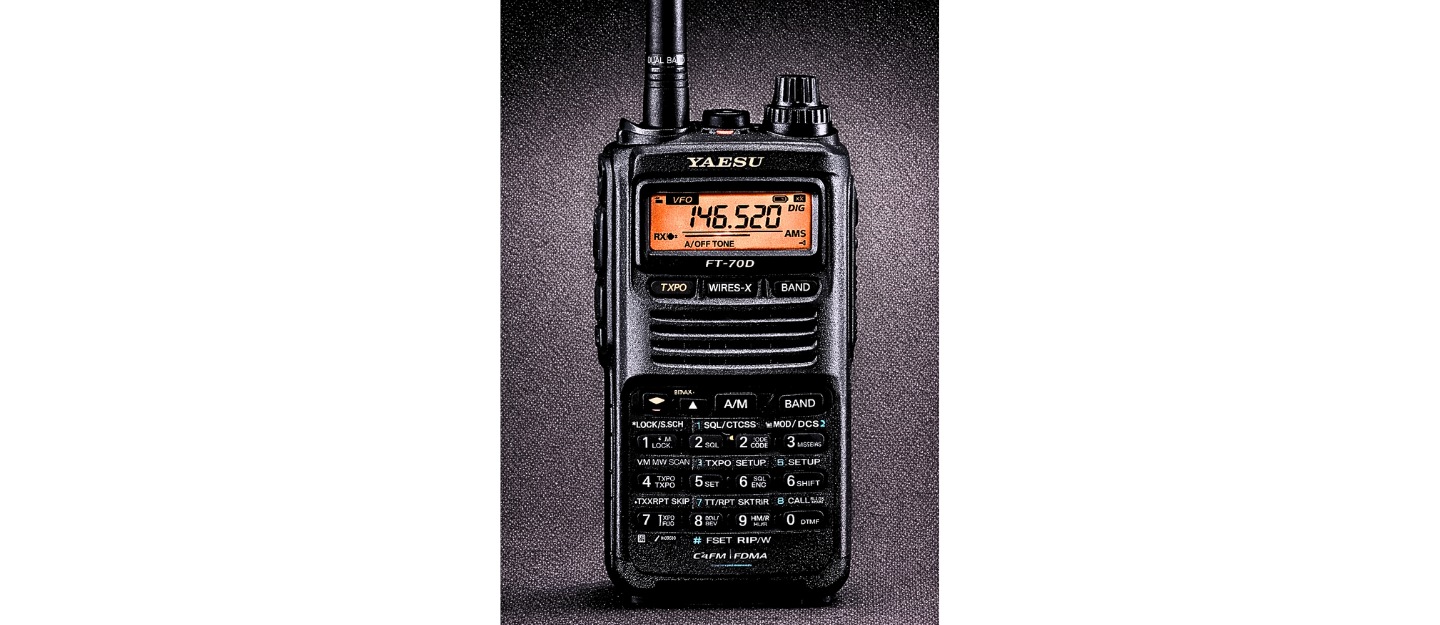
The Yaesu FT-70D is a dual-band handheld transceiver designed for reliable analog and digital communication across VHF and UHF amateur bands. It combines durable construction, straightforward controls, and advanced digital voice capability into a compact portable radio. As a result, it serves both new operators and experienced users who want dependable performance in a lightweight package.
Because modern amateur radio increasingly blends traditional FM communication with digital voice systems, the FT-70D integrates both seamlessly. It supports standard analog FM operation while also providing Yaesu’s digital voice technology. Therefore, operators can move between communication formats without changing equipment.
In addition, the radio emphasizes ease of use. Its menu structure remains simple, and its display clearly presents operating status. Consequently, users can adjust settings quickly in the field, which makes the radio especially practical for portable operation, emergency communication, and everyday repeater use.
If you would like to see more radios including other models and brands, check out the Complete Guide to Ham Radio Transceivers.
Yaesu FT-70D Specifications
| Feature | Specification |
|---|---|
| Frequency Bands | VHF 144–148 MHz, UHF 430–450 MHz |
| Operating Modes | FM Analog, C4FM Digital |
| Transmit Power | 5W / 2W / 0.5W |
| Audio Output | 700 mW |
| Receiver Coverage | Wideband receive |
| Display | Backlit LCD |
| Battery | 1800 mAh Li-ion |
| Memory Channels | 900 |
| Waterproof Rating | IP54 |
| Weight | Approx. 10.2 oz (with battery) |
Dual-Band Operating Capability and Frequency Coverage
The FT-70D operates across both major amateur handheld bands. This dual-band design allows flexible communication across local repeaters, simplex channels, and digital networks. Because VHF and UHF behave differently in various environments, access to both bands improves coverage in urban, suburban, and rural areas.
VHF signals typically travel farther in open environments. Meanwhile, UHF signals penetrate buildings more effectively. Therefore, the ability to select either band improves reliability depending on location.
Operating Frequency Range Chart
| Band | Frequency Range | Typical Use |
|---|---|---|
| VHF Receive | 108 – 174 MHz | Aircraft band monitoring and amateur VHF |
| VHF Transmit | 144 – 148 MHz | 2-meter amateur band |
| UHF Receive | 400 – 480 MHz | UHF monitoring and amateur repeaters |
| UHF Transmit | 430 – 450 MHz | 70-centimeter amateur band |
Because wide receive coverage allows monitoring beyond amateur allocations, the radio can monitor public service, weather, and aviation signals where permitted. Therefore, it functions as both a communication device and a monitoring receiver.
RF Output Power and Transmit Performance
The FT-70D provides multiple selectable power levels to balance battery life and communication range. High power operation delivers approximately 5 watts, which is standard for handheld amateur transceivers. Lower power settings conserve battery energy during local communication.
Because portable operation often requires efficient energy management, adjustable output power is essential. Operators can increase power for distant repeaters or reduce power for nearby simplex contacts. Consequently, the radio adapts easily to changing operating conditions.
The transmitter produces stable modulation and consistent signal output. Therefore, audio quality remains clear across both analog and digital modes.
Digital Voice Operation and System Integration
One of the defining features of the FT-70D is its digital voice capability. The radio supports digital communication that converts voice into data packets and transmits them efficiently across the airwaves. Because digital encoding preserves clarity even under weak signal conditions, communication often remains intelligible when analog audio becomes noisy.
Digital operation also allows access to linked repeater networks and digital reflectors. As a result, operators can communicate beyond local coverage areas through interconnected systems. This expands communication range without requiring additional RF power.
In addition, the digital voice transmission reduces background noise and improves speech clarity. Therefore, conversations sound more consistent and easier to understand.
C4FM Digital Modulation Technology
The FT-70D uses C4FM digital modulation, which forms the foundation of its digital voice operation. C4FM stands for Continuous 4-Level Frequency Modulation, and it allows the radio to transmit digital data efficiently while maintaining strong signal reliability. Because this modulation method uses four discrete frequency states, it carries more information than standard analog FM while preserving resistance to noise and signal degradation.
Unlike analog transmission, which gradually becomes noisy as signal strength drops, C4FM maintains clear audio until signal levels fall below usable thresholds. Therefore, operators often experience consistent voice clarity across wider coverage areas. In addition, digital error correction helps preserve intelligibility even when signals weaken or encounter interference.
C4FM also supports multiple transmission formats depending on operating conditions. The radio can prioritize voice clarity, data capacity, or balanced performance automatically. As a result, communication remains optimized without requiring manual adjustment. This adaptive behavior improves reliability when moving between strong and weak signal environments.
Another important advantage is spectral efficiency. Because C4FM transmits digitally encoded information, it uses bandwidth more effectively than traditional analog FM. Consequently, digital communication can deliver clearer audio while reducing susceptibility to background noise.
Furthermore, C4FM enables advanced digital features such as station identification data, digital squelch control, and network linking capability. These functions allow radios to communicate with greater precision and coordination. Therefore, operators gain access to expanded communication networks while maintaining local repeater compatibility.
In practical operation, C4FM improves communication stability, enhances audio quality, and expands network connectivity. Because it combines efficient modulation with adaptive performance control, it plays a central role in the FT-70D’s ability to deliver modern digital amateur radio communication.
CTCSS and DCS Tone Signaling
Tone signaling plays a critical role in repeater access and interference control. The FT-70D includes both CTCSS and DCS encoding and decoding.
CTCSS uses continuous sub-audible tones transmitted along with the main audio signal. Repeaters open only when they detect the correct tone. Therefore, unwanted signals do not activate the repeater.
DCS uses digitally coded squelch patterns instead of analog tones. Because digital codes offer many combinations, they provide more channel separation options.
These systems serve several purposes:
- Prevent unwanted repeater activation
- Reduce interference from other users
- Allow selective group communication
- Maintain quiet standby operation
Because many repeaters require tone access, full tone signaling capability ensures compatibility with modern repeater systems.
Display Screen and User Interface
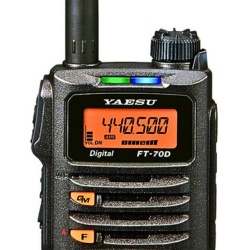
The Yaesu FT-70D features a clear multi-function LCD display that shows frequency, mode, signal strength, battery status, and menu indicators simultaneously. Because operators often need immediate situational awareness, the display prioritizes essential information.
Menu navigation uses simple button controls located below the display. Therefore, users can adjust settings quickly without navigating deep menu layers. This streamlined interface improves usability during field operation.
In addition, the display provides visual confirmation of tone settings, power level, and digital mode status. Consequently, operators always know the radio’s operating configuration.
Memory Channels and Scanning Functions
The radio includes programmable memory channels for storing frequently used frequencies. Because many operators rely on repeaters in multiple locations, memory storage simplifies rapid access.
Scanning functions automatically search stored channels or frequency ranges for active signals. Therefore, operators can monitor activity without manual tuning. This feature is especially useful when traveling or exploring new operating areas.
Receiver Sensitivity and Audio Performance
The FT-70D uses a high-sensitivity receiver that detects weak signals effectively. Because handheld radios often operate with limited antenna height, strong receiver performance is essential.
Audio output is clear and sufficiently loud for outdoor use. In addition, digital audio processing maintains consistent volume and clarity. Therefore, communication remains understandable even in noisy environments.
Battery System and Portable Operation
The radio operates using a rechargeable lithium-ion battery pack. Because lithium-ion technology provides high energy density, the radio remains lightweight while delivering extended operating time.
Energy-saving features automatically reduce consumption when full power is unnecessary. Consequently, battery life improves during normal operation.
Portable operators benefit from the radio’s compact size and rugged construction. Therefore, it performs well during field deployment, emergency response, and travel.
Complete Technical Specifications
| Category | Specification |
|---|---|
| Frequency coverage | VHF and UHF dual band |
| Output power | Up to 5 watts selectable |
| Operating modes | Analog FM and digital voice |
| Tone systems | CTCSS and DCS encode/decode |
| Display | Multi-function LCD |
| Memory channels | Programmable channel storage |
| Scanning | Frequency and memory scanning |
| Battery type | Rechargeable lithium-ion |
| Audio output | High-clarity speaker |
| Construction | Compact handheld design |
Real-World Operating Performance
In practical use, the FT-70D delivers reliable local and regional communication. Because dual-band capability provides flexibility, operators can choose frequencies that match propagation conditions and terrain.
Digital mode operation improves communication clarity under marginal signal conditions. Meanwhile, analog FM remains available for compatibility with traditional repeaters. Therefore, the radio supports both legacy and modern communication systems.
Portable operation remains comfortable due to lightweight construction and efficient battery performance. Consequently, the radio functions well in both stationary and mobile environments.
Real-World Operating Experience
In practical operation, the FT-70D delivers strong and consistent handheld performance. The 5-watt transmit power provides reliable repeater access in typical urban and suburban environments, while audio output remains clear even in noisy surroundings.
Battery life is adequate for normal daily operation, though heavy digital use can reduce operating time. The radio performs especially well for portable operation, offering a balance between compact size and dependable communication capability.
For everyday repeater use, event communication, and general handheld operation, performance remains stable and predictable.
FT-70D vs Other Popular Handheld Radios
Compared with entry-level analog handhelds, the FT-70D offers the advantage of digital C4FM capability while maintaining straightforward operation. It provides more functionality than basic dual-band radios but remains simpler and more affordable than advanced touchscreen models.
Compared with premium digital handhelds, the FT-70D focuses on reliability and simplicity rather than advanced interface features. This makes it appealing to operators who want digital capability without complex menus or high cost.
The radio occupies a practical middle ground between basic analog handhelds and full-featured digital flagships.
Yaesu FT-70D vs FT-65 vs FT-5DR Comparison
| Feature | Yaesu FT-70D | Yaesu FT-65 | Yaesu FT-5DR |
|---|---|---|---|
| Operating Modes | FM + C4FM Digital | FM Analog Only | FM + C4FM Digital |
| Touchscreen | No | No | Yes |
| APRS | No | No | Yes |
| Output Power | 5 Watts | 5 Watts | 5 Watts |
| Display | Standard LCD | Basic LCD | Full Color Touchscreen |
| Battery Capacity | 1800 mAh | 1950 mAh | High capacity |
| Waterproof Rating | IP54 | IP54 | IPX7 |
| Best For | Simple digital operation | Budget analog use | Advanced digital users |
What This Comparison Shows
The FT-70D offers digital communication capability without the complexity or cost of advanced touchscreen radios. It provides more functionality than basic analog handhelds while remaining simpler and more affordable than premium digital models.
This makes it an excellent middle-tier option for operators who want reliable digital performance without advanced interface features.
Why the FT-70D Stands Out Among Handheld Radios
The Yaesu FT-70D balances simplicity, durability, and modern digital capability. Because it integrates analog and digital communication within a straightforward interface, operators gain versatility without complexity.
Its strong transmit power, clear audio, and full tone signaling support make it compatible with nearly any repeater system. In addition, digital voice capability expands communication beyond local coverage areas. Therefore, the radio supports both everyday operation and extended network communication.
Advantages and Limitations
| Pros | Cons |
|---|---|
| Compact and durable design | No touchscreen interface |
| Clear loud audio output | Basic display compared to high-end models |
| Supports analog and digital modes | Battery life moderate under heavy digital use |
| Simple and reliable operation | Limited advanced customization |
| Good value for digital capability | Fewer premium features |
Who Should Choose the FT-70D
This radio is ideal for operators who want dependable dual-band handheld performance with digital capability in a compact and durable design. It works well for everyday repeater use, portable operation, and operators transitioning from analog to digital communication.
Who Might Prefer Other Options
Operators seeking advanced touchscreen control, extended battery endurance, or highly customizable digital features may prefer more advanced handheld models designed for intensive digital operation.
Frequently Asked Questions
Is the Yaesu FT-70D waterproof?
It has an IP54 rating, meaning it is resistant to dust and light water exposure but not fully waterproof.
Does the FT-70D support APRS?
No. This model does not include built-in APRS functionality.
Is the FT-70D good for beginners?
Yes. Its simple interface and reliable operation make it a good choice for operators new to digital voice.
Can the FT-70D use both analog and digital repeaters?
Yes. It supports standard FM analog and Yaesu C4FM digital operation.
How long does the battery last?
Battery life depends on usage, but typical operation provides a full day of moderate use.
Final Operating Perspective on Yaesu FT-70D
The Yaesu FT-70D delivers reliable dual-band performance with practical digital capability in a compact and easy-to-use handheld. It balances simplicity, durability, and modern communication features without unnecessary complexity.
For operators who want dependable everyday performance and straightforward digital operation, it represents a strong and practical choice.