
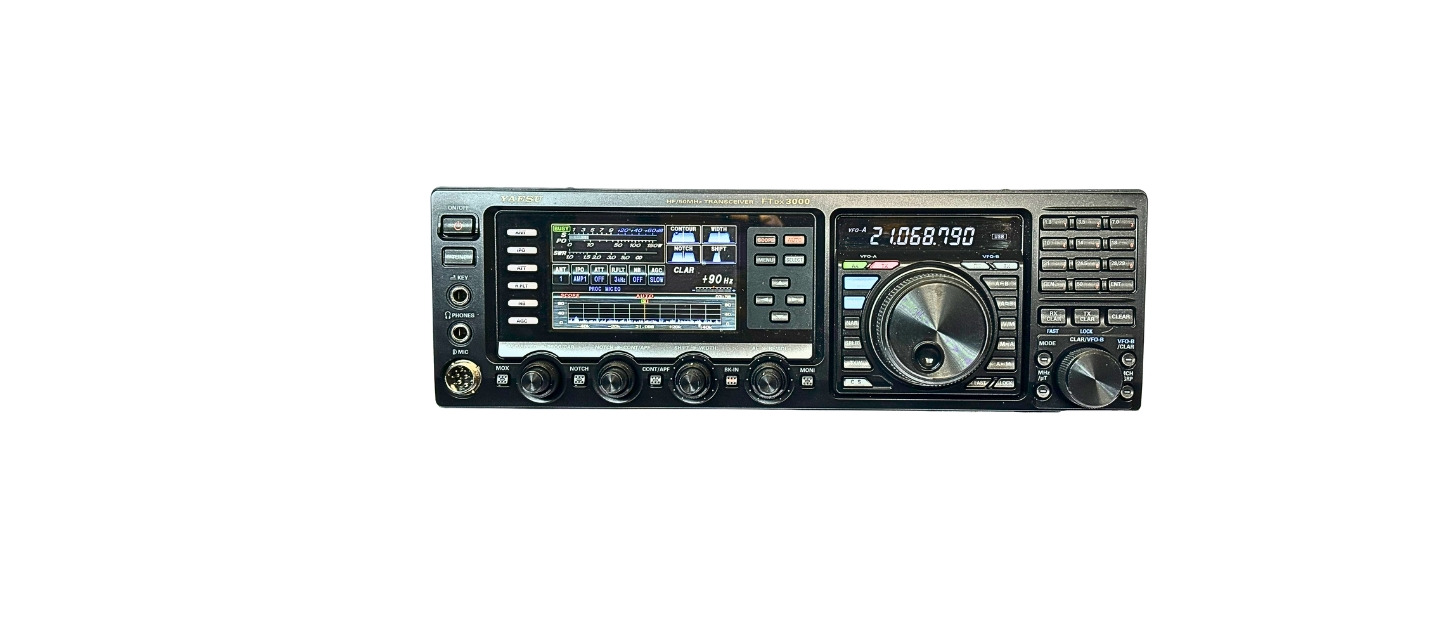
The Yaesu FTDX 3000 is a full-featured HF and 50 MHz base station transceiver designed for operators who demand exceptional receiver performance, strong transmit capability, and advanced signal visualization. It combines high dynamic range receiver architecture, powerful digital signal processing, and a large real-time spectrum display into a single operating platform. As a result, it delivers excellent performance in crowded band conditions while maintaining clear reception of weak signals.
Because modern HF operation often involves dense signal environments, the FTdx 3000 prioritizes selectivity and interference control. It uses advanced filtering and signal handling techniques to maintain clarity even when strong adjacent stations are present. Therefore, operators can isolate desired signals more effectively while reducing fatigue during long operating sessions.
In addition, the radio integrates digital control, flexible filtering, and real-time visual spectrum monitoring. Consequently, operators gain both precision tuning control and immediate awareness of band activity. This combination makes the FTdx 3000 highly capable across contesting, DX operation, digital communication, and everyday HF use.
If you would like to see more radios including other models and brands, check out the Complete Guide to Ham Radio Transceivers.
Receiver Architecture and Signal Handling Performance
The FTdx 3000 uses a high dynamic range receiver designed to preserve weak signal intelligibility in the presence of strong nearby transmissions. Because HF bands often contain multiple signals within narrow frequency spacing, strong signal handling is essential for effective operation.
The receiver incorporates narrow roofing filters that limit bandwidth early in the signal path. As a result, unwanted signals are reduced before amplification and detection. This approach minimizes intermodulation distortion and improves overall signal clarity.
In addition, digital signal processing allows precise adjustment of receive bandwidth. Operators can narrow or widen the passband depending on operating mode and interference conditions. Therefore, CW, SSB, and digital signals remain readable even under heavy band congestion.
Furthermore, advanced noise reduction algorithms continuously analyze incoming audio and suppress random noise components. Consequently, listening comfort improves significantly during long monitoring sessions.
Real-World Operating Performance
In actual on-air use, the FTdx 3000 demonstrates exceptional weak-signal recovery in crowded band conditions. During pileups and contest environments where multiple strong signals exist within a narrow frequency range, the receiver maintains clear separation between stations.
Strong adjacent signals rarely cause overload or masking. Weak stations remain readable even when powerful nearby transmitters are active. This is particularly noticeable during DX chasing, where narrow filtering and high dynamic range allow operators to isolate faint signals buried under band noise.
Long operating sessions also reveal low listening fatigue. Audio remains stable and clean, and noise reduction processing reduces background hiss without introducing digital artifacts. These characteristics make the radio well suited for contesting and extended monitoring.
Frequency Coverage and Band Capability
The FTdx 3000 provides full transmit capability across the HF amateur bands and the 6-meter band. At the same time, it offers wideband general-coverage reception for monitoring signals outside amateur allocations.
Because propagation varies widely across frequencies, broad coverage allows operators to adapt quickly to changing conditions.
Operating Frequency Range Chart
| Band | Approximate Frequency Range | Propagation Characteristics |
|---|---|---|
| 160 m | 1.8 – 2.0 MHz | Strong nighttime long-distance coverage |
| 80 m | 3.5 – 4.0 MHz | Regional daytime, extended nighttime range |
| 40 m | 7.0 – 7.3 MHz | Reliable global communication day and night |
| 30 m | 10.1 – 10.15 MHz | Stable digital and CW operation |
| 20 m | 14.0 – 14.35 MHz | Consistent worldwide propagation |
| 17 m | 18 MHz region | Moderate daytime DX performance |
| 15 m | 21 MHz region | Strong long-distance daytime propagation |
| 12 m | 24 MHz region | High-frequency band with variable openings |
| 10 m | 28 – 29 MHz | Highly dependent on solar activity |
| 6 m | 50 – 54 MHz | Sporadic E and VHF propagation events |
| General Receive | 30 kHz – 56 MHz | Monitoring and wideband reception |
Because each band responds differently to solar radiation and atmospheric conditions, operators can select frequencies that match current propagation behavior. Therefore, the radio supports flexible operating strategies throughout the solar cycle.
Output Power and Transmit Characteristics
The FTdx 3000 delivers up to 100 watts of RF output power. This level provides strong signal presence for most base station applications. Because full-power HF operation typically requires 100 watts, external amplification is not necessary for routine communication.
The transmitter maintains stable output across all supported modes. In addition, internal circuitry ensures consistent signal quality during continuous operation. Therefore, both analog voice and digital transmissions remain clean and properly modulated.
Because transmit stability directly affects signal intelligibility, regulated power output contributes to reliable communication performance.
Built-In Automatic Antenna Tuner
An internal automatic antenna tuner matches transmitter output to the antenna system. Because impedance mismatch reduces power transfer and increases reflected energy, automatic tuning protects the radio while maximizing efficiency.
The tuner stores previously matched settings for rapid recall. Therefore, when operators return to a frequency, the system restores tuning immediately. This feature reduces setup time during band changes and improves operating efficiency.
Real-Time Spectrum Scope and Waterfall Display
The Yaesu FTDX 3000 includes a large color display with integrated spectrum scope and waterfall visualization. This system continuously monitors signal activity across a selected frequency span.
The spectrum scope shows signal amplitude versus frequency. Meanwhile, the waterfall display shows signal intensity over time. As a result, operators can observe both instantaneous and historical band activity.
Because weak signals often appear visually before becoming audible, the waterfall improves signal discovery. In addition, operators can locate clear operating frequencies without scanning manually. Therefore, tuning becomes faster and more efficient.
Supported Operating Modes
The radio supports multiple communication modes, each optimized through adjustable filtering and signal processing.
- Upper and lower sideband voice transmission
- Continuous wave Morse communication
- Amplitude modulation reception and transmission
- Frequency modulation operation
- Radioteletype communication
- Computer-controlled digital modes
Because digital interface capability is built into the radio, computer-based modes integrate easily. Consequently, operators can run modern digital communication systems with minimal additional hardware.
Digital Signal Processing Features
Advanced DSP functions enhance both receive and transmit performance.
Digital noise reduction continuously analyzes incoming audio and suppresses random noise components. Adjustable IF bandwidth allows precise control over signal passband width. Automatic notch filtering removes interfering tones. Contour filtering shapes audio response to emphasize speech clarity.
Because these tools operate in real time, operators can optimize reception dynamically. Therefore, weak signals remain intelligible even in difficult band conditions.
Connectivity and Antenna Flexibility
The FTdx 3000 supports multiple antenna inputs and dedicated receive antenna connections. Because different antennas perform best on different bands, flexible switching simplifies station configuration.
Computer control ports allow integration with logging software, digital mode applications, and automated station control systems. Consequently, the radio adapts easily to modern operating environments.
Physical Design and Control Interface
The radio features a full-size front panel with dedicated controls for gain, filtering, tuning, and signal processing. Because direct physical control allows rapid adjustment, operators can respond immediately to changing band conditions.
The large display presents frequency, signal strength, filter settings, and spectrum data simultaneously. Therefore, all critical operating information remains visible without navigating menus.
Ergonomics and Daily Operating Experience
The FTdx 3000 is designed for extended operating sessions with direct-access front panel controls that minimize menu navigation. Frequently used functions such as gain adjustment, filtering, and tuning are available through dedicated knobs and buttons.
The tuning dial provides smooth and precise control, allowing rapid frequency changes without overshooting desired signals. The large display remains readable under varying lighting conditions, and the spectrum scope provides immediate situational awareness.
During long operating sessions, the control layout allows quick adjustments without interrupting listening concentration. This physical design supports efficient workflow during contesting, DX operation, and digital mode monitoring.
Pros and Cons of the FTdx 3000
Pros
Exceptional receiver dynamic range and signal separation
Effective roofing filters for crowded band conditions
Clear real-time spectrum scope and waterfall display
Stable 100-watt transmit output across modes
Internal automatic antenna tuner with memory
Extensive DSP filtering and noise reduction tools
Cons
Larger physical size compared to compact HF radios
Learning curve for advanced DSP controls
Higher current consumption than smaller transceivers
Menu system requires familiarity for full feature use
FTDX 3000 vs IC-7300 — Performance Comparison
The Yaesu FTDX 3000 and Icom IC-7300 are often compared because both offer strong HF performance with spectrum display capability. However, their receiver architectures differ significantly.
The Yaesu FTDX 3000 uses a high dynamic range superheterodyne design with roofing filters that limit signal bandwidth early in the receive chain. This improves performance in extremely crowded band conditions and reduces overload from strong nearby stations.
The IC-7300 uses a direct sampling SDR architecture that provides excellent spectral visibility and simplicity of operation. While highly capable, its strong-signal handling characteristics differ from traditional roofing-filter-based receivers.
Operators focused on contesting and dense signal environments often prefer the FTdx 3000 for its strong adjacent signal performance. Operators prioritizing compact size and simplified interface may prefer the IC-7300.
Both radios deliver excellent HF performance, but their design priorities differ.
Complete Technical Specifications
| Category | Specification |
|---|---|
| Frequency coverage transmit | Amateur HF bands plus 6 m |
| Frequency coverage receive | 30 kHz to 56 MHz |
| Maximum RF output power | 100 W |
| Operating modes | SSB, CW, AM, FM, RTTY, digital |
| Antenna tuner | Internal automatic |
| Display | Color TFT with spectrum and waterfall |
| Digital signal processing | Advanced filtering and noise reduction |
| Power requirement | 13.8 V DC |
| Current consumption | Approximately 23 A transmit |
| Dynamic range | Very high adjacent signal handling |
| Antenna connections | Multiple |
| Computer interface | Digital control capable |
Why the FTDX 3000 Remains Highly Respected
The FTdx 3000 combines high dynamic range reception, powerful filtering, real-time spectrum visualization, and stable transmit output into a single integrated system. Because it performs well under demanding signal conditions, operators rely on it for contesting, DX chasing, and digital communication.
In addition, its balance of analog control and digital processing creates an intuitive operating experience. Therefore, it supports both traditional operating techniques and modern digital workflows.
Best Operating Applications for the Yaesu FTDX 3000
The FTDX 3000 performs particularly well in demanding signal environments. Its receiver architecture and filtering capabilities make it especially suitable for contesting, DX chasing, and weak-signal work.
Digital mode operators benefit from stable transmit output and precise bandwidth control. The spectrum scope allows rapid identification of open frequencies, improving efficiency during band changes.
Because of its strong signal handling and detailed control features, the radio is best suited for base station installations where performance is the primary priority.
Who Should Consider Other Radios
Operators seeking a compact or portable HF transceiver may prefer smaller models designed for mobile or field use. Beginners who prefer minimal configuration may find simplified SDR-based radios easier to operate initially.
Stations with limited operating space or power availability may also benefit from smaller or lower-current radios. While the FTdx 3000 excels in performance, it is designed primarily for fixed-station operation rather than portability.
FTdx 3000 Buyer Decision Checklist
Use this checklist to determine whether the Yaesu FTdx 3000 is the right HF transceiver for your operating needs.
Choose the FTdx 3000 if you:
✔ Operate in crowded band conditions and need strong adjacent signal rejection
✔ Regularly chase weak DX signals or participate in contests
✔ Prefer physical controls over deep menu navigation
✔ Want a high dynamic range receiver with roofing filters
✔ Use a fixed base station with sufficient desk space and power capacity
✔ Value detailed filtering and advanced DSP adjustment
✔ Want a built-in antenna tuner with memory
✔ Use spectrum scope visualization to monitor band activity
You may want to consider other radios if you:
✔ Need a compact or portable HF transceiver
✔ Prefer simplified SDR-style operation with fewer manual controls
✔ Want lower power consumption for mobile or field use
✔ Are new to HF and want minimal setup complexity
✔ Have limited operating space
✔ Prioritize price over advanced receiver performance
For operators focused on maximum receive performance and signal control, the FTdx 3000 is an excellent choice. For portability or simplified operation, other models may be more suitable.
Frequently Asked Questions About the FTdx 3000
Is the FTdx 3000 good for contesting?
Yes. Its high dynamic range receiver and strong filtering make it well suited for crowded band conditions.
Does the FTdx 3000 support digital modes?
Yes. Computer control and stable transmit characteristics support modern digital operation.
Is the receiver sensitive to weak signals?
Yes. Narrow filtering and noise reduction help maintain weak signal intelligibility.
Does it include an internal antenna tuner?
Yes. The built-in tuner automatically matches impedance and stores settings.
Is the FTdx 3000 suitable for beginners?
It can be used by beginners, but its advanced controls are best utilized by experienced operators.
Final Operating Perspective
The Yaesu FTDX 3000 delivers a complete HF operating platform built around precision signal handling and advanced visualization. Its wide frequency coverage, stable 100-watt transmit capability, automatic antenna matching, digital signal processing, and real-time spectrum monitoring create a powerful base station environment.
Because it combines strong engineering with practical usability, it continues to stand as one of the most capable HF transceivers available for serious amateur radio operation.