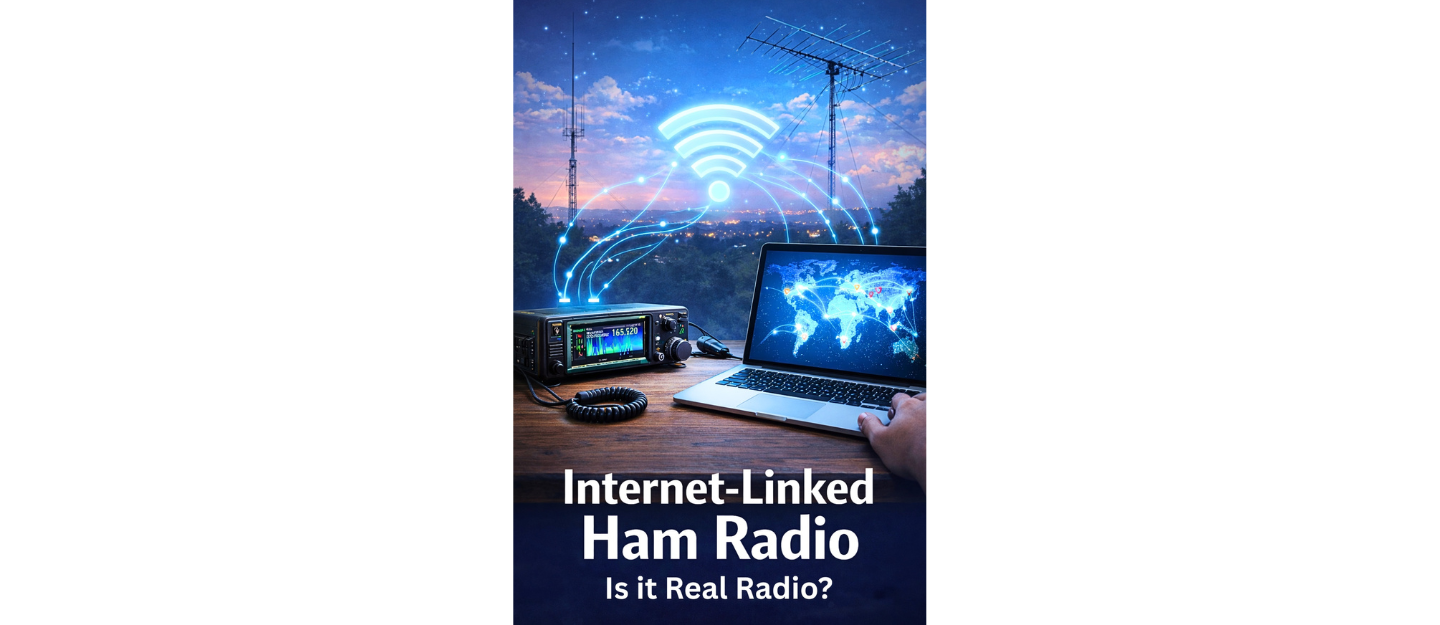
Internet-linked radio blends traditional RF transmission with network connectivity. Because modern radios now include Wi-Fi, Ethernet, or cellular backhaul, audio and data can travel beyond line-of-sight limits.
Operators can hear distant signals through servers and gateways instead of ionospheric paths. Moreover, these systems often preserve familiar radios, microphones, and operating practices. As a result, the term describes a hybrid rather than a replacement.
How Traditional Radio Defines Itself
Traditional radio relies on electromagnetic waves that propagate through space. Because energy leaves the antenna and travels independently, operators experience distance, fading, noise, and interference. Skill matters in choosing frequency, antenna, and timing. Additionally, radio historically rewards experimentation with propagation and equipment. Consequently, many operators view RF-only paths as the core identity of radio.
How Internet Linking Changes the Path
Internet-linked systems reroute audio or data through servers once RF reaches a local gateway. Because packets traverse fiber and routers, distance collapses to network latency. Therefore, the signal no longer depends on propagation conditions after the gateway. Additionally, reliability improves because the network avoids atmospheric effects. As a result, communication becomes consistent but less organic.
What Still Counts as Radio
The RF portion still exists, and operators still transmit and receive over the air locally. Because antennas, power levels, and modulation remain relevant, radio technique does not disappear. Therefore, many argue the activity still qualifies as radio-assisted communication. Moreover, licensing, spectrum discipline, and operating etiquette still apply. Consequently, the identity shifts without vanishing.
What Changes Fundamentally
The moment packets replace propagation, physics stops setting the limits. Because servers relay audio deterministically, fading and skip no longer shape outcomes. Therefore, weak-signal skill loses importance beyond the gateway. Additionally, congestion and server outages replace noise and interference as failure modes. As a result, the challenge moves from RF mastery to network reliability.
The Skill Debate Among Operators
Some operators value the craft of pulling signals from noise. Because internet linking removes that struggle, they feel it dilutes the art. Therefore, they reserve the word radio for RF-only contacts. Others value accessibility and inclusion. Because linking lowers barriers, newcomers participate sooner. Consequently, the community splits along philosophical lines rather than technical ones.
Emergency and Practical Use Cases
Internet-linked radio shines in coordination and coverage. Because gateways extend reach instantly, responders share information quickly. Therefore, situational awareness improves during complex events. However, dependence on infrastructure introduces fragility. Because networks fail during disasters, RF-only paths regain importance. As a result, resilient planning often includes both methods.
Latency, Synchronization, and Human Perception
Latency subtly alters conversation dynamics. Because packets add delay, operators speak over one another more often. Therefore, operating rhythm changes compared to simplex RF. Additionally, echo and level mismatches require adjustment. Consequently, operators learn new habits that differ from traditional on-air technique.
Regulation, Ethics, and Transparency
Rules often permit linking while requiring identification and control. Because operators remain accountable, ethics still matter. Therefore, transparency about signal paths becomes important. Additionally, some communities expect disclosure when contacts use internet backhaul. As a result, trust hinges on honesty rather than purity tests.
Cultural Impact on the Hobby
Internet linking broadens participation. Because geography matters less, communities grow across borders. Therefore, mentoring and social connection increase. However, local experimentation can decline when convenience dominates. Consequently, clubs that balance both approaches tend to thrive.
Where Innovation Fits
Innovation rarely replaces old methods outright. Because hybrids often coexist, operators choose tools per goal. Therefore, experimentation continues with antennas and modes alongside software and networking. Additionally, cross-pollination inspires new techniques. As a result, the definition of radio expands instead of shrinking.
Internet-Linked Radio, Is It Still Radio
Yes and no, depending on intent. Because RF still initiates and terminates communication, radio remains present. However, because the internet substitutes for propagation, the experience changes fundamentally. Therefore, internet-linked systems represent radio plus networking, not radio alone. Ultimately, the label matters less than clarity, honesty, and purposeful use.
Please consider Donating to help support this channel