
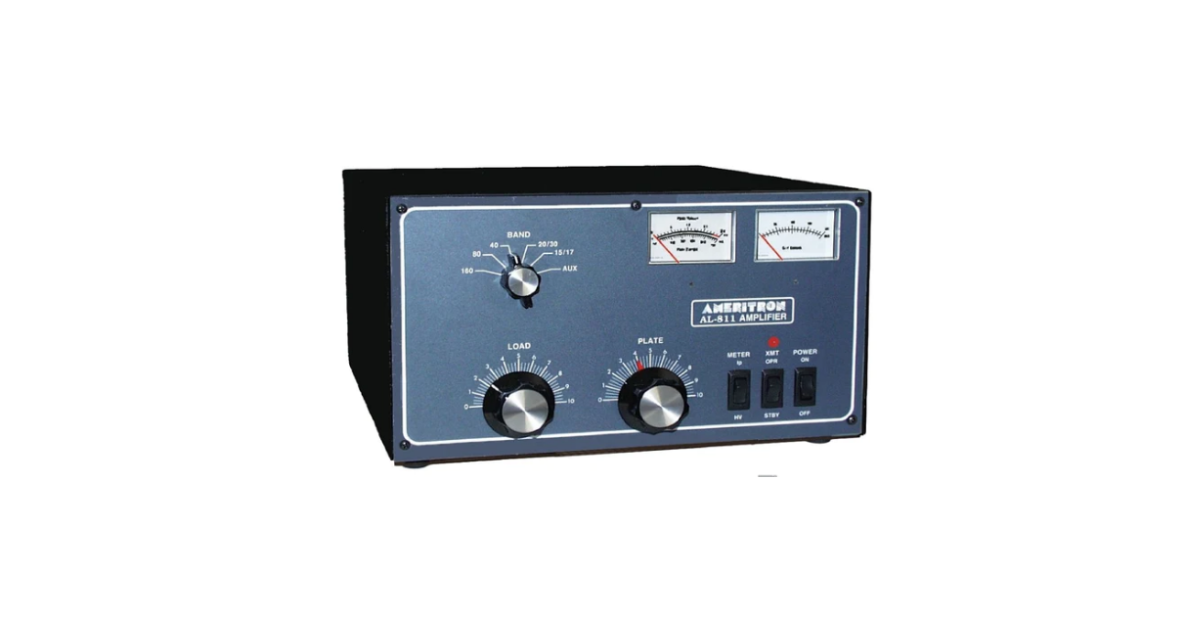
The Ameritron Al-811 amplifier is one of the most widely used entry-level HF linear amplifiers in amateur radio. It boosts the typical 100-watt output of most transceivers to approximately 600 watts peak envelope power on SSB. That increase often makes the difference between barely being heard and breaking through a DX pileup.
Ameritron designed the AL-811 to be straightforward, durable, and affordable while still delivering the performance many amateur radio operators need to improve their signal strength. Using three 811A transmitting tubes, the amplifier provides reliable RF amplification across the HF amateur bands with simple manual tuning controls and built-in operating protections.
High-power amplifiers like the Palstar LA-1K increase transmitted signal strength across the amateur bands as part of a broader category of RF amplification equipment. Operators comparing different amplifier designs, technologies, and power levels may want to explore the
Complete Guide to Ham Radio Amplifiers, which explains how solid-state and tube amplifiers work, how to choose the right amplifier for a station, and what factors affect real-world performance.
Ameritron AL-811 Amplifier Overview
The AL-811 grounded-grid HF linear amplifier gives amateur radio operators more signal strength than a typical barefoot transceiver can provide. The amplifier uses three 811A transmitting tubes to generate RF amplification and produces around 600 watts PEP on SSB when driven properly.
Two large tuning knobs control the Plate and Load adjustments used to tune the amplifier. The Plate control uses a ball-bearing vernier reduction drive, allowing precise tuning adjustments so operators can quickly locate the correct tuning point.
Two large illuminated meters on the front panel allow continuous monitoring of amplifier operating conditions. One meter displays grid current so the operator can detect improper loading that could stress the tubes. The second meter switches between high voltage and plate current, providing a clear indication of how the amplifier is operating during tuning and transmission.
The amplifier uses a heavy-duty power supply that runs from standard 120-volt household power and typically draws about eight amps during operation. Ameritron includes its Adapt-A-Volt power transformer, which allows the amplifier to compensate for high or low line voltage conditions and maintain stable performance.
The First 600 Watts Makes the Biggest Difference
Increasing transmitter power has a noticeable effect on signal strength at distant receiving stations. Moving from the typical 100-watt output of a transceiver to approximately 600 watts represents a substantial increase in effective radiated power.
Increasing power from 600 watts to the legal limit of 1500 watts adds signal strength, but the improvement is smaller than the initial increase from barefoot operation. The difference between 600 watts and 1500 watts is roughly four decibels, which is slightly more than half an S-unit on most receivers.
For many amateur radio stations, the first several hundred watts of amplification provide the most significant improvement in the ability to work DX stations and maintain reliable contacts.
The AL-811 provides coverage across the HF amateur bands and supports all common operating modes. Typical output levels are approximately 600 watts PEP on SSB, around 500 watts on CW, and roughly 400 watts on AM, FM, RTTY, and SSTV.
The amplifier also operates on the WARC bands and many MARS frequencies when operators perform the appropriate modification.
Cooling and Internal Design
Vacuum tube amplifiers generate significant heat during operation, so proper cooling is essential. The AL-811 uses a quiet cooling fan that pressurizes the cabinet and forces air across the tubes and internal components.
This airflow helps maintain safe operating temperatures and allows the amplifier to operate reliably during extended transmissions.
The amplifier uses low-loss slug-tuned coils mounted on the rear panel to optimize RF performance across the HF spectrum. These coils work together with high-quality silver mica capacitors that help maintain stable tuning and reduce drift.
The input circuit uses a tuned Pi-network that presents a proper 50-ohm load to the driving transceiver. This design ensures compatibility with modern radios, including sensitive solid-state transmitters.
Station Integration and Operating Features
The Ameritron AL-811 includes several features that allow it to integrate easily into a typical amateur radio station.
An Operate/Standby switch allows the operator to instantly switch between amplified operation and barefoot operation without disconnecting the amplifier. This feature is especially useful when using a manual antenna tuner or when operating on frequencies where additional power is not required.
A transmit LED indicator provides visual confirmation when the amplifier is keyed.
The amplifier uses a 12-volt DC keying relay that is compatible with most modern solid-state transceivers. To protect the radio’s keying circuit, a back-pulse canceling diode prevents voltage spikes from damaging the transceiver during transmit switching.
Operators who require fast break-in CW operation can use the optional external QSK-5 PIN diode switching module, which provides extremely fast transmit-receive switching for full break-in Morse code operation.
The 811A Transmitting Tube
The AL-811 uses three 811A transmitting tubes to generate RF amplification. The 811A tube has been widely used in amateur radio amplifiers for decades because of its durability, availability, and relatively low cost.
These tubes use a directly heated thoriated tungsten filament cathode that produces strong electron emission and stable RF amplification.
The internal elements of the tube are widely spaced, which allows the tube to tolerate relatively high voltages and occasional tuning mistakes without immediate failure. This makes amplifiers that use 811A tubes somewhat forgiving compared to many solid-state amplifiers.
Another advantage of the 811A tube is availability. Manufacturers still produce replacement tubes widely, and they remain relatively inexpensive compared with many transmitting tubes used in higher-power amplifiers.
As a result, many operators recommend amplifiers using the 811A tube for amateur radio operators purchasing their first HF amplifier.
Real-World Operating Experience
In actual operation the AL-811 proved to be a reliable and easy-to-use amplifier. Within the first two months of operation it was possible to work 141 countries using an end-fed wire antenna.
The amplifier’s additional power made it easier to break through DX pileups and reach stations that were difficult to contact with barefoot power.
Learning to tune the amplifier was straightforward. Even while learning the tuning procedure, occasional tuning mistakes did not cause damage to the amplifier or the tubes.
Colored arrows placed near the tuning knobs mark typical starting points for commonly used bands, which makes tuning faster. This allowed quick adjustments when changing bands before final tuning.
The front-panel meters are bright and easy to read, making it easy to monitor operating conditions while transmitting. The cooling fan was also surprisingly quiet and maintained proper operating temperatures without excessive noise.
Like most tube amplifiers, the AL-811 has some weight due to its large power transformer and internal components, but this is typical for amplifiers in this power class.
The standby switch proved particularly useful when operating with a manual antenna tuner, allowing quick switching between amplified and barefoot operation.
Although the station later upgraded to a Palstar LA-1K amplifier, the AL-811 still serves as a backup amplifier.Its reliability and ease of operation make it an excellent first amplifier for many amateur radio operators.
Who the Ameritron AL-811 Is Best For
The Ameritron AL-811 suits amateur radio operators who want to move beyond barefoot operation without investing in a full legal-limit amplifier.
It works well for operators chasing DX stations, stations using modest antenna systems, and operators who want moderate amplification without the complexity or cost of higher-power equipment.
Because the amplifier uses durable and widely available 811A tubes, maintenance costs are relatively low compared to many larger amplifiers.
Frequently Asked Questions About the Ameritron AL-811 Amplifier
How much power does the Ameritron AL-811 produce?
The Ameritron AL-811 typically produces around 600 watts PEP on SSB, about 500 watts on CW, and roughly 400 watts on AM, FM, RTTY, and SSTV when properly tuned.
Is the AL-811 a good amplifier for beginners?
Yes. Many operators recommend the AL-811 as a first HF amplifier because its 811A tubes tolerate brief tuning mistakes better than many solid-state amplifiers.
What tubes does the AL-811 use?
The amplifier uses three 811A transmitting tubes that provide RF amplification.
Does the AL-811 operate on standard household power?
Yes. The amplifier runs from standard 120-volt household power and typically draws about eight amps during operation.
Can the AL-811 be used with modern solid-state transceivers?
Yes. The amplifier includes a 12-volt keying relay and protective circuitry that allows safe operation with most modern radios.
Ameritron Al-811 amplifier
The Ameritron Al-811 amplifier remains one of the most practical entry-level HF amplifiers available for amateur radio operators. Its combination of moderate power output, simple tuning controls, and durable tube design provides a reliable way to increase signal strength without moving to a full legal-limit amplifier.
For many stations the first 600 watts of amplification offered by the AL-811 delivers the greatest improvement in real-world operating performance, helping operators reach more stations and improve their success when working DX.
About the Author
Vince, W2KU, is a licensed Extra class amateur radio operator and the founder of Ham Shack Reviews. The amateur radio community named him Amateur of the Year in 2026 for his contributions to practical amateur radio education and equipment evaluation.
He primarily operates HF, knows propagation very well, operates mobile and handhelds daily. Vince exchanges QSL cards for DXCC, contest confirmation, and award tracking and is the club QSL manager. His guidance focuses on practical operating procedures, accurate logging, and real-world amateur radio practices.
Please consider Donating to help support this channel