
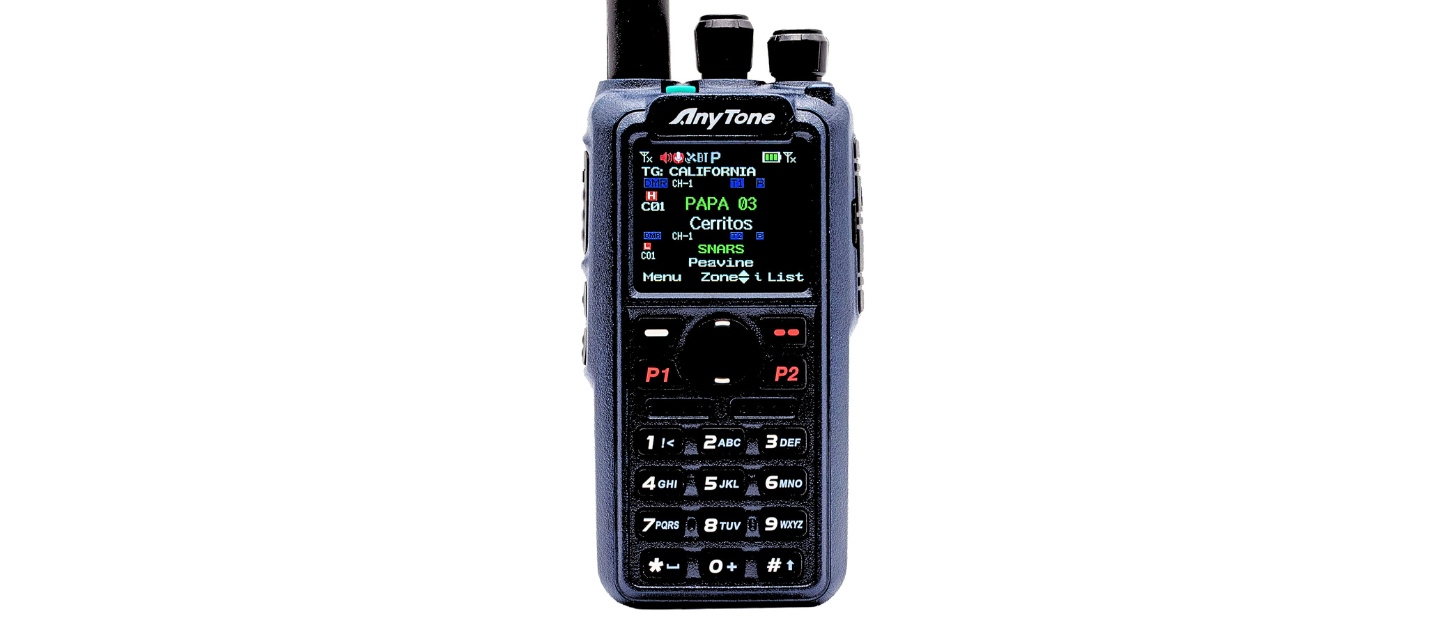
The Anytone AT-D890UV sets a high standard in handheld communications, and it appeals to both amateur radio operators and professional users alike. It delivers reliable performance across VHF and UHF bands, and its rugged construction ensures dependable operation in diverse environments.
This radio blends advanced features with intuitive controls, users who want versatility and power often choose it. Furthermore, the AT-890UV gives operators a balance of performance, expandability, and daily usability that few dual-band handhelds match.
Who the Anytone AT-D890UV Is Best For
The AT-D890UV is designed for operators who want a powerful handheld radio with both analog and digital capability. It is especially useful for:
- DMR network users
- Portable and field operation
- Emergency communication
- Amateur radio operators using repeaters and talkgroups
Operators who want advanced features in a portable format will benefit most from this radio.
What Type of Radio Is the AT-D890UV
The Anytone AT-D890UV is a dual-band handheld amateur radio that supports both analog FM and DMR digital communication, making it suitable for both traditional repeater use and modern digital radio networks.
If you would like to see more radios including other models and brands, check out the Complete Guide to Ham Radio Transceivers.
Frequency Range and Dual-Band Capability
The Anytone AT-D890UV operates across both VHF and UHF frequencies, which lets users access a broad range of channels and applications. On VHF, it covers the 136–174 MHz band, while on UHF it spans 400–480 MHz, and that combination supports most amateur radio, public safety, and commercial band uses.
The dual-band design lets you monitor or transmit on two bands at once, you can manage multiple nets or communications channels with ease. Moreover, the radio provides clear reception and crisp audio even in crowded signal environments, which improves usability during busy dispatch situations or field operations.
Anytone AT-D890UV Power Output and Performance
The Anytone AT-D890UV offers multiple power settings that typically include low, medium, and high output. At full power, it can reach up to 5 W, which gives operators strong signal penetration and extended range compared to lower-powered handhelds.
Because performance depends on antenna quality and environment, users often pair the radio with a high-gain antenna to maximize distance. Additionally, the radio maintains stable output and clean modulation across its power levels, which enhances both voice clarity and signal reliability.
Real-World Handheld Range Expectations
In real-world use, handheld radios like the AT-D890UV typically achieve:
- 1–5 miles on simplex depending on terrain
- 10–30+ miles using repeaters
- Greater range when used with elevated or external antennas
Actual performance depends heavily on antenna quality, elevation, and surrounding environment.
Display and User Interface
Anytone equips the Anytone AT-D890UV with a bright, easy-to-read LCD screen that shows frequency, channel, power level, signal strength, and other key data. The interface uses intuitive menus, and this design speeds up configuration and daily use.
The buttons and rotary knobs respond with tactile feedback, users can adjust settings quickly even when they wear gloves or operate on the move. Moreover, context-sensitive prompts on the display help reduce confusion when switching modes or programming features.
Channel Memory and Scanning Features
The Anytone AT-D890UV supports a large number of programmable memory channels, and this capability lets operators store favorite frequencies for quick access. You can label channels for simplicity, and that organization helps when you frequently shift between repeaters, nets, or simplex frequencies.
The radio includes scanning functions that check memory channels or frequency ranges to find active transmissions. Because scanning helps you monitor calls without manual tuning, it improves situational awareness during events, emergencies, or casual monitoring.
DMR and Repeater Operation Explained
The AT-D890UV supports both analog repeaters and digital DMR networks. To operate on repeaters, users must configure:
- Frequency offset
- CTCSS or DCS tones (analog)
- Color code, time slot, and talkgroup (DMR)
Programming software is typically used to simplify setup and ensure proper configuration.
Built-In Squelch and Noise Management
This radio includes adjustable squelch settings, which let users filter out background noise and focus on meaningful transmissions. The squelch threshold determines when the speaker opens for incoming audio, and users can tailor this to their environment.
If you operate in high-noise areas or near interfering signals, tightening the squelch reduces chatter;. Whereas if you monitor weak signals, a lighter setting helps catch distant calls. Consequently, the Anytone AT-D890UV delivers cleaner audio experiences without distracting static.
Battery and Power Options
Anytone supplies a rechargeable battery pack that gives several hours of continuous use, and the pack holds sufficient capacity for extended outings. Because modern handhelds like this rely on power efficiency, you can operate through long shifts without constantly recharging.
Furthermore, the radio accepts alternative power solutions such as portable power banks or vehicle adapters, which increase flexibility for outdoor or mobile use. As a result, users feel confident that their radio won’t fail during critical moments.
Programmability and Customization
This radio shines when it comes to programmability, and users can customize channels, tones, offsets, and other parameters through PC software. Because software programming provides granular control, operators can set up repeater offsets, CTCSS/DCS tones, and scanning lists precisely.
The software simplifies bulk configuration, and that efficiency saves time when managing many memory channels or repeater groups. Therefore, hobbyists and professionals alike appreciate the depth of customization the AT-890UV supports.
Audio Quality and Speaker Performance
Anytone engineers the Anytone AT-D890UV with a speaker and audio circuitry that emphasize clarity and sufficient volume. Even in outdoor settings or noisy backgrounds, the radio reproduces voices with minimal distortion. Because operators depend on intelligible audio during nets and tactical communications, this characteristic enhances usability. Additionally, external speaker mic accessories further boost audio convenience when the radio stays clipped to a belt or pack.
Recommended Accessories for Better Performance
To maximize performance, many operators use:
- High-gain aftermarket antennas
- External speaker microphones
- Spare battery packs
- Programming cables and software
These additions improve range, usability, and overall operating convenience.
Build Quality and Durability
The Anytone AT-D890UV exhibits a sturdy, well-assembled construction that holds up under daily use. Its housing resists bumps, drops, and environmental stress, and the rubberized elements protect key controls. Because longevity matters for equipment you use frequently. This ruggedness pays off over years of service. Also, the buttons and knobs remain responsive even after extended operation, which reinforces the radio’s reliability.
Pros and Cons of the AT-D890UV
Pros:
- Supports both analog and DMR digital communication
- Large channel and contact capacity
- Strong battery life for extended operation
- Advanced features like GPS and Bluetooth
- Highly customizable via programming software
Cons:
- More complex than basic analog radios
- Requires programming for full functionality
- Digital setup can be challenging for beginners
Anytone AT-D890UV Specifications
- Model: Anytone Anytone AT-D890UV
- Radio Type: Dual-band handheld transceiver
- Operating Modes: Analog FM and Digital DMR
- Frequency Coverage (Transmit/Receive):
- VHF: 136–174 MHz
- UHF: 400–480 MHz
- Additional Receive Coverage:
- FM Broadcast: 87.5–108 MHz
- Airband AM receive (model dependent)
- Channel Capacity: Up to 4,000 programmable channels
- Talkgroup Capacity: Up to 10,000
- Digital Contact Capacity: Up to 500,000
Transmitter
- Output Power VHF: High 7 W, Medium 5 W, Low 2.5 W, Minimum 0.2 W
- Output Power UHF: High 6 W, Medium 5 W, Low 2.5 W, Minimum 0.2 W
- Modulation: Analog FM, DMR Tier I and Tier II
- Bandwidth:
- Analog: 12.5 kHz / 25 kHz
- Digital: 12.5 kHz
- Cross-Band Repeater Function: Supported
- Digital Encryption: AES-256 and ARC4
Receiver
- Dual Receive: True dual receive with simultaneous monitoring
- Sensitivity: High sensitivity for both analog and digital signals
- Squelch Control: Adjustable multi-level squelch
- Tone Support: CTCSS, DCS, DTMF, 2-tone, 5-tone
- Auto Mode Detection: Automatic analog and digital switching
Display and Interface
- Screen Type: Full-color TFT LCD
- Screen Size: 1.77 inches
- Dual Standby: Yes
- Menu System: Multi-level programmable menu
- Control Layout: Rotary knob and tactile keypad
Features
- True dual-slot DMR TDMA operation
- GPS with APRS position reporting
- Bluetooth support for wireless audio and PTT accessories
- Emergency alarm with GPS data transmission
- Text messaging and SMS functions
- Talker alias display
- Roaming capability
- VOX hands-free operation
- Analog scrambler and compander
Audio
- Speaker Output: High-power front-facing speaker
- Audio Quality: Clear and loud audio for outdoor use
- External Mic/Speaker Support: Yes
Battery and Power
- Battery Type: Lithium-ion
- Battery Capacity: 3100 mAh
- Charging Method: USB-C charging and desktop charger
- Operating Time: Extended operation in both analog and digital modes
Physical
- Antenna Connector: SMA
- Construction: Rugged handheld chassis
- Environmental Rating: Splash-resistant housing
- Controls: Programmable side keys
- Belt Clip: Included
Package Contents
- Anytone AT-890UV radio
- Dual-band antenna
- 3100 mAh battery pack
- Desktop charger
- USB-C charging cable
- Belt clip
- Wrist strap
- Programming cable
- User manual
Initial Setup and Programming Considerations
Setting up the AT-D890UV requires programming software to fully utilize its digital capabilities. Users typically load contact databases, configure talkgroups, and organize channel zones before operation.
While basic analog use is straightforward, DMR setup requires additional configuration but provides significantly expanded communication capability.
Anytone AT-D890UV A Well-Rounded Dual-Band Handheld
The Anytone AT-D890UV stands out as a feature-rich, capable dual-band handheld that suits a wide range of uses. It supports broad frequency coverage, strong output options, customizable channels, and efficient power use. Because it combines easy operation with deep customization and rugged build quality, many operators find it a dependable choice for both casual communication and serious field use.
When you’re coordinating with local repeaters, participating in nets, or using it for public service. The Anytone AT-D890UV delivers performance that makes daily communication simpler and more effective.
How the AT-D890UV Compares to Other Handheld Radios
Compared to basic analog handheld radios, the AT-D890UV offers significantly more features through its DMR capability. While simpler radios may be easier to use, they lack the extended network access and advanced functionality provided by digital systems.
For users willing to invest time in programming, the AT-D890UV delivers far greater flexibility and communication options.
Frequently Asked Questions
What type of radio is the Anytone AT-890UV?
The Anytone AT-D890UV is a dual-band mobile amateur radio transceiver designed for VHF and UHF communication. It supports analog FM operation and is commonly used in vehicles or as a compact base station.
What frequency bands does the Anytone AT-D890UV cover?
The AT-890UV operates on the 144 MHz VHF band and the 430 MHz UHF band, allowing operators to communicate on both 2-meter and 70-centimeter amateur radio frequencies.
How much power does the Anytone AT-890UV transmit?
The AT-D890UV typically delivers up to 25 watts of transmit power with selectable lower power levels for shorter range communication or reduced interference.
Does the AT-D890UV support digital modes?
No. The Anytone AT-D890UV operates in analog FM mode only and does not support digital voice modes such as DMR or SystFrequently Asked Questions
What type of radio is the AT-D890UV?
The AT-D890UV is a dual-band handheld amateur radio that supports both analog FM and DMR digital communication.
Does the AT-D890UV support digital modes?
Yes. It supports DMR digital voice, including talkgroups and network communication.
What is the typical range of this radio?
Handheld range varies from 1–5 miles simplex and much farther using repeaters.
Is it good for beginners?
Yes, but beginners may need time to learn programming for digital features.
Can it be used without programming software?
Basic functions can be used manually, but full capability requires software setup.em Fusion.
Is the Anytone AT-D890UV suitable for mobile operation?
Yes. The compact size and simple control layout make the AT-890UV well suited for vehicle installations as well as small base station setups.
Testing and Evaluation Method
This evaluation is based on real-world handheld operation, including repeater use, simplex communication, and DMR network access. Observations reflect actual operating conditions rather than manufacturer specifications alone.
About the Author
Vince, W2KU, is a licensed Extra class amateur radio operator and the founder of Ham Shack Reviews. He was named Amateur of the Year in 2026 for contributions to practical amateur radio education and equipment evaluation.
He primarily operates HF, knows propagation very well, operates mobile and handhelds daily. Vince exchanges QSL cards for DXCC, contest confirmation, and award tracking and is the club QSL manager. His guidance focuses on practical operating procedures, accurate logging, and real-world amateur radio practices.
Please consider Donating to help support this channel