
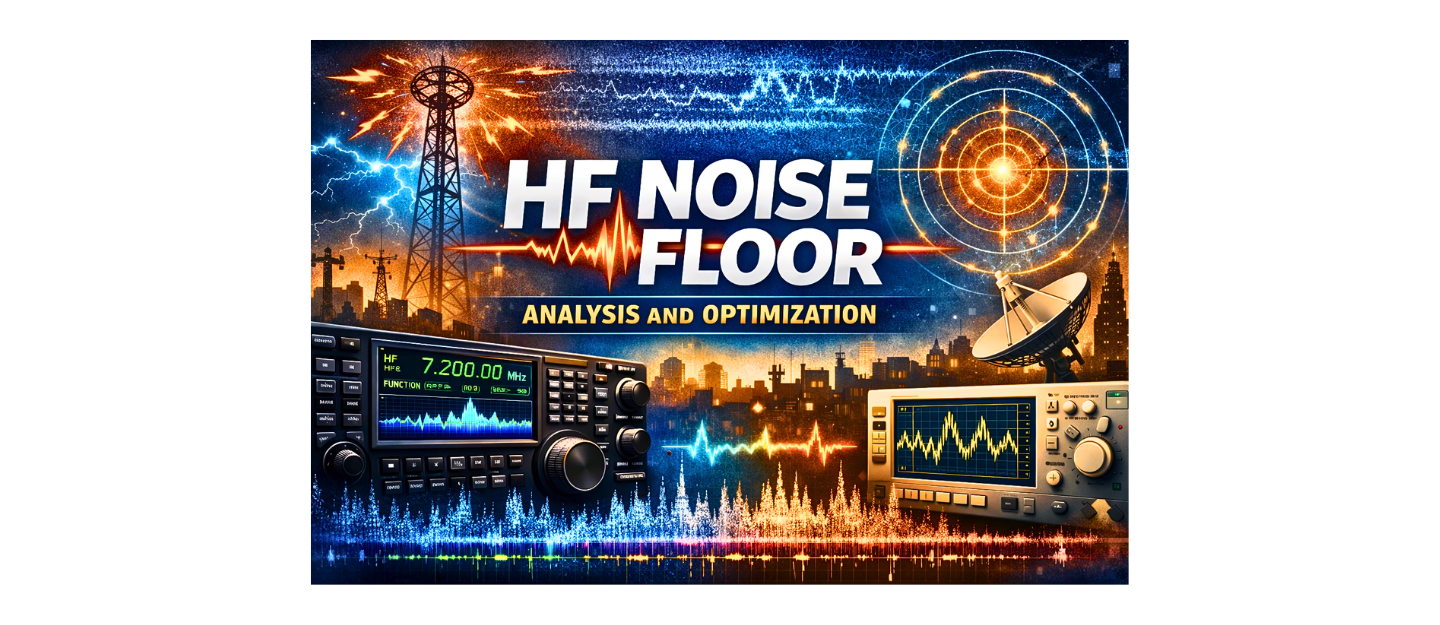
HF Noise Floor Explained: How to Reduce Noise and Improve Signal Reception
HF noise floor optimization is one of the most important skills in amateur radio, directly impacting your ability to hear weak signals and work DX. Whether you’re operating from a quiet rural location or battling heavy urban interference, understanding how to measure, identify, and reduce RF noise can dramatically improve your station performance.
In this guide, you will learn what the HF noise floor is, how to measure it accurately, what causes it, and proven methods to reduce it for clearer, more reliable communication.
HF noise floor analysis is essential for improving signal quality and ensuring reliable high-frequency communication. The noise floor represents the level of background noise in a receiver, below which signals become too weak to detect.
Because HF bands are often crowded and influenced by natural and man-made interference, understanding and controlling the noise floor directly impacts a station’s performance. Operators who analyze and optimize the noise floor can significantly enhance reception, reduce fatigue, and improve their chances of making clear long-distance contacts.
New to the hobby? Start with our Complete Guide to Ham Radio Fundamentals
What Is the HF Noise Floor in Simple Terms?
The HF noise floor is the level of background radio noise present in your receiver when no signal is being received. It determines the weakest signal you can hear—if a signal is below the noise floor, it will be lost. Lowering the noise floor improves your signal-to-noise ratio (SNR), making weak stations easier to copy.
What the HF Noise Floor Is
The HF noise floor consists of all unwanted signals and interference present within a receiver’s bandwidth. It includes natural sources such as atmospheric noise from thunderstorms, cosmic radiation, and solar activity. Additionally, human-made sources like power lines, switching power supplies, LED lighting, and consumer electronics contribute to higher noise levels.
Because the noise floor determines the weakest signal a receiver can detect, even small increases can mask distant or weak signals. As a result, identifying and minimizing these sources becomes a top priority for serious HF operators.
What Is a Good HF Noise Floor Level?
A good HF noise floor typically ranges between S1 and S3 on most receivers, depending on location and band conditions. In quiet rural environments, operators may achieve noise levels below S1, while urban stations often experience S5 or higher due to electrical interference.
- S1–S2: Excellent (very quiet)
- S3–S4: Good (manageable noise)
- S5–S7: Moderate (urban environment)
- S8+: Poor (heavy interference)
Because S-meters are not standardized, using a spectrum display or SDR provides more accurate readings in dBm.
Measuring the Noise Floor
To optimize the noise floor, operators must first measure it accurately. Most modern receivers and transceivers provide an S-meter reading, but this method often lacks precision. Instead, using specialized software-defined radios or spectrum analyzers offers more accurate measurements by displaying real-time noise levels across specific frequency ranges.
For consistent results, operators should take readings during quiet times, such as late at night, when atmospheric noise is minimal. Comparing measurements at different times and locations helps pinpoint trends and identify recurring interference sources.
Natural Noise Sources and Seasonal Effects
Natural noise varies depending on geographical location, time of day, and season. For instance, during summer months, thunderstorms generate significant atmospheric static, raising the noise floor on lower bands like 80 and 160 meters. Conversely, in winter, atmospheric noise decreases, allowing these bands to support clearer long-distance communication.
Additionally, solar activity plays a major role, as flares and geomagnetic storms can increase ionospheric disturbances, temporarily boosting background noise. Understanding these seasonal patterns helps operators predict when natural noise levels will be lowest and plan operating schedules accordingly.
What Causes High HF Noise Floor?
Several factors can raise the HF noise floor and reduce your ability to hear weak signals:
- Electrical interference from homes and nearby buildings
- Power lines and transformers
- Solar activity and geomagnetic storms
- Poor station grounding
- Low-quality power supplies and LED lighting
- Nearby electronic devices and chargers
Understanding these causes helps you systematically eliminate or reduce noise sources.
Identifying Man-Made Interference
Man-made noise often poses the greatest challenge for HF operators. Common sources include household electronics, such as televisions, chargers, and Wi-Fi routers. Even modern appliances like refrigerators and solar panel systems generate radio frequency interference.
Because these sources produce continuous or repetitive noise, they raise the overall noise floor significantly. Locating them requires careful observation and testing. For instance, turning off breakers systematically can reveal which circuits harbor noisy devices.
If you locate a breaker circuit that is creating noise, start unplugging one item at a time until the noise stops. Portable receivers and directional antennas also help track down interference outside the immediate property, such as nearby power lines or commercial buildings.
Step-by-Step: How to Reduce HF Noise Floor
Follow this proven process to lower your noise floor:
- Turn off all breakers and check baseline noise
- Restore power one circuit at a time
- Identify noisy devices by unplugging individually
- Add ferrite chokes to affected cables
- Improve station grounding
- Relocate antenna away from structures
- Use noise blankers and DSP filtering
- Consider a dedicated receive antenna
This systematic approach helps isolate and eliminate interference efficiently.
Techniques for Reducing the Noise Floor
Once sources of interference are identified, several strategies can reduce their impact. Installing ferrite chokes on cables suppresses unwanted currents that radiate noise. Shielded cables and proper grounding further prevent interference from entering the receiver. Additionally, relocating antennas away from noise sources dramatically improves reception by isolating them from problematic areas.
Using narrow filters within the transceiver helps block out-of-band interference, while external noise-canceling devices or phased arrays can actively suppress unwanted signals. Because each situation is unique, combining multiple techniques often yields the best results.
Optimizing Antenna Placement
Antenna placement plays a crucial role in noise floor optimization. Placing antennas higher and farther from man-made structures reduces their exposure to localized noise sources. Vertical antennas often pick up more ground noise, while horizontal antennas placed at strategic heights may offer better rejection of unwanted signals.
Additionally, directional antennas provide the advantage of focusing reception toward desired signals while nulling out noise from other directions. By experimenting with different antenna configurations and locations, operators can dramatically improve signal-to-noise ratios.
HF Noise Floor: Urban vs Rural Environments
Noise levels vary significantly based on location:
- Urban areas: Higher noise due to dense electronics and power infrastructure
- Suburban areas: Moderate noise with some interference sources
- Rural areas: Lowest noise levels, ideal for weak-signal work
Operators in noisy environments often rely on directional antennas, loops, or remote receive setups to overcome interference.
Using Noise Reduction Technology
Modern radios include advanced digital signal processing features that help reduce perceived noise. Noise blankers target repetitive interference, such as power line buzz, while digital noise reduction algorithms suppress background hiss without affecting desired signals.
External noise reduction devices can further enhance weak signal reception by combining signals from multiple antennas to cancel out noise sources. Although these technologies cannot replace proper noise floor management, they provide valuable tools for operators dealing with challenging environments.
Equipment That Helps Lower HF Noise Floor
Certain tools can significantly improve noise performance:
- Ferrite chokes for cable suppression
- External noise canceling units
- Magnetic loop receive antennas
- High-quality linear power supplies
- Software-defined radios (SDRs) for analysis
While equipment alone won’t solve all issues, it plays a key role in a clean station setup.
Monitoring and Continuous Improvement
Noise floor optimization is not a one-time task but an ongoing process. Because conditions change over time, regular monitoring ensures that performance remains optimal. Operators should keep detailed logs of noise floor readings, interference events, and adjustments made to their stations.
Reviewing this data over weeks or months reveals patterns and helps fine-tune strategies. Additionally, staying informed about local construction projects, new electrical installations, or solar activity alerts provides valuable insights into potential noise sources before they become problematic.
Benefits of a Lower Noise Floor
Lowering the noise floor offers numerous benefits beyond improved reception. Reduced background noise decreases operator fatigue during long listening sessions, making communications more enjoyable.
It also enhances emergency preparedness by ensuring that weak signals, such as those from low-power stations or remote locations, are not missed during critical situations. Furthermore, a quieter station performs better during contests and DX hunting, giving operators a competitive edge. Because these advantages compound over time, ongoing efforts to maintain a low noise floor deliver lasting rewards.
Author Experience and Station Insight
This guide is based on real-world HF operating experience, including testing noise levels across multiple bands, antenna configurations, and environments. Practical noise reduction techniques outlined here are commonly used by amateur radio operators to improve weak signal reception and overall station performance.
HF Noise Floor Conclusion
HF noise floor analysis and optimization form the foundation of successful high-frequency communication. By carefully measuring, identifying, and addressing noise sources, operators can unlock the full potential of their equipment and enjoy clearer, more reliable contacts.
While natural noise cannot be eliminated entirely, understanding its patterns allows for strategic planning. With consistent monitoring, proper equipment setup, and effective interference management, anyone can create an optimized station that thrives even in challenging RF environments.
Please consider Donating to help support this channel