
Complete Guide to Ham Radio Software
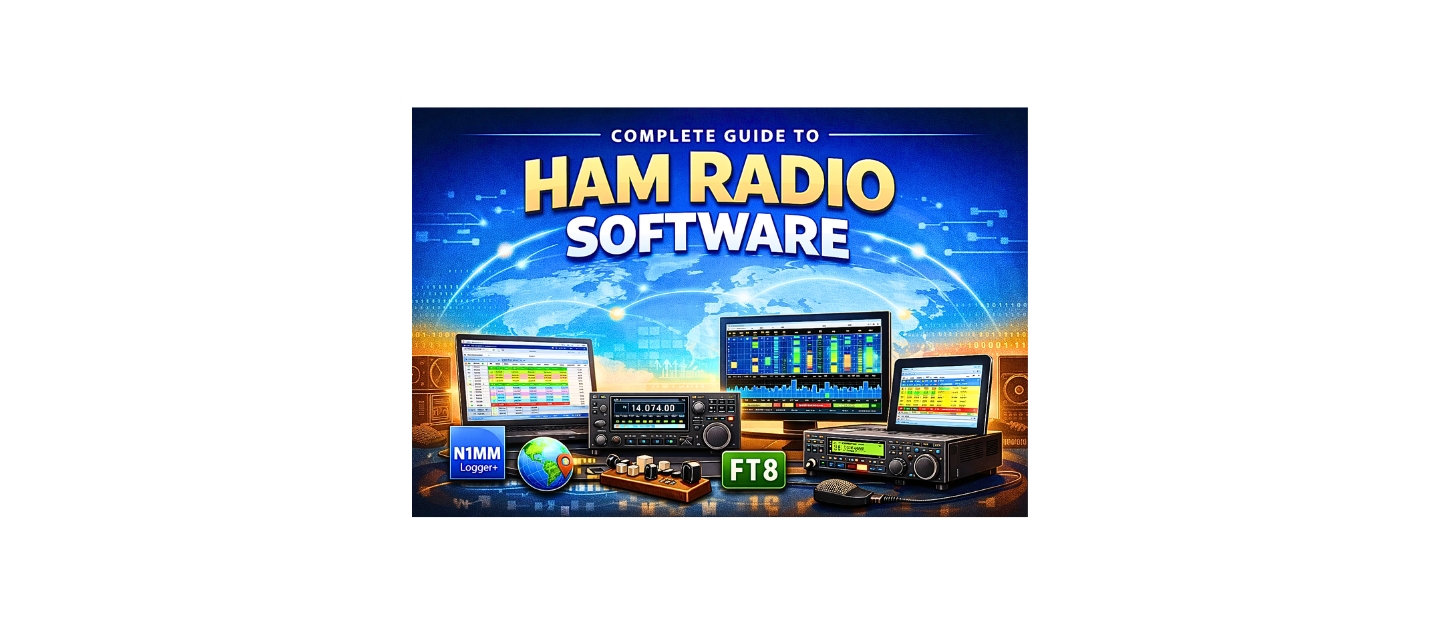
Complete guide to ham radio software, it has become one of the most powerful tools available to amateur operators. Programs can decode signals far below the noise floor, track propagation in real time, automatically log contacts, control radios remotely, and even identify Morse code transmissions across entire frequency bands simultaneously.
Modern amateur radio has evolved far beyond simple voice communication. Today’s ham radio stations often combine radios, computers, and advanced software to decode signals, automate tasks, analyze propagation, and communicate using sophisticated digital protocols.
For both beginners and experienced operators, understanding the ecosystem of ham radio software can dramatically improve station capability and operating efficiency. From digital modes like FT8 to advanced SDR visualization tools, modern software has transformed how amateur radio is practiced.
This guide provides a complete technical overview of the most important categories of ham radio software, how they work, and how operators integrate them into modern stations.
Why Ham Radio Software Is Essential in Modern Stations
Traditional amateur radio relied entirely on manual operation. Operators tuned radios, copied Morse code by ear, and logged contacts on paper. While those skills remain valuable, software now enhances nearly every part of radio operation.
Key capabilities provided by modern ham radio software include:
• Digital signal decoding
• Automated contact logging
• Radio control via computer
• Propagation monitoring
• Weak-signal communication
• Contest automation
• SDR spectrum visualization
• Remote station control
These capabilities allow operators to detect signals that would otherwise be impossible to hear, monitor entire bands at once, and communicate across continents using extremely low power.
Software also plays a major role in scientific experimentation within amateur radio. Many programs measure signal strength, propagation paths, and ionospheric behavior in ways that contribute valuable real-world data.
Major Categories of Ham Radio Software
Ham radio software generally falls into several functional categories. Most stations use multiple programs working together.
| Software Category | Purpose | Typical Use |
|---|---|---|
| Digital mode software | Decodes weak signal digital communications | FT8, FT4, JT65 |
| Logging software | Records contacts and manages QSLs | Awards, DX tracking |
| SDR software | Controls software-defined radios | Spectrum visualization |
| CW decoding tools | Automatically decode Morse code | CW Skimmer |
| CW decoding tools | Monitor HF conditions | Solar data, spotting |
| Contest software | Automates contest operations | Logging and scoring |
| Station control software | Automates radio and equipment control | Remote stations |
Each category addresses a specific need in amateur radio operation.
Digital Mode Software
Digital communication has become one of the most important applications of ham radio software. These programs decode signals using advanced signal processing algorithms.
Digital modes allow communication under extremely weak signal conditions where voice would be impossible.
The most widely used digital mode software today includes:
• WSJT-X
• FLDIGI
• JS8Call
• VARA
• JTDX
WSJT-X is particularly important because it supports several highly efficient weak-signal modes.
Weak Signal Modes: FT8 and FT4
FT8 has become one of the most widely used digital modes in amateur radio because it can decode signals as weak as −24 dB below the noise floor.
FT4 is a faster contest-optimized version of FT8 designed for rapid contacts.
Key characteristics of these modes include:
• Extremely narrow bandwidth
• Automated structured messaging
• Time-synchronized transmissions
• Highly efficient error correction
Typical FT8 message exchange includes:
- CQ call
- Response from another station
- Signal report
- Confirmation
Because messages are highly structured, decoding software can extract information even from extremely weak signals.
This capability allows small stations with modest antennas to make worldwide contacts that would otherwise require high power and large antenna systems.
Morse Code Decoding Software
While Morse code remains a manual skill for many operators, specialized software can automatically decode multiple CW signals simultaneously.
Programs such as CW Skimmer analyze wideband receiver data and detect individual Morse code transmissions across an entire frequency segment.
CW Skimmer works by:
• Analyzing FFT spectrum data from SDR receivers
• Identifying narrowband CW tones
• Automatically decoding Morse characters
• Tracking callsigns and signal strengths
This allows operators to monitor dozens or even hundreds of CW signals at once.
CW Skimmer also feeds data into global spotting networks.
Reverse Beacon Network
The Reverse Beacon Network (RBN) is a global system that collects CW Skimmer data from stations around the world.
When a station transmits Morse code, receiving stations equipped with CW Skimmer automatically detect the signal and upload information to the network.
Information reported typically includes:
• Callsign
• Frequency
• Signal strength
• Receiving station
• Timestamp
Operators use RBN to evaluate propagation conditions and measure station performance.
For example, after calling CQ, an operator can immediately see which stations around the world received the signal.
This makes RBN a powerful tool for antenna testing and propagation analysis.
SDR Software
Software Defined Radio (SDR) has dramatically transformed amateur radio. Instead of traditional hardware filters and demodulators, SDR systems perform signal processing entirely in software.
SDR software allows operators to visualize large sections of the radio spectrum using waterfall displays and spectrum analyzers.
Popular SDR software platforms include:
• SDR# (SDRSharp)
• HDSDR
• SDR Console
• GNU Radio
• PowerSDR
These programs display signal activity across entire bands, allowing operators to identify signals instantly.
Key SDR features include:
• Real-time spectrum analysis
• Wideband recording
• Multiple simultaneous receivers
• Advanced filtering and DSP
• Waterfall visualization
SDR technology also enables advanced signal analysis and experimentation that would be impossible with traditional radios.
Ham Radio Logging Software
Logging software records radio contacts and provides powerful tools for managing station activity.
Although logging is not required by regulation in many countries, it is essential for contesting and award tracking.
Modern logging software includes features such as:
• Automatic logging from digital modes
• Callsign lookup databases
• DX cluster integration
• Award tracking (DXCC, WAS, etc.)
• QSL card management
• Contest scoring
Popular logging programs include:
| Logging Software | Key Features |
|---|---|
| Log4OM | Advanced DX tools and automation |
| N1MM Logger+ | Contest logging standard |
| Ham Radio Deluxe Logbook | Integrated station suite |
| DXKeeper | Award tracking and LoTW integration |
| CQRLOG | Linux logging software |
Logging software often integrates directly with digital mode programs to automatically record contacts.
Contest Software
Amateur radio contests require extremely efficient logging and rapid contact handling.
Contest software automates nearly every aspect of contest operation, including:
• Logging contacts
• Serial number generation
• Real-time scoring
• Duplicate detection
• Band change tracking
N1MM Logger+ is widely regarded as the standard contest software used by competitive operators worldwide.
It supports dozens of contest formats and integrates with radios, keyers, and spotting networks.
Propagation Monitoring Software
HF radio propagation depends heavily on solar activity and ionospheric conditions. Propagation software helps operators understand current band conditions and choose the best frequencies for communication.
Common propagation tools include:
• VOACAP prediction software
• Solar flux monitoring tools
• MUF prediction software
• Beacon monitoring systems
Operators frequently combine propagation tools with spotting networks to evaluate band openings.
Important solar and ionospheric parameters include:
• Solar flux index (SFI)
• K-index (geomagnetic activity)
• A-index
• Maximum usable frequency (MUF)
Station Control and Automation Software
Modern ham radio stations often include multiple radios, amplifiers, antennas, and rotators. Station control software coordinates these components.
Functions commonly include:
• CAT radio control
• Rotor positioning
• Antenna switching
• Amplifier control
• Remote operation
Remote station operation has become increasingly common, allowing operators to control radios over the internet from anywhere in the world.
Software platforms like RemoteHams and specialized remote control programs enable full remote station management.
Integrating Multiple Software Systems
A modern amateur radio station often runs several programs simultaneously.
A typical integrated station may include:
• WSJT-X for digital modes
• Log4OM for logging
• N1MM Logger+ for contests
• SDR Console for spectrum monitoring
• CW Skimmer for Morse decoding
These programs communicate through standardized interfaces such as:
• CAT control protocols
• TCP/IP connections
• virtual serial ports
Integration allows seamless data sharing between programs.
For example, a decoded FT8 contact can automatically be logged in the station database.
Hardware Requirements for Ham Radio Software
Most modern ham radio software runs on standard desktop or laptop computers.
However, certain applications benefit from more powerful hardware.
Typical requirements include:
Minimum Station Computer
• Dual-core processor
• 8 GB RAM
• SSD storage
Advanced SDR or contest stations often use:
• Multi-core processors
• 16–32 GB RAM
• High-performance graphics
• Multiple monitors
Multiple monitors are particularly useful because operators can view spectrum displays, logs, and digital decoding windows simultaneously.
Best Practices for Software-Driven Stations
Operators who rely heavily on software should follow several best practices to maintain reliable station performance.
Recommended practices include:
• Keep accurate system time using NTP synchronization
• Maintain regular software updates
• Backup log databases frequently
• Use dedicated audio interfaces for digital modes
• Monitor CPU usage during contests
Accurate time synchronization is particularly important for digital modes like FT8, which require transmissions to start at precise time intervals.
The Future of Ham Radio Software
Ham radio software continues to evolve rapidly as computing power increases and signal processing techniques improve.
Several emerging trends are shaping the future of amateur radio software:
- Artificial intelligence signal decoding
- Machine-learning noise reduction
- Advanced SDR architectures
- Cloud-connected radio networks
- Automated propagation analysis
These technologies may eventually allow fully automated monitoring of entire HF bands with unprecedented sensitivity.
Despite these advances, amateur radio remains fundamentally about experimentation and learning. Software simply expands the capabilities available to operators.
Complete Guide to Ham Radio Software
Ham radio software has become one of the most transformative developments in modern amateur radio. From decoding extremely weak digital signals to visualizing entire radio bands with SDR technology, software enables capabilities that were unimaginable just a few decades ago.
Operators who learn to integrate logging software, digital mode programs, SDR tools, and propagation systems can dramatically increase station performance and operating efficiency.
FAQ (Featured Snippet Optimized)
What software do ham radio operators use?
Ham radio operators use software for logging contacts, decoding digital modes, controlling radios, analyzing propagation, operating SDR receivers, and managing contest activity.
What is the best ham radio digital mode software?
WSJT-X is widely considered the most important digital mode software because it enables weak-signal modes like FT8, FT4, JT65, and WSPR.
What is SDR software in amateur radio?
SDR software controls software-defined radios, displaying spectrum and waterfall data while allowing demodulation of multiple signals simultaneously.
Do ham radio operators need logging software?
Logging software is not required by law but is essential for contesting, award tracking, QSL management, and maintaining accurate station records.
What is CW Skimmer used for?
CW Skimmer automatically decodes multiple Morse code signals simultaneously and feeds spotting networks like the Reverse Beacon Network.
What is the Reverse Beacon Network?
The Reverse Beacon Network collects CW Skimmer data from stations worldwide to show real-time propagation and DX activity.
About the Author
Vince, W2KU, is a licensed Extra class amateur radio operator and the founder of Ham Shack Reviews. He was named Amateur of the Year in 2026 for contributions to practical amateur radio education and equipment evaluation.
He knows propagation very well, operates mobile and handhelds daily. Vince exchanges QSL cards for DXCC, contest confirmation, and award tracking and is the club QSL manager. His guidance focuses on practical operating procedures, accurate logging, and real-world amateur radio practices.
Please consider Donating to help support this channel