
Complete Guide To Receiver Controls
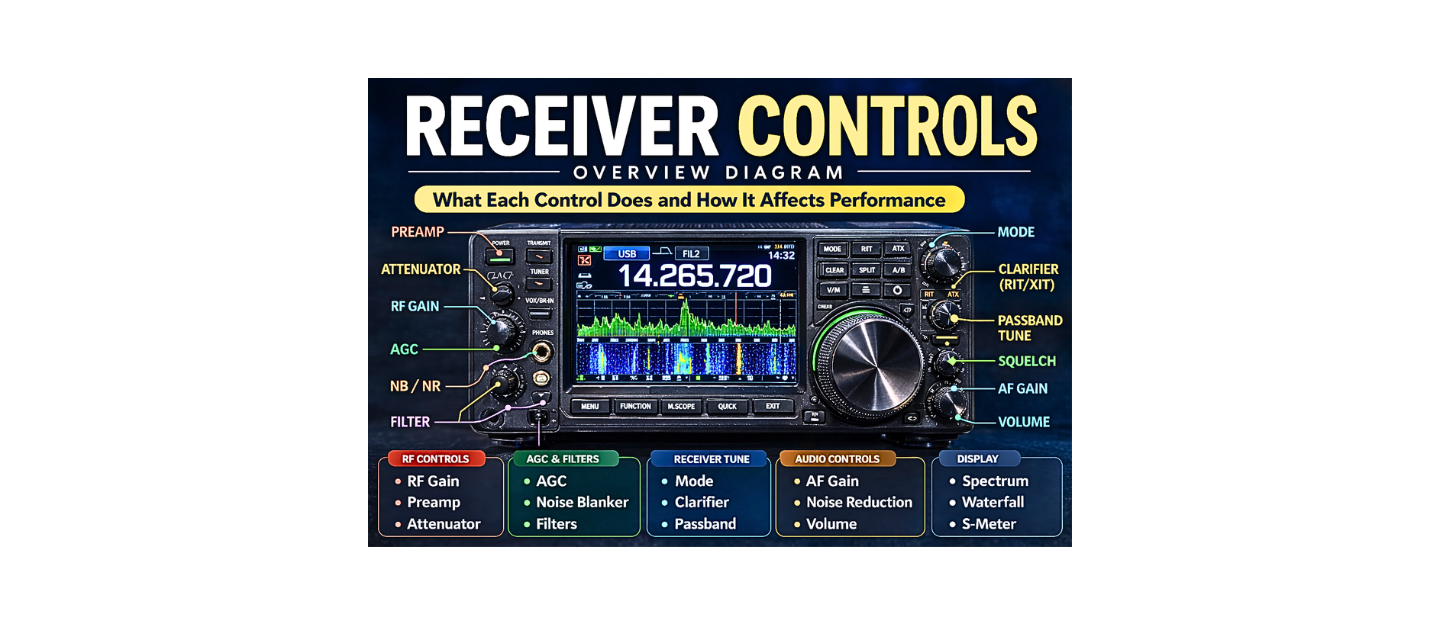
Complete Guide To Receiver Controls are the interface between an operator and the radio’s signal processing system. While tuning a frequency selects the signal you want to hear, receiver controls determine how well you hear it. These controls manage signal strength, noise levels, interference rejection, and audio clarity.
Modern transceivers contain sophisticated signal processing systems, yet the operator still plays a critical role in optimizing performance. Controls such as RF gain, squelch, automatic gain control (AGC), bandwidth filters, and noise reduction allow the radio to adapt to different propagation conditions and signal environments.
Understanding these controls is essential for amateur radio operators, shortwave listeners, and communications professionals. Proper adjustment can mean the difference between copying a weak signal and hearing nothing but noise.
This guide explains the most important receiver controls, how they work, and how to use them effectively in real-world operating conditions.
Why Receiver Controls Matter
Radio signals vary dramatically depending on propagation, interference, and transmitter strength. Even a high-end receiver cannot automatically compensate for every condition without operator input.
Receiver controls allow operators to:
- Improve weak signal reception
- Reduce background noise
- Minimize interference from nearby stations
- Stabilize audio levels during fading
- Adapt the receiver to different operating modes
Without proper adjustment, even a powerful radio may perform poorly.
Receiver controls are especially important in crowded bands, during poor propagation, or when operating in noisy RF environments.
The Core Controls Found on Most Radios
Most amateur and communications receivers share a similar set of front-panel controls. While their exact design varies between manufacturers, the underlying functions remain consistent.
| Control | Purpose | Primary Benefit |
|---|---|---|
| RF Gain | Adjusts receiver sensitivity | Prevents overload and improves weak signals |
| Squelch | Mutes background noise | Keeps receiver silent without signals |
| AGC | Stabilizes signal strength | Reduces audio fluctuation during fading |
| Bandwidth | Adjusts filter width | Improves selectivity and reduces interference |
| Noise Reduction | Digital signal processing | Reduces static and background noise |
Each of these controls affects how the receiver processes incoming signals.
RF Gain Control: Managing Receiver Sensitivity
RF gain controls the amplification applied to signals entering the receiver’s front end. By adjusting RF gain, operators control how sensitive the receiver is to incoming signals.
At maximum RF gain, the receiver amplifies signals as much as possible. This increases sensitivity but can also allow more noise and interference into the system.
Reducing RF gain lowers the amplification level. This may seem counterintuitive, but it often improves readability in crowded bands.
Practical uses of RF gain include:
- Reducing noise on weak signals
- Preventing receiver overload from strong stations
- Improving readability during band congestion
- Controlling background noise levels
Many experienced operators reduce RF gain slightly when copying weak signals. This lowers noise levels and improves the signal-to-noise ratio.
Squelch Control: Silencing Background Noise
Squelch is a threshold control that mutes the receiver when signals fall below a certain level.
Without squelch, a radio produces constant background noise when no station is transmitting. This can be distracting, particularly for monitoring operations.
The squelch control allows the operator to set a signal threshold. Signals below that level are muted, while signals above it pass through to the speaker.
Typical applications include:
- Repeater monitoring
- Scanner operation
- Two-way radio communications
- VHF/UHF monitoring
Proper squelch adjustment is important. If set too high, weak signals may be missed. If set too low, background noise may constantly open the receiver.
For weak signal work, many operators turn squelch completely off.
Automatic Gain Control (AGC)
Automatic Gain Control adjusts receiver amplification automatically to maintain consistent audio levels.
Radio signals frequently fade due to propagation changes, atmospheric conditions, and multipath interference. Without AGC, signal strength variations would cause dramatic audio level changes.
AGC solves this problem by dynamically adjusting receiver gain. When signals become stronger, AGC reduces amplification. When signals fade, amplification increases.
Most radios provide several AGC settings:
| AGC Setting | Response Speed | Typical Use |
|---|---|---|
| Fast | Rapid response | CW and digital modes |
| Medium | Balanced response | General operation |
| Slow | Gradual response | SSB voice signals |
Fast AGC quickly reacts to signal changes but may cause audio pumping in voice signals. Slow AGC provides smoother audio but reacts more slowly to sudden signal peaks.
Choosing the appropriate AGC speed improves overall listening comfort.
Receiver Bandwidth Controls and Filtering
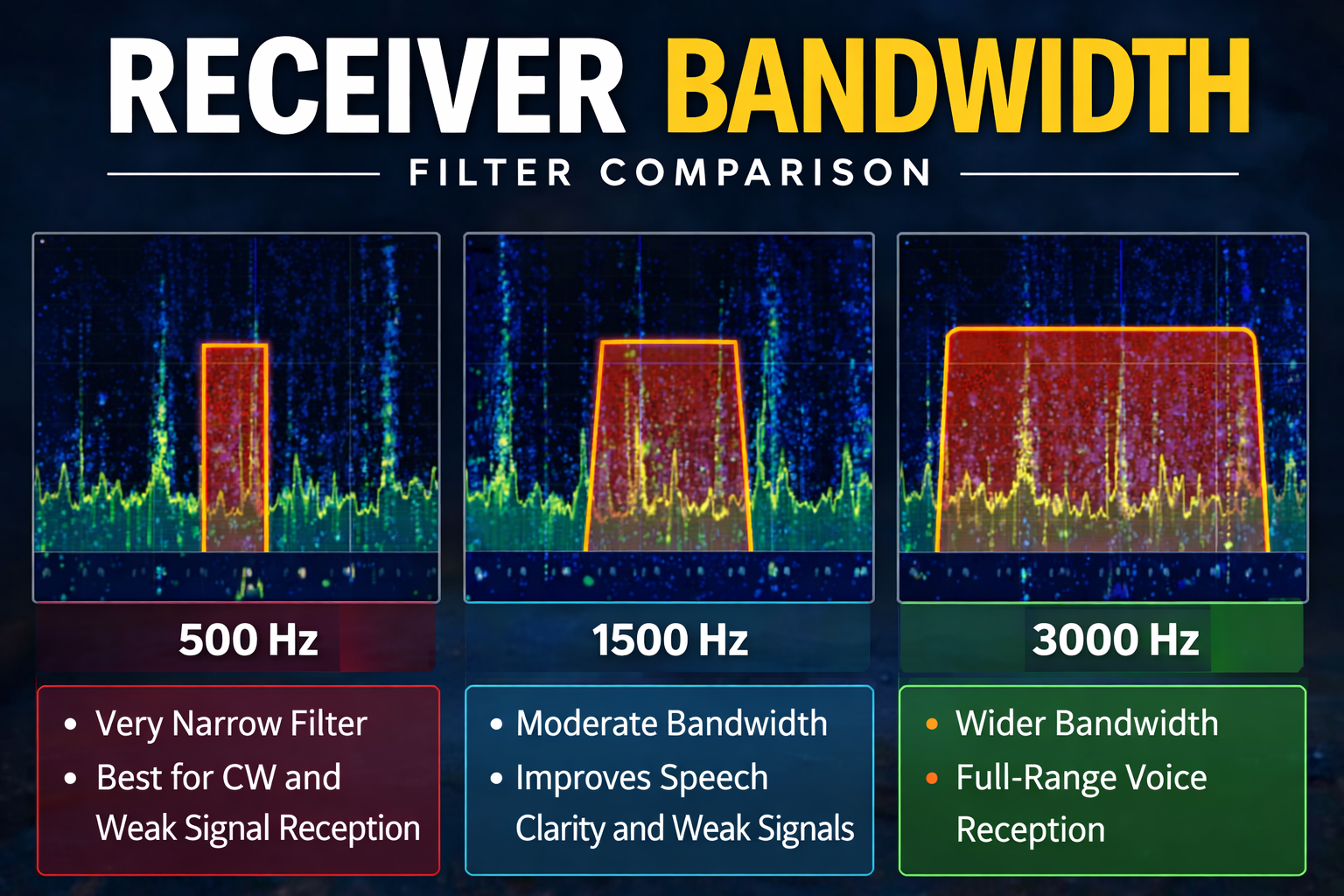
Bandwidth controls adjust the width of the receiver’s passband filter. This determines how much of the radio spectrum around the tuned frequency is allowed through the receiver.
Wide bandwidth allows more audio frequencies through the receiver. This improves sound quality but increases the chance of interference from nearby signals.
Narrow bandwidth reduces interference by limiting the range of frequencies accepted by the receiver.
Typical bandwidth values include:
| Mode | Typical Bandwidth |
|---|---|
| AM | 6–10 kHz |
| SSB | 2.4–3 kHz |
| CW | 500–800 Hz |
| Digital Modes | 200–500 Hz |
Reducing bandwidth is one of the most effective ways to improve signal clarity in crowded bands.
Modern radios often include digital signal processing filters that allow extremely precise bandwidth adjustments.
Noise Reduction and DSP Controls
Many modern receivers include digital signal processing (DSP) features designed to reduce noise and improve signal clarity.
Digital signal processing systems analyze incoming signals and remove noise components while preserving the desired signal.
Common DSP features include:
- Digital noise reduction
- Automatic notch filtering
- Manual notch filtering
- Interference rejection algorithms
These controls are especially useful for removing:
- Power line noise
- Static crashes
- Carrier interference
- Heterodyne tones
While DSP is powerful, excessive noise reduction can distort signals. Operators should apply these tools carefully to avoid degrading audio quality.
Practical Receiver Control Adjustment Strategy
Experienced operators typically adjust receiver controls in a specific order to optimize reception.
A common tuning strategy includes:
- Tune to the desired frequency.
- Adjust RF gain to reduce noise.
- Set AGC speed appropriate to the mode.
- Adjust bandwidth to reduce adjacent interference.
- Apply noise reduction if needed.
- Use squelch only when monitoring channels.
This step-by-step approach allows the operator to systematically improve reception.
Receiver Controls in Weak Signal Conditions
Weak signal reception is where receiver controls become most important.
When signals are near the noise floor, careful adjustment can significantly improve readability.
Recommended adjustments for weak signals include:
- Slightly reduce RF gain
- Narrow receiver bandwidth
- Disable squelch
- Use slow AGC
- Apply moderate noise reduction
These adjustments improve signal-to-noise ratio and allow weak signals to stand out from background noise.
Receiver Controls in Strong Signal Environments
Strong signal conditions present a different challenge. Nearby transmitters can overload a receiver, creating distortion or spurious signals.
To manage strong signals:
- Reduce RF gain
- Use narrower filters
- Activate attenuators if available
- Use notch filters for interfering carriers
These adjustments protect receiver circuitry and improve overall signal clarity.
How Receiver Design Affects Control Performance
Not all receivers respond equally to control adjustments. High-quality receivers typically include:
- High dynamic range front ends
- Advanced DSP filtering
- Selectable IF bandwidths
- Multiple AGC response options
These design features allow operators to fine-tune reception under challenging conditions.
Entry-level radios may have fewer adjustable parameters, but the fundamental control principles remain the same.
Common Mistakes When Using Receiver Controls
Even experienced operators sometimes misuse receiver controls. Common mistakes include:
- Running RF gain at maximum constantly
- Setting squelch too high
- Using excessive noise reduction
- Choosing the wrong AGC speed
- Leaving bandwidth too wide in crowded bands
Learning how each control interacts with the others improves receiver performance dramatically.
The Future of Receiver Control Technology
Modern radios increasingly rely on digital signal processing and software-defined architectures.
Software-defined radios (SDR) allow receiver parameters to be adjusted through software interfaces rather than physical knobs.
This technology provides:
- Adjustable filter shapes
- Real-time spectrum displays
- Adaptive noise filtering
- Advanced interference suppression
Despite these advances, the core receiver control concepts remain unchanged. Operators still manage sensitivity, noise levels, and signal filtering to optimize reception.
Complete Guide To Receiver Controls
Complete Guide To Receiver Controls show the essential tools for maximizing radio performance. Understanding how RF gain, squelch, AGC, bandwidth filters, and noise reduction interact allows operators to adapt their radios to changing signal conditions.
Whether working weak DX signals, monitoring repeaters, or listening to crowded bands, proper adjustment of receiver controls significantly improves signal clarity and listening comfort.
Mastering these controls transforms a radio from a simple receiver into a highly adaptable communications tool capable of performing well under a wide range of operating conditions.
About the Author
Vince, W2KU, is a licensed Extra class amateur radio operator and the founder of Ham Shack Reviews. He was named Amateur of the Year in 2026 for contributions to practical amateur radio education and equipment evaluation.
He primarily operates HF, knows propagation very well, operates mobile and handhelds daily. Vince exchanges QSL cards for DXCC, contest confirmation, and award tracking and is the club QSL manager. His guidance focuses on practical operating procedures, accurate logging, and real-world amateur radio practices.
Frequently Asked Questions
What are receiver controls in a radio?
Receiver controls are adjustments that allow operators to manage signal sensitivity, noise levels, filtering, and audio output. These controls optimize how a radio receives and processes incoming signals.
What does RF gain do on a receiver?
RF gain adjusts the amplification applied to incoming signals before they are processed by the receiver. Reducing RF gain can help control noise and prevent receiver overload from strong signals.
What is AGC in a radio receiver?
Automatic Gain Control (AGC) automatically adjusts receiver amplification to keep audio levels consistent as signal strength changes. This prevents sudden loud or weak audio during signal fading.
Should squelch be used for weak signals?
No. Squelch should generally be turned off when trying to receive weak signals because it may block signals that fall below the squelch threshold.
Why is receiver bandwidth important?
Bandwidth determines how much of the radio spectrum the receiver allows through. Narrower bandwidth improves selectivity and reduces interference from nearby signals.
What receiver setting helps reduce interference?
Reducing bandwidth, lowering RF gain, and using notch filters are the most effective ways to reduce interference from nearby stations.
Please consider Donating to help support this channel