

Ham radio operators often rely on specialized equipment to optimize communication systems, and duplexer are a critical component in many installations. These devices are especially important in repeater systems, where they enable simultaneous transmitting and receiving through a single shared antenna.
Who Needs a Duplexer in Ham Radio?
If you operate a repeater, run a shared antenna system, or need simultaneous transmit and receive capability, a duplexer is essential. Without proper frequency isolation, transmitter power can overload the receiver and make full-duplex operation impossible. Understanding when a duplexer is required helps prevent equipment damage and ensures reliable communication.
New to antenna systems? See our Complete Guide to Ham Radio Antennas.
What Is a Duplexer?
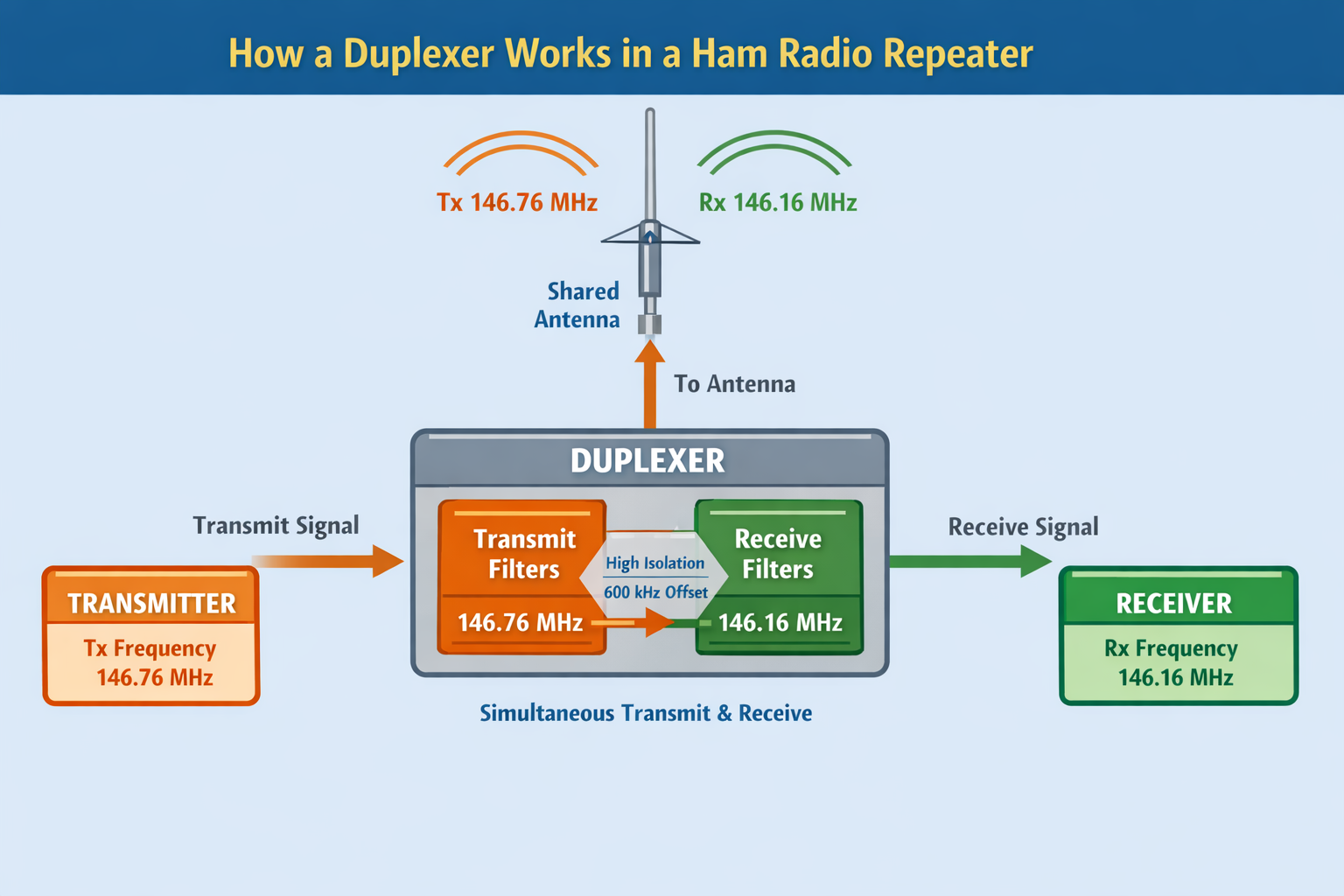
A duplexer is an RF filtering device that allows a radio system to transmit and receive signals at the same time using one antenna. It works by separating transmit and receive signals based on frequency while providing strong isolation between the transmitter and receiver.
This isolation prevents the high-power transmit signal from entering and overloading the sensitive receiver front end. Without a duplexer, simultaneous full-duplex operation on one antenna would not be possible.
Duplexers are most commonly used in repeater systems, where a signal is received on one frequency and retransmitted on another frequency continuously.
Real-World Repeater Example
A typical 2-meter repeater may transmit on 146.940 MHz while receiving on 146.340 MHz. Without a duplexer, the high-power transmit signal would overwhelm the receiver. A properly tuned duplexer isolates these frequencies so the repeater can receive and transmit at the same time using a single antenna.
Types of Duplexers
Not all duplexers are built the same. Different designs provide different levels of isolation, power handling, and frequency flexibility.
The two most common types used in amateur radio repeater systems are pass-reject duplexers and band-pass/band-reject duplexers.
Pass-reject duplexers allow the desired transmit frequency to pass while rejecting the receive frequency, and vice versa. These are widely used in amateur repeater installations because they provide strong isolation with relatively simple tuning.
Band-pass/band-reject duplexers provide additional filtering by tightly controlling which frequency ranges pass through the system. These are often used in high-RF environments where interference from nearby transmitters is a concern.
Large repeater installations often use multi-cavity duplexers. Each cavity acts as a highly selective filter, improving isolation and reducing interference. More cavities generally provide better performance but increase size, cost, and tuning complexity.
Duplexer vs Diplexer: What Is the Difference?
Duplexers and diplexers are often confused, but they serve different purposes.
A duplexer allows a radio to transmit and receive on different frequencies at the same time using a single antenna. It is specifically designed for full-duplex operation, such as repeater systems.
A diplexer combines or separates two different frequency bands so they can share one antenna system. For example, a diplexer might allow a VHF radio and a UHF radio to use the same antenna without interfering with each other.
In simple terms, a duplexer separates transmit and receive frequencies for simultaneous operation, while a diplexer separates different frequency bands for shared antenna use.
Single-Antenna Operation
In repeater installations, transmit and receive antennas would normally need large physical separation to prevent interference. A duplexer eliminates this requirement by allowing both signals to share the same antenna while remaining electrically isolated.
Repeaters operate using a frequency offset between transmit and receive.
Typical amateur radio offsets are:
• VHF repeaters — 600 kHz offset
• UHF repeaters — 5 MHz offset
This frequency separation allows the duplexer filters to isolate the signals effectively.
Frequency Isolation and Receiver Protection
Transmitters operate at much higher power levels than received signals. A repeater transmitter may output tens of watts, while received signals are often measured in microvolts.
Without proper filtering, transmit energy would desensitize or damage the receiver. Duplexers provide high isolation, often 70 to 100 dB preventing transmitter energy from leaking into the receive path.
This isolation ensures stable repeater operation and protects sensitive RF components.
Efficient Use of Equipment and Space
Using one antenna instead of two reduces tower space, feedline cost, installation complexity, and maintenance requirements. This is especially important for rooftop, tower, and shared-site installations where antenna separation is limited.
Duplexers allow compact and efficient repeater deployment without sacrificing performance.
Duplexer Cost and What Affects Price
Duplexer prices vary widely depending on design and performance.
Single-cavity or compact mobile duplexers are typically the most affordable but offer limited isolation and power handling.
Multi-cavity repeater duplexers provide significantly better filtering and higher power capability, which increases cost.
Frequency band, power rating, build quality, and tuning precision all influence price.
Professional-grade duplexers used at shared repeater sites are typically more expensive due to tighter filtering requirements and durable construction.
Investing in a properly rated duplexer improves system reliability and reduces long-term maintenance.
Advantages of Using Duplexers
Compact System Design
A single shared antenna simplifies installation and reduces structural requirements. This is ideal for limited-space installations and professional repeater sites.
High RF Performance
Modern duplexers handle high transmit power while maintaining strong isolation and low signal loss. Properly tuned duplexers provide stable, interference-free operation.
Frequency Flexibility
Most duplexers can be tuned to specific transmit and receive frequency pairs, allowing use across VHF, UHF, and commercial land-mobile bands.
Lower Infrastructure Cost
Reducing the number of antennas, feedlines, and mounting hardware lowers total system cost while simplifying maintenance.
Duplexer vs Diplexer vs Splitter — What’s the Difference?
A duplexer separates transmit and receive frequencies on the same band for full-duplex operation.
A diplexer combines or separates different frequency bands into one antenna system.
A splitter divides signal power between multiple devices but does not provide frequency isolation.
Using the wrong device can cause severe signal loss or equipment damage.
How Duplexers Work
Duplexers use precision RF filter cavities to control which frequencies pass to each port.
Common filter types include:
Band-pass filters — pass only the desired frequency range
Notch filters — reject a specific frequency while passing others
Transmit filters pass the transmit frequency to the antenna while blocking it from the receiver. Receive filters pass incoming signals to the receiver while rejecting transmit energy.
These filtering stages create the isolation required for full-duplex operation.
Why Duplexer Tuning Is Critical
Duplexers must be precisely tuned using specialized test equipment such as a service monitor or network analyzer. Even small frequency shifts can reduce isolation and cause desense, intermodulation, or receiver overload. Professional tuning ensures maximum isolation and minimum insertion loss.
How Duplexers Are Tuned
Duplexers must be carefully tuned to the exact transmit and receive frequencies used by the radio system. Proper tuning ensures maximum isolation between the transmitter and receiver while minimizing signal loss.
Tuning is performed by adjusting the resonant frequency of each cavity filter. This process requires specialized test equipment such as a service monitor, spectrum analyzer, or tracking generator.
During tuning, technicians measure insertion loss, return loss, and isolation between frequencies. Adjustments are made until the duplexer passes the desired frequency efficiently while rejecting unwanted signals.
Because temperature, component aging, and installation changes can affect performance, duplexers may require periodic retuning to maintain optimal operation.
Important Duplexer Specifications
Several technical specifications determine duplexer performance.
Isolation measures how effectively the duplexer prevents transmit power from entering the receiver. Higher isolation provides better protection and cleaner reception.
Insertion loss refers to the signal power lost while passing through the duplexer. Lower insertion loss improves overall system efficiency and signal strength.
Power handling indicates the maximum transmitter power the duplexer can safely manage without overheating or distortion.
Frequency spacing defines the minimum difference between transmit and receive frequencies required for proper operation. Narrow spacing typically requires more cavities and more precise tuning.
Understanding these specifications helps ensure the duplexer matches the requirements of the repeater or radio system.
How to Choose the Right Duplexer
Selecting the correct duplexer depends on several factors related to system requirements and operating environment.
Frequency band is the first consideration. Duplexers must be designed specifically for VHF, UHF, or other operating bands.
Transmit power rating must meet or exceed the output power of the transmitter to prevent overheating and component failure.
Frequency separation between transmit and receive channels determines how much filtering is required. Smaller frequency spacing requires higher performance duplexers.
Installation environment also matters. High-RF sites with multiple transmitters require greater isolation and more cavity filtering.
Physical size and number of cavities should match performance needs and available installation space.
Choosing the right duplexer ensures reliable operation, protects equipment, and maintains clear signal quality.
How to Choose the Right Duplexer
When selecting a duplexer, consider:
- Operating frequency band (VHF or UHF)
- Frequency separation between transmit and receive
- Required isolation level (typically 70–100 dB)
- Maximum transmitter power rating
- Number of cavities
- Physical size and installation space
A duplexer must be tuned precisely to your repeater frequencies for proper operation.
Common Applications of Duplexers in Ham Radio
Repeater Systems
Duplexers are essential for VHF and UHF repeaters operating with one antenna and continuous transmit/receive capability.
Shared-Antenna Mobile Installations
Some advanced mobile or control systems use duplexing to manage multiple signal paths efficiently.
Fixed Base Stations
Club and home repeater installations use duplexers to simplify antenna systems and reduce physical footprint.
Duplexer Installation Best Practices
Proper installation is critical for duplexer performance.
Use high-quality low-loss coaxial cable to minimize signal attenuation between the radio, duplexer, and antenna.
Ensure all connectors are properly tightened and weatherproofed to prevent moisture intrusion and signal degradation.
Maintain proper grounding of the duplexer and associated equipment to reduce noise and protect against electrical surges.
Keep transmit and receive feedlines properly routed to avoid coupling and unwanted interference.
Adequate ventilation should be provided to prevent overheating, especially in high-power installations.
Correct installation ensures maximum isolation, stable tuning, and long-term reliability.
Common Duplexer Problems and Troubleshooting
Several issues can affect duplexer performance.
Receiver desense occurs when transmit power leaks into the receiver, reducing sensitivity. This is often caused by poor tuning or insufficient isolation.
High insertion loss can reduce transmit range and weaken received signals. This may result from damaged cavities, poor connectors, or mistuned filters.
Intermodulation interference can occur in high-RF environments where multiple transmitters interact.
Temperature changes can shift tuning and reduce filtering effectiveness over time.
Most problems can be resolved through proper retuning, inspection of feedlines and connectors, and verifying system grounding.
Why Duplexers Are Essential in Repeater Operation
Repeaters must receive weak incoming signals while simultaneously transmitting strong outgoing signals. Without extreme signal isolation, the transmitter would overpower the receiver instantly.
Duplexers make continuous, full-duplex repeater operation possible while maintaining signal clarity and system stability.
Common Duplexer Problems and Fixes
- Poor isolation → duplexer mistuned
- Weak receive signal → excessive insertion loss
- Repeater desense → insufficient frequency separation
- High SWR → bad antenna or coax
- Overheating → power rating exceeded
Most issues are resolved through proper tuning and installation.
Final Thoughts on Ham Radio Duplexers
Duplexers are a fundamental component of repeater systems and shared-antenna RF installations. By isolating transmit and receive frequencies, they enable simultaneous operation, protect sensitive equipment, and simplify antenna infrastructure.
For amateur radio repeaters, a properly tuned duplexer is not optional — it is essential for reliable, interference-free communication.
“Based on real repeater installation and tuning experience…”
Frequently Asked Questions About Duplexers
What does a duplexer do in a repeater?
It allows the repeater to transmit and receive at the same time using one antenna while keeping the transmitter and receiver isolated.
Can a duplexer work without tuning?
No. Duplexers must be tuned to the exact transmit and receive frequencies for proper isolation and performance.
Do duplexers reduce signal strength?
Yes, slightly. All duplexers introduce some insertion loss, but properly tuned units minimize this effect.
How often should a duplexer be retuned?
Retuning may be required if frequencies change, performance drops, or environmental conditions affect the system.
Can I use a duplexer for two radios on different bands?
No. That requires a diplexer, not a duplexer.