
Eliminating common mode current, it rides on the outside of your coax shield. It turns your feed line into part of the antenna. Consequently, it brings RF into the shack, raises noise, and distorts patterns. You must treat it like a fault, not a feature.
Common-mode current usually appears because of imbalance or poor grounding. A classic example is an end-fed antenna without a good counterpoise. Then the coax shield completes the circuit and radiates. Sometimes nearby metal, routing, or mismatched baluns worsen it.
Recognizing Common-Mode Current Symptoms
You often notice RF bites on mics or key paddles. Sometimes you hear strange audio distortion or clicking in speakers. Additionally, gear may reset when you transmit. Touching equipment might change the SWR reading.
Your pattern can also skew badly. The antenna may favor odd directions that modeling never predicted. Furthermore, receive noise might rise because the feed line acts like a long noise antenna. Neighbors may also complain about interference on their electronics.
Verify the Basics
You should start by confirming your station wiring and grounding. Check that the rig, power supply, and tuner share a solid station ground point. Then ensure all connectors are tight, clean, and properly crimped or soldered.
You must also verify the antenna is reasonably resonant. If the tuner compensates for a wildly reactive load, common-mode problems often increase. Therefore, tune the antenna length and placement before chasing ghosts on the coax.
Detecting Common-Mode Current
You can detect common-mode current several ways. A simple method uses a small RF current meter clipped around the coax. Then you transmit a carrier and compare readings along the line.
If you do not have a meter, you can use indirect methods. Touch the coax or gear with the back of your hand at low power. Additionally, move your hand along the line and watch the SWR meter. Changes with hand position hint at common-mode issues.
Use Current Baluns When Needed
You kill common-mode current most effectively with a good current balun. Unlike a voltage balun, a current balun strongly resists shield currents. Therefore, it forces equal and opposite currents into a balanced antenna.
You should place a current balun at the transition between unbalanced and balanced parts. For example, install one at the feed point of a dipole fed with coax. Then additional chokes near the shack can further reduce shield currents.
Building an Effective Choke Balun
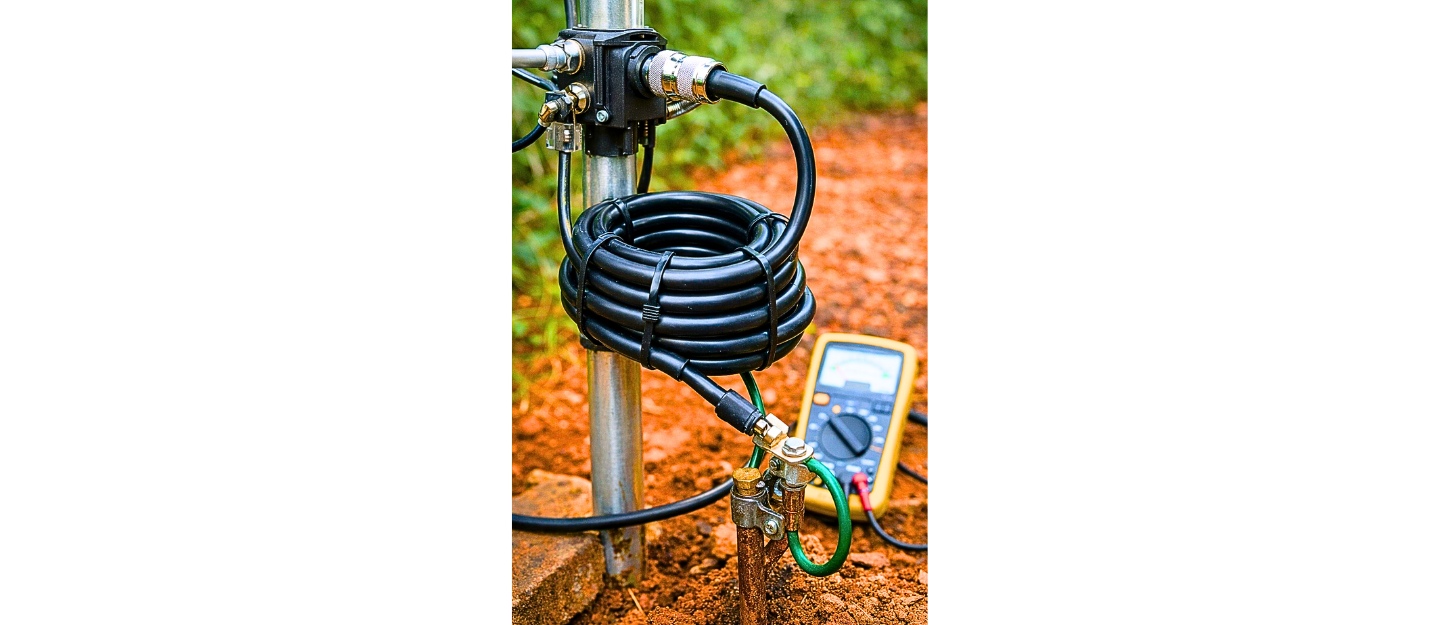
You can build a choke by coiling coax into several turns. However, its effectiveness depends on turns, diameter, and frequency. Therefore, many operators prefer ferrite chokes using appropriate mix material.
You should slide several ferrite beads or clamp-on cores over the coax. Aim for high impedance at the operating bands. More cores or turns usually increase choking effectiveness. Then mount the choke close to the antenna feed point.
Fixing End-Fed Antennas
End-fed and random-wire antennas love to create common-mode currents. The feed point sees high impedance and demands a counterpoise. Without one, the coax shield becomes that counterpoise and radiates strongly.
You should always provide a deliberate return path. Add a short radial or several counterpoise wires tuned near quarter wavelength. Then place a strong choke on the coax a few feet from the matchbox. This combination often tames shield radiation.
Improving Grounding and Bonding
Good grounding and bonding reduce common-mode problems significantly. You should bond all station equipment together with short, wide conductors. Then connect this station bus to a proper earth reference if possible.
You must avoid long, skinny ground leads that behave like antennas themselves. Instead, use copper strap or wide braid for RF bonding. Additionally, bond coax entry panels, lightning arrestors, and any external enclosures to the same reference.
Rethinking Feed Line Routing
Coax routing strongly affects common-mode behavior. You should route coax away from the antenna as directly and perpendicularly as possible. Avoid running the feed line parallel and close to radiating elements.
Additionally, keep coax away from house wiring and large metal objects. Sharp bends and tight coils near the shack can sometimes worsen coupling. Therefore, aim for smooth runs, gentle curves, and separation from other conductors.
Testing Changes Systematically
You must change one thing at a time when hunting common-mode current. First, measure baseline behavior: SWR, noise, and any RF in the shack. Then add a choke or counterpoise and test again at several power levels.
Keep detailed notes for each modification. Over time, you will see which interventions help most. Because every station and antenna is different, a personal logbook of fixes becomes invaluable.
Handling Multi-Band Antennas
Multi-band traps, off-center-fed dipoles, and fan antennas can complicate common-mode behavior. A single choke may not work equally well on all bands. Therefore, you may need multiple chokes or different ferrite mixes.
You should identify which bands show the worst symptoms. Then prioritize choking and balancing solutions for those frequencies first. Sometimes adding a second choke at a different position cures stubborn bands.
Comparison Differential Measurement
You can compare different configurations back-to-back. For instance, test with the choke at the feed point, then at the shack, then at both. Keep power, frequency, and operating mode constant during each run.
If common-mode current falls, you will notice more stable SWR and fewer RF artifacts. You may also see lower noise and improved receive behavior. In this way, you systematically converge on the best configuration.
Integrating RFI Suppression
Common-mode current often drives RFI into household gear. You can treat RFI and common-mode as related problems. First, choke the coax and bond the station. Then add ferrite cores to affected device cables as needed.
You should attack the main RF path before chasing every individual symptom. Once the shield stops radiating, many RFI issues vanish. Remaining problems often require only a few targeted ferrites on specific cables.
Maintaining Your Fixes
Your station evolves, and so does common-mode behavior. New antennas, equipment, or furniture can change coupling paths. Consequently, you should periodically recheck for symptoms after major changes.
Inspect chokes, grounds, and connectors annually. Weather, corrosion, or physical stress may degrade performance. By treating common-mode control as periodic maintenance, you keep the station quiet and predictable.
Building a Personal Checklist
You benefit from a repeatable checklist. Start with verifying antenna resonance and feed point hardware. Then confirm station bonding, grounding, and coax routing. After that, add or upgrade current baluns and chokes.
Finally, run test transmissions on each band and mode. Watch for SWR shifts, RFI, and audio issues. When you follow this routine, you consistently hunt and kill common-mode current before it ruins your operating.
Eliminating Common Mode Current
Eliminating common mode current prevents the quiet sabotages stations when operators ignore balance, grounding, and feed line behavior. However, once you recognize the symptoms and treat your coax shield as a potential radiator, you gain powerful leverage over RF problems.
With combined proper antenna tuning, deliberate counterpoises, solid bonding, and well-placed current chokes, you transform a noisy, temperamental setup into a predictable and stable station.
As you systematically test each change and document the results, you develop a personal playbook that makes future troubleshooting faster and easier. Ultimately, eliminating common-mode current is not a one-time fix but an ongoing discipline that pays off every time you transmit cleanly, copy weak signals more clearly, and operate without unexpected RF surprise
Please consider Donating to help support this channel