
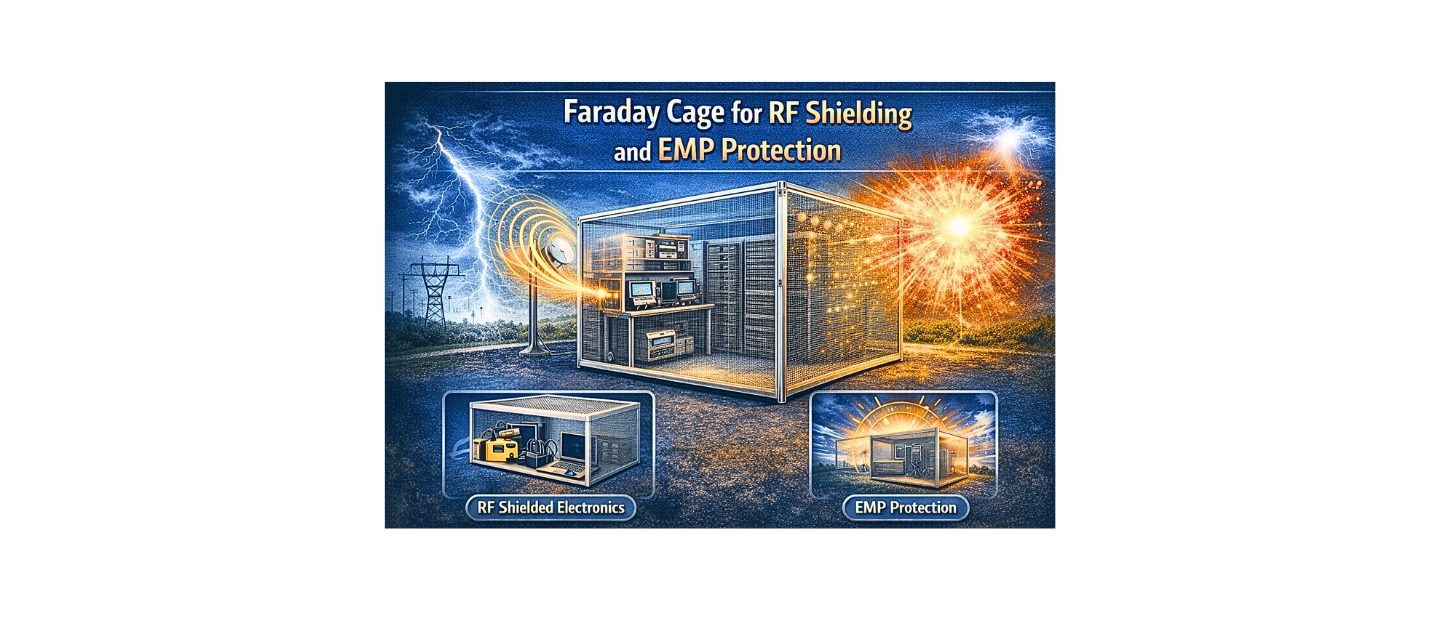
A Faraday cage is one of the most effective methods for protecting electronics from electromagnetic interference, radio frequency energy, and electromagnetic pulse events. Amateur radio operators, engineers, and emergency preparedness enthusiasts frequently use Faraday shielding to protect sensitive equipment such as transceivers, SDR receivers, laptops, and power supplies.
The principle behind a Faraday cage is straightforward: a conductive enclosure redistributes electromagnetic energy around its exterior surface, preventing the energy from penetrating inside the enclosure. When designed correctly, a Faraday cage can significantly reduce radio frequency interference and protect electronics from powerful electromagnetic disturbances.
Understanding how Faraday cages work, how to build them correctly, and how to test their effectiveness is essential for anyone who relies on electronic communication systems. This guide explains the science behind electromagnetic shielding, practical construction techniques, material selection, and real-world performance considerations.
What Is a Faraday Cage
A Faraday cage is a conductive enclosure that blocks external electromagnetic fields. You can build the enclosure from solid metal sheets, conductive mesh, or any continuous conductive structure that surrounds the protected space.
When electromagnetic waves strike the conductive surface, electrons in the metal move in response to the electric field. This movement redistributes the electromagnetic energy around the outer surface of the enclosure.
Because the electric field cannot penetrate a continuous conductor, the interior of the enclosure remains largely isolated from external electromagnetic radiation.
Common Faraday cage designs include:
• Metal boxes or cabinets
• Copper mesh enclosures
• Aluminum shielding containers
• Conductive fabric tents
• Shielded rooms or chambers
The effectiveness of a Faraday cage depends on material conductivity, enclosure continuity, mesh size, and the frequencies involved.
How It Block Electromagnetic Fields
Electromagnetic waves consist of oscillating electric and magnetic fields. When these fields encounter a conductive surface, free electrons within the conductor begin to move. This electron motion creates an opposing electromagnetic field that cancels the incoming energy at the surface.
The result is that most electromagnetic energy reflects off the outer surface rather than entering the enclosure. Two main mechanisms contribute to Faraday shielding:
Reflection Loss
Conductive surfaces reflect a large portion of incoming RF energy due to impedance mismatch between air and the conductor.
Absorption Loss
Some electromagnetic energy penetrates slightly into the conductor but is rapidly dissipated as heat due to electrical resistance.
The combination of reflection and absorption dramatically reduces the energy that reaches the interior space.
Faraday Cage Effectiveness by Frequency
Shielding performance depends heavily on the frequency of the electromagnetic signal. Higher frequencies require tighter mesh spacing and more careful enclosure design.
| Frequency Range | Typical Sources | Shielding Requirements |
|---|---|---|
| Low Frequency (kHz) | Power lines | Thick conductive material |
| HF (3–30 MHz) | Amateur radio | Moderate shielding |
| VHF/UHF (30–1000 MHz) | Broadcast signals | Smaller mesh openings |
| Microwave (GHz) | Radar, Wi-Fi | Very fine mesh or solid metal |
For ham radio operators, most shielding concerns occur within the HF, VHF, and UHF ranges.
Materials Used to Build Faraday Cages
Different conductive materials provide varying levels of shielding performance. Material choice affects both attenuation and construction practicality.
| Material | Conductivity | Advantages | Limitations |
|---|---|---|---|
| Copper | Very high | Excellent shielding | Expensive |
| Aluminum | High | Lightweight and affordable | Harder to solder |
| Steel | Moderate | Strong and durable | Lower conductivity |
| Brass mesh | High | Flexible shielding | Higher cost |
Copper often provides superior laboratory-grade shielding because it conducts electricity extremely well.
However, many amateur radio operators use aluminum enclosures because they cost less and are easier to obtain.
Mesh Size and Shielding Performance
When a Faraday cage uses mesh instead of solid metal, the size of the openings becomes critical.
A general rule is that the mesh openings should be significantly smaller than the wavelength of the electromagnetic signal being blocked.
The wavelength equation is:
λ = c ÷ f
Where:
λ = wavelength
c = speed of light
f = frequency
Example wavelengths:
| Frequency | Wavelength |
|---|---|
| 7 MHz | 42.8 meters |
| 144 MHz | 2.08 meters |
| 2.4 GHz | 12.5 cm |
For effective shielding, mesh openings should be less than one tenth of the wavelength.
This rule ensures that electromagnetic waves cannot pass through the openings.
Building a Practical Faraday Cage
Constructing a functional Faraday cage does not require expensive laboratory equipment. Many effective shielding containers can be built using readily available materials.
Common construction approaches include:
Metal Storage Containers A galvanized steel trash can with a tight-fitting lid can serve as a simple Faraday enclosure. The lid must maintain electrical continuity around the entire rim.
Metal Equipment Cases Aluminum instrument cases provide excellent shielding when conductive gaskets ensure good contact between panels.
Copper Mesh Enclosures Copper mesh can form a lightweight Faraday cage for laboratory testing or temporary shielding applications.
Shielded Cabinets Larger cabinets can protect entire radio stations or communication systems.
Shielded Cabinets Larger cabinets can protect entire radio stations or communication systems.
Important Construction Principles
Several critical design principles determine whether a Faraday cage actually works.
Continuous Conductive Surface All sides of the enclosure must be electrically connected. Even small gaps can allow electromagnetic leakage.
Good Electrical Contact Joints between panels should maintain low resistance connections.
Minimal Openings Any penetration such as wires or ventilation holes should be filtered or shielded.
Conductive Gaskets Doors or removable lids should use conductive gaskets or metal-to-metal contact surfaces.
Poorly constructed cages often fail because of small gaps or discontinuities.
Grounding a Faraday Cage
Grounding a Faraday cage is often misunderstood. In many cases, operators do not need to ground the cage for effective RF shielding.
The cage redistributes charges across its conductive surface whether or not it connects to earth ground.
However, grounding may be beneficial when:
• static charge buildup is possible
• lightning protection is needed
• safety requirements require grounding
For most RF shielding applications, the continuity of the enclosure matters more than the ground connection.
Testing Faraday Cage Performance
Testing ensures that the enclosure actually blocks electromagnetic energy as expected.
Several simple testing methods can verify shielding performance.
Cell Phone Test Place a cell phone inside the enclosure and attempt to call it. If the phone loses signal, the shielding is likely effective.
Handheld Radio Test Transmit with a handheld radio near the enclosure and monitor reception inside the cage.
RF Signal Analyzer More advanced testing can use spectrum analyzers to measure attenuation across different frequencies.
Proper testing is essential because even small gaps can dramatically reduce shielding effectiveness.
Common Faraday Cage Mistakes
Several common construction errors significantly reduce shielding performance.
Frequent mistakes include:
• gaps around lids or doors
• insulated surfaces preventing electrical contact
• openings larger than the target wavelength
• unshielded cable penetrations
• plastic containers lined only partially with foil
Even a small seam can act as an antenna and allow RF leakage.
Faraday Cages for EMP Protection
Electromagnetic pulse events can generate extremely high-energy electromagnetic fields capable of damaging electronics.
A properly constructed Faraday cage can protect equipment by blocking the rapid electromagnetic field surge from reaching sensitive circuits.
Equipment commonly protected in EMP scenarios includes:
• HF transceivers
• SDR receivers
• power supplies
• spare radios
• computers and storage drives
Multiple layers of shielding often provide greater protection against extreme electromagnetic pulses.
Faraday Cage vs RF Shielding Room
Professional laboratories often use shielded rooms rather than small enclosures.
| Feature | Faraday Cage | Shielded Room |
|---|---|---|
| Size | Small container | Entire room |
| Cost | Low | Very high |
| Shielding level | Moderate | Extremely high |
| Typical use | Equipment storage | EMC testing |
Ham radio operators typically use Faraday cages because they provide excellent protection at a fraction of the cost.
Practical Applications for Radio Operators
Faraday cages serve several useful roles in amateur radio stations.
• protecting backup radios from EMP events
• isolating test equipment from interference
• preventing RF leakage during experiments
• shielding sensitive SDR receivers
• storing spare electronics
In high RF environments, proper shielding can significantly reduce interference and improve measurement accuracy.
Final Thoughts
Faraday cages provide one of the most effective methods for protecting electronics from electromagnetic interference and electromagnetic pulse events. By using conductive materials, minimizing openings, and maintaining electrical continuity, a properly constructed enclosure can dramatically reduce electromagnetic energy entering a protected space.
For amateur radio operators and electronics enthusiasts, Faraday cages offer practical protection for critical equipment and enable accurate testing of radio systems in controlled electromagnetic environments.
FAQ
What does a Faraday cage protect against?
A Faraday cage protects electronics from electromagnetic interference, radio frequency signals, and electromagnetic pulse energy by redistributing electrical fields around its outer surface.
Can a Faraday cage block radio signals?
Yes. A properly constructed Faraday cage can block or greatly reduce radio signals across many frequencies, depending on material conductivity and mesh size.
Do Faraday cages need to be grounded?
Grounding is not required for basic RF shielding, but grounding may improve safety and static discharge in certain applications.
What materials work best for Faraday cages?
Copper and aluminum provide excellent electromagnetic shielding because of their high electrical conductivity.
Can a metal box act as a Faraday cage?
Yes. A continuous metal enclosure with good electrical contact across all seams can function as an effective Faraday cage.
How can you test a Faraday cage?
Simple tests include placing a cell phone or radio inside the enclosure and checking whether signals are blocked or significantly reduced.
About the Author
Vince, W2KU, is a licensed Extra class amateur radio operator and the founder of Ham Shack Reviews. He was named Amateur of the Year in 2026 for contributions to practical amateur radio education and equipment evaluation.
He knows propagation very well, operates mobile and handhelds daily. Vince exchanges QSL cards for DXCC, contest confirmation, and award tracking and is the club QSL manager. His guidance focuses on practical operating procedures, accurate logging, and real-world amateur radio practices.
Please consider Donating to help support this channel