

What Is Frequency Modulation (FM)
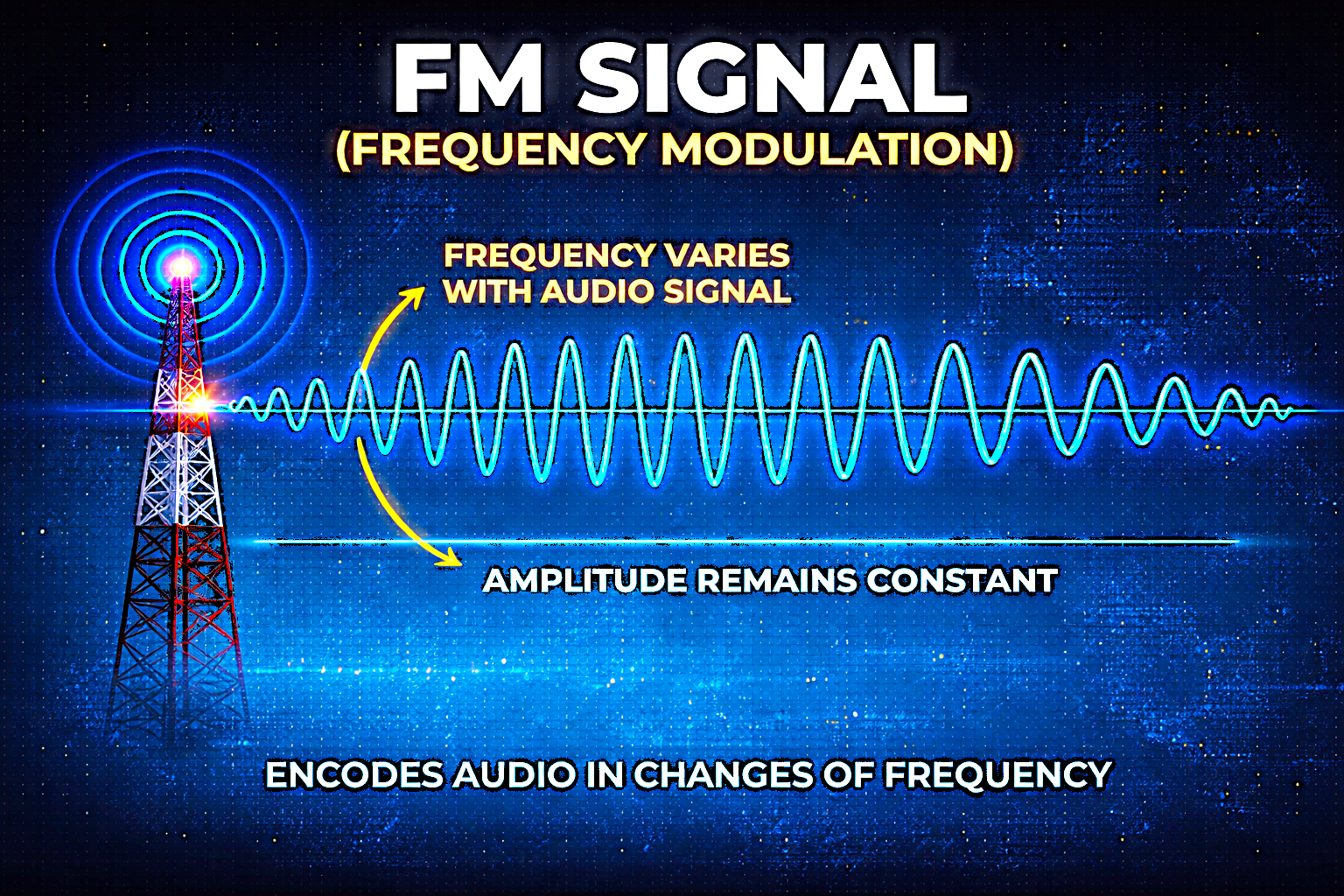
Frequency modulation FM encodes information in a radio signal by varying the frequency of the carrier wave. Unlike amplitude modulation AM, which changes signal strength, FM maintains a constant amplitude while shifting frequency in response to the input audio signal.
This approach results in significantly improved audio clarity and strong resistance to noise and interference. Because most electrical noise affects amplitude rather than frequency, FM signals remain clean even in challenging environments.
New to the hobby? Start with our Complete Guide to Ham Radio Fundamentals.
How FM Works
In an FM signal, the carrier frequency increases and decreases in direct proportion to the audio signal being transmitted. When the audio signal rises, the frequency deviates higher than the carrier. When it falls, the frequency drops below the carrier.
The amount of frequency shift is called deviation, and it directly impacts audio quality and bandwidth. Wideband FM provides higher fidelity but uses more spectrum, while narrowband FM reduces bandwidth at the expense of some audio quality.
Because the amplitude remains constant, FM receivers can ignore many types of noise, resulting in clearer communication compared to AM.
The Invention of Frequency Modulation
In the 1930s, American electrical engineer Edwin Howard Armstrong developed frequency modulation to overcome the limitations of AM radio.
At the time, AM signals were heavily affected by static, electrical interference, and atmospheric noise. Armstrong discovered that by encoding audio into frequency variations instead of amplitude changes, these noise sources could be largely eliminated.
His invention led to the first FM broadcasts in the late 1930s and fundamentally changed radio communication by introducing high-fidelity, low-noise transmission.
FM vs AM: Key Differences
Frequency modulation and amplitude modulation differ in how they encode information and how they respond to interference.
FM maintains constant signal strength and varies frequency, while AM varies signal strength. Because most interference affects amplitude, AM signals are more susceptible to noise.
FM also benefits from the capture effect, where the receiver locks onto the strongest signal and suppresses weaker ones on the same frequency. This results in clearer communication in crowded environments.
However, FM typically requires more bandwidth than AM, which can limit channel availability in some systems.
FM in Amateur Radio
Frequency modulation is widely used in amateur radio, especially on VHF and UHF bands. It is the standard mode for local communication due to its clarity and ease of use.
Most handheld radios and mobile rigs operate using FM. Repeaters, which extend communication range, rely heavily on FM because it provides consistent audio quality and reliable operation.
FM is commonly used for:
- Local repeater communication
- Simplex operation between nearby stations
- Emergency communication networks
- Public service events
Its simplicity makes it the most accessible mode for new operators, while its reliability keeps it widely used among experienced hams.
FM Repeaters and the Capture Effect
FM repeaters are a core part of amateur radio infrastructure. They receive a signal on one frequency and retransmit it on another, allowing operators to communicate over much greater distances.
The capture effect plays a major role in repeater operation. When multiple signals are present, the repeater receiver locks onto the strongest signal and rejects weaker ones. This reduces interference and improves communication clarity.
This behavior is one reason FM is preferred for repeater systems over other modulation types.
FM in CB Radio
Frequency modulation has recently been introduced into Citizens Band CB radio following regulatory approval by the Federal Communications Commission.
Traditionally, CB radio used AM and SSB modes. The addition of FM provides improved audio clarity and reduced noise, particularly in urban environments where interference is common.
While FM does not increase communication range compared to SSB, its resistance to interference makes it a valuable option for short-range communication.
As more CB radios include FM capability, its adoption is expected to grow.
Advantages of Frequency Modulation
Frequency modulation offers several important advantages over other modulation types. FM signals are highly resistant to noise because interference typically affects amplitude rather than frequency. This results in clearer audio, even in environments with electrical interference.
The capture effect improves usability by allowing receivers to focus on the strongest signal, reducing confusion from overlapping transmissions.
FM also supports high-quality audio transmission, making it suitable for voice communication and certain data applications. These characteristics make FM one of the most reliable modulation methods for everyday communication.
Limitations of FM
Despite its advantages, FM is not ideal for all situations. FM signals typically require more bandwidth than AM or SSB, which limits the number of available channels in a given frequency range.
FM is also less efficient for long-distance communication on HF bands, where modes like SSB are preferred due to better power efficiency and propagation characteristics.
Additionally, the capture effect, while useful, can completely suppress weaker signals, which may not be desirable in some operating scenarios.
Is FM Useful in Ham Radio
FM remains one of the most practical and widely used modes in amateur radio, particularly for local communication.
It is ideal for repeaters, handheld radios, and mobile operation, where clear and reliable audio is more important than maximum range.
While it is not typically used for long-distance HF communication, FM plays a critical role in daily operations, emergency communication, and public service events. Its ease of use and reliability make it a foundational mode for both new and experienced operators.
Conclusion
Frequency modulation continues to be a fundamental part of modern radio communication. By encoding audio into frequency changes rather than amplitude, FM provides clear, reliable communication with strong resistance to interference.
From amateur radio repeaters to CB radio and commercial broadcasting, FM remains one of the most effective and widely used modulation methods available.
Understanding how FM works and where it performs best allows operators to choose the right mode for their specific communication needs.
Frequently Asked Questions
What is frequency modulation in simple terms?
Frequency modulation is a method of transmitting audio by varying the frequency of a radio signal while keeping its strength constant.
Why is FM clearer than AM?
FM is clearer because most noise affects signal amplitude, and FM does not rely on amplitude to carry information.
What is the capture effect in FM?
The capture effect allows an FM receiver to lock onto the strongest signal and ignore weaker ones on the same frequency.
Is FM used on HF bands?
FM is rarely used on HF because it is less efficient than modes like SSB for long-distance communication.
What is FM used for in ham radio?
FM is commonly used for repeaters, local communication, handheld radios, and emergency communication networks.
About the Author
Vince, W2KU, is a licensed Extra class amateur radio operator and the founder of Ham Shack Reviews. The committee named him Amateur of the Year in 2026 for his contributions to amateur radio education and equipment evaluation.
He runs Ham Shack Reviews across both his website and YouTube channel, where he shares in-depth guides, real-world operating techniques, and equipment insights for amateur radio operators.
He primarily operates HF, knows propagation very well, operates mobile and handhelds daily. Vince exchanges QSL cards for DXCC, contest confirmation, and award tracking and is the club QSL manager. His guidance focuses on practical operating procedures, accurate logging, and real-world amateur radio practices.
Please consider Donating to help support this channel