
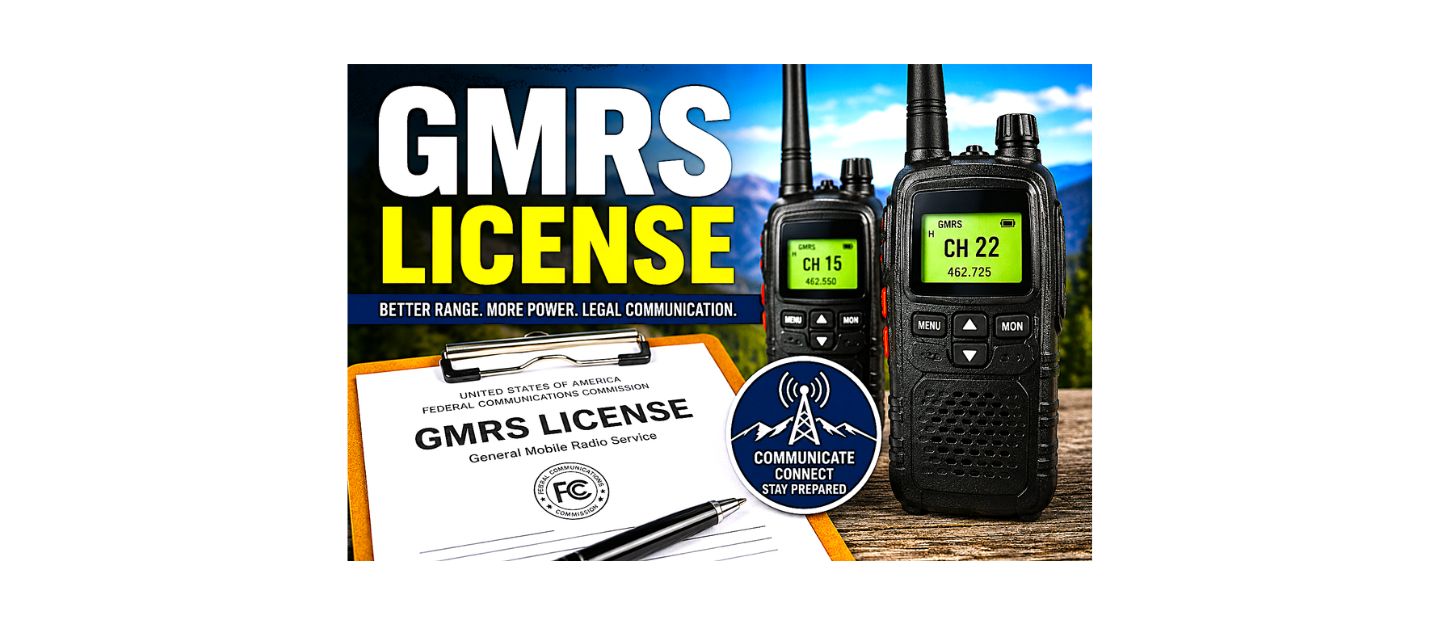
GMRS License
A GMRS license allows individuals to legally operate on the General Mobile Radio Service frequencies, which are used for personal or family communication. These channels provide better range and power options than the unlicensed Family Radio Service (FRS), making them useful for outdoor activities, neighborhood communication, and emergency preparedness.
Because GMRS operates on specific UHF channels and allows for higher power outputs and repeater use, the Federal Communications Commission (FCC) requires users to hold a license. However, the process is straightforward, and the license covers the entire family.
This guide explains who can apply, how much a GMRS license costs, how the application process works, and the advantages of becoming a licensed GMRS operator.
A GMRS license allows individuals to legally operate on the General Mobile Radio Service frequencies, which are used for personal or family communication. These channels provide better range and power options than the unlicensed Family Radio Service (FRS), making them useful for outdoor activities, neighborhood communication, and emergency preparedness.
Because GMRS operates on specific UHF channels and allows for higher power outputs and repeater use, the Federal Communications Commission (FCC) requires users to hold a license. However, the process is straightforward, and the license covers the entire family.
For a full overview of this technology and related systems, see our Complete Guide to Two-Way Radios
What You Need to Know Before Applying
To get a GMRS license, you must be at least 18 years old and not be a representative of a foreign government. While this may sound formal, the application process is surprisingly simple. Most people complete it online in a matter of minutes.
There is no exam required to obtain a GMRS license. Unlike amateur (ham) radio, you don’t need to study frequencies, technical concepts, or regulations. You simply fill out the application, pay the fee, and receive your license within days.
Understanding the basic licensing requirements before you begin helps make the application process quick and straightforward. Since no examination is required, most applicants can complete the process online with very little preparation.
Cost and Application Process
As of now, the GMRS license fee is $35, and the license is valid for 10 years. This is a one-time payment per term, and it covers your immediate family, including your spouse, children, parents, grandparents, aunts, uncles, and in-laws.
The FCC’s Universal Licensing System (ULS) is where you submit the application.. After registering for an FCC Registration Number (FRN), you can log in, complete the GMRS license form, and submit payment. Therefore, within a few business days, you’ll receive your call sign and legal authorization to transmit.
Once your application has been processed, you receive your GMRS call sign and may begin operating under the terms of your license. Because the license remains valid for 10 years, there is no need to renew annually.
Power Limits and Range
GMRS radios can transmit at up to 50 watts on certain channels, though most handheld radios operate between 1 and 5 watts. Vehicle-mounted and base station radios tend to use more power, giving you greater coverage.
Additionally, GMRS allows the use of repeaters, which are stations that receive and rebroadcast signals to extend range significantly. Because of this, communication distances can exceed 20 miles or more under optimal conditions.
Even without repeaters, GMRS offers better range than FRS due to higher power limits and the use of detachable antennas. However, terrain, weather, and obstructions still affect range, just as with any radio system.
Actual communication distance depends on many factors, including antenna height, surrounding terrain, buildings, and the availability of repeaters. Even so, GMRS generally provides greater communication flexibility than lower-power personal radio services.
Advantages of Having a GMRS License
One of the biggest benefits of a GMRS license is access to more powerful radios and repeaters. FRS radios use lower power and fixed antennas, but GMRS gives you flexibility. Because of this, many families, preppers, and off-roaders choose GMRS for reliable long-range communication.
Another major advantage is that your entire family is covered under one license. There’s no need for each person to apply individually. This makes GMRS ideal for family road trips, camping, hiking, or even emergency coordination around your neighborhood.
Moreover, GMRS has fewer interference issues compared to unlicensed services. Since only licensed users can operate on the channels, the airwaves tend to be less congested. As a result, communication is more reliable and clear.
For many users, the combination of higher power limits, repeater access, and family licensing makes GMRS an attractive communications option for both everyday activities and emergency planning.
Key Takeaways
- A GMRS license is required to legally operate GMRS radios.
- No examination is required.
- The license is valid for 10 years.
- One license covers immediate family members.
- GMRS allows higher power levels than FRS.
- Repeaters can greatly extend communication range.
- The application process is completed online.
Is It Worth Getting a GMRS License?
For those who want dependable communication without needing to pass an exam, the GMRS license offers a perfect middle ground. It provides much of the range and power flexibility of ham radio, without the commitment of technical study. At the same time, it offers more capability than basic walkie-talkies.
When you’re planning a backcountry adventure, setting up a family communication plan, or just want a more powerful radio solution, getting your GMRS license is a smart move. Since the process is easy and the license lasts a full decade, it’s a small investment with big returns in communication confidence.
If your goal is reliable family communication, outdoor recreation, or improved emergency preparedness, obtaining a GMRS license is a straightforward way to expand your communication capabilities while remaining within FCC licensing requirements.
Frequently Asked Questions
Do I need to pass a test to get a GMRS license?
No. There is no examination required.
How long does a GMRS license last?
A GMRS license is valid for 10 years.
Does one license cover my family?
Yes. A single GMRS license covers your immediate family.
Can GMRS radios use repeaters?
Yes. GMRS permits repeater operation, allowing much greater communication range.
What is the maximum power allowed?
GMRS radios can operate at up to 50 watts on certain channels.
Final Thoughts
Obtaining a GMRS license is one of the simplest ways to gain access to more capable personal radio communications. By understanding the licensing requirements, application process, power limits, and operating advantages, you can determine whether GMRS is the right communication solution for your family and outdoor activities.