
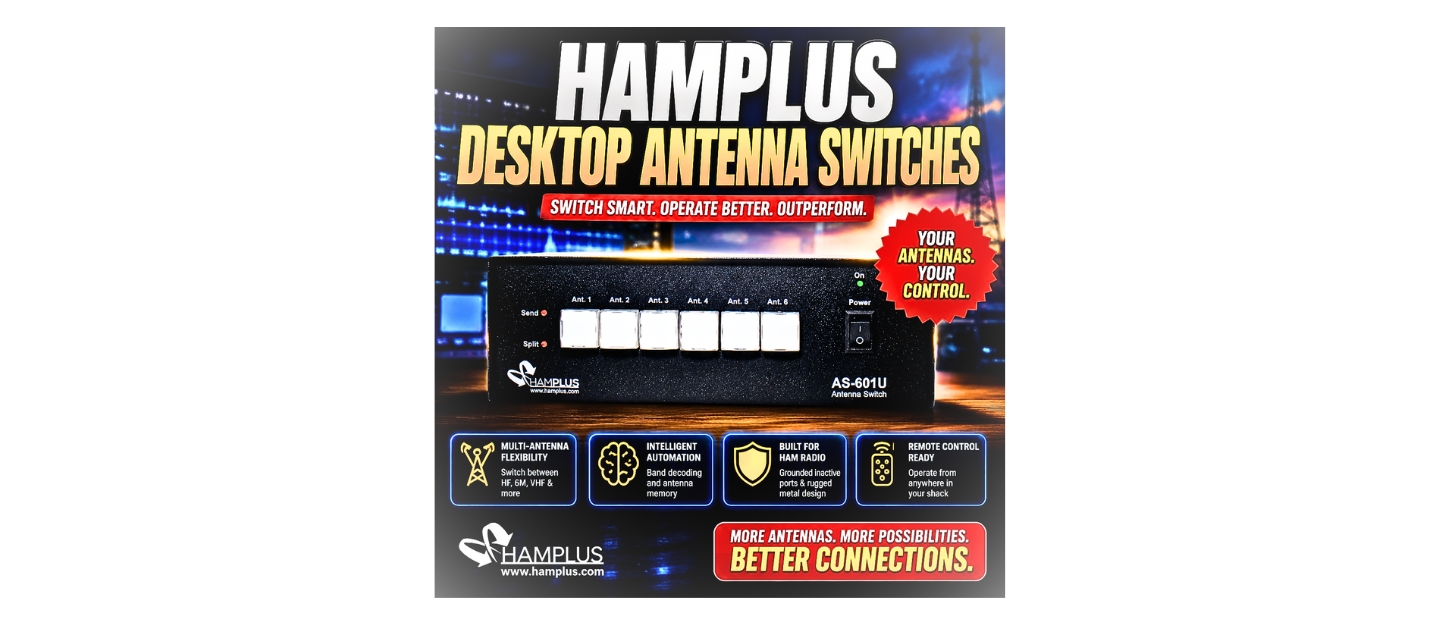
Finding the Hamplus desktop antenna switches that simplifies station management can make operating more efficient, especially when multiple radios and antennas are part of the station.
The Hamplus Desktop Antenna Switches are designed for desktop operation and combine automatic and manual switching with band memory, allowing operators to manage several antenna and radio connections from a single unit.
This model supports up to six antennas and while covering frequencies from 0 to 60 MHz. The switch uses standard SO-239 RF connectors, operates from a 13.8 Vdc power source, and is rated for up to 2 kW PEP. These specifications make it suitable for stations requiring organized antenna routing without constantly reconnecting coaxial cables.
An antenna switch serves as the central connection point between radios and antennas. Instead of manually disconnecting one coax cable and reconnecting another every time a different antenna is needed, the switch allows the desired antenna path to be selected quickly. This not only improves convenience but also helps keep the operating position organized.
Whether you operate a single HF transceiver or maintain several radios connected to multiple antennas, a desktop antenna switch can streamline station operation. The combination of automatic and manual control, band memory, multiple antenna ports, and high-power capability provides flexibility for a variety of operating situations.
New to antenna systems? See our Complete Guide to Ham Radio Antennas.
Quick Verdict: Hamplus Desktop Antenna Switches
The Hamplus desktop antenna switches provide desktop antenna management with automatic and manual operation, band memory, support for six antennas and three radios, coverage from 0 to 60 MHz, SO-239 connectors, a 2 kW PEP power rating, and 13.8 Vdc operation. For operators looking to organize multiple antenna connections from a central desktop unit, the listed specifications offer a versatile switching solution.
At a Glance
| Feature | Specification |
|---|---|
| Product | Hamplus Desktop Antenna Switch |
| Condition | Scratch/Dent |
| Operation | Automatic and Manual |
| Band Memory | Included |
| Antenna Capacity | 6 Antennas |
| Radio Capacity | 3 Radios |
| Frequency Coverage | 0–60 MHz |
| RF Connectors | SO-239 |
| Power Rating | 2 kW PEP |
| Operating Voltage | 13.8 Vdc |
| Quantity | Each |
Key Features
Automatic and Manual Switching
The unit supports both automatic and manual operating modes. Automatic switching can simplify station operation by reducing the need to manually change antenna selections, while manual control provides direct operator selection whenever desired.
Having both options available gives operators flexibility depending on their operating preferences and station configuration.
Band Memory
The switch includes band memory, which remembers previously selected antenna assignments for different operating bands. This feature streamlines station operation by automatically recalling antenna selections when you change bands.
Six Antenna Connections
Support for six antennas provides flexibility for stations using multiple antenna systems. Operators often install different antennas to optimize performance across various frequency ranges and operating objectives. The six antenna ports let them keep those antennas connected and ready for immediate selection.
Three Radio Connections
The ability to connect up to three radios allows multiple transceivers to share available antennas through the switching system instead of requiring separate coax routing for every radio.
Wide Frequency Coverage
The specified operating range extends from 0 through 60 MHz. This range covers the HF spectrum and extends into the lower VHF frequencies, making the switch suitable for stations operating across a broad portion of the amateur radio spectrum.
SO-239 Connectors
SO-239 connectors remain one of the most widely used connector types in amateur radio equipment. Their widespread compatibility allows many existing coaxial cables to connect directly without requiring adapter cables.
High Power Rating
The switch carries a 2 kW PEP rating, indicating it is intended for high-power amateur radio operation within its specified limits.
Desktop Design
A desktop configuration keeps switching controls accessible while allowing all antenna and radio connections to remain organized at the operating position.
Understanding Desktop Antenna Switches
Desktop antenna switches serve as the traffic directors of an amateur radio station.The switch routes RF energy through the selected antenna connection, eliminating the need to disconnect and reconnect coaxial cables every time you change antennas
For stations with multiple antennas, this greatly simplifies everyday operation. Operators can maintain dedicated antennas for different operating goals while managing those connections from a single control point.
A properly organized station also reduces cable clutter and minimizes repeated handling of coax connectors, which can help preserve connector condition over time.
Automatic vs. Manual Operation
Automatic switching and manual switching each provide unique operating advantages. The automatic operation can simplify station management by reducing operator interaction during antenna selection, particularly when supported by compatible station configurations.
Manual operation allows the operator to select the desired antenna directly whenever preferred. Many operators appreciate having manual control available because it provides immediate selection without relying solely on automated operation.
Having both operating modes available offers flexibility for a wide variety of station layouts.
Why Band Memory Matters
Band memory is designed to improve operating convenience by remembering antenna selections associated with particular operating bands.
Instead of repeatedly choosing the same antenna after every band change, remembered settings can help make routine station operation more efficient.
For operators who frequently change bands throughout an operating session, this feature can contribute to a smoother operating experience.
Multiple Antennas for Greater Flexibility
Many amateur radio stations use more than one antenna.
Examples may include:
- Multiband wire antennas
- Directional antennas
- Vertical antennas
- Portable antennas
- Specialty antennas for particular operating goals
Supporting six antenna connections allows these systems to remain connected simultaneously, reducing the need to disconnect and reconnect feed lines.
Managing Multiple Radios
Modern amateur radio stations may include more than one transceiver.
Some operators dedicate different radios to separate operating activities, while others maintain additional radios for monitoring or specialized operating modes.
Supporting three radio connections provides flexibility for organizing these station configurations while centralizing antenna management.
Frequency Coverage
The specified frequency range extends from 0 to 60 MHz.
This wide operating range encompasses the HF amateur bands and reaches into the lower VHF spectrum. Broad frequency coverage allows one switching system to support numerous operating activities without requiring separate switching equipment for different portions of the spectrum.
SO-239 Connectors
SO-239 connectors have long been a standard connector choice in amateur radio equipment.
Their widespread use means many stations already utilize compatible coaxial cables, simplifying equipment integration without requiring specialized connector systems.
Maintaining secure coax connections remains an important part of reliable station performance regardless of equipment configuration.
2 kW PEP Power Rating
The listed 2 kW PEP rating indicates the switch is designed for high-power amateur radio applications within its specified operating limits.
Power ratings are important because every component in the RF signal path must be capable of safely handling transmitted power.
Matching equipment ratings throughout the station helps maintain reliable operation.
13.8 Vdc Operation
The Hamplus desktop antenna switches operates from a 13.8 Vdc power source. This operating voltage is widely used throughout amateur radio equipment, allowing many stations to power multiple accessories from a common DC power supply.
Installation Considerations
Desktop antenna switches are typically positioned where controls remain easily accessible during normal operation. Organizing coaxial cables before installation helps create a cleaner operating position while making future maintenance easier.
Labeling antenna feed lines and radio connections can further simplify everyday operation, particularly when several antennas remain connected simultaneously.
Who Should Consider This Switch?
Based on the published specifications, this switch may appeal to:
- Amateur radio operators with multiple antennas
- Stations using more than one transceiver
- Operators seeking both automatic and manual switching capability
- High-power HF stations operating within the published specifications
- Operators looking for centralized antenna management
Specifications
| Specification | Value |
|---|---|
| Product Type | Desktop Antenna Switch |
| Condition | New or Scratch/Dent |
| Switching Modes | Automatic / Manual |
| Band Memory | Yes |
| Maximum Antennas | 6 |
| Maximum Radios | 3 |
| Frequency Range | 0–60 MHz |
| RF Connectors | SO-239 |
| Power Rating | 2 kW PEP |
| Operating Voltage | 13.8 Vdc |
Frequently Asked Questions
What type of antenna switch is this?
The published specifications identify it as a desktop antenna switch with automatic and manual operation.
How many antennas can it support?
The specifications state support for up to six antennas.
How many radios can be connected?
The switch supports connections for up to three radios.
What frequencies does it cover?
The published operating range is 0 through 60 MHz.
What connectors does it use?
The switch uses SO-239 RF connectors.
What operating voltage is required?
The listed operating voltage is 13.8 Vdc.
What is the published power rating?
The switch is rated for 2 kW PEP.
Experience effortless antenna management with Hamplus Desktop Antenna Switches, built for contesters, DXers, and everyday amateur radio enthusiasts who demand reliability.
Hamplus Desktop Antenna Switches
The Hamplus Desktop Antenna Switches combine automatic and manual operation, band memory, support for six antennas and three radios, 0–60 MHz frequency coverage, SO-239 connectors, a 2 kW PEP power rating, and 13.8 Vdc operation in a desktop switching solution.
For amateur radio operators managing multiple antennas and radios from a single operating position, the published specifications describe a versatile station accessory designed to simplify antenna routing while keeping equipment connections organized.
Please consider Donating to help support this channel