
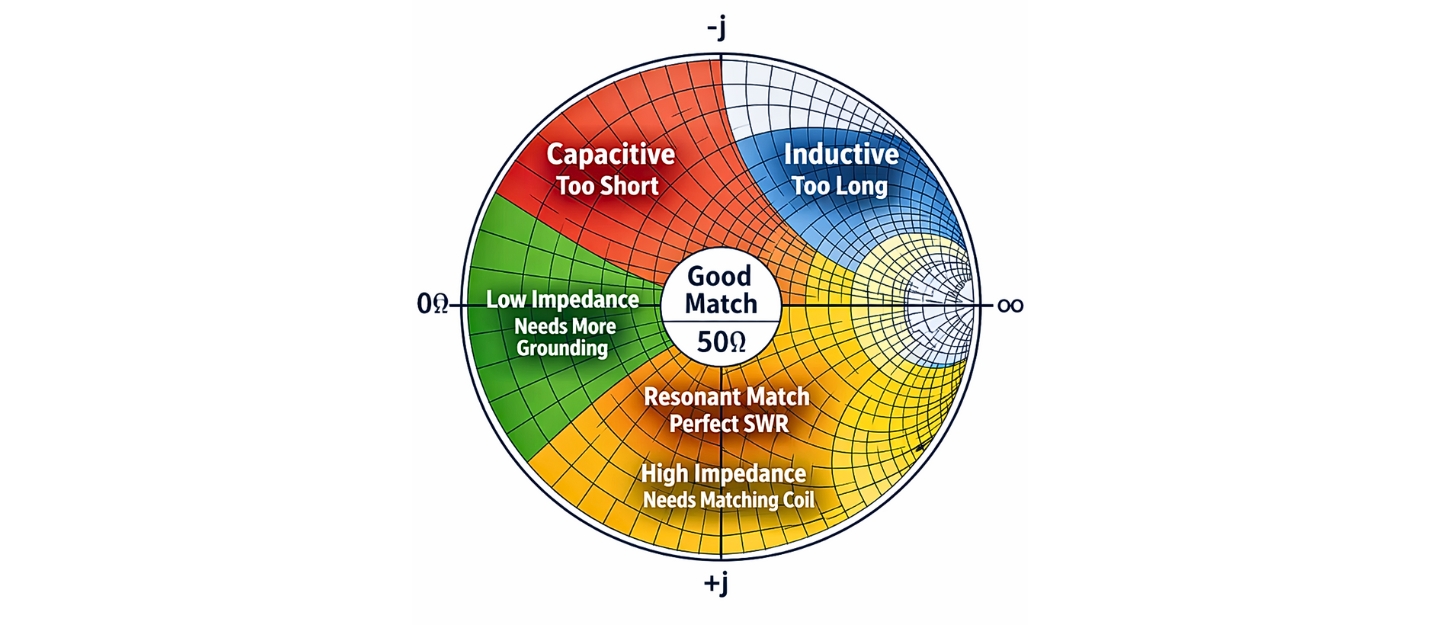
How To Read A Smith Chart Smith Chart as intimidating. However, the chart simply visualizes impedance behavior in a circular format. Therefore, once you understand its logic, it becomes an intuitive design and troubleshooting tool. Moreover, the Smith Chart replaces tedious calculations with clear geometric insight.
What the Smith Chart Represents
The Smith Chart maps complex impedance onto a normalized circle. In other words, it shows resistance and reactance at the same time. Consequently, you can see how an antenna or transmission line behaves at a glance. Although the chart looks abstract, every point directly corresponds to a real impedance value.
Normalized Impedance and Why It Matters
Before using the chart, you must normalize impedance to a reference value, usually the system impedance. Therefore, you divide the measured impedance by the reference impedance. As a result, the chart works universally for many systems. Consequently, the same chart applies whether you design for fifty ohms or another standard.
Understanding the Horizontal Axis
The horizontal center line represents purely resistive values. Specifically, points on this line contain no reactance. Therefore, movement left or right changes resistance only. Moreover, the chart center represents a perfect match, which means normalized resistance equals one.
Resistance Circles Explained
Every circle centered on the horizontal axis represents constant resistance. As resistance increases, these circles move toward the right edge. Conversely, lower resistance circles move left. Therefore, by locating your impedance point, you immediately know the resistive component. Additionally, this visual approach speeds matching decisions.
Reactance Arcs and Their Meaning
Curved arcs above and below the horizontal line represent reactance. Inductive reactance appears above the center line, while capacitive reactance appears below it. Consequently, vertical movement on the chart indicates reactance changes. Thus, the chart instantly shows whether your load behaves inductively or capacitively.
The Outer Circle and Reflection Coefficient
The outer boundary of the chart represents a reflection coefficient magnitude of one. In practice, this means total reflection. Therefore, any point inside the chart indicates some degree of power transfer. Moreover, distance from the center directly relates to mismatch severity.
Standing Wave Ratio on the Chart
You can read standing wave ratio using circles centered at the chart center. These circles represent constant SWR values. Consequently, once you plot an impedance, you can estimate SWR without calculations. Therefore, the chart links impedance behavior directly to transmitter performance.
Plotting an Impedance Point
To plot an impedance, first normalize the value. Then, locate the corresponding resistance circle. Next, follow the appropriate reactance arc until they intersect. Consequently, the intersection marks the operating point. Although this process seems complex, practice quickly builds confidence.
Moving Along a Transmission Line
Movement around the chart perimeter represents changing position along a transmission line. Specifically, rotating clockwise moves toward the load, while rotating counterclockwise moves toward the generator. Therefore, the chart models how impedance transforms along a line. Moreover, this feature proves invaluable for feedline analysis.
Electrical Length and Rotation
The chart perimeter includes wavelength scales. Consequently, rotation corresponds to electrical length changes. Therefore, you can predict impedance shifts caused by feedline length. Additionally, this insight explains why trimming coax sometimes alters SWR dramatically.
Using the Chart for Impedance Matching
The Smith Chart excels at matching network design. For example, adding series or shunt components moves the impedance point in predictable directions. Therefore, designers can visualize matching steps before building circuits. Moreover, this method reduces trial-and-error tuning.
Series and Shunt Component Effects
Series inductors and capacitors move points along constant resistance circles. In contrast, shunt components move points along constant conductance circles. Consequently, each component type produces a distinct motion. Therefore, understanding these paths simplifies matching strategy selection.
Conductance and Admittance View
The chart also supports admittance representation. By rotating the impedance point 180 degrees, you view conductance and susceptance instead. Consequently, the same chart serves dual purposes. Therefore, experienced designers switch views effortlessly during network design.
Practical Antenna Analysis
When analyzing antennas, the Smith Chart reveals bandwidth and tuning behavior. For example, frequency sweeps trace arcs across the chart. Consequently, you can see how impedance changes with frequency. Therefore, the chart explains why antennas match well at some frequencies and poorly at others.
Diagnosing Feedline and Load Problems
Unexpected chart movements often signal problems. For instance, erratic loops may indicate poor connections or common-mode currents. Therefore, the Smith Chart becomes a diagnostic window. Moreover, this visual feedback often reveals issues faster than numeric readings.
Common Beginner Mistakes
Many beginners misinterpret chart symmetry. However, each region carries specific meaning. Additionally, skipping normalization leads to incorrect conclusions. Therefore, careful setup matters. Moreover, patience builds accuracy over time.
Building Intuition Through Practice
The Smith Chart rewards repetition. Each plotted point reinforces spatial understanding. Consequently, operators begin predicting behavior before plotting. Therefore, the chart evolves from a reference into a mental model.
How To Read A Smith Chart
How to read a smith chart that condenses complex RF behavior into a single image. Because it visualizes resistance, reactance, and reflection simultaneously, it empowers informed decisions. Therefore, mastering it unlocks deeper control over antennas and transmission lines. In the end, the Smith Chart transforms impedance from math into motion.
Please consider Donating to help support this channel