
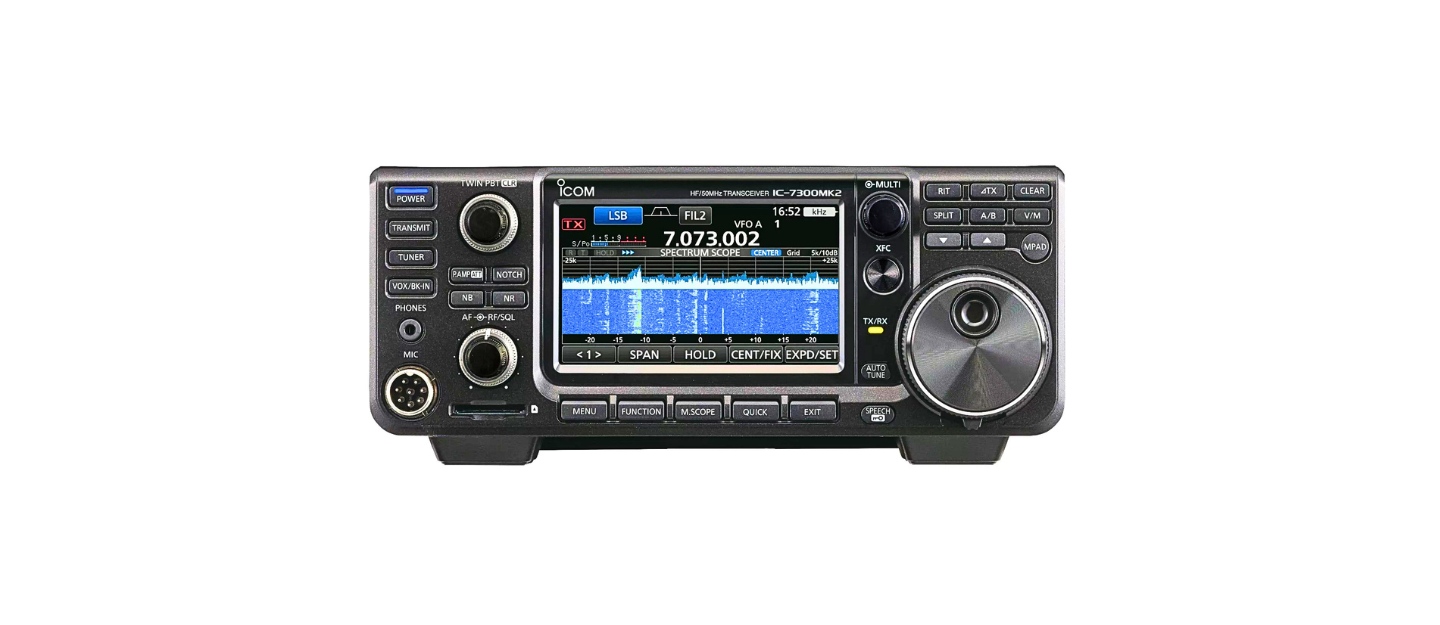
The IC-7300 MKII review shows the next evolutionary step in Icom’s widely respected direct-sampling HF transceiver platform. Building on the architecture introduced with the original IC-7300, the MKII refines receiver performance, digital signal processing, and user interface responsiveness while maintaining the compact footprint that made the original model one of the most influential HF radios of the last decade.
Unlike traditional superheterodyne transceivers that rely on multiple intermediate frequency stages, the IC-7300 MKII uses a direct RF sampling architecture. Incoming RF signals are digitized immediately after the front-end filtering stage and processed entirely within the digital domain. This design allows sophisticated filtering, spectrum analysis, and signal processing to occur before demodulation, greatly improving signal visibility and interference control.
The result is a radio capable of strong performance across contesting, DX operation, digital modes, and everyday HF communication.
If you would like to see more radios including other models and brands, check out the
Complete Guide to Ham Radio Transceivers.
ICOM IC-7300 MKII Technical Overview
- Model: ICOM IC-7300 MKII
- Radio Type: HF / 6 Meter SDR Transceiver
- Architecture: Direct RF Sampling SDR
- Frequency Coverage: 0.03–74.8 MHz (receive)
- Transmit Bands: Amateur HF bands + 6 meters
- Maximum Output Power: 100 watts
- Modes: SSB, CW, AM, FM, RTTY, Digital Modes
- Display: High-resolution color touchscreen spectrum scope
- Internal Sound Card: Integrated USB audio interface
- Antenna Tuner: Built-in automatic tuner
- Weight: Approximately 9 pounds
The IC-7300 MKII integrates advanced digital signal processing into a compact desktop transceiver platform suitable for home stations, portable operation, and contest environments.
First Impressions
The IC-7300 MKII immediately feels like a radio designed by operators who understand everyday station use. The front panel is clean and logically organized, with the large main tuning knob positioned for comfortable operation and the color touchscreen providing quick access to the radio’s most-used functions.
Build quality inspires confidence without making the radio excessively heavy. The controls have a positive feel, the touchscreen responds quickly to input, and the display remains easy to read from normal operating distance. Rather than requiring constant menu navigation, common adjustments such as filter width, noise reduction, and transmit settings are available with only a few touches, allowing operators to stay focused on making contacts instead of searching through menus.
Direct Sampling Receiver Architecture
Traditional HF radios typically convert incoming signals through multiple intermediate frequency stages before reaching the detector. While effective, this design introduces limitations in dynamic range and filter flexibility.
The IC-7300 MKII instead uses direct RF sampling. After passing through a bandpass filter, incoming RF signals are digitized by a high-speed analog-to-digital converter. Once in the digital domain, the radio applies digital signal processing algorithms to extract and filter signals.
This approach offers several advantages:
• Digital filtering with extremely sharp cutoff characteristics
• High-resolution spectrum scope visualization
• Reduced analog component distortion
• Flexible demodulation modes
The receiver processes signals with exceptional precision, allowing operators to isolate weak stations even in crowded band conditions.
Receiver Dynamic Range and Sensitivity
Measured receiver sensitivity for the IC-7300 platform typically falls near:
- SSB/CW sensitivity: approximately 0.16 µV for 10 dB SNR
- AM sensitivity: approximately 1 µV
Reciprocal mixing dynamic range is typically around 97 dB at 2 kHz spacing, depending on operating conditions. These figures allow the radio to maintain strong signal clarity even in congested contest environments where strong adjacent signals may otherwise overload lesser receivers.
The combination of digital filtering and dynamic range ensures weak signals remain audible even in challenging RF environments.
Digital Signal Processing Capabilities
Digital signal processing forms the core of the IC-7300 MKII’s performance advantages.
DSP functions include:
- Variable IF bandwidth filtering
- Noise reduction algorithms
- Automatic notch filtering
- Manual notch filtering
- Noise blanker for impulse interference
Because filtering occurs digitally, operators can shape passband width and filter skirts precisely. This level of control allows narrow CW filters, wide SSB audio response, or optimized digital mode bandwidths depending on operating conditions.
On-the-Air Performance
During normal operating conditions, the IC-7300 MKII performs exceptionally well across a wide range of amateur radio activities. The receiver remains quiet, signals are well defined, and the digital filtering allows weak stations to stand out without introducing excessive audio artifacts.
The real-time spectrum scope quickly becomes one of the radio’s most valuable operating tools. Instead of tuning blindly across the band, operators can instantly identify activity, locate open frequencies, or spot weak DX stations that might otherwise go unnoticed. For contesting and DX hunting, this visual awareness significantly improves operating efficiency.
Digital mode operators will also appreciate how simple station setup becomes. With both CAT control and audio carried over a single USB cable, programs such as WSJT-X, FLDIGI, and Winlink can be configured in only a few minutes without external interfaces or additional wiring.
Spectrum Scope and Waterfall Display
One of the defining features of the IC-7300 platform is its real-time spectrum scope. The high-resolution display provides:
- Band activity visualization
- Signal strength indicators
- Real-time waterfall display
- Touchscreen frequency selection
Operators can visually identify signals across the band and instantly tune to them by touching the display. This capability dramatically improves situational awareness compared to radios without integrated spectrum scopes.
Transmitter Performance
The IC-7300 MKII delivers up to 100 watts of output power across HF and 6 meter amateur bands. Selectable power levels allow adjustment from low output for QRP operation up to full power for DX and contest conditions.
Transmit audio quality is shaped through digital equalization and compression controls. These adjustments allow operators to optimize voice clarity or emphasize signal penetration depending on propagation conditions. Harmonic suppression and spectral purity remain well within amateur regulatory limits when paired with properly tuned antennas.
Transmit audio quality is equally impressive. The adjustable transmit equalizer allows operators to tailor audio characteristics for natural rag-chew conversations or stronger punch during DX pileups. Compression controls provide additional talk power while maintaining clean transmitted audio when properly adjusted.
During extended operating sessions, the radio remains stable with consistent power output and predictable thermal performance. The automatic antenna tuner completes matches quickly on antennas within its operating range, allowing rapid band changes with minimal interruption.
Built-In USB Sound Card Integration
A major advantage of the IC-7300 design is its integrated USB audio interface. This connection allows direct integration with digital mode software without external sound cards.
Supported digital modes include:
- FT8
- FT4
- PSK31
- RTTY
- JT65
- Winlink
A single USB cable carries both CAT control commands and audio data between the radio and computer. This simplifies station setup while maintaining clean digital audio paths.
Internal Automatic Antenna Tuner
The IC-7300 MKII includes an internal automatic antenna tuner capable of matching moderate SWR mismatches. Typical matching range covers approximately 3:1 SWR.
The tuner allows quick band changes when using multi-band antennas such as dipoles, verticals, or trap antennas. However, extremely mismatched antennas may still require an external tuner.
Receiver Performance in Real RF Environments
In practical operation, the IC-7300 demonstrates strong performance across a variety of HF conditions.
In crowded band environments such as contests or DX pileups, digital filtering helps isolate individual signals while maintaining strong audio intelligibility.
Weak signals can often be extracted using a combination of narrow bandwidth filtering, noise reduction, and passband tuning.
The spectrum scope further assists operators by revealing signals that may otherwise be buried within background noise.
User Interface and Operating Experience
The touchscreen interface significantly improves operational efficiency.
Common adjustments such as filter width, noise reduction, and frequency tuning can be performed directly through the display.
The front panel layout includes:
- Main tuning dial
- Touchscreen control panel
- Dedicated function buttons
- Multifunction knobs for quick adjustments
This design allows rapid changes without complex menu navigation.
Build Quality and Ergonomics
The compact cabinet makes the IC-7300 MKII an excellent choice for stations where desk space is limited. Despite its relatively small size, the controls never feel crowded. Frequently used buttons are positioned logically around the main tuning dial, allowing operators to make adjustments without taking their attention away from the display.
The touchscreen remains one of the strongest features of the radio. Unlike systems that bury functions inside multiple menu levels, the IC-7300 MKII allows many common adjustments to be completed directly from the display, significantly reducing operating complexity for both new and experienced amateur radio operators.
CW and Digital Mode Operation
The IC-7300 MKII performs well for CW and digital operation.
CW features include:
- Adjustable keyer speed
- Multiple CW filters
- Adjustable sidetone
- Electronic keyer memory
For digital modes, the built-in USB sound interface eliminates the need for external audio hardware. Operators can begin operating digital modes with minimal setup.
Comparison with Competing HF Radios
Compared to other radios in its class, the IC-7300 MKII offers a combination of SDR performance and user-friendly design.
Advantages include:
- Integrated spectrum scope
- Direct sampling receiver architecture
- USB sound card integration
- Compact desktop footprint
Operators considering the IC-7300 MKII often compare it with the Yaesu FT-710, Yaesu FTDX10, Icom IC-7610, and FlexRadio 6400. While those radios offer additional features such as higher dynamic range, dual receivers, or expanded networking capabilities, they also command significantly higher prices.
For many amateur radio operators, the IC-7300 MKII review represents the best balance of modern SDR technology, ease of operation, and overall value without moving into the premium price category.
For many amateur operators, the IC-7300MKII platform represents an ideal balance between performance and affordability.
Ideal Operating Applications
The IC-7300 MKII Review shows it performs well in several common amateur radio scenarios.
DX Operation
Strong receiver filtering and spectrum visualization assist with identifying distant stations.
Contesting
Dynamic range and filtering maintain signal clarity in crowded bands.
Digital Modes
Integrated USB sound interface simplifies computer integration.
General HF Communication
Reliable operation across all amateur HF bands.
Pros
- Outstanding direct RF sampling receiver
- Excellent real-time spectrum scope
- Integrated USB sound card for digital modes
- Sharp DSP filtering
- Responsive color touchscreen
- Compact desktop footprint
- Easy computer integration
- Excellent value for the performance offered
Cons
- Single receiver design
- Internal tuner has limited matching range
- No built-in LAN remote operation
- Dynamic range is lower than premium contest transceivers costing several times more
Frequently Asked Questions
Is the IC-7300 MKII a software defined radio?
Yes. The radio uses a direct RF sampling architecture that processes signals digitally rather than relying on traditional analog intermediate frequency stages.
Does the IC-7300 MKII support digital modes?
Yes. The integrated USB sound card allows direct operation with digital software such as WSJT-X without additional audio interfaces.
What power output does the IC-7300 MKII provide?
The radio provides up to 100 watts of transmit power across HF and 6 meter amateur bands.
Is the IC-7300 MKII good for beginners?
Yes. Despite advanced internal technology, the touchscreen interface and built-in digital integration make it accessible for new HF operators.
Technical Evaluation
Engineering Rating: ★★★★☆ (4.6/5)
The IC-7300 MKII review successfully combines modern SDR technology with an intuitive operating experience. Its direct RF sampling architecture, responsive spectrum scope, integrated USB interface, and advanced DSP capabilities deliver performance that exceeds what many operators expect from a mid-priced HF transceiver.
Although premium contest radios offer higher receiver dynamic range, dual independent receivers, and additional professional-level features, the IC-7300 MKII remains one of the strongest values available for amateur radio operators seeking advanced performance without entering the highest price tier.
Whether operating DX, contesting, running digital modes, or enjoying everyday HF communication, the IC-7300 MKII provides a capable, reliable, and highly enjoyable operating experience that continues the success of one of amateur radio’s most respected SDR platforms.
Please consider Donating to help support this channel