

When choosing Indoor vs. Outdoor Antennas, it is a critical decision for amateur radio operators. Each type offers unique advantages and limitations, depending on location, operating style, and regulatory restrictions.
Indoor antennas provide convenience and ease of installation, while outdoor antennas generally offer superior performance due to unobstructed placement. Furthermore, environmental factors such as interference, weather, and available space influence which type is most effective.
By understanding the differences, operators can make informed choices to maximize performance and reliability.
New to antenna systems? See our Complete Guide to Ham Radio Antennas.
By understanding the differences, operators can make informed choices to maximize performance and reliability.
Indoor vs. Outdoor Antennas at a Glance
For many amateur radio operators, the choice between indoor and outdoor antennas comes down to balancing performance, convenience, available space, and installation restrictions. Indoor antennas are often easier to install and maintain, making them attractive for apartment dwellers, renters, and operators facing homeowner association restrictions. Outdoor antennas generally provide stronger signal performance, reduced interference, and greater operating range due to their elevated placement and improved radiation efficiency.
Both options can provide successful communication when properly installed and matched to operating goals. Understanding the strengths and limitations of each approach allows operators to select the antenna system that best fits their station requirements, budget, and operating environment.
Key Differences Between Indoor and Outdoor Antennas
| Factor | Indoor Antennas | Outdoor Antennas |
|---|---|---|
| Installation Difficulty | Easy | Moderate to High |
| Cost | Lower | Higher |
| Maintenance | Minimal | Regular Inspection Required |
| Signal Performance | Moderate | High |
| Noise Levels | Often Higher | Usually Lower |
| DX Capability | Limited | Excellent |
| HOA Friendly | Yes | Sometimes Restricted |
| Weather Exposure | None | Significant |
| Expansion Potential | Limited | Extensive |
Advantages of Indoor Antennas
Indoor antennas are easy to install and maintain, making them ideal for operators with limited outdoor space or living in HOAs or apartments. Additionally, they allow quick adjustments and experimentation with different configurations without dealing with weather exposure.
Operators can use magnetic loops, dipoles, or small vertical antennas indoors to access a range of bands. However, indoor antennas often face limitations in efficiency due to nearby structures, walls, and electrical noise. Despite these challenges, careful placement and proper grounding can significantly improve signal performance.
Challenges of Indoor Antennas
One major challenge with indoor antennas is limited range. Nearby walls, furniture, and electronic devices can attenuate signals and create noise. Consequently, long-distance DX contacts may be difficult without optimizing antenna type and placement. Moreover, operators must consider safety issues such as RF exposure and potential interference with household electronics.
To mitigate these problems, using balanced antennas, ferrite chokes, and strategic positioning near windows or higher elevations often helps. Even though indoor antennas cannot match outdoor installations in raw efficiency, thoughtful setup can still provide satisfying performance.
Common Indoor Antenna Types
Indoor operators use several antenna designs depending on available space and operating objectives. Popular choices include compact magnetic loop antennas, shortened dipoles, end-fed wire antennas, portable verticals, and attic-mounted installations. Each design offers different trade-offs between efficiency, bandwidth, and ease of installation.
Selecting the correct indoor antenna often depends on room dimensions, noise levels, operating frequency, and the ability to position the antenna away from electronic devices that may generate interference.
Advantages of Outdoor Antennas
Outdoor antennas generally offer superior performance due to their elevated placement and lack of nearby obstructions. They can include large dipoles, verticals, yagis, and beam antennas, all of which improve radiation efficiency and signal reach. Additionally, outdoor antennas can be installed with proper grounding and weatherproofing, ensuring long-term reliability.
They operate with less interference from household electronics, operators often experience clearer signals and stronger reception. Furthermore, outdoor antennas support high-power transmissions and broader frequency coverage, making them ideal for contesting, DXing, and serious experimentation.
Common Outdoor Antenna Types
Outdoor antenna installations can range from simple wire antennas to highly directional arrays. Many operators choose dipoles, vertical antennas, end-fed wire antennas, beam antennas, or multi-element directional systems depending on their operating goals.
The increased flexibility available outdoors allows operators to experiment with antenna height, orientation, and radiation patterns, often resulting in improved coverage and more reliable communications across multiple amateur radio bands.
Challenges of Outdoor Antennas
Despite their advantages, outdoor antennas come with installation and maintenance challenges. Weather exposure, including wind, rain, ice, and lightning, can damage components if not properly protected.
Consequently, operators must invest in sturdy mounts, guy wires, and corrosion-resistant materials. Furthermore, zoning restrictions, homeowner association rules, or limited property space may restrict installation options.
Regular inspection and preventive maintenance are critical to ensure performance and safety. Although outdoor antennas generally outperform indoor setups, careful planning and maintenance are essential to maximize their benefits.
Performance Considerations
Outdoor antennas generally outperform indoor antennas in both transmission and reception. Higher placement reduces signal obstruction, while larger designs allow more efficient radiation patterns.
In contrast, indoor antennas face more noise and signal blockage, which can reduce range and clarity. However, indoor setups can still be effective for local communication or casual operation when optimized. Understanding the trade-offs between signal strength, coverage, and convenience helps operators select the right antenna for their needs.
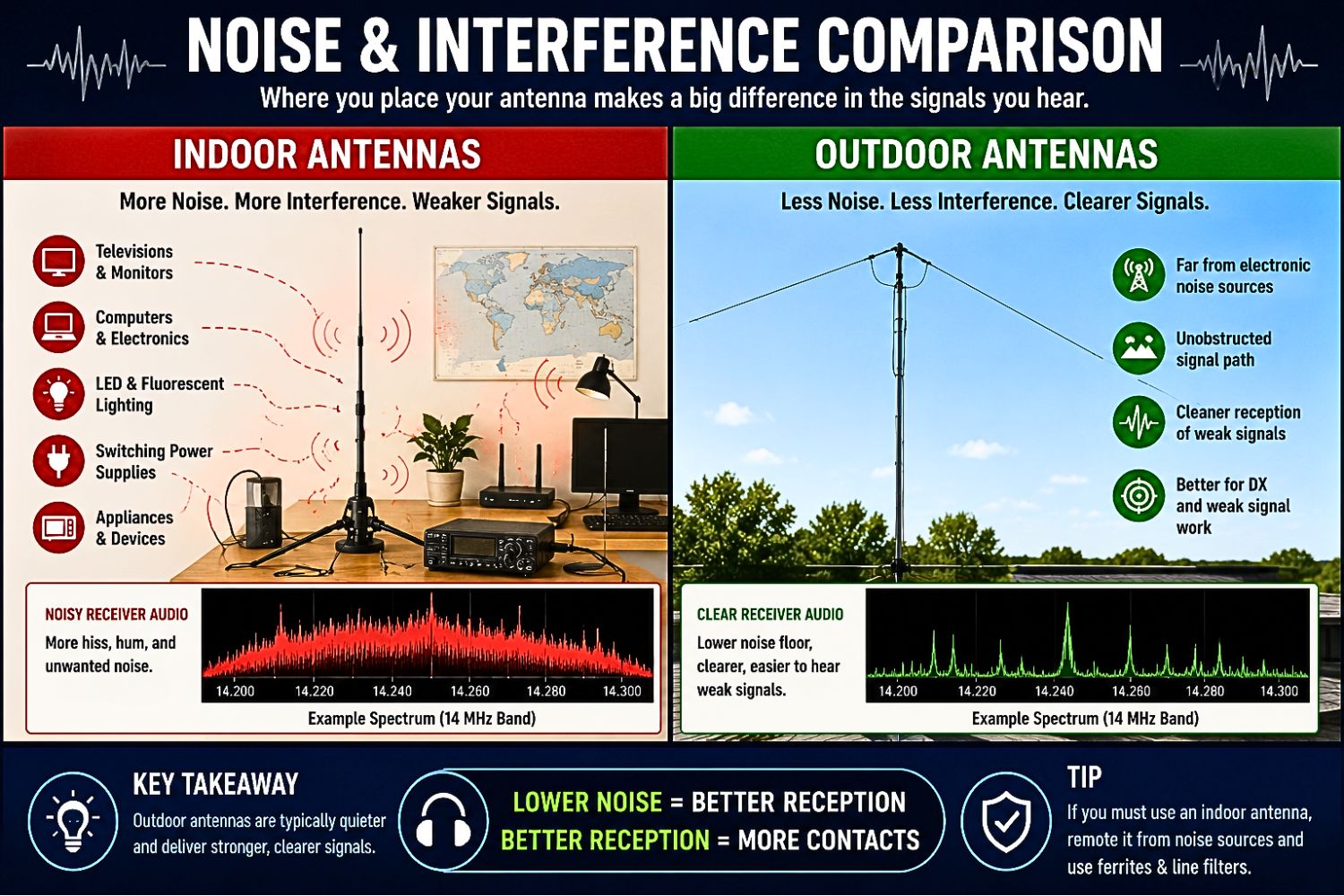
Noise and Interference Comparison
Radio frequency interference can significantly impact operating performance regardless of antenna type. Indoor antennas are commonly affected by televisions, computers, LED lighting, power supplies, appliances, and other household electronics that generate unwanted noise.
Outdoor antennas are typically positioned farther from these interference sources, allowing operators to receive weaker signals more clearly. Reducing noise levels often improves overall station performance as much as increasing antenna gain or transmitter power.
Installation and Safety Factors
Installation considerations differ dramatically between indoor and outdoor antennas. Indoor antennas typically require minimal tools, occasional adjustments, and careful placement to avoid interference. Conversely, outdoor antennas often need ladders, climbing gear, and grounding systems for safe and effective installation.
As operators must consider lightning protection, proper guying, and weatherproofing for outdoor setups. Because safety is paramount, taking precautions during installation prevents accidents and protects both operators and equipment.
Cost and Maintenance
Indoor antennas usually cost less and require minimal ongoing maintenance. Operators can easily inspect, adjust, or replace components without major effort. Outdoor antennas, however, involve higher initial costs due to materials, mounting hardware, and potential professional installation.
Additionally, they require periodic maintenance to check for corrosion, loose fittings, and damage from weather. Despite the added cost and effort, outdoor antennas generally provide superior long-term performance, making them worthwhile for serious operators.
Hybrid Approaches
Some operators use hybrid strategies to combine the benefits of indoor and outdoor antennas. For instance, small portable antennas indoors can supplement larger outdoor antennas during adverse weather. Similarly, rooftop or balcony installations offer improved elevation while staying within legal or spatial limits.
These portable or temporary outdoor antennas can be deployed during field operations or special events. By creatively combining indoor and outdoor setups, operators can maximize flexibility, performance, and convenience.
Questions to Ask Before Choosing an Antenna
Before selecting an antenna system, operators should evaluate several practical considerations:
- How much space is available for installation?
- Are there homeowner association or zoning restrictions?
- Is long-distance DX communication a primary goal?
- What operating bands will be used most often?
- How much maintenance can realistically be performed?
- Are weather conditions likely to affect the installation?
- What budget is available for equipment and supporting hardware?
Answering these questions helps narrow antenna choices and improves the likelihood of long-term satisfaction with the installation.
ethernetChoosing the Right Antenna for Your Needs
Selecting the best antenna depends on operating goals, available space, budget, and environmental factors. Indoor antennas suit urban operators, renters, or casual users seeking convenience. Outdoor antennas suit serious operators seeking maximum range, efficiency, and reliability.
Furthermore, evaluating maintenance capabilities, weather conditions, and local regulations helps determine the best choice. By carefully considering these factors, operators can achieve optimal performance and satisfaction, regardless of whether they choose indoor or outdoor solutions.
Long-Term Considerations of
Long-term, outdoor antennas typically offer greater performance and scalability, while indoor antennas provide flexibility and convenience. Operators should consider future expansion, potential moves, or changes in operating style when making decisions.
Additionally, understanding seasonal and environmental impacts ensures the chosen antenna continues to perform optimally over time. By balancing performance, convenience, cost, and safety, operators can enjoy reliable communication and successful amateur radio experiences for years to come.
Indoor vs. Outdoor Antennas FAQ
Which antenna type performs better for ham radio?
Outdoor antennas generally provide better performance because they are installed higher and farther away from structures and electronic noise sources. This often results in stronger signals and improved reception.
Are indoor antennas good for beginners?
Yes. Indoor antennas are often easier to install, require less maintenance, and allow new operators to begin operating quickly while learning antenna fundamentals.
Can indoor antennas work for DX communications?
Indoor antennas can make long-distance contacts under favorable conditions, although outdoor antennas typically provide greater efficiency and stronger signal performance.
Do outdoor antennas require grounding?
Proper grounding is recommended for outdoor antennas to improve safety and help protect equipment from lightning-related electrical surges.
Which antenna type is more affordable?
Indoor antennas generally cost less because they require fewer mounting materials, support structures, and weatherproofing components.
Indoor vs. Outdoor Antennas Conclusion
Choosing between indoor vs. outdoor antennas ultimately depends on your priorities, operating goals, and available space. Indoor antennas provide convenience, easy installation, and flexibility, making them ideal for urban or restricted environments.
Conversely, outdoor antennas offer superior performance, greater range, and more efficient radiation patterns, making them the preferred choice for serious operators and long-distance communication.
Carefully considering factors such as maintenance, cost, safety, and environmental conditions, operators can select the antenna that best suits their needs. Ultimately, understanding the trade-offs and planning thoughtfully ensures reliable, effective, and enjoyable amateur radio operation.
Indoor vs. Outdoor Antennas: Final Comparison
While outdoor antennas usually deliver the highest performance, indoor antennas continue to provide practical solutions for operators with limited space or installation restrictions. The best antenna is ultimately the one that matches the operator’s environment, operating goals, and maintenance capabilities while providing reliable communication on the desired frequencies.
Please consider Donating to help support this channel