
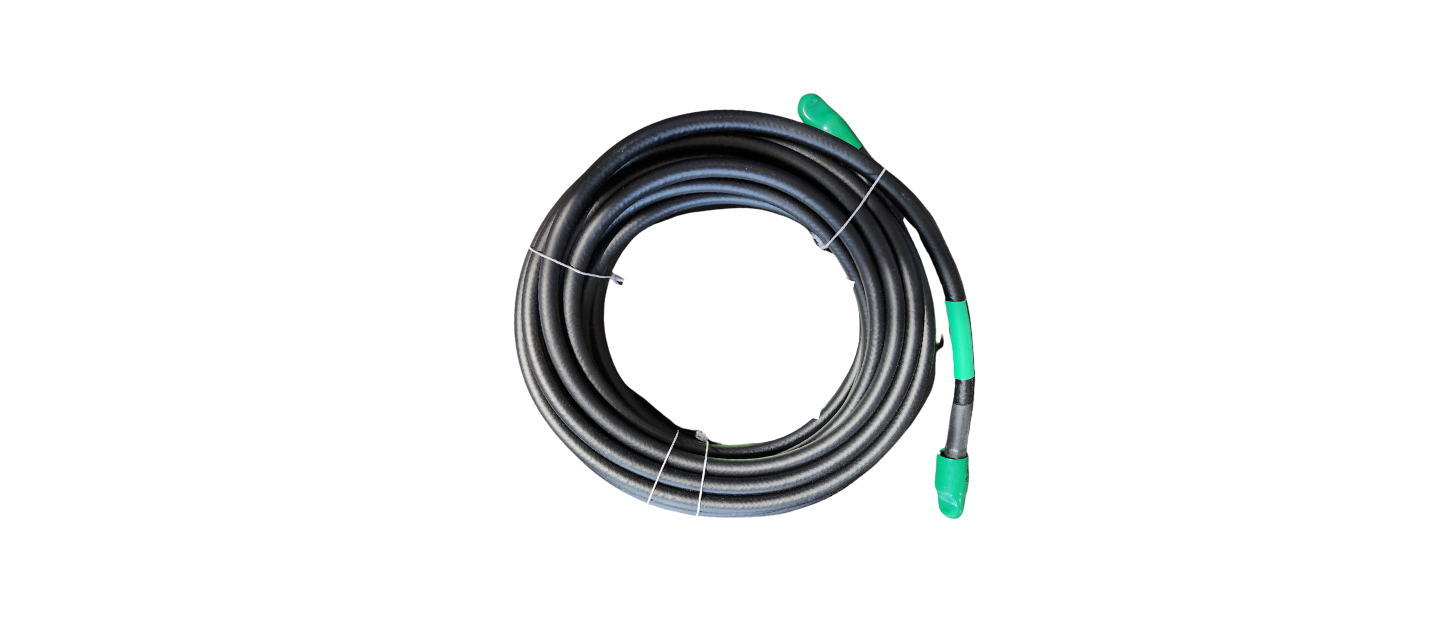
What Is LMR-400 Coaxial Cable?
LMR-400 is a low-loss 50-ohm coaxial cable designed for RF signal transmission with minimal attenuation. It is widely used in amateur radio, wireless networking, and commercial RF systems because it delivers more power to the antenna and reduces signal loss over long cable runs.
Low loss LMR 400 is crucial in radio frequency (RF) applications, including amateur radio stations. The Low loss coaxial cable minimizes signal attenuation delivering a more power and cleaner signal to the antenna. This preservation of signal strength ensures that the transmitted signal arrives at its destination with minimal degradation. This offers a higher quality communication clarity and range.
With reduced signal loss, low loss coaxial cable enables RF signals to travel longer distances without significant attenuation. This characteristic is particularly advantageous in long-distance communication scenarios, allowing operators to reach farther with their transmissions.
Low loss coaxial cable helps maintain a high signal-to-noise ratio (SNR). This results in cleaner received signals, reducing the impact of noise and interference and improving overall communication quality. High-loss cables can dissipate a significant portion of the transmitted power as heat. This results are an inefficient power transfer and reduced effective radiated power. Low loss coaxial cable, however, ensures efficient power transfer, while maximizing the signal’s effectiveness.
LMR-400 Technical Performance Characteristics
LMR-400 is a 50-ohm coaxial cable engineered for low signal attenuation across a wide frequency range. Its design uses a solid copper-clad aluminum center conductor, a foam polyethylene dielectric, and multiple shielding layers to reduce signal loss and external interference.
One of the most important performance characteristics is attenuation. LMR-400 provides significantly lower loss than many common coaxial cables, especially at VHF and UHF frequencies where signal loss increases rapidly.
The cable also offers high shielding effectiveness, which helps prevent unwanted RF interference from entering or leaving the feedline. This improves signal integrity in both transmit and receive operation.
LMR-400 supports high power handling compared to smaller coax types. This makes it suitable for base stations, repeater installations, and long feedline runs where maintaining signal strength is critical.
Its low loss, strong shielding, and stable impedance allow RF systems to operate closer to their designed performance levels, improving efficiency and communication reliability.
Typical Electrical Specifications
Characteristic impedance: 50 ohms
Velocity factor: approximately 85%
Shielding effectiveness: greater than 90 dB
Outer diameter: about 0.405 inches
Operating temperature range: typically −40°F to +185°F
Frequency Range and Performance
LMR-400 performs efficiently from HF through microwave frequencies. Its low attenuation makes it especially valuable at VHF, UHF, and above, where signal loss increases rapidly with frequency. Feedline efficiency works together with antenna height and take-off angle to determine how far your signal travels.
Using low loss coaxial cable contributes improves the overall performance and reliability of RF systems. The low loss cable helps ensure that RF equipment operates at its full potential, achieving optimal performance and functionality. With a higher initial cost compared to standard coaxial cables, its superior performance can lead to long-term cost savings. It reducing the need for signal amplification, repeaters, or additional antennas to compensate for signal loss.
Is Low Loss LMR 400 the Best Coax for you
Low Loss LMR 400 may be the best coaxial cable for your amateur radio station depending on various factors such as frequency range, power requirements, budget, and installation environment. However, some commonly recommended coaxial cables for amateur radio stations include:
LMR 240 is a durable, low loss coax cable. It is ideal for various applications such as telecommunications, wireless communication, and RF installations. With its flexible design and superior performance, LMR 240 delivers reliable signal transmission in demanding environments.
LMR 400 is a popular choice for amateur radio stations due to its low loss, wide frequency range, and high power handling capabilities. It offers excellent performance for both HF and VHF/UHF applications and is suitable for both indoor and outdoor installation.
LMR 600 is for high-power applications or installations requiring even lower loss, LMR 600 is a premium option. LMR 600 offers higher performance on long runs, and higher frequencies.
RG-213 is another commonly used coaxial cable for amateur radio is RG-213. It offers good performance at a more affordable price point compared to LMR 400. RG-213 is suitable for HF and VHF/UHF applications and is a reliable choice for most amateur radio setups.
RG-8X is often used in portable setups where a smaller and flexible cable is required.. While it has higher loss compared to LMR 400 and RG-213, RG-8X is suitable for lower power applications and shorter cable runs.
RG-8/U is a rugged and durable coaxial cable suitable for outdoor installations and harsh environments. RG-8/U has earned a reputation for delivering consistent signal transmission in demanding environments.
| Cable Type | Loss at 100 ft (144 MHz) | Loss at 100 ft (440 MHz) |
|---|
| RG-8X | ~3.9 dB | ~6.8 dB |
| RG-213 | ~2.1 dB | ~3.7 dB |
| LMR-400 | ~1.5 dB | ~2.7 dB |
| LMR-600 | ~1.0 dB | ~1.8 dB |
Lower dB loss means more transmitted power reaches the antenna and more received signal reaches the radio.
Coaxial Cable Loss Comparison (Approximate)
Lower dB loss means more signal power reaches the antenna.
When LMR-400 Is the Best Option
LMR-400 performs best when:
- Cable runs exceed 50 feet
- Operating on VHF, UHF, or higher frequencies
- Running higher transmit power
- Installing permanent base station feedlines
- Minimizing receive noise is important
It provides an excellent balance of performance, flexibility, and cost.
When You May Not Need LMR-400
LMR-400 may be unnecessary if:
- Cable runs are short (under 25 feet)
- Operating primarily on HF
- Portable flexibility is more important than loss
- Budget is limited
- Lightweight cable is required
In these cases, RG-213 or RG-8X may be more practical.
Selecting Low Loss Coax
When selecting coaxial cable for your amateur radio station, consider factors such as frequency range, power handling capability, loss specifications, connector compatibility, and installation requirements.
It’s also essential to use high-quality connectors and properly install and terminate the coaxial cable to ensure optimal performance and reliability. If you’re unsure which coaxial cable is best for your specific setup, consulting with experienced amateur radio operators or professionals can help you make an informed decision.
Common LMR-400 Installation Mistakes
Poor connector installation is the most common cause of performance problems. Improper crimping or soldering can create high resistance and signal loss.
Sharp bends can deform the dielectric and change impedance. Water intrusion into connectors can quickly damage the cable.
Always use quality connectors, proper tools, and weatherproof all outdoor connections.
Standard LMR-400 vs LMR-400 Equivalent Cables
Some manufacturers sell “LMR-400 type” or “LMR-400 equivalent” cable. These may look similar but often use different materials and shielding designs.
Genuine Times Microwave LMR-400 typically provides consistent specifications and long-term durability. Lower-cost alternatives may have higher loss or reduced weather resistance.
Low Loss LMR 400 Coax Review
I use LMR 400 coax for everything, even the jumpers. All of my runs are 100′ or less, I have direct burial out to my antenna switch and that has never failed. I did have a connector fail on my dual band vertical, however, my installation skills could have been the issue.
I find it to be flexible enough for jumpers, and it has been in use for many years. Since my runs are under 100′ the low loss is not noticeable. I am satisfied with it and will continue to use it.
If you would like to try LMR 400 make sure you get the official Times Microwave Brand and not a lower quality equivalent.
Real-World Performance Benefits
Replacing high-loss coax with LMR-400 can significantly increase effective radiated power. Even a few decibels of reduced loss can make weak signals easier to receive and improve transmitted signal strength.
Many operators notice improved VHF and UHF performance immediately after upgrading feedline cable.
Final Verdict: Is LMR-400 Worth It?
LMR-400 remains one of the most widely used low-loss coaxial cables in amateur radio because it delivers excellent signal efficiency, strong shielding, and dependable long-term durability. For most base station installations and moderate to long feedline runs, it offers an excellent balance of performance, cost, and practicality.
Frequently Asked Questions About LMR-400
Is LMR-400 better than RG-213?
LMR-400 has significantly lower signal loss, especially at VHF and UHF, making it more efficient for longer feedline runs.
How much signal loss does LMR-400 have per 100 feet?
Typical loss is about 1.5 dB at 144 MHz and about 2.7 dB at 440 MHz.
Is LMR-400 waterproof?
The cable jacket is weather resistant, but connectors must be properly sealed to prevent moisture intrusion.
Is LMR-400 worth the cost?
For longer runs or higher frequency operation, the reduced signal loss often provides noticeable performance improvement.