

Notch filters explained, also known as a band-stop filter is designed to remove a specific frequency or narrow range of frequencies while allowing all others to pass. In radio and audio systems, this makes it one of the most effective tools for eliminating interference without degrading overall signal quality.
This guide explains how notch filters work, when to use them, and how to apply them in real-world radio and electronic systems.
For instance, they have many uses in communications. Audio processing, and electronics to mitigate interference or eliminate unwanted signals. This article will explore how notch filters work, their advantages, and practical applications.
Understanding how to properly adjust receiver settings can dramatically improve signal clarity and reduce interference. If you want a deeper explanation of controls like RF gain, squelch, AGC, and bandwidth filters, see the Complete Guide to Receiver Controls, where each control is explained in detail with practical tuning examples.
Notch Filters Explained in Simple Terms
A notch filter removes a specific unwanted frequency from a signal while leaving the rest of the signal unchanged. It is commonly used to eliminate interference such as hum, noise, or unwanted carriers.
Why Notch Filters Matter in Real Systems
Interference is one of the most common problems in radio and audio systems. Even a single unwanted tone or signal can make communication difficult or unusable.
Notch filters allow operators to target and remove these specific problems without affecting the rest of the signal. This makes them especially valuable in crowded RF environments, weak-signal conditions, and precision audio applications.
How a Notch Filter Works
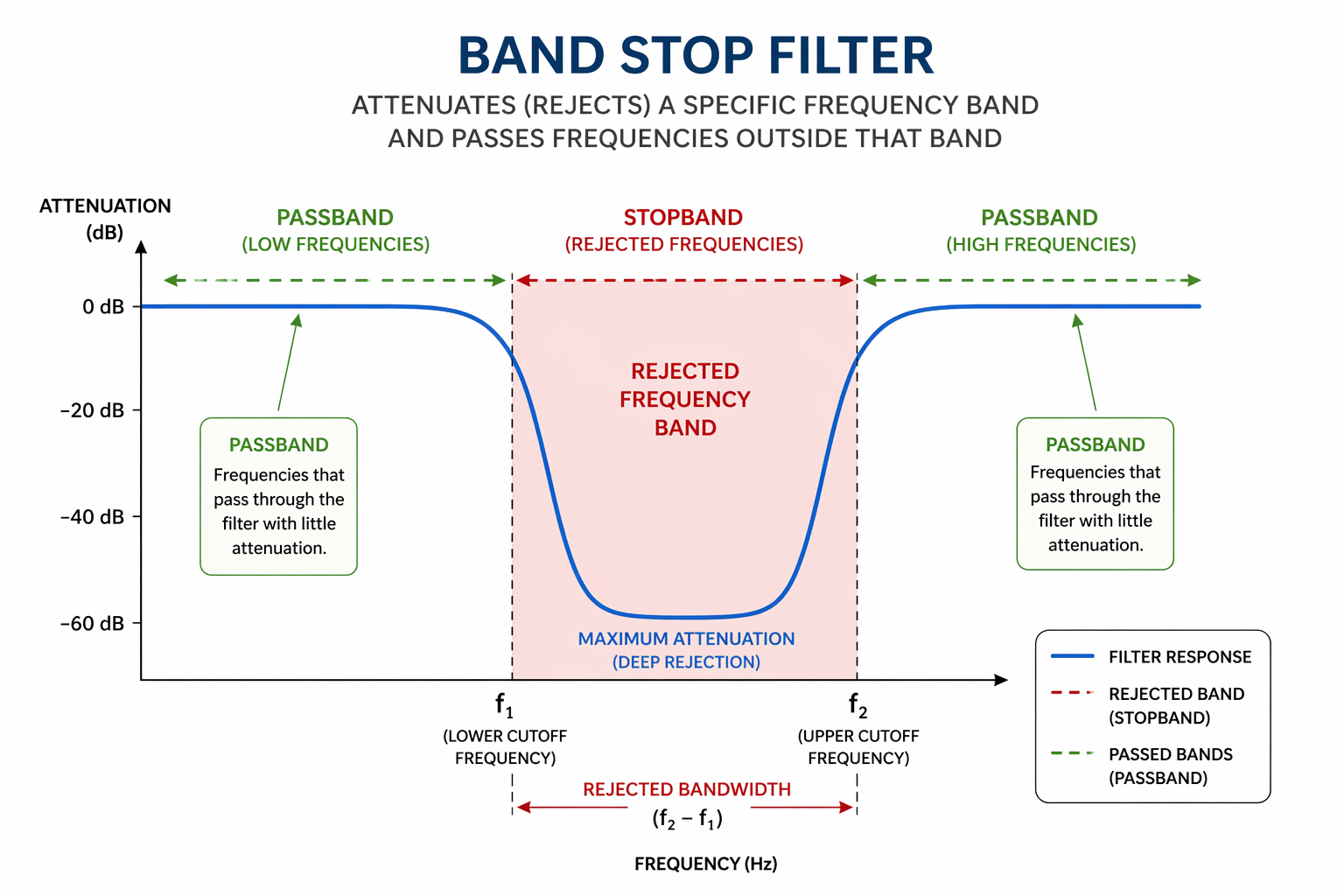
At its core, a notch filter targets a specific frequency range (the “notch” band) and drastically reduces its amplitude whTest and Fine-Tune the Filter
After setting the notch filter, check if the unwanted signal or noise has been reduced or removed.
- If the interference is still present, adjust the center frequency slightly
- If the desired signal sounds distorted, reduce the bandwidth or adjust the filter
- Repeat small adjustments until the interference is minimized without affecting the main signal
For advanced setups, test equipment like a spectrum analyzer can be used, but most users can tune effectively by listening and making small adjustments.ile leaving frequencies outside this range mostly unaffected. The notch filter’s functionality is determined by its center frequency, bandwidth, and the amount of attenuation it provides.
Key Components
- Center Frequency (f₀): The frequency at which the filter provides maximum attenuation.
- Bandwidth: The range of frequencies around the center frequency that are attenuated. Narrow bandwidth filters are more selective, targeting precise frequencies, while wider ones affect a broader range.
- Q Factor (Quality Factor): A measure of the sharpness of the filter. Higher Q factors result in sharper attenuation at the center frequency.
How It Works Physically
- In Analog Circuits:
Notch filters in analog systems are typically implemented using resistors, capacitors, and inductors. These components are arranged in specific configurations (such as parallel LC circuits). To create destructive interference at the desired frequency. - In Digital Systems:
Digital notch filters rely on mathematical algorithms to process signals and suppress unwanted frequencies. In addition to being highly customizable and used in software-defined radios and audio applications.
Advantages of Notch Filters
- Selective Frequency Suppression
Notch filters can target and eliminate a single frequency or a narrow band, such as interference from power line noise (50/60 Hz) or spurious signals. - Signal Integrity
By only affecting specific frequencies, notch filters preserve the rest of the signal, maintaining its overall quality. - Versatility
From radio communications to medical devices (e.g., ECG machines) where removing unwanted noise is critical. - Compact Design
With modern systems, digital notch filters are built into. Eliminating the need for bulky hardware components. - Cost-Effective
Analog notch filters, built with basic components, are inexpensive and straightforward to design.
Related Radio Signal Optimization Guides
Notch filters work best when combined with proper receiver settings, filtering techniques, and antenna optimization. Adjusting RF gain, bandwidth, and filtering can further improve signal clarity.
Applications of Notch Filters
- Audio Processing: To remove unwanted frequencies, such as hums or feedback noise.
- Radio Communications: To filter out interference from other transmitters or unwanted harmonics. Also used in duplexers for repeater systems.
- Medical Equipment: To eliminate power line noise in devices like ECG and EEG machines.
- Instrumentation: To isolate signals in measurement systems.
Real-World Notch Filter Performance Insight
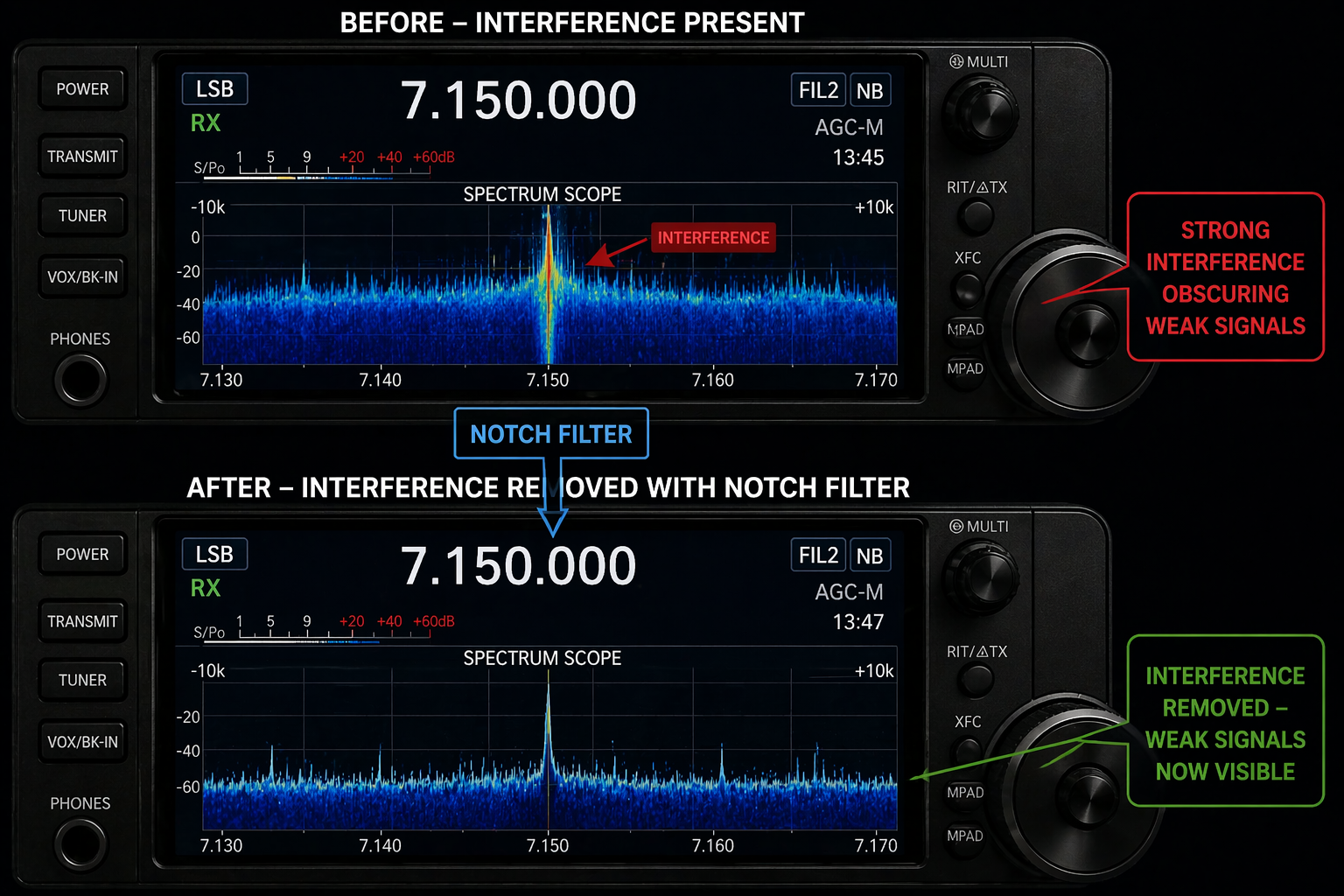
In real-world operation, notch filters are commonly used to eliminate heterodynes, power line noise, and interfering carriers. When properly adjusted, they can make otherwise unreadable signals clear and usable.
However, improper settings can remove parts of the desired signal, so careful adjustment is critical for best results.
Step by Step: How to Use a Notch Filter
1. Identify the Frequency to Suppress
Determine the exact frequency or range of frequencies causing interference. This is the center frequency (f₀) of your notch filter.
2. Choose the Right Filter Type
- For analog systems, select an LC or RC filter circuit that matches your desired frequency range.
- For digital systems, implement a digital notch filter in software using tools like MATLAB or DSP processors.
3. Set the Bandwidth and Q Factor
Adjust the bandwidth to ensure the filter suppresses only the desired range while preserving nearby frequencies. Use a higher Q factor for narrow notches or a lower Q factor for broader suppression.
4. Integrate the Filter into Your System
Place the notch filter in the signal path where interference is present. For radio communications, this could be between the antenna and receiver, while in audio systems, it might be in the preamp stage.
5. Test and Optimize
Use a signal generator and spectrum analyzer to test the filter’s performance. While fine-tuning the components or parameters to achieve optimal attenuation at the desired frequency.
Common Notch Filter Mistakes
- Setting the notch too wide → removes desired signal
- Incorrect center frequency → interference remains
- Overuse of filtering → reduces audio clarity
- Not verifying with test equipment → inaccurate tuning
Notch Filter vs Other Filters
- Notch Filter: Removes one specific frequency
- Band-pass Filter: Allows only a selected range
- Low-pass Filter: Blocks high frequencies
- High-pass Filter: Blocks low frequencies
Notch filters are unique because they remove only a targeted interference source without affecting the rest of the signal.
Final Thoughts on Notch Filters
Notch filters are one of the most effective tools for eliminating interference while preserving overall signal quality. Whether used in radio communications, audio processing, or electronic systems, they provide precise control over unwanted frequencies.
When properly configured, a notch filter can dramatically improve clarity, reduce noise, and enhance system performance without affecting desired signals.
Notch Filter FAQs
What does a notch filter do?
It removes a specific unwanted frequency from a signal while allowing others to pass.
What is the difference between a notch filter and a band-stop filter?
They are the same. A notch filter is a narrow band-stop filter.
Where are notch filters used in ham radio?
They are used to remove interference, heterodynes, and unwanted signals from receivers.
Can a notch filter remove noise?
Yes, if the noise is at a specific frequency, such as power line hum.
Do notch filters affect signal quality?
Only if set incorrectly. A properly tuned notch filter preserves the rest of the signal.
Please consider Donating to help support this channel