
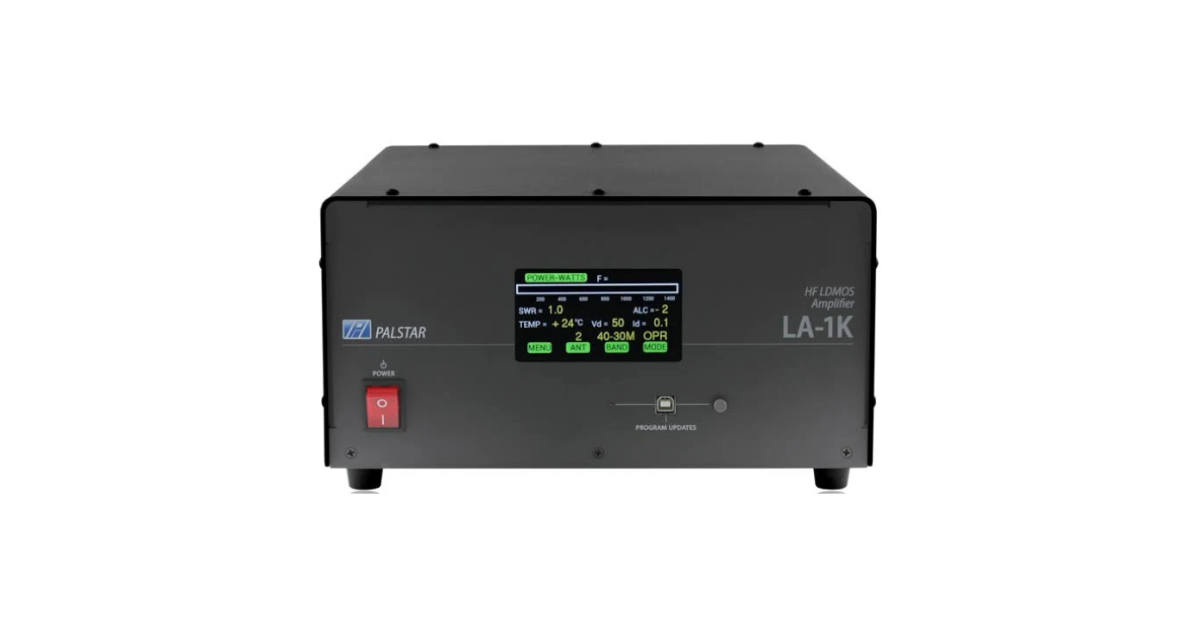
Palstar LA-1K Amplifier Overview
The Palstar LA-1K is a 1000-watt solid-state HF amplifier designed for amateur radio operators who want legal-limit style power without the complexity of tube amplifiers. Built around modern LDMOS transistor technology, the LA-1K delivers high output power with relatively low drive requirements while maintaining excellent spectral cleanliness across the HF and 6-meter bands.
Unlike traditional amplifiers that require manual tuning and warm-up time, the LA-1K operates instantly with automatic band switching, intelligent protection systems, and an integrated high-current power supply. These features make it particularly attractive for contest operators, DX enthusiasts, and stations running digital modes that require stable, clean RF amplification.
This guide explains how the amplifier works, its technical performance, real-world operating behavior, and how it compares with other modern solid-state HF amplifiers.
Because the LA-1K uses dual high-power LDMOS devices, it produces full output with modest drive power. Typically, only 35 to 50 watts of drive is required to reach full output. This efficiency makes it compatible with a wide range of modern transceivers without requiring excessive drive levels or complicated tuning procedures.
In addition, RF sensing allows automatic keying without the need for an interface cable. However, operators who prefer hard keying or band data integration can still connect interface cables if desired. This flexibility allows the amplifier to operate easily in both simple and advanced station configurations.
New to Ham Radio Amplifiers? See our Complete Guide to Ham Radio Amplifiers.
Key Features
- 1000-watt HF and 6-meter output capability
- Dual high-power LDMOS transistors
- Automatic band switching
- Built-in high-current power supply
- RF sensing for automatic keying
- Full-color TFT touch display
- Advanced protection monitoring
What Is the Palstar LA-1K Amplifier?
The Palstar LA-1K is a 1000-watt solid-state HF and 6-meter amplifier that uses LDMOS transistor technology to deliver high output power with modest drive requirements. It includes a built-in power supply, automatic band switching, advanced protection systems, and clean signal amplification designed for modern amateur radio operation.
Palstar LA-1K Technical Specifications
| Specification | Value |
|---|---|
| Output Power | Up to 1000 watts (SSB/CW) |
| Frequency Coverage | 1.8 – 54 MHz |
| Technology | Dual LDMOS transistors |
| Gain | ~13 dB |
| Drive Power Required | 35–50 watts typical |
| Power Supply | Built-in 50V DC |
| Cooling | Multi-speed variable fans |
| Band Switching | Automatic with optional band data |
| Antenna Outputs | 3 selectable outputs |
| Weight | Approx. 27 lbs shipping |
Learn More About Amateur Radio Amplifiers
High-power amplifiers like the Palstar LA-1K are part of a larger category of RF amplification equipment used to increase transmitted signal strength across the amateur bands. Operators comparing different amplifier designs, technologies, and power levels may want to explore the Complete Guide to Ham Radio Amplifiers, which explains how solid-state and tube amplifiers work, how to choose the right amplifier for a station, and what factors affect real-world performance.
Palstar LA-1K Quick Performance Summary
The Palstar LA-1K is a 1000-watt solid-state HF amplifier designed for efficient high-power operation with modest drive requirements. It delivers full output across 1.8 through 54 MHz, integrates a built-in high-current power supply, and provides automatic band switching with optional data control. Clean signal output, modern LDMOS technology, and intelligent protection systems make it suitable for both everyday operation and demanding high-duty cycles.
Who the Palstar LA-1K Is Best For
The Palstar LA-1K is particularly well suited for several types of amateur radio stations:
- DX stations needing stronger signal penetration during weak propagation
- Contest operators who require reliable high output during long operating sessions
- Digital mode operators running FT8, RTTY, or other high-duty cycle modes
- Operators upgrading from barefoot transceiver power
Because the amplifier delivers full output with modest drive power, it integrates easily with many modern HF transceivers.
Key Features of the Palstar LA-1K
- Dual LDMOS transistor RF stage
- 1000-watt output capability
- Built-in high-current power supply
- Automatic band switching
- RF sensing for automatic keying
- Full color TFT touch display
- Intelligent protection monitoring
- Vacuum relay transmit/receive switching
Designed for Seamless Station Integration
The LA-1K works with most transceivers and antenna tuners, but it was specifically designed to pair perfectly with the Palstar HF-AUTO automatic antenna tuner. When used together, the amplifier and tuner create a highly efficient, automated station with minimal manual adjustment.
A full-color TFT touch screen provides real-time status monitoring and intuitive control. Operators can quickly view output power, operating conditions, and system status without navigating complex menus. This modern interface makes the amplifier feel responsive and easy to manage during active operating.
Reliable transmit/receive switching is handled by a vacuum relay. Vacuum relays are widely respected for durability and long switching life, which is critical in high-power HF operation. Combined with a built-in 50V DC, 42-amp power supply, the LA-1K operates as a complete self-contained amplification system.
Basic Station Setup and Integration
Installing the LA-1K is straightforward. The RF output of the transceiver connects to the amplifier input, and the amplifier output connects to the antenna system or tuner. Once power is connected and grounding is secured, the amplifier automatically detects RF and begins operating.
When a band data cable is used, band switching becomes instantaneous. Without it, RF sensing provides automatic operation with minimal configuration. Because the internal power supply is built in, no external high-voltage supply or complex wiring is required.
Clean Signal Performance and Efficiency
Signal purity is a defining characteristic of this amplifier. The LA-1K incorporates a “Pure Signal” design approach that focuses on clean output and minimal distortion. This results in a crisp transmitted signal that meets strict spectral standards across all amateur bands.
The amplifier has exceeded FCC compliance testing requirements, demonstrating both spectral cleanliness and efficient RF amplification. Clean amplification is especially important when operating high power, because excessive distortion can cause interference across adjacent frequencies.
With approximately 13 dB of gain, the amplifier delivers strong amplification while maintaining stable operating characteristics across the full HF spectrum and into 6 meters.
Spectral Cleanliness and Transmitted Signal Quality
High-power amplification must maintain spectral purity to avoid interference with adjacent frequencies. The LA-1K is engineered to produce a clean output signal with minimal distortion, which helps maintain clear transmission even in crowded band conditions.
Clean amplification improves intelligibility and reduces unwanted signal spread. This becomes especially important during high-power operation, where distortion can affect large portions of the band if not controlled properly.
Maintaining spectral cleanliness also reflects good operating practice and helps ensure compliance with transmission standards.

Rear Panel Connectivity and Station Control
The rear panel layout supports flexible station configuration. One RF input feeds three selectable antenna outputs, all using standard SO-239 connectors. This allows quick switching between multiple antennas without external switching hardware.
Additional connections include RCA jacks for keying and ALC control, along with dual DB-9 connectors for band data interface integration. These connections allow automatic band switching and coordinated operation with compatible transceivers.
Power connectivity is equally flexible. The amplifier ships with both 110-volt and 220-volt power cables, allowing immediate operation without rewiring. A grounding terminal with wing nut provides secure station grounding for safe operation.
Intelligent Protection Systems
High-power solid-state amplifiers require advanced protection to prevent component damage. The LA-1K includes multiple monitoring systems that automatically protect the LDMOS devices during abnormal conditions.
The current protection system activates when transistor drain current exceeds safe limits. Thermal protection monitors heatsink temperature and disables operation if overheating occurs. Overdrive protection prevents excessive input power from reaching the transistors. Frequency protection monitors specific restricted operating ranges and prevents transmission when necessary.
Together, these systems continuously monitor operating conditions and respond instantly to protect the amplifier’s core components.
Thermal Design and Cooling Performance
Heat management is critical in high-power solid-state amplification. The LA-1K uses variable multi-speed cooling fans that respond automatically to operating load. This dynamic cooling system maintains stable internal temperatures without running at maximum speed continuously.
Efficient thermal transfer through the aluminum chassis helps dissipate heat evenly, reducing localized stress on power components. Stable thermal control contributes directly to consistent output and long component life.
Because temperature regulation remains stable even during extended transmissions, performance does not degrade under sustained operating conditions.
Firmware Updates and Long-Term Support
A front-panel UART connection allows convenient firmware updates using a standard USB-to-UART cable. Software updates are provided free and can be installed easily by following simple instructions. This allows the amplifier to remain current with improvements and refinements over time.
Technical Performance Specifications
The LA-1K delivers full legal-limit style performance across amateur bands. It produces up to 1000 watts on SSB and CW, while supporting reduced power levels for continuous duty modes such as FM, RTTY, and AM carrier operation. Coverage spans 1.8 through 54 MHz, making it suitable for HF and 6-meter operation.
A heavy powder-coated aluminum chassis provides structural strength and effective heat management. Variable three-speed cooling fans regulate temperature automatically, balancing thermal control and noise management.
The amplifier uses dual 600-watt LDMOS transistors, providing substantial headroom and reliable output capability. The internal power supply delivers stable high-current DC output to support sustained transmission.
Real-World Operating Experience
After two years of regular use, the LA-1K has proven exceptionally reliable. The first impression during unboxing is its solid construction and substantial feel. All connections are clearly labeled and simple to configure, which makes station integration straightforward.
Initial setup requires only minimal adjustment. Within a few button presses, the amplifier is ready for operation. When paired with an automatic antenna tuner, band changes and tuning become nearly effortless.
Drive power in practical operation ranges from about 15 to 40 watts. Output typically falls between 200 and 900 watts depending on mode and operating conditions. Running slightly below maximum output provides excellent performance while maintaining comfortable thermal margins.
Fan noise is noticeable but not distracting. The cooling system responds intelligently to operating load and maintains stable temperature during extended operation.
The touch display is bright, responsive, and highly readable. Control inputs register accurately, and system information is easy to monitor at a glance.
Firmware updating is straightforward, and instructions are clear. The process completes quickly without complication.
Overall performance has been consistently stable, predictable, and efficient. The amplifier delivers strong output, clean signal quality, and reliable operation across all supported bands.
Operating Power and Practical Performance
Although the amplifier is capable of full output, operating slightly below maximum provides excellent efficiency and longevity. Many operators choose to run reduced power for continuous modes or routine communication while reserving higher output for demanding conditions.
This flexibility allows the amplifier to perform equally well in casual operation, contesting, or long-distance DX work.
Performance in Contest and DX Operation
High-duty operating environments demand stable output and predictable thermal control. During extended operating periods, consistent power delivery becomes more important than peak output capability.
The LA-1K performs especially well in sustained operating conditions because output remains stable across long transmission cycles. Rapid transmit-receive switching supports high-rate contest operation, while clean signal characteristics help maintain readability in crowded band conditions.
For DX operation, reliable high power improves signal penetration under marginal propagation. Even moderate power increases can significantly improve contact reliability when signals are weak or fading.
Recommended Drive Power by Operating Mode
Proper drive levels ensure efficient amplification and long transistor life. Moderate drive settings typically provide excellent output while maintaining safe operating margins.
For SSB operation, moderate drive produces strong peak output with minimal stress. CW operation benefits from steady drive levels that maintain stable output without excessive heat buildup. Continuous duty modes such as RTTY and FM require reduced drive to maintain thermal stability during long transmissions.
Operating slightly below maximum output provides optimal efficiency and long-term reliability.
Build Quality and Mechanical Design
The LA-1K uses an 11-gauge aluminum chassis with a durable powder-coated finish. Mechanical construction feels rigid and robust. Controls are solid, connectors are secure, and internal cooling is well engineered.
Weighing approximately 27 pounds shipping weight, the amplifier balances substantial construction with manageable station placement.
Overall Performance Evaluation
The Palstar LA-1K combines modern solid-state amplification with practical station usability. It delivers high output power with modest drive requirements, maintains clean transmitted signal quality, and protects itself through intelligent monitoring systems.
Setup is simple, operation is intuitive, and long-term reliability has proven excellent. The amplifier integrates easily with modern transceivers and automated station components, making it suitable for both experienced operators and those upgrading from lower-power equipment.
After extended real-world operation, performance remains consistent and dependable. Output is strong, signal quality is clean, and control is effortless.
The only real wish is for an even higher-power model to exist alongside it.
Solid-State Versus Tube Amplifier Operation
Solid-state amplifiers such as the LA-1K differ significantly from traditional tube amplifiers. Tube amplifiers require manual tuning and periodic maintenance, while solid-state designs operate instantly without warm-up or adjustment. Solid-state systems also integrate protection circuitry that automatically prevents damage during abnormal conditions.
Tube amplifiers can tolerate higher mismatch conditions, but modern solid-state designs provide cleaner output, faster response, and simplified operation. For operators who value convenience and consistent performance, solid-state amplification offers clear advantages.
How the Palstar LA-1K Compares to Other Solid-State Amplifiers
The LA-1K competes directly with other high-power solid-state HF amplifiers designed for automated operation and clean signal output. Compared with many competing designs, it emphasizes simplicity, integrated power delivery, and straightforward station compatibility.
Some amplifiers focus heavily on advanced computer control or remote operation features. The LA-1K instead prioritizes reliable manual operation with optional automation. This approach appeals to operators who want dependable high-power performance without navigating complex software control environments.
Output capability, signal cleanliness, and protection systems place it firmly among modern high-power solid-state amplifier designs, while its integrated power supply reduces overall station complexity compared to systems requiring external supplies.
Long-Term Reliability and Component Longevity
Solid-state amplifier longevity depends on stable operating conditions, effective cooling, and proper drive levels. The LA-1K combines all three factors through thermal regulation, protection monitoring, and efficient power delivery.
Operating slightly below maximum output significantly reduces thermal stress and extends component life. Because the amplifier continuously monitors current, temperature, and drive levels, it prevents most conditions that could shorten transistor lifespan.
With routine operation inside recommended limits, solid-state amplifiers of this type typically provide long service life with minimal maintenance requirements.
Routine Maintenance and Operating Care
Unlike tube amplifiers, solid-state designs require minimal routine maintenance. However, maintaining airflow, keeping ventilation paths clear, and monitoring operating temperature help preserve performance over time.
Periodic inspection of connections and grounding ensures consistent electrical stability. Firmware updates should be installed when available to maintain optimal system behavior.
Good operating habits and proper station ventilation contribute significantly to long-term reliability.
Solid-State Amplifier Comparison Overview
| Feature | Palstar LA-1K | Typical Tube Amplifier | External PSU Solid-State |
|---|---|---|---|
| Tuning required | No | Yes | No |
| Warm-up time | None | Required | None |
| Built-in power supply | Yes | No | Often no |
| Automatic protection | Extensive | Limited | Extensive |
| Operation simplicity | Very high | Moderate | High |
| Maintenance level | Low | Higher | Low |
Is the Palstar LA-1K Worth It?
For operators who want reliable high power without manual tuning or complex station configuration, the LA-1K provides exceptional value. It delivers strong output, clean signal performance, and automatic protection in a fully integrated design.
The amplifier is particularly worthwhile for stations that operate frequently, run digital or contest activity, or want consistent high-power capability with minimal adjustment. Its combination of automation, signal quality, and reliability makes it a long-term station upgrade rather than a temporary accessory.
Palstar LA-1K Amplifier Summary
The Palstar LA-1K represents a modern approach to high-power amateur radio amplification. By combining solid-state LDMOS technology, intelligent protection monitoring, and a built-in high-current power supply, the amplifier delivers reliable high output with minimal operational complexity.
Final Verdict on the Palstar LA-1K
The Palstar LA-1K combines modern solid-state amplification with practical station usability. It delivers high output power, clean transmitted signals, and automatic protection in a compact integrated design.
Operation is simple, performance is consistent, and long-term reliability is excellent. The amplifier handles demanding operating conditions while remaining easy to manage during everyday use.
For operators seeking dependable high-power capability without the complexity of traditional amplification systems, the LA-1K stands out as a highly capable and practical solution.
Advantages and Considerations
The LA-1K offers strong performance and easy integration, but like any amplifier, it fits certain operating styles better than others.
Advantages include high output power with relatively low drive, integrated power supply, automatic operation, and clean transmitted signal quality. Setup is simple and requires minimal adjustment, which makes operation efficient and predictable.
Considerations include audible cooling fans during heavy operation and the need to manage drive power carefully for continuous duty modes. As with most solid-state amplifiers, maintaining proper antenna matching helps ensure stable performance.
Palstar LA-1K Pros and Cons
Pros
- Full 1000-watt output with modest drive power
- Built-in high-current power supply (no external PSU required)
- Extremely clean transmitted signal
- Automatic band switching and RF sensing
- Excellent protection systems for transistor safety
- Simple setup with no tuning required
- Solid heavy-duty construction
- Stable output during long operating sessions
- Works well for contesting and DX operation
Cons
- Cooling fans are audible under heavy load
- Higher purchase price than entry-level amplifiers
- Requires good antenna matching for best performance
- Continuous duty modes require reduced power operation
- No higher-power model available in the same design
Integrating the LA-1K Into a Complete Station
High-power amplification works best when combined with efficient antennas, proper feedline selection, and accurate impedance matching. When the amplifier is paired with a quality antenna tuner and well-designed antenna system, overall station performance improves significantly.
Understanding antenna behavior, feedline losses, and matching techniques helps ensure the amplifier operates efficiently across all bands.
Related Amplifier and Station Guides
If you are researching high-power station upgrades, you may also find these guides helpful:
- Solid-state vs tube amplifier comparison
- How to ground a high-power amateur radio station
- Choosing the right antenna tuner for HF amplifiers
- Complete guide to ham radio transceivers
Frequently Asked Questions About the Palstar LA-1K
How much drive power does the LA-1K require?
Most stations achieve full output using 35–50 watts of drive power depending on band and mode.
Can the LA-1K operate on 110 volts?
Yes. The amplifier ships with both 110-volt and 220-volt power cables for flexible installation.
Does the amplifier require manual tuning?
No. Solid-state operation allows instant operation without tuning adjustments.
Is the amplifier compatible with digital modes like FT8?
Yes, although reduced power levels are recommended for continuous duty modes.
Does the LA-1K include protection systems?
Yes. Protection circuits monitor current, temperature, overdrive conditions, and restricted frequencies.
Can the amplifier operate on 6 meters?
Yes. Coverage extends from 1.8 MHz through 54 MHz.
Is a band data cable required?
No. RF sensing allows automatic operation, though band data improves switching speed.
Amplifiers Often Compared to the Palstar LA-1K
Operators researching the LA-1K often compare it with other high-power solid-state amplifiers including models from Elecraft, ACOM, and SPE. Each design emphasizes slightly different priorities such as remote control capability, external power supplies, or maximum output capability.
About the Author
Vince, W2KU, is a licensed Extra class amateur radio operator and the founder of Ham Shack Reviews. He was named Amateur of the Year in 2026 for contributions to practical amateur radio education and equipment evaluation.
He primarily operates HF, knows propagation very well, operates mobile and handhelds daily. Vince exchanges QSL cards for DXCC, contest confirmation, and award tracking and is the club QSL manager. His guidance focuses on practical operating procedures, accurate logging, and real-world amateur radio practices.
Please consider Donating to help support this channel