

Using the Reverse Beacon Network-RBN in Amateur Radio
The Reverse Beacon Network-RBN has become one of the most valuable real-time monitoring tools available to amateur radio operators. It automatically detects CQ calls across the amateur bands and reports them instantly through a global network of receiving stations.
Unlike traditional DX clusters that rely on human operators to manually spot signals, the Reverse Beacon Network operates automatically using software-defined radios and decoding software. This automation allows the system to monitor multiple bands continuously and provide immediate reports when a station calls CQ.
For DXers, contest operators, and propagation researchers, the Reverse Beacon Network provides a powerful view into band activity and signal propagation. By examining where a signal is received and how strong it appears at different locations, operators gain real-time feedback about propagation conditions and station performance.
Because the system runs continuously and uses automated decoding, the Reverse Beacon Network produces a steady stream of objective data. This information allows operators to identify active stations, analyze propagation paths, and improve operating strategy.
For a deeper look at logging programs, digital mode software, contest tools, and station control applications, see the Complete Guide to Ham Radio Software.
What the RBN Is
The Reverse Beacon Network is a worldwide system of automated monitoring stations designed to detect amateur radio transmissions. These monitoring stations are commonly referred to as skimmers because they continuously scan large portions of the radio spectrum looking for CQ calls.
Each skimmer station listens across multiple amateur radio bands using a software-defined radio receiver connected to decoding software. When the software detects a valid CQ call, it extracts the call sign and other signal information from the transmission.
The skimmer then reports this information to the central Reverse Beacon Network servers. Within seconds, the data becomes available online for operators around the world.
Each spot typically includes several pieces of information:
- The transmitting station’s call sign
- The frequency where the signal was detected
- The operating mode
- Signal strength reported by the receiving station
- The call sign and location of the receiving skimmer
- The time the signal was detected
Because multiple skimmers may detect the same CQ call, operators often see several reports from different locations. These reports provide valuable insight into how a signal is propagating across different regions.
How the Reverse Beacon Network Works
The Reverse Beacon Network functions through a distributed monitoring architecture. Instead of relying on a single receiver, it uses hundreds of independent receiving stations located throughout the world.
Each skimmer station performs several functions simultaneously.
First, the station’s software-defined radio monitors wide segments of the amateur radio spectrum. Modern SDR receivers can observe large portions of a band at once, allowing the skimmer to listen for multiple signals simultaneously.
Second, decoding software analyzes incoming audio signals and attempts to identify Morse code transmissions that match the pattern of a CQ call.
Third, when the software successfully decodes a call sign, it generates a spot containing the signal details and sends it to the RBN servers.
Finally, the Reverse Beacon Network distributes the spot through web interfaces and data feeds used by amateur radio software.
Because this process is automated, the network can report new signals within seconds of detection. This speed makes the Reverse Beacon Network extremely useful during contests and DX events where activity changes rapidly.
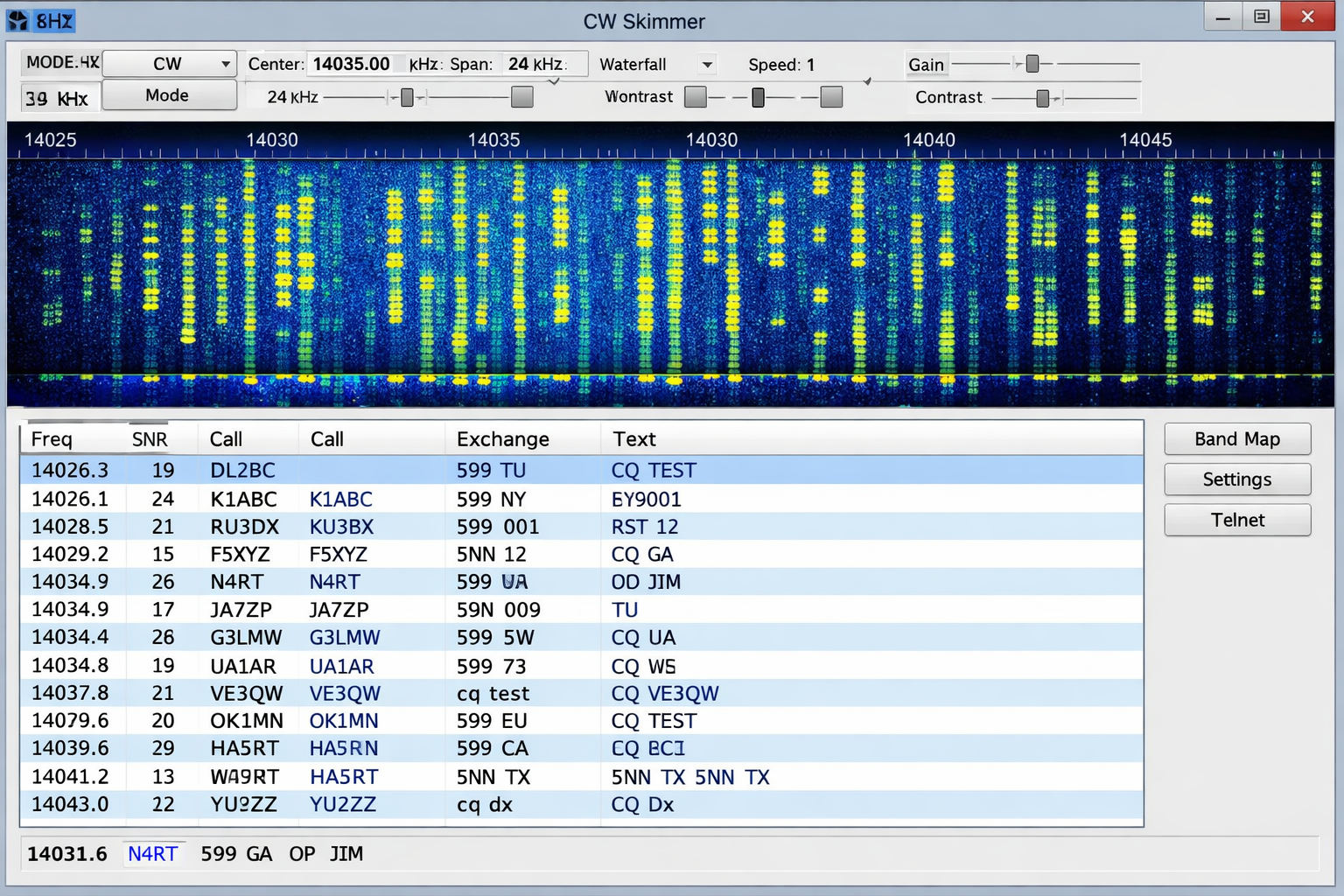
RBN Skimmer Stations and Monitoring Infrastructure
The global network of skimmer stations forms the backbone of the Reverse Beacon Network. These stations are operated by amateur radio volunteers who contribute monitoring coverage for the system.
A typical skimmer station includes several components.
First, a wideband antenna system allows the receiver to monitor multiple HF bands. Many skimmer operators use broadband antennas such as verticals, loops, or dedicated receiving arrays.
Second, the station uses a software-defined radio capable of observing large segments of spectrum. SDR receivers allow the monitoring software to decode signals across several frequencies simultaneously.
Third, a computer runs specialized decoding software designed for Morse code and other digital modes. Programs such as CW Skimmer or Skim-Server analyze incoming signals and extract call signs automatically.
Finally, the station connects to the internet so decoded spots can be transmitted to the Reverse Beacon Network servers.
Because skimmers are distributed globally, the network can monitor signals across multiple continents. This wide geographic coverage provides an accurate picture of worldwide band activity.
Reverse Beacon Network vs Traditional DX Clusters
The Reverse Beacon Network and traditional DX clusters both provide spotting information, but they operate in very different ways.
Traditional DX clusters rely on human operators to manually submit spots when they hear a station. While this method works well, it depends on operators being present and willing to submit reports.
The Reverse Beacon Network operates automatically and continuously.
| Spotting method | Reverse Beacon Network | Traditional DX Cluster |
|---|---|---|
| Spotting method | Automated skimmers | Human spotters |
| Reporting speed | Immediate automated reports | Manual submission |
| Signal information | Frequency, call sign, signal strength | Usually call sign and frequency |
| Coverage | Continuous monitoring | Depends on operator activity |
| Accuracy | Software decoding | Human interpretation |
Because of its automated nature, the Reverse Beacon Network often detects signals before they appear on traditional DX clusters.
Advantages of Using the Reverse Beacon Network
The Reverse Beacon Network provides several advantages that make it a powerful operating tool.
One of the most important benefits is real-time band awareness. Operators can instantly see which stations are calling CQ and where they are being heard.
Another major advantage is objective signal reporting. Automated decoding eliminates many of the errors that can occur when human operators manually report signals.
The network also allows operators to monitor their own signal performance. By calling CQ and observing which skimmers detect the signal, operators can evaluate antenna performance and propagation paths.
Additional advantages include:
- Continuous global monitoring
- Automated signal detection
- Integration with contest logging software
- Propagation analysis capability
- Real-time feedback on station performance
How Operators Use RBN for DX Spotting
For DX operators, the Reverse Beacon Network serves as an automated spotting system that reveals stations calling CQ across multiple bands.
Instead of manually tuning through every frequency, operators can monitor the RBN feed and immediately see active stations.
When a rare DX station begins calling CQ, skimmers often detect it within seconds. The resulting spots appear on the RBN network and allow operators to quickly locate the station.
Many operators combine RBN spotting with traditional listening techniques. They use the network to identify potential targets and then tune their receiver to confirm the signal before calling.
Using the Reverse Beacon Network to Evaluate Your Station
One of the most powerful uses of the Reverse Beacon Network-RBN is testing station performance.
By calling CQ briefly and then checking RBN results, operators can see exactly where their signal is being received.
Because each skimmer reports signal strength and location, operators can observe how their signal propagates across different regions.
This information can reveal several important details:
- Which directions produce the strongest signals
- Whether antennas are radiating effectively
- Which bands are open to specific regions
- How propagation conditions change over time
Many operators use RBN data to evaluate antenna installations, compare antenna designs, and monitor station improvements.
Using the Reverse Beacon Network to Study Propagation
The Reverse Beacon Network is also an excellent tool for studying radio propagation. By observing where signals are detected, operators can identify changing ionospheric conditions in real time.
For example, if a station calling CQ on 20 meters is suddenly heard by skimmers across Europe, this may indicate favorable propagation along that path. Similarly, signals detected near sunrise or sunset may reflect greyline propagation, where the transition between day and night enhances signal strength.
Because the RBN collects data continuously, operators can observe how propagation evolves throughout the day and across different seasons.
Integrating RBN with Contest Logging Software
Many contest operators integrate Reverse Beacon Network data directly into logging software. Popular contest programs such as N1MM Logger+, Win-Test, and DXLog support RBN spot feeds.
When integrated with logging software, RBN spots appear on a band map showing active stations across multiple frequencies. Operators can quickly identify new multipliers and jump to the correct frequency.
This capability dramatically improves contest efficiency by reducing the time required to search for new stations. Many advanced contest stations use RBN data alongside dual-radio setups, allowing them to call CQ on one radio while chasing new stations on another.
Filtering RBN Data for Better Operating Decisions
Because the Reverse Beacon Network produces a large number of spots, operators often use filters to manage the data.
Filtering allows operators to focus on signals relevant to their operating goals.
Common filters include:
- Band selection
- Mode filtering
- Geographic region filtering
- Signal strength thresholds
- Specific call sign searches
By narrowing the spot feed, operators can avoid information overload and concentrate on the most useful data.
Limitations of the Reverse Beacon Network
Although the Reverse Beacon Network is extremely useful, it has several limitations operators should understand.
First, the system primarily detects CQ calls rather than casual QSOs. If a station is not calling CQ, it may not appear in the RBN feed.
Second, the network currently performs best with CW signals, although support for additional modes has expanded.
Third, coverage depends on the geographic distribution of skimmer stations. Some regions have fewer skimmers, which can limit detection in those areas.
Because of these factors, the Reverse Beacon Network works best when combined with traditional band monitoring techniques.
Best Practices for Using the Reverse Beacon Network-RBN
Experienced operators treat the Reverse Beacon Network-RBN as a powerful supplement to traditional listening skills.
Effective use of RBN includes several best practices:
- Always listen to confirm a spotted signal before transmitting
- Use filters to reduce unnecessary spot data
- Monitor RBN while scanning the bands manually
- Compare RBN data with other propagation tools
Balancing automated tools with careful listening allows operators to make the most effective operating decisions.
Reverse Beacon Network in Modern Amateur Radio
The Reverse Beacon Network-RBN represents one of the most significant innovations in modern amateur radio monitoring. By combining automated signal detection with a global network of receivers, it provides an unprecedented view of band activity and signal propagation.
Operators who understand how to interpret RBN data gain a powerful advantage when pursuing DX contacts, analyzing propagation, or improving station performance.
Used wisely, the Reverse Beacon Network transforms real-time radio activity into actionable information that helps operators make better decisions on the air.
Frequently Asked Questions
What is the Reverse Beacon Network-RBN in amateur radio
The Reverse Beacon Network-RBN is a global system of automated receiving stations that detect CQ calls and report them online in real time.
How does the Reverse Beacon Network work
Software-defined radios and decoding software monitor amateur radio bands and automatically report detected transmissions to the RBN servers.
Can I see where my signal is heard using RBN
Yes. When you call CQ, skimmer stations that receive your signal report your call sign, frequency, and signal strength.
Do I need special equipment to use the Reverse Beacon Network
No special equipment is required to view RBN spots online. However, operating a skimmer station requires an SDR receiver and decoding software.
Is the Reverse Beacon Network better than DX clusters
The Reverse Beacon Network provides faster automated spotting, while DX clusters still provide valuable human reports. Many operators use both systems together.
How do contesters use the Reverse Beacon Network
Contesters integrate RBN spot feeds into logging software to identify active stations and quickly locate new multipliers.
About the Author
Vince, W2KU, is a licensed Extra class amateur radio operator and the founder of Ham Shack Reviews. He was named Amateur of the Year in 2026 for contributions to practical amateur radio education and equipment evaluation.
He knows propagation very well, operates mobile and handhelds daily. Vince exchanges QSL cards for DXCC, contest confirmation, and award tracking and is the club QSL manager. His guidance focuses on practical operating procedures, accurate logging, and real-world amateur radio practices.
Please consider Donating to help support this channel