
Greyline Propagation Explained for Ham Radio Operators
Greyline propagation is one of the most powerful and predictable long-distance propagation opportunities available to amateur radio operators. It occurs during the transition between day and night, when ionospheric conditions temporarily favor low-loss, long-distance HF signal travel.
This guide explains how greyline propagation works, how to predict it, and how to use it to consistently make long-distance contacts.
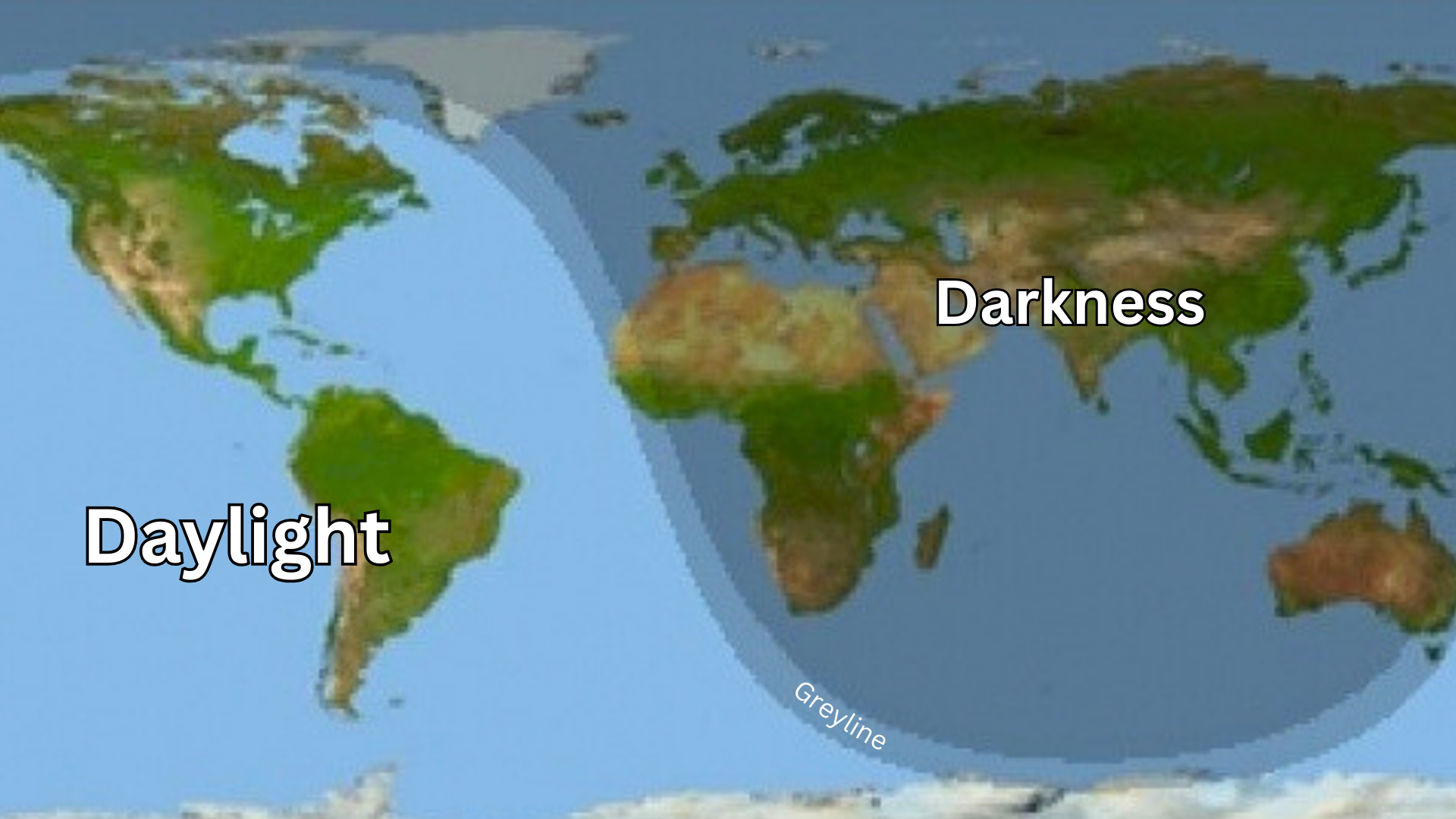
The science behind Greyline propagation refers to the study of a band around the Earth that separates daylight from darkness. It presents a multitude of opportunities for ham radio operators and shortwave listeners.
Greyline propagation is characterized by the rapid disappearance of the D layer. This layer absorbs HF signals, on the sunset side of the grey line. This creates favorable conditions for communication along this band. In addition, the absence of the D layer allows radio signals to travel through the ionosphere without significant absorption.
Amateur operators monitor and optimize communication along the shifting grey line. The benefit is clear and stronger signals compared to other propagation modes. This unique radio signal phenomenon opens up the possibility to communicate with various areas of the world. This creates an exciting area of study and experimentation in the field of radio communication.
Real-World Operating Context
This explanation is based on practical amateur radio operation during greyline conditions, including observed signal strength improvements, DX contact patterns, and repeatable propagation behavior across multiple bands.
Operators consistently report stronger signals and extended skip distances when operating along the greyline path, especially on lower HF bands.
What is Greyline Propagation?
The Earth’s ionosphere, consists of charged particles, which plays a crucial role in reflecting and refracting radio waves. During the transition periods between day and night, the ionosphere undergoes changes due to variations in solar radiation. This results in the formation of a gradient zone known as the greyline along the terminator.
The greyline region exhibits enhanced ionization gradients, where the ionosphere’s density changes rapidly. These gradients are critical for radio propagation because they affect the behavior of radio waves passing through the ionosphere.
One significant effect of the greyline is the reduced absorption of radio waves in the D-layer. The D-layer, presents primarily during daylight hours, and absorbs HF signals, limiting their propagation distance.
However, during the greyline periods, the lower D-layer absorption allows HF signals to penetrate deeper into the ionosphere. The absence of the D layer minimizes signal attenuation and enhances the overall signal quality.

The changing ionization gradients along the greyline path leads to long skip distances. Radio waves are refracted back to Earth at greater distances than usual. This enables communication over longer distances than would typically be possible at other times of the day.
The bending and refraction of radio waves is influenced by the changing ionization gradients along the greyline. This can result in enhanced signal strengths, making it easier to establish communication with distant stations.
The orientation of the greyline varies depending on geographical location and time of year. Amateur radio operators often track the greyline’s position. This lets them optimize their antenna direction to take advantage of the favorable propagation conditions it offers.
Why Greyline Propagation Is So Effective
Greyline propagation is effective because it combines two critical ionospheric conditions:
- Rapid disappearance of the D-layer on the sunset side
- Continued ionization in higher layers (E and F regions)
This creates a unique window where:
- Absorption is minimal
- Refraction remains strong
- Signals travel farther with less loss
This combination produces unusually strong long-distance signal paths that are not present during full daylight or complete darkness.
D Layer Disappearance
On the sunset side of the grey line, the D layer quickly disappears due to the lack of sunlight. This results in a temporary absence of signal absorption. This disappearance creates a favorable environment for radio signals to travel through the ionosphere with minimal obstruction.
With the absence of signal absorption, radio signals can propagate along the grey line and reach distant locations. As the grey line continuously shifts and transitions with the Earth’s rotation, the opportunities for greyline propagation change. Ham radio operators and shortwave listeners monitor these changes. Allowing them to optimize communication along this shifting band to communicate with various areas of the world.
Visual reference is an effective way to understand the concept of greyline propagation. The image below shows the Earth with the grey line marked, representing the boundary between daylight and darkness.

Best Bands for Greyline Propagation
Greyline propagation is most effective on lower HF bands, particularly:
- 160 meters
- 80 meters
- 40 meters
These bands benefit the most from reduced D-layer absorption during greyline transitions.
Higher bands such as 20 meters can also show enhancement, but effects are generally less dramatic.
| Key Points about Greyline Propagation |
|---|
| Radio signals can propagate along the grey line, which separates daylight from darkness on Earth. |
| The grey line provides an efficient means of long-distance communication. |
| The D layer, a part of the ionosphere that absorbs HF signals, disappears rapidly on the sunset side of the grey line. |
| Greyline propagation offers favorable conditions for radio signals to travel through the ionosphere without significant absorption. |
| The shifting grey line presents opportunities for communication with various areas of the world. |
“Greyline propagation allows for long-distance communication by leveraging the unique behavior of the D layer in the ionosphere. Understanding its technical aspects empowers radio enthusiasts to tap into this remarkable phenomenon.”
How to Use Greyline Propagation for DX Contacts
To take advantage of greyline propagation:
- Track sunrise and sunset at both your location and the target region
- Align your operating time with overlapping greyline paths
- Use low-angle radiation antennas (verticals work best)
- Monitor bands just before and after local sunrise/sunset
Timing and alignment are critical. The most effective contacts occur when both stations are near the greyline simultaneously.
Advantages of Greyline Propagation
Greyline propagation offers several advantages for long-distance communication, making it a valuable method for ham radio operators and shortwave listeners. One of the major advantages is the efficient propagation of radio signals along the grey line.
By leveraging these advantages, operators can overcome challenges associated with other propagation modes. Greyline propagation opens up opportunities for improved communication, enabling connections that might not be possible through other means.
Furthermore, greyline propagation provides the opportunity to communicate with particular areas of the world. Simply by monitoring and optimizing communication along the shifting grey line. As the Earth rotates, the grey line continuously moves and opens up new possibilities for reaching different geographical regions.
To summarize, the advantages of greyline propagation include:
- Efficient propagation along the grey line
- Clearer and stronger signals
- Ability to reach various areas of the world
Predicting Greyline Propagation
Predicting greyline propagation can be quite easy as it happens at dusk and dawn. Additionally, there are tools and techniques available that can assist in predicting the greyline. By monitoring solar activity, analyzing ionospheric conditions, and utilizing software tools that provide real-time data. Ham radio operators and shortwave listeners can increase their chances of successful communication along the grey line.
Tools to Track Greyline in Real Time
Several tools help visualize and predict greyline conditions:
- Greyline mapping software
- Solar data and space weather tools
- Real-time propagation maps
- Logging networks and DX clusters
These tools allow operators to anticipate propagation openings and adjust operating strategy accordingly.
Analyzing Ionospheric Conditions
Monitoring and analyzing ionospheric conditions using tools such as solar weather can provide valuable insights into signal behavior. By interpreting solar data, operators can predict the likely propagation paths and make informed decisions regarding greyline communication.
Common Mistakes When Using Greyline Propagation
Many operators fail to take full advantage of greyline due to avoidable mistakes:
- Operating too early or too late
- Ignoring target location greyline timing
- Using inefficient antennas for low-angle radiation
- Not monitoring band changes during transition periods
Greyline openings are often short, so timing and preparation are critical.
About the Author
Vince, W2KU, is a licensed Extra class amateur radio operator and the founder of Ham Shack Reviews. The committee named him Amateur of the Year in 2026 for his contributions to amateur radio education and equipment evaluation.
Contributions of Amateur Radio Community to Greyline Propagation Research
The amateur radio community has played a crucial role in advancing the research and understanding of greyline propagation. Through their expertise and dedication, radio enthusiasts have made significant contributions to the scientific community.
By leveraging cutting-edge technologies such as software-defined radios, high-speed computers, and the Internet. Amateurs have built extensive networks to monitor and log global amateur radio communications. This wealth of data has been instrumental in studying the characteristics and behavior of greyline propagation.
The collaboration between amateur radio operators and professionals has led to substantial advancements in greyline propagation research. Peer-reviewed studies have been published and shared, contributing to a deeper understanding of this unique propagation.
Amateur Radio Contributions in Heliosphere Research
| Contributions | Description |
|---|---|
| Ionospheric Monitoring | Amateur radio operators monitor changes in ionospheric conditions, providing valuable data for heliosphere research. |
| Global Propagation Analysis | Amateurs collect data from various locations, enabling the study of long-distance radio propagation and the global effects of the heliosphere. |
| Campaigns and Experiments | Amateurs participate in coordinated campaigns and experiments to capture simultaneous data from different locations, expanding the scope of heliosphere research. |
Advancing Technical Capabilities for Greyline Propagation Research
To further enhance the science behind Greyline propagation research, it is crucial to advance the technical capabilities. By developing new instrumentation and software tools designed specifically for greyline propagation research. We can gather more precise data and gain deeper insights into this fascinating phenomenon. These advancements will enable the amateur radio community to contribute significantly to the advancement of the science behind greyline propagation.
The Role of Advanced Instrumentation
The development of advanced instrumentation plays a pivotal role in advancing the science behind Greyline propagation research. These instruments allow for the precise measurements of critical parameters, such as signal strength, frequency variations, and ionospheric characteristics. By capturing high-quality data, researchers can analyze and model the behavior of greyline propagation with greater accuracy.
Frequently Asked Questions
What is greyline propagation in simple terms?
It is enhanced radio signal propagation that occurs along the transition between daylight and darkness.
When is greyline propagation strongest?
Around sunrise and sunset.
Which bands work best on greyline?
160m, 80m, and 40m.
Can greyline help with DX?
Yes. It often enables long-distance contacts with stronger signals.
How long does greyline last?
Typically a short window, often 30–60 minutes.
Editorial Integrity
This content is based on real-world amateur radio operating experience combined with established ionospheric science. No sponsorship or external influence affects the information presented. All observations reflect practical operating conditions and widely accepted propagation principles.
Please consider Donating to help support this channel