
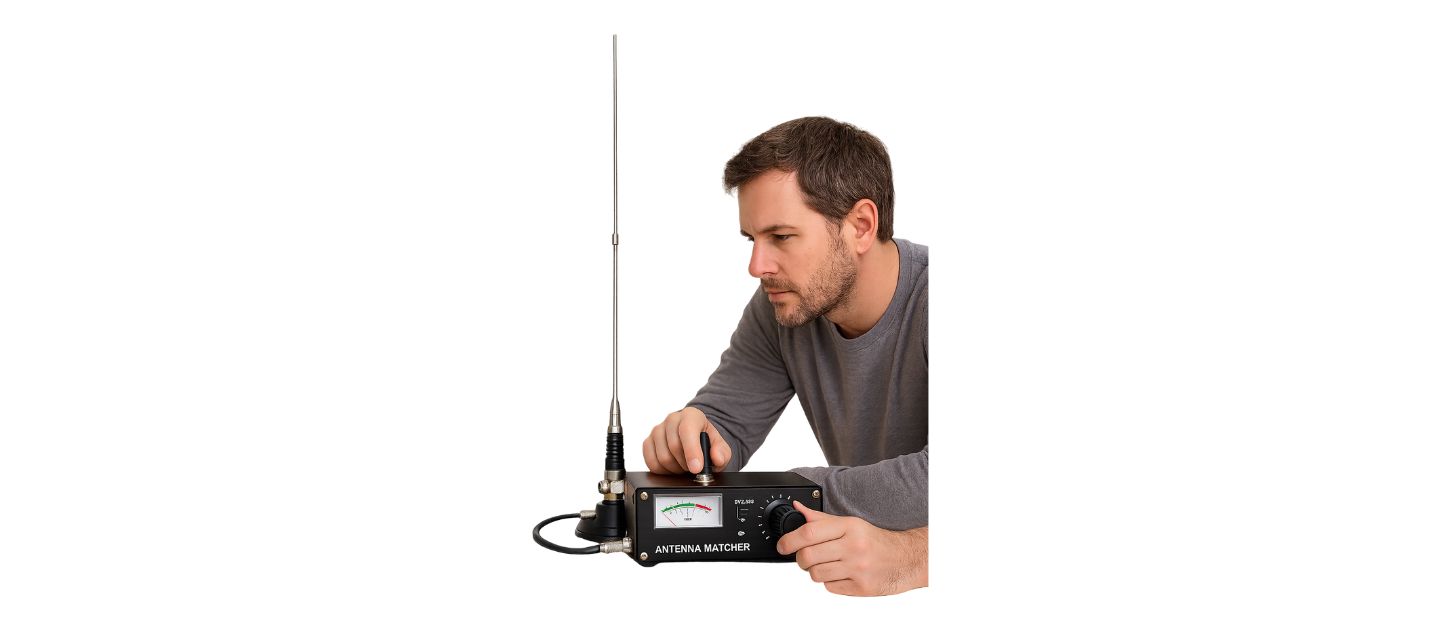
Setting Impedance in antennas is needed when an performs poorly, the problem is usually not resonance but impedance. Many operators assume that a low SWR means the antenna system is working efficiently. However, SWR only describes how the transmitter and feedline interact with the load they see. It does not directly reveal what is happening at the antenna feed-point. Because of this distinction, an antenna can show an excellent SWR while still transferring power inefficiently into radiation.
In real operating conditions, this situation is more common than many expect. An antenna may resonate exactly at the desired frequency, and therefore the SWR meter shows a clean match. However, the feed-point impedance may still contain resistance or reactance values that limit power transfer. As a result, signal strength suffers even though the transmitter appears to be operating normally. Consequently, understanding how to adjust impedance independently of SWR is essential for achieving maximum antenna performance.
New to antenna systems? See our Complete Guide to Ham Radio Antennas.
What Impedance Actually Means in an Antenna
Impedance is the total opposition to RF current flow at the feedpoint of an antenna. It includes two components: resistance and reactance. Resistance represents the portion of energy that is radiated or dissipated, while reactance represents stored energy in the antenna’s electric and magnetic fields.
At perfect resonance, reactance becomes zero. However, this does not guarantee that the remaining resistance matches the transmission line or transmitter. For example, an antenna may be resonant but still present 25 ohms or 100 ohms instead of the desired 50 ohms. Because transmitters and feedlines expect a specific impedance, proper matching is still required even when resonance is achieved.
Can an Antenna Have Low SWR but Incorrect Impedance?
Yes. An antenna can show a low SWR while still having incorrect feed-point impedance. SWR only indicates how well the transmitter and feedline are matched, not how efficiently the antenna radiates energy. Because transmission lines and matching networks can transform or mask impedance, the radio may see a good match even when the antenna itself is inefficient. As a result, power transfer can be reduced even though the SWR meter looks perfect.
Why SWR Alone Cannot Reveal True Antenna Performance
SWR measures reflected power along the transmission line, not the electrical condition at the antenna feed-point. Because transmission lines transform impedance as signals travel along them, the load seen by the transmitter may differ significantly from the load at the antenna. Therefore, the SWR reading at the radio may look ideal even when the antenna itself is not optimally matched.
Additionally, many antenna systems include tuners or matching networks that force the transmitter to see a proper load. While this protects the radio and reduces reflected power, it can also hide inefficiencies at the antenna. Consequently, the antenna may still operate with poor radiation efficiency even though SWR appears stable. This explains why low SWR does not always equal effective performance.
Furthermore, resonance and impedance are separate electrical properties. Resonance determines the frequency at which reactive components cancel each other. Meanwhile, impedance describes how energy flows into the antenna. Because these properties are independent, an antenna can resonate correctly while still presenting an undesirable feed-point resistance. Therefore, true optimization requires attention to both.
SWR vs Feed-Point Impedance Relationship Chart
| System Condition | SWR Reading | Feed-Point Impedance | What the Transmitter Sees | Actual Antenna Efficiency | What It Means in Practice |
|---|---|---|---|---|---|
| Perfect match | 1.0 : 1 | 50Ω resistive | Ideal load | Maximum | Full power transfer and optimal radiation |
| Resonant but wrong resistance | Low (1.2–1.5 : 1) | 25Ω or 100Ω | Appears acceptable after transformation | Reduced | Antenna is tuned but not transferring power efficiently |
| Impedance masked by tuner | Very low (near 1 : 1) | Highly mismatched | Perfect match at radio | Often reduced | Tuner hides mismatch but antenna still inefficient |
| Feedline transformation | Low to moderate | Varies along line | Acceptable at radio | Variable | Coax length alters what radio sees, not actual antenna condition |
| Reactive mismatch at feed-point | Low to moderate | Contains reactance | Acceptable after compensation | Reduced | Energy stored in system instead of radiated |
| True mismatch | High (> 2 : 1) | Far from 50Ω | Poor match | Low | Significant reflected power and poor radiation |
What Actually Happens at the Feed-Point
The antenna feed-point is where energy transitions from the transmission line into the radiating structure. At that location, the antenna presents a complex impedance consisting of resistance and reactance. Ideally, that impedance matches the characteristic impedance of the transmission system, which is often fifty ohms.
However, many factors influence feed-point impedance. Antenna height above ground affects current distribution. Nearby conductive objects alter electromagnetic coupling. Element spacing changes voltage and current relationships. Even weather and environmental conditions can shift impedance slightly. Because of these influences, a resonant antenna does not automatically present the correct feed-point resistance.
Therefore, when an antenna resonates but impedance is incorrect, power transfer becomes inefficient. Some energy reflects, some dissipates as heat, and some radiates unevenly. Consequently, correcting impedance directly at the feed-point improves system efficiency even if SWR already appears low.
Real Example of Impedance Correction
Consider a half-wave dipole that resonates at the desired frequency but measures seventy-two ohms at the feed-point. When connected directly to a fifty-ohm transmission line, some power reflects because the impedance does not match the system.
If a four-to-one balun or matching network transforms the seventy-two-ohm resistance closer to fifty ohms, power transfer improves immediately. The antenna still resonates at the same frequency, but more transmitted energy converts into radiation instead of reflection or loss.
This example shows that resonance alone does not ensure efficient operation. Proper impedance transformation improves performance even when SWR already appears acceptable.
Methods That Change Impedance Without Changing SWR
If resonance is already correct, use these methods to adjust impedance while keeping SWR stable:
• Move the antenna feed-point position
• Use an impedance transformer such as a balun or unun
• Install a matching network like an L-network, gamma match, or hairpin
• Use transmission line length as an impedance transformer
• Add shunt reactive components such as capacitors or inductors
Each method modifies how energy enters the antenna rather than changing its electrical length.
Common Impedance Values in Typical Antennas
Different antenna types naturally produce different feed-point impedance values. A center-fed half-wave dipole in free space typically measures about seventy-two ohms. A quarter-wave vertical with a good ground system often approaches thirty-six ohms. End-fed half-wave antennas can present very high impedance, sometimes thousands of ohms.
Because these values rarely match transmission line impedance exactly, matching methods are required. Understanding typical feed-point values helps operators select the correct transformer ratio or matching network before making adjustments.
The Correct Approach to Impedance Adjustment
When resonance is already correct, the goal is not to retune the antenna but to adjust how energy couples into it. Changing antenna length shifts resonance and alters the SWR curve. Therefore, impedance correction must occur without changing the electrical length of the radiating structure.
This approach focuses on reshaping the electrical conditions at the feed-point while preserving the resonant frequency. As a result, the antenna continues operating on the desired band while energy transfer becomes more efficient. This principle forms the foundation of proper impedance matching.
Adjusting Feed-Point Position
One of the most effective methods is repositioning the feed-point. Voltage and current vary along an antenna element, and therefore impedance changes depending on where the feedline connects. By moving the feed-point slightly along the element, resistance can be adjusted without altering resonance.
For example, shifting the feed-point toward the center of a dipole generally increases feed-point resistance. Conversely, moving it toward the ends decreases resistance. Because the overall electrical length remains unchanged, the resonant frequency stays nearly the same. Consequently, SWR changes very little while impedance moves toward the desired value.
This technique is widely used in dipoles, loops, and off-center-fed designs because it provides precise control without structural modification.
Using Impedance Transformers
Impedance transformers provide another highly effective method. These devices convert one impedance ratio into another while preserving the electrical behavior of the antenna. Because the transformation occurs electrically rather than physically, the antenna continues to resonate at the same frequency.
Transformers can convert high feed-point resistance into a value compatible with the transmission line. For instance, a transformer can reduce a two-hundred-ohm feed-point to fifty ohms. As a result, the transmitter sees the proper load while the antenna itself remains unchanged.
This method is particularly useful with multiband wire antennas, end-fed systems, and broadband designs where feed-point impedance varies significantly across frequencies.
Applying Matching Networks
Matching networks reshape impedance through reactive components such as inductors and capacitors. These components store and release energy in ways that cancel unwanted reactance and adjust resistance. Because matching networks operate at the feed-point, they modify how the antenna interacts with the feedline without altering physical dimensions.
Many antenna designs incorporate matching networks directly into their feed assemblies. Hairpin matches, gamma matches, and L-networks are common examples. These systems adjust impedance while preserving resonance, and therefore SWR remains largely unchanged.
Matching networks provide fine control and are especially valuable when feed-point impedance must be adjusted precisely for maximum efficiency.
Using Transmission Line Transformation
Transmission lines can also function as impedance transformers when cut to specific electrical lengths. Because impedance repeats along a transmission line in predictable patterns, certain line lengths convert one impedance into another before it reaches the transmitter.
Quarter-wave matching sections are widely used for this purpose. However, other carefully chosen line lengths can produce similar effects. Although this method does not change the antenna’s actual feed-point impedance, it changes what the transmitter sees. Therefore, SWR can remain stable while impedance presented to the radio becomes correct.
This technique is commonly used in end-fed antennas, matching stubs, and broadband feed systems.
Shunt Reactive Components for Fine Adjustment
Parallel inductors or capacitors can shift impedance by balancing reactive energy at the feed-point. These components alter the electrical conditions locally without affecting the overall antenna length. Therefore, resonance remains stable while impedance changes.
A shunt inductor can reduce high feed-point resistance, while a shunt capacitor can increase low resistance. Because these adjustments occur without structural changes, SWR usually remains steady. Consequently, shunt matching is widely used in vertical antennas, mobile radiators, and directional arrays.
| Method | What It Changes | Does It Move Resonance? | Best Use Case | Precision Level |
|---|
| Feed-point repositioning | Feed-point resistance | No | Dipoles, loops, off-center-fed antennas | High |
| Impedance transformer (balun/unun) | Resistance ratio | No | Multiband wire, end-fed antennas | High |
| Matching network (L, gamma, hairpin) | Resistance and reactance | Usually no | Permanent antenna installations | Very high |
| Transmission line transformation | Impedance seen at transmitter | No | Matching sections, feedline tuning | Moderate |
| Shunt capacitor or inductor | Reactive balance at feed-point | No | Fine adjustment and mobile antennas | Very high |
Why Proper Impedance Matters Even With Low SWR
When impedance matches the transmission system, energy transfers efficiently into radiation. Signal strength increases, system losses decrease, and the radiation pattern becomes more predictable. Additionally, equipment operates under reduced electrical stress, which improves long-term reliability.
Even when SWR appears acceptable, improving feed-point impedance can produce measurable performance gains. Therefore, serious antenna optimization always includes impedance correction, not just resonance tuning.
How to Diagnose an Impedance Problem Step-by-Step
If your antenna shows low SWR but performance seems weak, follow this process:
- Confirm the antenna is resonant at the intended frequency
- Measure impedance directly at the feed-point if possible
- Compare feed-point impedance to system design value
- Check whether a tuner is masking mismatch
- Evaluate feedline length for impedance transformation effects
- Adjust matching method without changing antenna length
- Re-measure efficiency across the operating bandwidth
This method identifies whether the issue is resonance, impedance, or feedline transformation.
Measuring Impedance Accurately
Accurate adjustment requires accurate measurement. Because feedlines transform impedance, measuring only at the transmitter can produce misleading results. Whenever possible, measurements should be taken directly at the feed-point.
Direct measurement reveals true resistance, reactive components, and bandwidth behavior. Consequently, adjustments become predictable and repeatable. With accurate data, operators can refine matching precisely rather than relying on indirect indicators.
Tools Used to Measure Antenna Impedance
Several instruments allow operators to evaluate antenna impedance directly. An SWR meter provides basic reflected power information, but antenna analyzers measure resistance and reactance across frequency. Vector network analyzers provide even more detailed electrical data, including phase relationships and complex impedance plots.
Each tool provides increasing levels of precision. Basic meters help identify mismatch, while advanced analyzers allow precise tuning and optimization. Selecting the appropriate measurement tool depends on the level of adjustment accuracy required.
Why Measuring at the Radio Can Be Misleading
Measuring SWR or impedance at the transmitter does not always reflect the true feed-point condition. Transmission lines transform impedance along their length, so the value seen at the radio may differ significantly from the antenna itself. In addition, tuners and matching devices can force the transmitter to see a proper load even when the antenna is inefficient. Therefore, accurate antenna evaluation requires measurement as close to the feed-point as possible whenever practical.
Quick Diagnostic Checklist for Impedance Problems
When antenna performance seems weak despite low SWR, verify the following conditions. Confirm the antenna resonates at the intended frequency. Measure feed-point impedance directly if possible. Determine whether a tuner is masking mismatch. Evaluate feedline length for impedance transformation effects. Inspect nearby objects or ground conditions that may alter current distribution.
Systematically checking these factors helps isolate whether the issue originates from resonance, impedance, feedline behavior, or environmental influence.
Setting Impedance in Antennas
Setting impedance in a tuned antenna ensures that the system not only resonates at the correct frequency but also transfers power efficiently into radiation. Although resonance determines where the antenna operates, impedance determines how well it operates. Therefore, true optimization requires both.
By adjusting feed-point position, applying impedance transformers, using matching networks, shaping transmission line behavior, or adding reactive components, operators can refine impedance without disturbing SWR. As a result, the antenna becomes electrically balanced, efficient, and predictable.
When resonance and impedance align correctly, the antenna delivers maximum performance, consistent signal strength, and reliable operation across the intended band. Consequently, the system performs as designed every time transmission begins.