
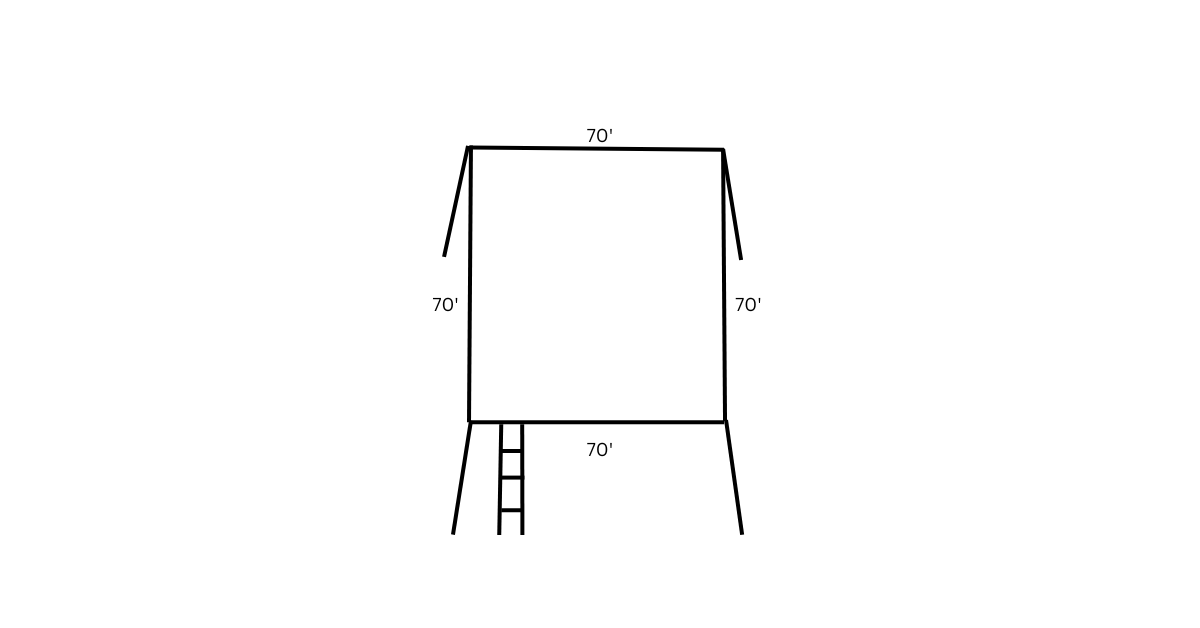
A sky loop antenna is a full-wave horizontal loop installed above ground that provides excellent receive sensitivity, low noise performance, and strong multi-band operation. Because the loop forms a closed circuit, it naturally reduces pickup of local electrical noise while maintaining efficient radiation. As a result, many operators report stronger received signals, quieter backgrounds, and more consistent transmit performance compared to dipoles or vertical antennas.
Sky loops can operate as resonant antennas on their design frequency while still working effectively across multiple higher bands when used with a tuner. This makes them one of the most flexible and high-performance wire antennas that can be installed in limited space.
Building a sky loop antenna is well worth the effort. Many operators notice about 1–2 dB stronger received signals and a 1–3 dB lower noise floor compared to other common wire antennas. The best aspect of the sky loop is that you will be heard on transmit. A common misconception is that you need acres of land, but an 80 meter sky loop can fit in a 75-foot by 75-foot lot.
New to antenna systems? See our Complete Guide to Ham Radio Antennas.
Why Sky Loop Antennas Receive So Well
The loop can be resonant on one band and non-resonant on others without suffering significant performance loss. There are several ways to build a loop. You can build a square horizontal sky loop, a triangular delta loop mounted vertically or horizontally, a rectangular loop, or even a circular loop if enough supports are available.
Sky loops often outperform other wire antennas because their closed-loop design distributes current evenly around the entire structure. Because the loop captures signal energy from all directions, it produces strong reception while reducing sensitivity to local electrical interference.
In addition, horizontal loops installed at height tend to favor higher radiation angles on lower bands, which improves regional coverage. As frequency increases, the antenna develops multiple lobes that support long-distance communication. This natural multi-pattern behavior is one reason sky loops work well across many bands.
Polarization of a Sky Loop
A horizontal sky loop is primarily horizontally polarized. Horizontal polarization often receives less man-made noise than vertically polarized antennas because much of the electrical noise generated by power lines, appliances, and urban infrastructure tends to be vertically polarized.
Polarization also interacts with antenna height. A low horizontal loop radiates strongly at high angles, which supports regional communication. As height increases, radiation angles become lower and more effective for long-distance contacts. This relationship between polarization and height is one reason horizontal loops are known for quiet reception and broad coverage.
Radiation Pattern and Coverage Characteristics
A horizontal sky loop produces a radiation pattern that changes with both height and operating frequency. On lower frequencies where the loop is electrically close to ground, radiation occurs at higher angles. This favors regional communication and strong near-vertical incidence skywave performance.
As frequency increases, the electrical size of the loop becomes larger relative to wavelength. Multiple radiation lobes form and energy concentrates at lower takeoff angles. These lower angles support long-distance communication and improved DX capability.
A single sky loop can therefore provide both regional and long-distance performance simply by operating on different bands.
Height Above Ground and Performance
Loop height is best understood in terms of wavelength rather than feet. When installed low relative to wavelength, a loop radiates primarily at high angles. As the loop is raised higher, radiation angles become lower and ground losses decrease.
For best efficiency on lower HF bands, installing the loop around one-quarter wavelength above ground produces noticeable improvements. However, even lower installations still perform well because current is distributed across a large area of wire.
If maximum height is not possible, maintaining loop shape and proper tension is usually more important than gaining a few extra feet of elevation.
Choosing the Right Loop Size for Your Space
Before cutting wire, evaluate the maximum perimeter you can support. Although full-wave loops perform best at their design frequency, slightly smaller loops still operate effectively when used with a tuner. Available space often determines the lowest practical band.
Because loop performance depends more on total wire length than shape, operators can adapt the design to fit available supports.
The first step is choosing the lowest frequency you want the antenna to operate on. The wire should be cut for that band. For example, if building an 80 meter sky loop for 3.800 MHz:
1005 ÷ 3.800 = 264.47 feet
Cut the wire slightly long, around 268 to 270 feet, to allow trimming during tuning.
Or just use our Skyloop and Delta Loop Calculator
Why the 1005 ÷ Frequency Formula Works
The wire length formula calculates the approximate circumference of a full-wave loop in feet. Because radio waves travel slightly slower through wire than through free space, the formula accounts for electrical shortening. Insulation type, nearby objects, and installation height all affect final resonance, so trimming after installation is always necessary.
Feed-Point Impedance of a Full-Wave Loop
A full-wave loop typically presents a feed-point impedance higher than standard 50-ohm coax systems. Depending on height and shape, impedance commonly falls somewhere between about 80 and 200 ohms.
Height strongly influences this value. As the loop rises higher above ground, impedance generally increases. Nearby objects, ground conductivity, and feedline interaction can also change the measured resistance.
Because the natural impedance rarely equals transmission line impedance, some form of matching is usually required.
Matching Methods for Sky Loops
Balanced feedline with an antenna tuner provides the widest multi-band coverage and maintains excellent efficiency across many frequencies.
A 4:1 balun with coax is simpler to install and works well for single-band or limited multi-band operation.
Some installations use ladder line from the antenna to a ground-level balun, then coax to the shack. Others use a remote tuner at the feedpoint.
The best choice depends on operating goals, feedline routing, and convenience.
Feedpoint Location Choices on a Sky Loop
| Feedpoint Location | Polarization Tendency | Radiation Pattern | Typical Use | Advantages | Considerations |
|---|---|---|---|---|---|
| Bottom center of loop | Mostly horizontal | Broad, symmetrical coverage | General HF operation | Simple feed routing, stable pattern | Requires balanced feed or good choke |
| Bottom corner of loop | Mixed polarization | Slight directional bias | Multi-band use, casual DX | Easy mechanical installation | Pattern slightly less uniform |
| Midpoint of vertical side | Mixed horizontal and vertical | Lower takeoff angle possible | DX operation | Can improve long-distance performance | Feedline routing may be less convenient |
| Top center of loop | Mostly horizontal | High-angle radiation dominant | Regional / NVIS operation | Strong local and medium range coverage | Harder to access physically |
| Top corner of loop | Mixed polarization | Irregular multi-lobe pattern | Experimental setups | Can favor certain directions | Pattern harder to predict |
| Center of one horizontal side (off-center feed) | Mixed polarization | Directional lobes develop on higher bands | Multi-band performance tuning | Can shape pattern for specific directions | Requires careful tuning |
| Ladder line hanging from corner (common multiband feed) | Balanced multi-mode | Frequency-dependent pattern | Wideband operation with tuner | Excellent multiband flexibility | Pattern varies by band |
Feedpoint Location Choices on a Sky Loop
Where you connect the feedline affects impedance and balance. A loop will operate when fed almost anywhere, but certain locations are more practical.
A bottom corner feed is the most common method. It provides easy access, simple feedline routing, and stable impedance. This is the standard choice for most horizontal loops.
Feeding at the center of one side is also possible and may slightly change impedance. Symmetrical feed locations help maintain electrical balance when using ladder line.
Top feedpoints are rarely used because they are difficult to access and offer little performance advantage.
Materials Needed for the Build
- 270 feet of insulated stranded copper wire
- 4 or more antenna insulators
- UV-resistant Dacron support rope
- Ladder line or a high SWR-rated balun with coax
- Soldering equipment or crimp connectors
- Heat shrink and weatherproofing materials
Sky Loop Construction
Choose supports that allow the loop to be installed as high as possible and spaced to match the loop shape. Raise Dacron rope over supports and attach insulators at the antenna wire ends. Run the wire through the insulators and tension the loop evenly. Secure all ropes so they cannot slip or damage the supports.
Why Sky Loop Shape Has Little Effect on Performance
Although square, triangular, and circular loops look different, electrical performance depends mainly on total wire length. Because current flows around the entire loop, shape has only minor influence on radiation pattern. Circular loops distribute current most evenly but require more support points.
Feedline Routing Best Practices
Route feedlines away from metal objects, house wiring, and gutters. Keep ladder line spaced away from conductive surfaces and drop it straight down when possible. Coax feedlines should use a choke or current balun to reduce common-mode currents. Seal all outdoor connections against moisture.
Ladder Line Connection
If using ladder line, connect it to the antenna and raise the loop to operating height. Connect the feedline to a balanced tuner. Measure SWR at the design frequency and trim the loop for lowest SWR. Tune other bands with the antenna tuner.
Balun and Coax Connection
Connect each end of the loop to the balun and run coax to the shack. Adjust loop length for lowest SWR at the desired frequency or acceptable SWR across multiple bands.
Non-Resonant Operation
The loop can be installed and tuned with an antenna tuner on each band. Sky loops perform well as multi-band non-resonant antennas.
Common Installation Mistakes
- Installing the loop too close to ground
- Allowing uneven tension or distorted shape
- Running feedline parallel to antenna wire
- Poor waterproofing of connections
- Mounting too close to buildings or wiring
Lightning and Safety Considerations
Ground feedlines properly and use a lightning arrestor where the feedline enters the building. Provide a static discharge path and disconnect equipment during storms. Ensure supports and ropes are rated for long-term outdoor load.
Expected On-Air Performance
Most operators notice quieter reception than vertical antennas, strong regional coverage on lower bands, and multiple directional lobes on higher bands that support DX. Balanced feed systems typically provide the widest usable frequency range.
Real-World Results
One installation used ladder line with the loop cut for 3.800 MHz but tuned for lowest SWR on 14.200 MHz. The antenna still worked well on 40 and 80 meters with higher SWR.
Performance across 80 through 10 meters was excellent, including the WARC bands. Compared to previous antennas, the sky loop delivered stronger signals and a noticeably lower noise floor. With a modern transceiver, signals sounded full and clear. A second loop for 160 meters can even be installed above or around the existing loop if space allows.
Please consider Donating to help support this channel